
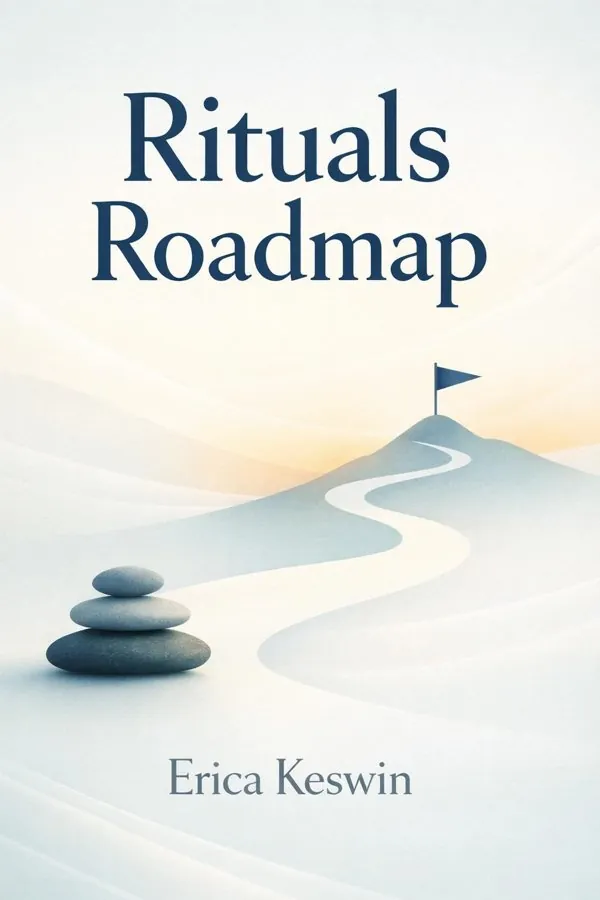
Rituals Roadmap: The Human Way to Transform Everyday Routines Into Workplace Magic: Summary & Key Insights
by Erica Keswin
 10 min9 chaptersAudio available
Key Takeaways from Rituals Roadmap: The Human Way to Transform Everyday Routines Into Workplace Magic
Long before organizations had strategy decks, humans had rituals.
Engagement is rarely destroyed by one dramatic event; more often, it erodes through a thousand moments of disconnection.
The most powerful rituals are not the most elaborate; they are the most authentic.
People do their best work when they feel they are not merely employed, but included.
Purpose fades when work becomes a blur of tasks.
What Is Rituals Roadmap: The Human Way to Transform Everyday Routines Into Workplace Magic About?
Rituals Roadmap: The Human Way to Transform Everyday Routines Into Workplace Magic by Erica Keswin is a leadership book spanning 5 pages. In Rituals Roadmap, workplace strategist Erica Keswin argues that what makes a company feel human is not a slogan on the wall or a list of benefits, but the repeated moments that shape how people experience work together. Rituals—intentional, symbolic practices that mark beginnings, endings, transitions, successes, and setbacks—can turn ordinary routines into sources of trust, connection, and meaning. In a time when many organizations are navigating burnout, hybrid work, and weakened culture, Keswin shows that rituals are not soft extras. They are practical leadership tools that help people feel seen, aligned, and committed. Drawing on behavioral science, organizational research, and examples from companies of different sizes, Keswin explains how rituals build belonging, reinforce values, and improve performance without requiring huge budgets or dramatic restructuring. Her perspective carries weight because she has spent years advising leaders on creating healthier, more human-centered workplaces. This book matters because it offers a simple but powerful idea: culture is not built in occasional grand gestures. It is built in the small, repeatable acts that tell people who they are, what matters here, and how they belong.
This FizzRead summary covers all 9 key chapters of Rituals Roadmap: The Human Way to Transform Everyday Routines Into Workplace Magic in approximately 10 minutes, distilling the most important ideas, arguments, and takeaways from Erica Keswin's work. Also available as an audio summary and Key Quotes Podcast.
Rituals Roadmap: The Human Way to Transform Everyday Routines Into Workplace Magic
In Rituals Roadmap, workplace strategist Erica Keswin argues that what makes a company feel human is not a slogan on the wall or a list of benefits, but the repeated moments that shape how people experience work together. Rituals—intentional, symbolic practices that mark beginnings, endings, transitions, successes, and setbacks—can turn ordinary routines into sources of trust, connection, and meaning. In a time when many organizations are navigating burnout, hybrid work, and weakened culture, Keswin shows that rituals are not soft extras. They are practical leadership tools that help people feel seen, aligned, and committed.
Drawing on behavioral science, organizational research, and examples from companies of different sizes, Keswin explains how rituals build belonging, reinforce values, and improve performance without requiring huge budgets or dramatic restructuring. Her perspective carries weight because she has spent years advising leaders on creating healthier, more human-centered workplaces. This book matters because it offers a simple but powerful idea: culture is not built in occasional grand gestures. It is built in the small, repeatable acts that tell people who they are, what matters here, and how they belong.
Who Should Read Rituals Roadmap: The Human Way to Transform Everyday Routines Into Workplace Magic?
This book is perfect for anyone interested in leadership and looking to gain actionable insights in a short read. Whether you're a student, professional, or lifelong learner, the key ideas from Rituals Roadmap: The Human Way to Transform Everyday Routines Into Workplace Magic by Erica Keswin will help you think differently.
- ✓Readers who enjoy leadership and want practical takeaways
- ✓Professionals looking to apply new ideas to their work and life
- ✓Anyone who wants the core insights of Rituals Roadmap: The Human Way to Transform Everyday Routines Into Workplace Magic in just 10 minutes
Want the full summary?
Get instant access to this book summary and 100K+ more with Fizz Moment.
Get Free SummaryAvailable on App Store • Free to download
Key Chapters
Long before organizations had strategy decks, humans had rituals. We used them to create order in uncertainty, strengthen group identity, and give emotional meaning to shared experience. Keswin begins from this deep human truth: people do not thrive on efficiency alone. They need rhythm, symbolism, and repeated moments that help them interpret what is happening around them. That is why rituals appear in families, religions, sports teams, military units, and communities—and why they matter at work more than most leaders realize.
A ritual is not just a habit or routine. A routine helps something get done; a ritual helps people understand why it matters. For example, a weekly team meeting becomes a ritual when it includes a consistent opening question, a moment of recognition, or a shared reflection tied to team values. The structure may be simple, but the emotional meaning changes everything. People stop experiencing the activity as a task and start experiencing it as a cultural signal.
Keswin highlights how rituals reduce anxiety during change, foster trust through predictability, and improve cohesion by giving people shared reference points. This is especially important in modern workplaces where change is constant and employees often feel fragmented by digital communication and competing demands. A ritual says, in effect, “This is how we gather. This is what we value. This is how we move through uncertainty together.”
Leaders often underestimate these effects because rituals can look small from the outside. But their influence accumulates. A meaningful onboarding ritual, a consistent way of celebrating wins, or a humane practice for closing difficult projects can shape morale more deeply than another motivational speech.
Actionable takeaway: Audit your team’s existing routines and ask which ones already carry emotional meaning—and which could be redesigned into true rituals that create clarity, connection, and trust.
Engagement is rarely destroyed by one dramatic event; more often, it erodes through a thousand moments of disconnection. Keswin argues that rituals matter because they fill the emotional gap between formal systems and lived experience. Companies may offer compensation, benefits, and flexible work arrangements, but people stay committed when they feel recognized, connected, and part of something larger than themselves.
In many workplaces, leaders focus on culture as an abstract concept, something to define in a values statement or annual retreat. But employees experience culture through repeated interactions: how meetings begin, how newcomers are welcomed, how effort is acknowledged, how departures are handled, and how teams respond under pressure. Rituals make those moments visible and intentional. They help transform values from words into behaviors.
For example, a company that says it values appreciation might create a Friday ritual where team members publicly thank a colleague for a specific contribution. A workplace that prizes learning might end projects with a no-blame reflection ritual where teams discuss what worked, what failed, and what should change next time. A manager who wants to build trust in a remote team might start each Monday with a short personal check-in before diving into tasks. None of these practices are complicated, but each reinforces emotional safety and belonging.
Keswin’s broader point is that rituals are practical because they address what many workplaces are missing: moments that humanize performance. When people feel connected, they collaborate more openly, recover from stress more effectively, and interpret organizational challenges with greater resilience. Rituals do not replace strong strategy or good management, but they make both more sustainable.
Actionable takeaway: Choose one recurring team moment—such as a weekly meeting, project kickoff, or monthly review—and add a meaningful ritual element that reflects what your team most needs right now: appreciation, learning, trust, or focus.
The most powerful rituals are not the most elaborate; they are the most authentic. Keswin emphasizes that leaders cannot copy another company’s practices and expect the same results. A ritual works only when it fits the people, purpose, and context of the organization. This means design matters. A meaningful ritual is intentional, repeatable, emotionally resonant, and tied to a specific cultural need.
Keswin encourages leaders to start by asking a few practical questions. What moment are we trying to shape? What feeling do we want people to have? What value are we reinforcing? What symbolism or language would make this moment memorable? These questions help distinguish performative activity from something genuinely useful. If a ritual feels forced, overly scripted, or disconnected from daily reality, employees will sense it immediately.
A good example is onboarding. Many companies treat it as paperwork and orientation. But it can become a ritual of belonging if every new employee receives a thoughtful welcome, hears the founding story, meets key colleagues in a consistent sequence, and is invited to share something personal about how they work best. Similarly, a team could create a ritual for launching major projects by beginning with the project’s purpose, clarifying what success will mean for customers, and ending with a shared commitment from each participant.
Keswin also stresses that rituals do not need to be expensive or time-consuming. In fact, simple rituals often work best because they are easier to sustain. What matters is consistency and meaning. A small symbolic act repeated over time can become central to a team’s identity.
Actionable takeaway: Before creating a new ritual, identify the exact moment it is meant to improve, the value it should express, and one simple repeated element that will make it feel distinct and memorable.
People do their best work when they feel they are not merely employed, but included. Keswin treats belonging as one of the most important outcomes rituals can create. In many organizations, exclusion does not happen through explicit rejection; it happens through omission. New hires are left to decode unwritten norms, remote employees are forgotten in key moments, quieter contributors go unseen, and people from underrepresented groups may feel they must constantly adapt to fit in. Rituals can counter this by making inclusion visible and repeatable.
Belonging rituals help answer a basic human question: “Do I matter here?” They can be woven into hiring, onboarding, meetings, celebrations, and even daily communication. A team might begin meetings with a quick round where every participant speaks early, reducing the chance that some voices remain peripheral. Managers can create one-on-one rituals that invite employees to share not just updates, but concerns, aspirations, or current energy levels. Companies can mark work anniversaries in ways that reflect individual contributions rather than generic recognition.
Keswin also points out that rituals of belonging are especially important in hybrid environments, where proximity often determines visibility. If in-office employees build informal bonds while remote colleagues are left out, culture fragments quickly. A deliberate ritual—such as sending remote hires a welcome package, pairing them with a culture buddy, or making team celebrations inclusive across locations—helps prevent belonging from becoming accidental.
Belonging does not come from occasional statements about inclusivity. It comes from repeated experiences that make people feel noticed, respected, and invited into the group. Rituals are valuable because they ensure those experiences are not left to chance.
Actionable takeaway: Create one ritual that guarantees every team member is seen consistently—such as a structured meeting check-in, a new-hire welcome tradition, or a monthly recognition practice that highlights diverse contributions.
Purpose fades when work becomes a blur of tasks. Keswin argues that rituals help reconnect people to why their work matters, especially when deadlines, metrics, and constant communication threaten to make everything feel transactional. Most employees want more than instructions. They want context, meaning, and reminders that their effort contributes to something worthwhile.
Purpose rituals link everyday activity to a larger mission. They can appear at the start of a project, during times of challenge, or at regular intervals when teams need to reset. For example, a customer-focused organization might begin weekly meetings by sharing one real customer story that illustrates the impact of the team’s work. A healthcare leader might open shifts with a brief reminder of the patient-centered purpose behind operational goals. A nonprofit team could celebrate milestones not just by citing numbers achieved, but by revisiting the human outcomes those numbers represent.
Keswin’s insight is that purpose is not self-sustaining. Leaders often assume that because the company mission exists, employees automatically feel connected to it. But purpose must be renewed, especially in environments where people are stretched thin or physically dispersed. Rituals serve as recurring moments of alignment. They help employees interpret effort in a meaningful frame rather than seeing work as an endless stream of deliverables.
These rituals also strengthen decision-making. When a team regularly re-centers on purpose, choices become easier to evaluate: does this action support what we exist to do, or is it just noise? Over time, purpose rituals can improve motivation, resilience, and ethical clarity.
Actionable takeaway: Introduce a simple recurring practice that connects work to impact—such as opening meetings with a customer story, revisiting team mission at project kickoff, or ending the month by reflecting on who benefited from the team’s efforts.
High performance is not built only through goals and accountability; it is built through the human conditions that allow people to focus, recover, learn, and collaborate well. Keswin makes the case that rituals are not opposed to performance—they are one of its hidden drivers. When teams know how to start work, end work, respond to setbacks, and celebrate progress, they waste less energy on confusion and emotional friction.
Performance rituals create consistency in moments that often determine execution. A pre-meeting ritual can ensure everyone arrives prepared and aligned. A project kickoff ritual can clarify roles, expectations, and success metrics before confusion takes hold. A post-project ritual can turn experience into learning by asking what the team should continue, stop, and improve. Even a simple daily shutdown ritual can help employees close open loops, reduce stress, and return the next day with more clarity.
Keswin also warns against glorifying constant busyness. Sustainable performance requires rituals of recovery as much as rituals of output. Teams that never pause to acknowledge effort, reflect on lessons, or mark completion often slide into exhaustion. In contrast, teams that intentionally close chapters and celebrate progress create momentum without burning people out.
For leaders, the key shift is to see rituals as operational tools, not ornamental culture pieces. If a ritual improves clarity, coordination, or resilience, it directly supports results. A sales team might use a Monday huddle ritual to share priorities and anticipated obstacles. A product team might end each sprint with a ritualized retrospective focused on learning rather than blame. A manager might establish a norm that difficult conversations always begin by naming shared goals.
Actionable takeaway: Identify one performance bottleneck on your team—misalignment, weak handoffs, meeting fatigue, or poor learning after setbacks—and design a repeatable ritual that directly improves that moment.
One of the most overlooked leadership skills is helping people move well from one chapter to another. Keswin shows that transitions—joining a team, finishing a project, changing roles, returning from leave, leaving a company, or experiencing loss—are emotionally charged moments. When organizations rush past them, employees often feel disoriented, undervalued, or disconnected. Rituals help people process change and carry meaning across boundaries.
A beginning matters because it shapes identity. A thoughtful first-day or first-week ritual can turn onboarding from administration into welcome. A milestone matters because it affirms progress and helps people see growth. An ending matters because it gives closure, captures lessons, and honors effort. Yet many companies treat endings especially poorly. Employees leave with a generic email, teams complete major work without reflection, and significant transitions disappear into the next urgent task.
Keswin argues that this is a missed opportunity. A departure ritual, for example, can preserve relationships, reinforce gratitude, and surface institutional learning. A project-closing ritual can help a team recognize what was accomplished, who contributed, and what should carry forward. Return-to-work rituals after parental leave or sabbatical can help reintegrate employees with dignity and support.
These moments matter because people remember them disproportionately. The rituals surrounding transitions often become the stories employees tell about an organization. Were they welcomed warmly? Was their contribution seen? Were endings handled with respect? These answers shape culture as much as everyday interactions.
Actionable takeaway: Choose one transition your organization currently handles too mechanically—onboarding, promotion, project completion, or employee departure—and create a short ritual that adds welcome, reflection, gratitude, or closure.
A ritual may begin as an idea, but it survives only if leaders model its importance. Keswin makes clear that culture-building rituals cannot be delegated entirely to HR, internal communications, or enthusiastic employees. Leaders signal what matters by what they consistently do, not by what they endorse in theory. If a ritual is frequently skipped, rushed, or treated as optional by those in authority, others will quickly conclude it is symbolic fluff.
This does not mean leaders must control every ritual. In fact, some of the best practices emerge from teams themselves. But leaders must protect the time, attention, and legitimacy that rituals require. If a manager says appreciation matters but never participates in recognition moments, the ritual weakens. If a company claims employee well-being is important but repeatedly cancels recovery practices under pressure, people learn that performance matters only in its narrowest form.
Keswin also emphasizes listening. Leaders should observe whether rituals still feel useful, inclusive, and aligned with current reality. A ritual that once energized a team can become stale, performative, or burdensome if it is never revisited. Sustaining rituals requires a balance of consistency and renewal. The core purpose stays stable, but the expression can evolve.
Strong leaders treat rituals as part of management infrastructure. They use them to reinforce values, navigate tension, and create psychological steadiness during uncertainty. They understand that employees watch the emotional tone of repeated interactions for clues about what the organization truly believes.
Actionable takeaway: Pick one existing ritual and strengthen it through visible leadership behavior—show up on time, participate fully, explain why it matters, and periodically ask the team how the ritual could be improved without losing its purpose.
Hybrid work exposes a painful truth: culture cannot rely on physical proximity anymore. Keswin argues that rituals become even more essential when people are distributed across homes, offices, time zones, and digital platforms. Without intentional shared moments, work fragments into transactions, communication becomes purely functional, and employees lose the ambient connection once created by simply being together.
In hybrid settings, rituals provide continuity. They replace accidental culture with designed culture. But they must be adapted thoughtfully. A ritual that works in a physical office may exclude remote participants if it depends on side conversations, room energy, or in-person symbolism. Keswin encourages leaders to ask whether each ritual is equitable across locations. Does everyone have access? Does everyone get seen and heard? Does the format create the same emotional experience for those not in the room?
Examples include opening virtual meetings with a structured check-in rather than letting in-office chatter dominate, creating digital recognition rituals that are timely and personal, or sending physical materials to remote employees before major events so they can participate more fully. Teams can also establish asynchronous rituals, such as a weekly shared reflection thread, when time zones make live gathering difficult.
The larger lesson is that hybrid culture does not happen naturally. It must be designed with intention and maintained with discipline. The best hybrid rituals are inclusive, simple, and repeatable. They acknowledge that people may work in different places, but they still need common experiences that create identity and trust.
Actionable takeaway: Review your team’s current rituals from the perspective of a remote employee and redesign one of them so participation, visibility, and emotional impact are equal regardless of location.
All Chapters in Rituals Roadmap: The Human Way to Transform Everyday Routines Into Workplace Magic
About the Author
Erica Keswin is a workplace strategist, speaker, and author focused on helping organizations build stronger cultures through human-centered leadership. She is known for translating ideas about connection, trust, and employee experience into practical actions leaders can use every day. Through her advisory work, speaking engagements, and writing, Keswin has worked with companies seeking to improve engagement, strengthen relationships, and create more meaningful workplaces. Her perspective is shaped by years of observing how culture is formed not only by policies and strategy, but by repeated behaviors and shared moments. In Rituals Roadmap, she brings that expertise to a timely challenge: how to make work more connected, purposeful, and sustainable in modern organizations, especially amid rapid change and hybrid work realities.
Get This Summary in Your Preferred Format
Read or listen to the Rituals Roadmap: The Human Way to Transform Everyday Routines Into Workplace Magic summary by Erica Keswin anytime, anywhere. FizzRead offers multiple formats so you can learn on your terms — all free.
Available formats: App · Audio · PDF · EPUB — All included free with FizzRead
Download Rituals Roadmap: The Human Way to Transform Everyday Routines Into Workplace Magic PDF and EPUB Summary
Key Quotes from Rituals Roadmap: The Human Way to Transform Everyday Routines Into Workplace Magic
“Long before organizations had strategy decks, humans had rituals.”
“Engagement is rarely destroyed by one dramatic event; more often, it erodes through a thousand moments of disconnection.”
“The most powerful rituals are not the most elaborate; they are the most authentic.”
“People do their best work when they feel they are not merely employed, but included.”
“Purpose fades when work becomes a blur of tasks.”
Frequently Asked Questions about Rituals Roadmap: The Human Way to Transform Everyday Routines Into Workplace Magic
Rituals Roadmap: The Human Way to Transform Everyday Routines Into Workplace Magic by Erica Keswin is a leadership book that explores key ideas across 9 chapters. In Rituals Roadmap, workplace strategist Erica Keswin argues that what makes a company feel human is not a slogan on the wall or a list of benefits, but the repeated moments that shape how people experience work together. Rituals—intentional, symbolic practices that mark beginnings, endings, transitions, successes, and setbacks—can turn ordinary routines into sources of trust, connection, and meaning. In a time when many organizations are navigating burnout, hybrid work, and weakened culture, Keswin shows that rituals are not soft extras. They are practical leadership tools that help people feel seen, aligned, and committed. Drawing on behavioral science, organizational research, and examples from companies of different sizes, Keswin explains how rituals build belonging, reinforce values, and improve performance without requiring huge budgets or dramatic restructuring. Her perspective carries weight because she has spent years advising leaders on creating healthier, more human-centered workplaces. This book matters because it offers a simple but powerful idea: culture is not built in occasional grand gestures. It is built in the small, repeatable acts that tell people who they are, what matters here, and how they belong.
More by Erica Keswin
You Might Also Like

Extreme Ownership
Jocko Willink
10 min
Dare to Lead
Brene Brown
10 min
Leaders Eat Last
Simon Sinek
10 min
The 21 Irrefutable Laws of Leadership
John Maxwell
10 min
Start With Why
Simon Sinek
10 min
How to Lead When You're Not in Charge
Clay Scroggins
10 minBrowse by Category
Ready to read Rituals Roadmap: The Human Way to Transform Everyday Routines Into Workplace Magic?
Get the full summary and 100K+ more books with Fizz Moment.