
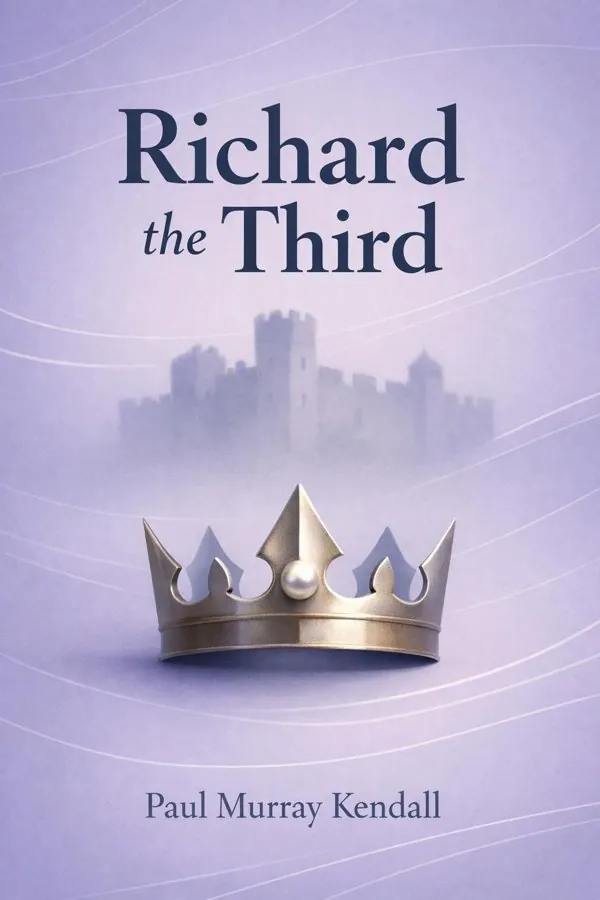
Richard the Third: Summary & Key Insights
 10 min9 chaptersAudio available
What Is Richard the Third About?
Richard the Third by Paul Murray Kendall is a world_history book spanning 9 pages. A comprehensive biography of King Richard III of England, exploring his life, reign, and the controversies surrounding his legacy. Kendall presents a detailed historical analysis that challenges traditional Tudor-era depictions of Richard as a villain, offering a more nuanced portrait based on contemporary sources.
This FizzRead summary covers all 9 key chapters of Richard the Third in approximately 10 minutes, distilling the most important ideas, arguments, and takeaways from Paul Murray Kendall's work. Also available as an audio summary and Key Quotes Podcast.
Richard the Third
A comprehensive biography of King Richard III of England, exploring his life, reign, and the controversies surrounding his legacy. Kendall presents a detailed historical analysis that challenges traditional Tudor-era depictions of Richard as a villain, offering a more nuanced portrait based on contemporary sources.
Who Should Read Richard the Third?
This book is perfect for anyone interested in world_history and looking to gain actionable insights in a short read. Whether you're a student, professional, or lifelong learner, the key ideas from Richard the Third by Paul Murray Kendall will help you think differently.
- ✓Readers who enjoy world_history and want practical takeaways
- ✓Professionals looking to apply new ideas to their work and life
- ✓Anyone who wants the core insights of Richard the Third in just 10 minutes
Want the full summary?
Get instant access to this book summary and 100K+ more with Fizz Moment.
Get Free SummaryAvailable on App Store • Free to download
Key Chapters
Richard Plantagenet was born into a kingdom perpetually at war with itself. The youngest surviving son of Richard, Duke of York, he came into a world where noble ambitions were sharpened into weapons and family loyalty was both a creed and a curse. His childhood was overshadowed by his father’s claim to the throne and the violent power struggle against the Lancastrians. These formative years instilled in Richard not the luxury of peace but the instinct to survive through discipline and fidelity.
Raised partly at Middleham Castle under the tutelage of the Neville family, Richard absorbed lessons in chivalry and governance from one of England’s most seasoned political dynasties. He was closely tied to his brother Edward, whose ascension as Edward IV would later shape Richard’s own destiny. Kendall portrays Richard as deeply influenced by this fraternal bond; he considered himself Edward’s servant, defender, and partner in the vast enterprise of stabilizing the Yorkist rule.
England itself was in turmoil. The fifteenth century was marked by feudal fragmentation, economic instability, and the decay of royal authority. In this crucible, Richard’s sense of order and loyalty developed—not as abstract virtues but as survival tools. His youth was not softened by pageantry but hardened by exile and battle. Thus, when Kendall reconstructs these years, he portrays a boy both somber and resolute, already shaped by grief and by a profound awareness of how quickly fortune could turn against him.
The Wars of the Roses were not only a dynastic conflict but a crucible in which Richard’s character was forged. As Edward IV raised the Yorkist banner, Richard became a soldier at an age when most should still have been learning court manners. He fought at Barnet and Tewkesbury, where victory consolidated Yorkist control. Kendall describes these campaigns not merely as military triumphs but as episodes that revealed Richard’s courage and loyalty. He was no distant prince; he fought in the thick of battle, earning the respect of hardened men.
Through these years, the young duke witnessed both the glory and fragility of kingship. Edward’s rule depended on delicate alliances and constant vigilance against betrayal. Richard learned that stability required both decisiveness and mercy — a balance he would later struggle to maintain as king. Kendall underscores this formative contradiction: Richard’s sense of justice was always entwined with his sense of danger. The experience of seeing his father slain, his brother crowned, and his enemies executed taught him that power in England was never secure.
The war also introduced Richard to the realities of governance, for after the Yorkist consolidation, Edward entrusted him with responsibilities that would prepare him for his future role in the North. The duke transformed from mere soldier to administrator, and Kendall shows how this transition marked his evolution from loyalty in battle to loyalty in service.
+ 7 more chapters — available in the FizzRead app
All Chapters in Richard the Third
About the Author
Paul Murray Kendall (1911–1973) was an American historian and biographer known for his scholarly works on English and French history. He taught at Ohio University and gained recognition for his biographies of Richard III and Louis XI, noted for their narrative depth and historical rigor.
Get This Summary in Your Preferred Format
Read or listen to the Richard the Third summary by Paul Murray Kendall anytime, anywhere. FizzRead offers multiple formats so you can learn on your terms — all free.
Available formats: App · Audio · PDF · EPUB — All included free with FizzRead
Download Richard the Third PDF and EPUB Summary
Key Quotes from Richard the Third
“Richard Plantagenet was born into a kingdom perpetually at war with itself.”
“The Wars of the Roses were not only a dynastic conflict but a crucible in which Richard’s character was forged.”
Frequently Asked Questions about Richard the Third
Richard the Third by Paul Murray Kendall is a world_history book that explores key ideas across 9 chapters. A comprehensive biography of King Richard III of England, exploring his life, reign, and the controversies surrounding his legacy. Kendall presents a detailed historical analysis that challenges traditional Tudor-era depictions of Richard as a villain, offering a more nuanced portrait based on contemporary sources.
You Might Also Like
The Age of Capital
Eric Hobsbawm
10 min
The Gulag Archipelago
Aleksandr Solzhenitsyn
10 min
Jerusalem: The Biography
Simon Sebag Montefiore
10 min
The Anglo-Saxons
James Campbell
10 min
The Boer War
Thomas Pakenham
10 min
The Industrial Revolutionaries: The Making of the Modern World 1776–1914
Gavin Weightman
10 minBrowse by Category
Ready to read Richard the Third?
Get the full summary and 100K+ more books with Fizz Moment.