
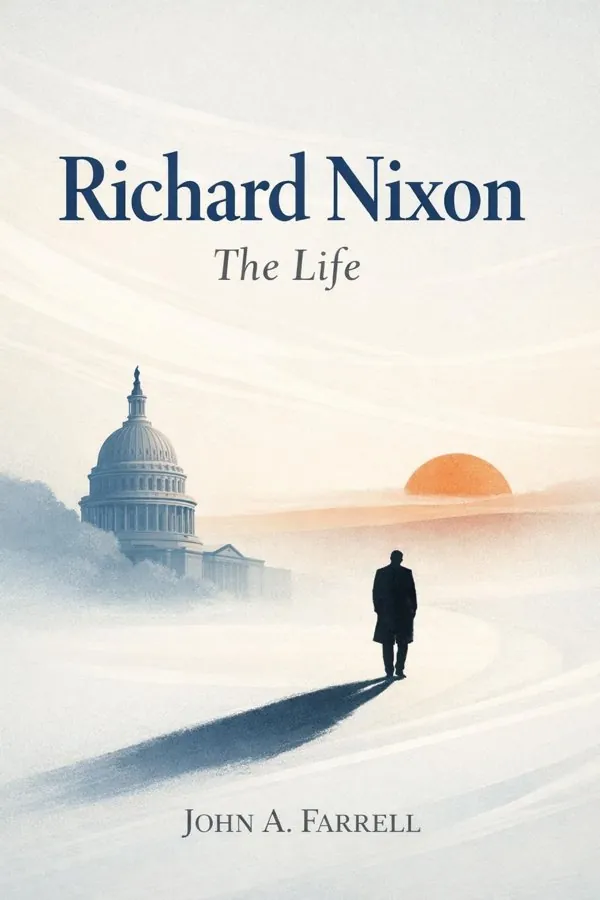
Richard Nixon: The Life: Summary & Key Insights
 10 min9 chaptersAudio available
Key Takeaways from Richard Nixon: The Life
Great political lives often begin with a private wound, and Farrell shows that Nixon’s began in deprivation, loss, and emotional distance.
Moments of national crisis often reveal who can convert obscurity into momentum, and World War II gave Nixon exactly that opening.
Being second in command can either refine a leader or embitter him, and for Nixon it did both.
Some careers end in loss; others are rebuilt by it.
Leaders are often judged by whether they are idealists or tacticians, but Nixon was powerful because he was both at once.
What Is Richard Nixon: The Life About?
Richard Nixon: The Life by John A. Farrell is a biographies book spanning 7 pages. John A. Farrell’s Richard Nixon: The Life is a sweeping, deeply researched portrait of one of the most brilliant, tormented, and consequential figures in American political history. Rather than reducing Nixon to a caricature of paranoia or portraying him only as the president who resigned in disgrace, Farrell reconstructs a full human life: the poor boy from California, the relentless political fighter, the foreign-policy strategist, and the wounded man whose private demons eventually consumed his public achievements. Drawing on newly released documents, White House tapes, private correspondence, and extensive archival research, Farrell shows how Nixon’s strengths and weaknesses were inseparable. The same discipline, strategic intelligence, and resilience that enabled his astonishing rise also fed the distrust, secrecy, and grievance that brought him down. This biography matters because Nixon’s story is not just about one presidency. It is about ambition in democracy, the corrosive effects of insecurity, the temptations of power, and the danger of believing that victory justifies every method. Farrell writes with the authority of a veteran journalist and biographer, blending narrative energy with sharp historical judgment.
This FizzRead summary covers all 9 key chapters of Richard Nixon: The Life in approximately 10 minutes, distilling the most important ideas, arguments, and takeaways from John A. Farrell's work. Also available as an audio summary and Key Quotes Podcast.
Richard Nixon: The Life
John A. Farrell’s Richard Nixon: The Life is a sweeping, deeply researched portrait of one of the most brilliant, tormented, and consequential figures in American political history. Rather than reducing Nixon to a caricature of paranoia or portraying him only as the president who resigned in disgrace, Farrell reconstructs a full human life: the poor boy from California, the relentless political fighter, the foreign-policy strategist, and the wounded man whose private demons eventually consumed his public achievements. Drawing on newly released documents, White House tapes, private correspondence, and extensive archival research, Farrell shows how Nixon’s strengths and weaknesses were inseparable. The same discipline, strategic intelligence, and resilience that enabled his astonishing rise also fed the distrust, secrecy, and grievance that brought him down. This biography matters because Nixon’s story is not just about one presidency. It is about ambition in democracy, the corrosive effects of insecurity, the temptations of power, and the danger of believing that victory justifies every method. Farrell writes with the authority of a veteran journalist and biographer, blending narrative energy with sharp historical judgment.
Who Should Read Richard Nixon: The Life?
This book is perfect for anyone interested in biographies and looking to gain actionable insights in a short read. Whether you're a student, professional, or lifelong learner, the key ideas from Richard Nixon: The Life by John A. Farrell will help you think differently.
- ✓Readers who enjoy biographies and want practical takeaways
- ✓Professionals looking to apply new ideas to their work and life
- ✓Anyone who wants the core insights of Richard Nixon: The Life in just 10 minutes
Want the full summary?
Get instant access to this book summary and 100K+ more with Fizz Moment.
Get Free SummaryAvailable on App Store • Free to download
Key Chapters
Great political lives often begin with a private wound, and Farrell shows that Nixon’s began in deprivation, loss, and emotional distance. Born in 1913 in Yorba Linda, California, Richard Milhous Nixon grew up in a family shaped by hardship. His parents, Frank and Hannah Nixon, were deeply influenced by Quaker values such as thrift, discipline, and endurance, but their home was also marked by tension and grief. The family struggled financially, and the deaths of two of Nixon’s brothers left a lasting emotional scar. Nixon learned early that life was unforgiving and that survival required self-control, effort, and emotional concealment.
Farrell argues that this background produced the central paradox of Nixon’s character. He developed extraordinary stamina, seriousness, and self-discipline, but he also absorbed a sense of exclusion. He never felt naturally accepted by the elite world he later entered. Even when he achieved status, he still thought and reacted like an outsider peering in through the window. That feeling sharpened his ambition. He studied relentlessly, excelled academically, and built his identity around being underestimated and then proving others wrong.
This pattern appears far beyond politics. Many high achievers are driven not by confidence but by remembered humiliation. Nixon’s life shows how early adversity can produce both resilience and resentment. The lesson is not that hardship determines destiny, but that unresolved insecurity can shape choices long after circumstances improve.
A practical takeaway is to examine the private stories that drive public behavior. Ambition can be productive, but when it is fueled by grievance alone, it can distort judgment. Know what your struggles have taught you, and just as importantly, know what they have wounded.
Moments of national crisis often reveal who can convert obscurity into momentum, and World War II gave Nixon exactly that opening. Before the war, he had already shown promise as a lawyer and local civic figure, but military service gave him organizational experience, credibility, and a narrative of service that would prove politically valuable. Nixon served in the Navy in the Pacific, where he became known less for battlefield heroics than for efficiency, administrative competence, and poise under pressure. Farrell presents this period as important because it strengthened Nixon’s belief that disciplined work and strategic positioning could move him upward.
After the war, Nixon entered politics with stunning speed. In 1946, he challenged Democratic congressman Jerry Voorhis and won, in part by mastering the new language of anti-communism and by running a hard, highly effective campaign. He understood that postwar America rewarded candidates who could present themselves as defenders of national security and opponents of ideological threat. His rise continued with the Alger Hiss case, where his aggressive pursuit of a State Department official accused of espionage made him a national figure. To admirers, Nixon was courageous and relentless; to critics, he was opportunistic and ruthless. Farrell shows that both views contain truth.
This chapter highlights a timeless leadership reality: institutions often elevate the person who combines competence with narrative. Nixon did not simply work hard; he made sure his work fit the anxieties of his era. In any profession, advancement often goes to those who understand both performance and timing.
The actionable takeaway is to pair skill with strategic awareness. Doing good work matters, but understanding the broader context in which that work will be judged can determine whether effort remains invisible or becomes transformative.
Being second in command can either refine a leader or embitter him, and for Nixon it did both. Chosen as Dwight D. Eisenhower’s running mate in 1952, Nixon became one of the youngest vice presidents in American history. Farrell shows that these years were crucial in shaping his political method. Nixon learned the mechanics of national power, the rhythms of executive decision-making, and the demands of representing the United States abroad. He developed a reputation for sharp debating, tireless travel, and fierce partisan discipline. The famous Checkers speech, delivered to save his place on the ticket after allegations about campaign funds, also revealed one of Nixon’s greatest talents: his ability to appeal directly to middle-class voters who felt looked down upon by elites.
Yet the Eisenhower years also deepened Nixon’s emotional instability. Eisenhower valued Nixon’s usefulness but kept him at a certain distance. Nixon often sensed, correctly or not, that he was not fully trusted or embraced by the establishment around the president. Farrell portrays this as a recurring pattern. Nixon could win power, but he rarely felt secure inside it. He became highly attuned to slight, image, and hidden opposition.
Professionally, this period offers an important insight into apprenticeship. High-level experience can provide essential knowledge, but if a person interprets every ambiguity as disrespect, learning becomes entangled with grievance. Nixon gained foreign-policy sophistication and executive seasoning, but he also carried away fresh resentments.
The practical lesson is to treat subordinate roles as training grounds rather than emotional tests. When you work near power, pay attention to how decisions are made, how alliances function, and where your blind spots lie. Expertise grows fastest when ego does not dominate every interaction.
Some careers end in loss; others are rebuilt by it. Farrell makes clear that Nixon’s defeats in 1960 and 1962 were not merely setbacks but identity-shattering blows that forced reinvention. In 1960, he narrowly lost the presidency to John F. Kennedy in one of the closest elections in American history. Many Republicans believed irregularities had influenced the result, but Nixon refused to launch a prolonged challenge, partly out of institutional caution and partly because he lacked the political position to do so effectively. Two years later, he lost the California governor’s race and famously lashed out at the press, declaring that they would not have Nixon to kick around anymore.
At that moment, many assumed his national career was finished. Farrell’s contribution is to show how Nixon used exile as strategy. He practiced law, traveled, built relationships, and studied the fractures forming in American politics. He recognized that the Democratic coalition was under strain, that cultural conflict was intensifying, and that a candidate who spoke for the so-called silent majority might return to the center of national life. Nixon moderated his public image, sharpened his message, and waited.
This part of the biography is especially useful for readers interested in resilience. Nixon did not recover because he became emotionally whole; he recovered because he learned to repackage himself for a changed political environment. Reinvention does not require purity. It requires realism, patience, and an ability to reinterpret failure as reconnaissance.
The actionable takeaway is to use setbacks diagnostically. When defeat comes, do not only ask what was lost. Ask what the loss revealed about timing, audience, communication, and identity. Reinvention begins when self-pity gives way to strategic learning.
Leaders are often judged by whether they are idealists or tacticians, but Nixon was powerful because he was both at once. Elected president in 1968 and reelected overwhelmingly in 1972, Nixon entered office amid war abroad and upheaval at home. Farrell emphasizes that Nixon possessed a formidable strategic mind, especially in foreign affairs. Working closely with Henry Kissinger, he pursued détente with the Soviet Union, opened relations with China, and sought to reshape the global balance of power through negotiation rather than pure confrontation. These achievements required patience, secrecy, and intellectual boldness. The opening to China in particular stands as one of the most consequential diplomatic moves of the twentieth century.
At home, Nixon was more complicated than his reputation sometimes suggests. He could be conservative rhetorically while governing pragmatically. His administration supported environmental initiatives, created the Environmental Protection Agency, and engaged with economic regulation in ways that do not fit simple ideological labels. Yet these policy successes existed alongside constant political calculation. Nixon viewed governance and electoral advantage as inseparable. He framed issues through the lens of coalition management, media image, and enemies to be neutralized.
Farrell shows that this blend of vision and manipulation explains both Nixon’s effectiveness and his danger. He could think long-term on strategy while thinking short-term on control. In modern leadership, this combination is not rare. Many successful executives and politicians are excellent planners who are simultaneously tempted to overmanage perception and opposition.
The takeaway is to distinguish strategic secrecy from corrosive secrecy. Confidentiality can enable breakthrough decisions, but when every challenge is treated as a threat to be contained, leaders drift from statecraft into siege mentality. Build systems that protect both innovation and accountability.
Political success often comes from naming public anxiety before others do, and Nixon understood the fears and resentments of a divided America with unusual precision. Farrell presents Nixon as a master interpreter of social unrest in the late 1960s and early 1970s. The Vietnam War, urban riots, campus protests, racial conflict, and cultural upheaval had left many Americans feeling disoriented and unheard. Nixon addressed these voters through the language of order, patriotism, and restraint. His appeal to the silent majority was not merely a slogan. It was a durable political framework that reorganized American conservatism and helped reshape the Republican Party.
Nixon’s insight was that many citizens did not see themselves as extremists but as people whose habits, loyalties, and authority structures were being mocked by cultural elites. He turned that perception into political capital. Farrell is careful, however, not to romanticize this strategy. Nixon could exploit division as well as interpret it. His use of coded language on race and crime, his Southern strategy, and his instinct to harness grievance for electoral gain show how leaders can convert social fracture into durable coalitions while worsening the fracture itself.
This dynamic remains highly relevant. Modern politics still rewards those who can frame themselves as champions of the overlooked majority against arrogant institutions. The danger is that a leader may become more invested in preserving outrage than solving the underlying tensions.
The practical takeaway is to pay attention to how emotional narratives shape public life. Whether in politics, organizations, or communities, people respond not only to policy proposals but to whether they feel respected. Address fear and resentment honestly, but do not build identity around permanent division.
Scandals rarely begin with a single bad decision; they emerge from cultures where distrust has become normal. Farrell’s treatment of Watergate is one of the book’s most important achievements because he shows that the break-in and cover-up were not shocking departures from Nixon’s style but logical extensions of patterns long in place. Nixon had spent decades thinking in terms of enemies, leaks, plots, and information control. He believed opponents were ruthless, the press was hostile, and survival required preemptive aggression. In that environment, surveillance, dirty tricks, and deception could be rationalized as defensive necessities.
The Watergate break-in itself was clumsy, but the real destruction came from the cover-up. Nixon’s instinct was not transparency but containment. He tried to limit investigations, manage subordinates, and protect the presidency through secrecy. Farrell demonstrates that Nixon was neither a comic villain nor an innocent trapped by overzealous aides. He was a president whose own habits of mind made illegal and self-destructive behavior increasingly likely. The White House tapes, intended in part as instruments of control and historical preservation, became devastating evidence of his role.
The broader lesson is organizational. Ethical collapse often occurs where loyalty is prized above truth, where leaders signal that results matter more than methods, and where subordinates learn to anticipate what the boss wants without being told directly. Many institutions fail this way, not through isolated corruption but through accumulated permission.
The actionable takeaway is to audit the moral assumptions inside your systems. Ask what behaviors people feel pressured to justify in the name of winning. If secrecy, fear, and tribalism are becoming normalized, the crisis has already begun even if no public scandal has yet appeared.
Public disgrace may end an office, but it does not end a life, and Farrell is especially strong on Nixon’s post-presidential years. After resigning in 1974, Nixon left the White House humiliated, politically toxic, and physically diminished. Yet he refused to disappear. Over time, he rebuilt a measure of influence through writing, foreign-policy commentary, and private diplomacy. He met world leaders, published books, and gradually reentered public conversation as an elder statesman, particularly on international affairs. Farrell does not treat this rehabilitation as fake, but neither does he let it obscure the scale of Nixon’s wrongdoing.
What makes this section compelling is the coexistence of partial recovery and permanent stain. Nixon remained intellectually formidable. He could still analyze global strategy with impressive depth. He could also be reflective, even poignant, about his mistakes. But he never fully escaped the shadow of Watergate, nor did he entirely resolve the traits that had helped cause it. His legacy remained split: architect of major diplomatic realignments, destroyer of trust in the presidency.
For readers, this raises a difficult question about judgment. How should we assess people who achieve genuine greatness in one arena and catastrophic failure in another? Farrell’s answer is neither cancellation nor absolution. It is integration. A truthful account must include the full record.
The practical takeaway is to resist simple narratives of redemption. Recovery after failure is possible, and people can contribute meaningfully after public error. But accountability requires memory. The goal is not to erase a fall through later productivity, but to build a life in which achievement no longer depends on the habits that caused the fall.
The most unsettling biographies are the ones that refuse easy moral distance, and Farrell’s Nixon is troubling because he is recognizable. He is not portrayed as a monster from another species of humanity. He is disciplined, intelligent, perceptive, hardworking, and often strategically brilliant. Those qualities make his collapse more instructive, not less. Nixon’s life suggests that the danger in leadership is rarely weakness alone. It is strength without inner balance. His memory, tactical sense, endurance, and command of policy gave him immense capacity. But insecurity, resentment, and suspicion remained largely unmastered. Power amplified rather than healed them.
Farrell’s larger argument is that character cannot be separated from statecraft. A leader may achieve real policy success while privately cultivating habits that endanger institutions. In Nixon’s case, personal grievance and constitutional responsibility were never fully disentangled. He often interpreted institutional limits as personal attacks and opposition as illegitimate sabotage. Once a leader thinks that way, abuse becomes easier to justify.
This is why the book matters beyond twentieth-century history. In business, government, and public life, societies are often tempted to excuse corrosive behavior when attached to competence. Nixon reminds us that brilliance does not cancel moral risk. In fact, talent can make moral risk more dangerous by giving it greater reach.
The actionable takeaway is to evaluate leaders whole. Do not ask only whether someone can win, execute, or outthink rivals. Ask what emotional patterns they normalize, how they handle dissent, and whether their methods strengthen or weaken the institutions they lead. Sustainable leadership requires not just ability, but self-command.
All Chapters in Richard Nixon: The Life
About the Author
John A. Farrell is an American journalist and biographer known for his rigorous research, narrative clarity, and sharp insight into political character. Over the course of his career, he has worked as a reporter and editorial writer, bringing a strong investigative sensibility to historical nonfiction. Farrell has written acclaimed biographies of major American figures, including Clarence Darrow, Tip O’Neill, Ted Kennedy, and Richard Nixon. His work often focuses on the intersection of personality, power, and public life, showing how private motives shape major historical events. In Richard Nixon: The Life, Farrell combines archival depth, newly available documents, and a seasoned reporter’s instinct for revealing detail to produce a portrait that is both fair-minded and penetrating. He is widely respected for making complex political history readable without sacrificing nuance.
Get This Summary in Your Preferred Format
Read or listen to the Richard Nixon: The Life summary by John A. Farrell anytime, anywhere. FizzRead offers multiple formats so you can learn on your terms — all free.
Available formats: App · Audio · PDF · EPUB — All included free with FizzRead
Download Richard Nixon: The Life PDF and EPUB Summary
Key Quotes from Richard Nixon: The Life
“Great political lives often begin with a private wound, and Farrell shows that Nixon’s began in deprivation, loss, and emotional distance.”
“Moments of national crisis often reveal who can convert obscurity into momentum, and World War II gave Nixon exactly that opening.”
“Being second in command can either refine a leader or embitter him, and for Nixon it did both.”
“Some careers end in loss; others are rebuilt by it.”
“Leaders are often judged by whether they are idealists or tacticians, but Nixon was powerful because he was both at once.”
Frequently Asked Questions about Richard Nixon: The Life
Richard Nixon: The Life by John A. Farrell is a biographies book that explores key ideas across 9 chapters. John A. Farrell’s Richard Nixon: The Life is a sweeping, deeply researched portrait of one of the most brilliant, tormented, and consequential figures in American political history. Rather than reducing Nixon to a caricature of paranoia or portraying him only as the president who resigned in disgrace, Farrell reconstructs a full human life: the poor boy from California, the relentless political fighter, the foreign-policy strategist, and the wounded man whose private demons eventually consumed his public achievements. Drawing on newly released documents, White House tapes, private correspondence, and extensive archival research, Farrell shows how Nixon’s strengths and weaknesses were inseparable. The same discipline, strategic intelligence, and resilience that enabled his astonishing rise also fed the distrust, secrecy, and grievance that brought him down. This biography matters because Nixon’s story is not just about one presidency. It is about ambition in democracy, the corrosive effects of insecurity, the temptations of power, and the danger of believing that victory justifies every method. Farrell writes with the authority of a veteran journalist and biographer, blending narrative energy with sharp historical judgment.
You Might Also Like

An American Marriage
Tayari Jones
10 min
Benjamin Franklin: An American Life
Walter Isaacson
10 min
I Know Why The Caged Bird Sings
Maya Angelou
10 min
Long Walk to Freedom
Nelson Mandela
10 min
Persepolis
Marjane Satrapi
10 min
Surely You're Joking, Mr. Feynman!
Richard P. Feynman
10 minBrowse by Category
Ready to read Richard Nixon: The Life?
Get the full summary and 100K+ more books with Fizz Moment.