
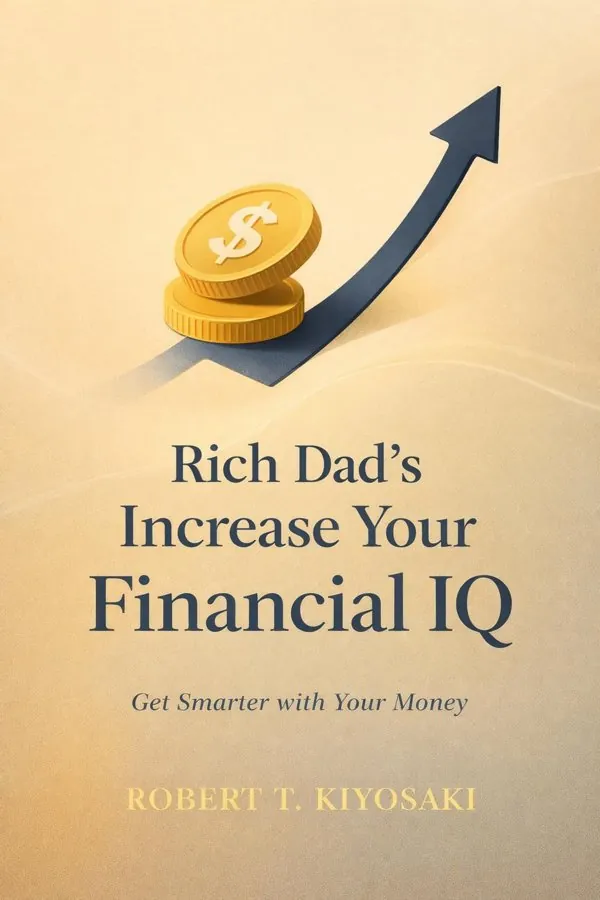
Rich Dad's Increase Your Financial IQ: Get Smarter with Your Money: Summary & Key Insights
 10 min9 chaptersAudio available
Key Takeaways from Rich Dad's Increase Your Financial IQ: Get Smarter with Your Money
The biggest myth about money is that financial success belongs only to people born with special talent.
Working harder is often praised as the answer to financial stress, but Kiyosaki insists that effort alone does not create wealth.
Many people focus on how to make money, but far fewer learn how to keep it.
A budget is not a punishment; it is a mirror.
One of Kiyosaki’s most important ideas is that leverage is neither good nor bad; it is powerful.
What Is Rich Dad's Increase Your Financial IQ: Get Smarter with Your Money About?
Rich Dad's Increase Your Financial IQ: Get Smarter with Your Money by Robert T. Kiyosaki is a finance book spanning 8 pages. Most people spend years learning how to earn a living, but very little time learning how money actually works. In Rich Dad's Increase Your Financial IQ, Robert T. Kiyosaki argues that this gap is the real reason so many intelligent, hardworking people struggle financially. Building on the ideas that made the Rich Dad series famous, Kiyosaki introduces financial intelligence as a practical skill set anyone can develop. He breaks it into five core areas: making more money, protecting it, budgeting it, leveraging it, and improving the quality of your financial information. What makes this book matter is its focus on decision-making, not just motivation. Kiyosaki wants readers to understand why some people thrive in economic uncertainty while others fall behind, even when they have similar incomes. Drawing on his signature contrast between "rich dad" and "poor dad" thinking, he challenges conventional beliefs about jobs, savings, debt, and investing. Whether or not readers agree with all of his methods, the book pushes them to think more strategically about cash flow, assets, risk, and opportunity. For anyone seeking greater control over money, it offers a mindset shift as much as a financial framework.
This FizzRead summary covers all 9 key chapters of Rich Dad's Increase Your Financial IQ: Get Smarter with Your Money in approximately 10 minutes, distilling the most important ideas, arguments, and takeaways from Robert T. Kiyosaki's work. Also available as an audio summary and Key Quotes Podcast.
Rich Dad's Increase Your Financial IQ: Get Smarter with Your Money
Most people spend years learning how to earn a living, but very little time learning how money actually works. In Rich Dad's Increase Your Financial IQ, Robert T. Kiyosaki argues that this gap is the real reason so many intelligent, hardworking people struggle financially. Building on the ideas that made the Rich Dad series famous, Kiyosaki introduces financial intelligence as a practical skill set anyone can develop. He breaks it into five core areas: making more money, protecting it, budgeting it, leveraging it, and improving the quality of your financial information.
What makes this book matter is its focus on decision-making, not just motivation. Kiyosaki wants readers to understand why some people thrive in economic uncertainty while others fall behind, even when they have similar incomes. Drawing on his signature contrast between "rich dad" and "poor dad" thinking, he challenges conventional beliefs about jobs, savings, debt, and investing. Whether or not readers agree with all of his methods, the book pushes them to think more strategically about cash flow, assets, risk, and opportunity. For anyone seeking greater control over money, it offers a mindset shift as much as a financial framework.
Who Should Read Rich Dad's Increase Your Financial IQ: Get Smarter with Your Money?
This book is perfect for anyone interested in finance and looking to gain actionable insights in a short read. Whether you're a student, professional, or lifelong learner, the key ideas from Rich Dad's Increase Your Financial IQ: Get Smarter with Your Money by Robert T. Kiyosaki will help you think differently.
- ✓Readers who enjoy finance and want practical takeaways
- ✓Professionals looking to apply new ideas to their work and life
- ✓Anyone who wants the core insights of Rich Dad's Increase Your Financial IQ: Get Smarter with Your Money in just 10 minutes
Want the full summary?
Get instant access to this book summary and 100K+ more with Fizz Moment.
Get Free SummaryAvailable on App Store • Free to download
Key Chapters
The biggest myth about money is that financial success belongs only to people born with special talent. Kiyosaki argues the opposite: financial intelligence is not an inborn gift, but a set of skills developed through practice, mistakes, observation, and better decisions. Just as someone can learn a language or a sport, they can learn to read financial statements, evaluate opportunities, manage risk, and recognize the difference between an asset and a liability.
At the center of the book is the idea that traditional education often prepares people to work for money rather than understand money. Many people can earn a salary, but still make poor choices with taxes, debt, spending, investments, and long-term planning. Financial intelligence, in Kiyosaki’s view, means becoming better at solving money problems in real life. It is not about memorizing formulas. It is about seeing opportunities others miss and understanding the consequences of financial choices.
For example, two people may receive the same raise. One upgrades their lifestyle immediately, taking on more recurring expenses. The other uses the extra income to buy income-producing assets or pay down costly debt. Their intelligence is revealed not by their income, but by what they do next.
Kiyosaki’s message is empowering because it shifts responsibility back to the individual. If money is a skill, then weakness in money is not a permanent identity. Readers can improve by studying personal finance, reviewing their own financial habits, asking better questions, and treating every financial mistake as feedback.
Actionable takeaway: Start increasing your financial IQ by reviewing one recent money decision and asking what it taught you about earning, spending, borrowing, or investing.
Working harder is often praised as the answer to financial stress, but Kiyosaki insists that effort alone does not create wealth. The real question is not simply how hard you work, but how intelligently you produce income. Financially successful people, he argues, understand systems, markets, timing, and value creation. They do not rely on one paycheck when they can build multiple streams of income.
Kiyosaki contrasts two mindsets: one sees a job as the main path to security, while the other sees a job as temporary support while building assets. This distinction matters. A person who depends entirely on earned income remains vulnerable to taxes, layoffs, inflation, and limited time. A person who learns to create businesses, invest in real estate, or acquire cash-flowing assets begins to separate income from hours worked.
This does not mean everyone should quit their job tomorrow. Instead, Kiyosaki encourages readers to ask better questions: How can I solve a problem people will pay for? How can I use my skills to generate income beyond a salary? How can I create recurring revenue instead of one-time earnings? A teacher might create educational products. A designer might build a small agency. An employee might direct a portion of income into dividend stocks or rental properties.
The deeper point is that high income does not automatically mean high financial IQ. Many top earners remain trapped because they never learn to produce money in scalable ways. Making more money intelligently means understanding leverage, ownership, and demand.
Actionable takeaway: Identify one way to create a second income stream, however small, that is not directly tied to extra hours of labor.
Many people focus on how to make money, but far fewer learn how to keep it. Kiyosaki argues that protecting money is one of the most neglected dimensions of financial intelligence. A person can earn a lot and still lose everything through taxes, lawsuits, inflation, bad deals, poor planning, or emotional decisions. Wealth is not just built through growth; it is preserved through protection.
In Kiyosaki’s framework, protection involves understanding legal structures, tax rules, contracts, insurance, and risk exposure. The financially intelligent person does not assume money is safe simply because it sits in an account or because income is high. Instead, they think defensively as well as offensively. Entrepreneurs often use corporations or limited liability entities to reduce legal vulnerability. Investors diversify thoughtfully, maintain reserves, and study the downside before chasing returns.
A practical example is the difference between buying an investment blindly and evaluating the layers of risk first. What happens if rents fall, interest rates rise, or a major repair appears? What taxes will apply? What insurance is needed? The same principle applies to ordinary households. Emergency funds, proper health coverage, estate planning, and fraud awareness are all forms of financial defense.
Kiyosaki also points to inflation as a silent wealth destroyer. Money sitting idle may appear safe, but if its purchasing power is shrinking, it is still being lost. Protection therefore includes placing capital in assets that can hold or grow value over time.
Actionable takeaway: Review your financial defenses this week by checking your emergency savings, insurance coverage, tax awareness, and exposure to any single financial risk.
A budget is not a punishment; it is a mirror. Kiyosaki treats budgeting not as a restrictive spreadsheet exercise but as a way to reveal how money actually flows through your life. People often say they value freedom, stability, or investing, yet their spending patterns may tell a different story. Financial intelligence begins when you stop guessing and start measuring.
Kiyosaki’s approach differs from traditional advice that simply says, “spend less.” He is more interested in cash flow management. Where is money coming from? Where is it going? Which expenses build future security, and which simply support temporary lifestyle upgrades? This perspective helps readers understand why some people with moderate incomes become wealthy while some high earners stay stressed.
For instance, a person who carefully tracks recurring expenses may discover that small monthly commitments—subscriptions, car upgrades, dining habits, debt payments—quietly absorb the money that could have purchased assets. Another person may realize that their biggest issue is not overspending but inconsistent income planning. Budgeting then becomes a strategic tool for smoothing volatility and preparing for opportunities.
The goal is not extreme deprivation. Kiyosaki generally emphasizes directing money toward assets first and lifestyle second. This means treating investing, debt reduction, or business growth as priorities rather than leftovers. A strong budget supports freedom because it creates surplus capital and reduces dependence on future earnings.
Done well, budgeting also builds emotional discipline. You become less likely to react impulsively and more likely to make intentional choices aligned with long-term goals.
Actionable takeaway: Track every inflow and outflow for the next 30 days, then identify one recurring expense you can redirect toward an asset or financial goal.
One of Kiyosaki’s most important ideas is that leverage is neither good nor bad; it is powerful. Used wisely, leverage can accelerate wealth creation. Used carelessly, it can magnify mistakes and destroy financial stability. Increasing your financial IQ means learning to tell the difference.
Kiyosaki broadens leverage beyond borrowing money. He includes leverage of debt, time, systems, people, and knowledge. A business owner uses systems and employees to serve more customers than they could alone. An investor may use financing to acquire a larger asset than cash alone would allow. A knowledgeable person uses information as leverage by spotting opportunities before the crowd does.
But leverage is dangerous when the underlying judgment is weak. Buying a property with debt can build wealth if the cash flow is strong, the market is understood, and reserves are in place. The same decision can become disastrous if based on speculation, unrealistic assumptions, or no contingency plan. Similarly, using credit cards to maintain a lifestyle is leverage in the worst sense: borrowing against the future without building an asset.
Kiyosaki’s broader lesson is that financially intelligent people do not fear leverage, but they respect it. They run scenarios. They understand best-case and worst-case outcomes. They know that the amplified upside always comes with amplified exposure.
In everyday life, leverage can begin small. Learning software that improves your productivity, building a repeatable service process, or investing in education that increases earning power are all forms of leverage with relatively controlled risk.
Actionable takeaway: Before using any form of leverage, write down exactly what it multiplies, what could go wrong, and how you would handle the downside.
In a world flooded with financial news, more information does not automatically lead to better judgment. Kiyosaki argues that one of the highest forms of financial intelligence is improving the quality of the information you use. The issue is not access to data; it is learning which data matters, how to interpret it, and how to avoid being misled by headlines, sales pitches, and conventional wisdom.
Financially weak decisions often come from acting on incomplete or low-quality information. Someone buys a stock because a friend recommends it. Another takes out a loan without understanding the interest structure. A homebuyer focuses on monthly payments but ignores maintenance, taxes, and long-term affordability. In each case, the problem is not a lack of effort but a lack of usable financial understanding.
Kiyosaki encourages readers to study accounting basics, cash-flow analysis, market dynamics, and tax implications. You do not need to become a professional analyst, but you do need enough literacy to ask informed questions. For example: Does this asset produce cash flow? What assumptions support this return? What fees are hidden? What happens if conditions change?
He also warns against depending exclusively on experts. Advisors can be helpful, but outsourcing all thinking is risky. Financial intelligence means becoming a competent participant in your own decisions. The more clearly you can read numbers and incentives, the less likely you are to be manipulated.
This principle applies to ordinary choices as well: comparing mortgage terms, understanding retirement accounts, evaluating business expenses, or spotting emotional marketing disguised as financial advice.
Actionable takeaway: Choose one financial topic you usually avoid—taxes, investing, accounting, or debt—and spend one hour this week learning the basic concepts behind it.
Before money changes in your bank account, it usually changes in your thinking. Kiyosaki repeatedly argues that financial outcomes are deeply influenced by mindset. People do not just act from facts; they act from beliefs, habits, fears, and identity. If someone believes money is scarce, risky, or only available through exhausting labor, they will tend to make defensive, limited choices. If they believe money is a tool that can be learned, multiplied, and directed, they begin looking for possibility.
This is where Kiyosaki’s famous contrast between "poor dad" and "rich dad" becomes useful. It is less about two individuals than about two mental models. One prioritizes security, credentials, and avoiding mistakes. The other prioritizes financial education, asset-building, and learning through experience. Neither mindset guarantees success, but they lead to very different behaviors over time.
A scarcity mindset might cause someone to hoard cash while missing investment opportunities, avoid negotiation, or assume business ownership is only for others. A growth-oriented financial mindset asks, “What can I learn? How can I improve this deal? What asset could this money buy?” The shift is subtle but powerful.
Kiyosaki does not suggest blind optimism. Instead, he encourages readers to replace passive fear with active learning. Confidence comes not from pretending risk does not exist, but from becoming better equipped to handle it. When mindset changes, people often become more disciplined, more opportunity-aware, and less controlled by short-term emotion.
Actionable takeaway: Notice one limiting belief you hold about money and rewrite it as a learning question, such as “How can I become skilled enough to handle this?”
One of the toughest ideas in the book is that financial freedom begins when excuses end. Kiyosaki is blunt about the tendency to blame the economy, employers, schools, government, or bad luck for financial problems. While external conditions matter, he argues that progress starts when individuals accept responsibility for learning how money works and making better choices within their circumstances.
This does not mean ignoring structural challenges or pretending everyone starts equally. Rather, Kiyosaki’s point is practical: you cannot control interest rates, tax law, or inflation, but you can control your education, habits, attention, and willingness to adapt. Responsibility turns frustration into agency.
In practice, this means taking ownership of your financial statements, debts, spending, and goals. It means understanding that no employer, advisor, or institution cares about your financial future as much as you should. A person who waits for perfect conditions may remain stuck for years. A person who starts learning, tracking, and acting gains momentum even from a difficult starting point.
Examples are often ordinary: creating a debt payoff plan instead of avoiding statements, learning to invest before receiving a raise, or building savings before upgrading lifestyle. Responsibility also includes emotional maturity—recognizing when pride, fear, or impatience is driving poor decisions.
Kiyosaki’s broader argument is that wealth is built intentionally. It is usually the result of repeated choices made by someone who decided to become the primary manager of their financial life.
Actionable takeaway: Write down your top three financial problems, then next to each one list one action fully within your control that you can take this month.
There is no single formula for wealth, and Kiyosaki’s final message is that readers must build a path that fits their own strengths, goals, and risk tolerance. Financial freedom is not a product you buy or a script you follow. It is a personal system you design over time through income strategy, asset allocation, education, and disciplined execution.
Kiyosaki often emphasizes entrepreneurship and investing, but the broader lesson is adaptability. One reader may pursue rental real estate. Another may build a side business. Someone else may focus on acquiring marketable skills, eliminating destructive debt, and steadily investing in assets. The common thread is intentional movement away from total dependence on earned income.
A useful feature of this idea is that it removes the fantasy of overnight transformation. Financial independence is usually built in stages: stabilize cash flow, reduce vulnerabilities, increase earning power, buy assets, improve judgment, and repeat. The process may look different across professions and life stages, but the principle remains the same. You are creating a machine that gradually produces more freedom, options, and resilience.
Kiyosaki also challenges readers to define what freedom means to them. Is it leaving a job, creating family security, having control over time, or building generational wealth? Clarity matters because money without direction can lead to random activity rather than strategic progress.
The destination is not just riches. It is having the intelligence and structure to make money serve your life rather than dominate it.
Actionable takeaway: Create a one-page personal financial freedom plan with your target outcome, income sources, asset goals, learning priorities, and next three concrete steps.
All Chapters in Rich Dad's Increase Your Financial IQ: Get Smarter with Your Money
About the Author
Robert T. Kiyosaki is an American entrepreneur, investor, speaker, and author best known for reshaping popular conversations around personal finance. He gained worldwide recognition with Rich Dad Poor Dad, a bestselling book that contrasted traditional views of work and money with a more entrepreneurial, asset-based approach to wealth building. Through his books, games, seminars, and educational content, Kiyosaki has encouraged millions of readers to study financial literacy, investing, business ownership, cash flow, and real estate. His work often challenges conventional beliefs about employment, savings, and retirement, urging people to become more financially independent and proactive. Although some of his ideas have been debated, his influence on modern financial education is undeniable, particularly among readers seeking practical frameworks for building long-term wealth.
Get This Summary in Your Preferred Format
Read or listen to the Rich Dad's Increase Your Financial IQ: Get Smarter with Your Money summary by Robert T. Kiyosaki anytime, anywhere. FizzRead offers multiple formats so you can learn on your terms — all free.
Available formats: App · Audio · PDF · EPUB — All included free with FizzRead
Download Rich Dad's Increase Your Financial IQ: Get Smarter with Your Money PDF and EPUB Summary
Key Quotes from Rich Dad's Increase Your Financial IQ: Get Smarter with Your Money
“The biggest myth about money is that financial success belongs only to people born with special talent.”
“Working harder is often praised as the answer to financial stress, but Kiyosaki insists that effort alone does not create wealth.”
“Many people focus on how to make money, but far fewer learn how to keep it.”
“A budget is not a punishment; it is a mirror.”
“One of Kiyosaki’s most important ideas is that leverage is neither good nor bad; it is powerful.”
Frequently Asked Questions about Rich Dad's Increase Your Financial IQ: Get Smarter with Your Money
Rich Dad's Increase Your Financial IQ: Get Smarter with Your Money by Robert T. Kiyosaki is a finance book that explores key ideas across 9 chapters. Most people spend years learning how to earn a living, but very little time learning how money actually works. In Rich Dad's Increase Your Financial IQ, Robert T. Kiyosaki argues that this gap is the real reason so many intelligent, hardworking people struggle financially. Building on the ideas that made the Rich Dad series famous, Kiyosaki introduces financial intelligence as a practical skill set anyone can develop. He breaks it into five core areas: making more money, protecting it, budgeting it, leveraging it, and improving the quality of your financial information. What makes this book matter is its focus on decision-making, not just motivation. Kiyosaki wants readers to understand why some people thrive in economic uncertainty while others fall behind, even when they have similar incomes. Drawing on his signature contrast between "rich dad" and "poor dad" thinking, he challenges conventional beliefs about jobs, savings, debt, and investing. Whether or not readers agree with all of his methods, the book pushes them to think more strategically about cash flow, assets, risk, and opportunity. For anyone seeking greater control over money, it offers a mindset shift as much as a financial framework.
More by Robert T. Kiyosaki
Why "A" Students Work for "C" Students and "B" Students Work for the Government: Rich Dad's Guide to Financial Education for Parents
Robert T. Kiyosaki
10 min
Rich Dad's Who Took My Money?: Why Slow Investors Lose and Fast Money Wins!
Robert T. Kiyosaki
10 min
Rich Dad's Cashflow Quadrant: Rich Dad's Guide to Financial Freedom
Robert T. Kiyosaki
10 min
Rich Dad's Guide to Investing: What the Rich Invest in, That the Poor and the Middle Class Do Not!
Robert T. Kiyosaki
10 minYou Might Also Like



Browse by Category
Ready to read Rich Dad's Increase Your Financial IQ: Get Smarter with Your Money?
Get the full summary and 100K+ more books with Fizz Moment.