
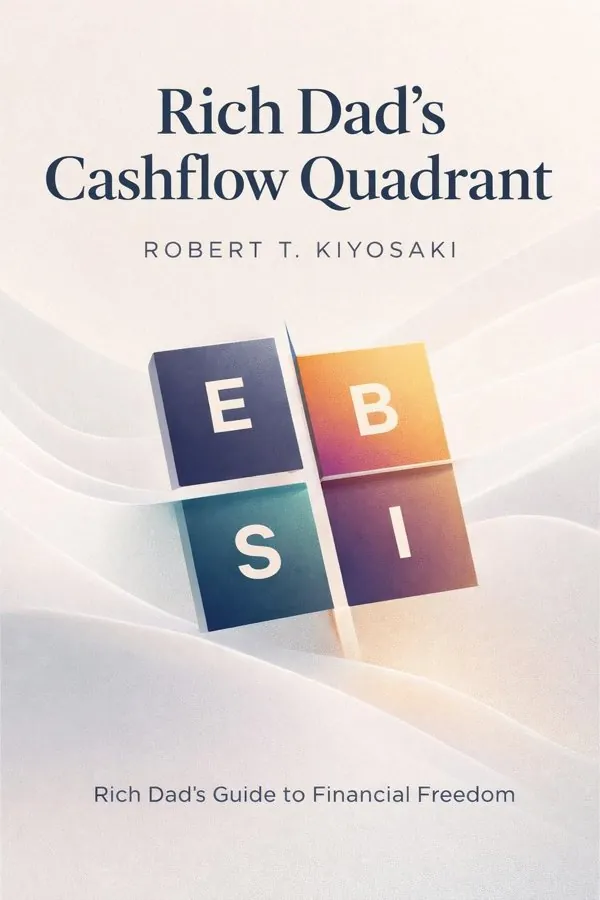
Rich Dad's Cashflow Quadrant: Rich Dad's Guide to Financial Freedom: Summary & Key Insights
 10 min5 chaptersAudio available
What Is Rich Dad's Cashflow Quadrant: Rich Dad's Guide to Financial Freedom About?
Rich Dad's Cashflow Quadrant: Rich Dad's Guide to Financial Freedom by Robert T. Kiyosaki is a finance book spanning 5 pages. Rich Dad's Cashflow Quadrant explains the four types of people who make up the world of business and the core differences between employees, self-employed individuals, business owners, and investors. Kiyosaki provides insights into how individuals can transition from the left side of the quadrant (E and S) to the right side (B and I) to achieve financial independence and freedom.
This FizzRead summary covers all 5 key chapters of Rich Dad's Cashflow Quadrant: Rich Dad's Guide to Financial Freedom in approximately 10 minutes, distilling the most important ideas, arguments, and takeaways from Robert T. Kiyosaki's work. Also available as an audio summary and Key Quotes Podcast.
Rich Dad's Cashflow Quadrant: Rich Dad's Guide to Financial Freedom
Rich Dad's Cashflow Quadrant explains the four types of people who make up the world of business and the core differences between employees, self-employed individuals, business owners, and investors. Kiyosaki provides insights into how individuals can transition from the left side of the quadrant (E and S) to the right side (B and I) to achieve financial independence and freedom.
Who Should Read Rich Dad's Cashflow Quadrant: Rich Dad's Guide to Financial Freedom?
This book is perfect for anyone interested in finance and looking to gain actionable insights in a short read. Whether you're a student, professional, or lifelong learner, the key ideas from Rich Dad's Cashflow Quadrant: Rich Dad's Guide to Financial Freedom by Robert T. Kiyosaki will help you think differently.
- ✓Readers who enjoy finance and want practical takeaways
- ✓Professionals looking to apply new ideas to their work and life
- ✓Anyone who wants the core insights of Rich Dad's Cashflow Quadrant: Rich Dad's Guide to Financial Freedom in just 10 minutes
Want the full summary?
Get instant access to this book summary and 100K+ more with Fizz Moment.
Get Free SummaryAvailable on App Store • Free to download
Key Chapters
Picture the quadrant divided into four sections marked E, S, B, and I. On the upper left is E—the Employee, the person who works for someone else. Beneath E is S—the Self-Employed, who may be doctors, lawyers, freelancers, or small business owners who actually work harder than employees but pride themselves on independence. On the right side, you find B—the Business Owner, who builds systems that operate without constant supervision, and below that, I—the Investor, whose money works continuously to generate more money.
Each quadrant represents a distinct philosophy. Employees value security and benefits; self-employed individuals value control and independence; business owners value leverage and leadership; investors value freedom and cash flow. Understanding these differences helps you see why people behave so differently when faced with financial challenges. The Employee mindset asks, “Will this be a secure job?” The Investor mindset asks, “Will this asset generate positive cash flow?”
My rich dad insisted that the key to financial freedom lies on the right side of the quadrant. The left side keeps you busy; the right side lets you build systems and investments that work regardless of your personal efforts. The moment you start thinking like a B or an I, you stop seeking job security and begin creating financial stability. This shift doesn’t happen overnight—it demands education, courage, and exposure to new opportunities—but it’s the gateway to wealth that lasts.
The left side of the quadrant—E and S—represents the foundation most people know too well. Employees crave stability and trade their skills for paychecks. Their income depends entirely on their ability to work. They often feel trapped because even when they earn more, their expenses and taxes tend to increase proportionally. The self-employed, though seemingly freer, face their own limitations. They may refuse to delegate tasks or build systems, often saying, “If you want it done right, do it yourself.” But this mindset still trades time for money, simply under the illusion of independence.
People on the left side often fear risk. They value job security and predictable income. They see taxes as inevitable burdens and debt as dangerous. My rich dad taught me that these beliefs are perfectly normal—but limited. Employees work hard for money, but they rarely make money work for them. Self-employed professionals often work harder than anyone else, yet their business depends entirely on their presence. If they stop, the income stops.
The challenge of the left side is hidden in comfort. It feels safe, yet that safety can disappear in a recession or with one bad month of business. It’s the side that teaches discipline and hard work—but without financial education, it rarely leads to freedom. To truly change your financial destiny, you must see beyond the paycheck and begin looking toward systems that produce income without your daily labor.
+ 3 more chapters — available in the FizzRead app
All Chapters in Rich Dad's Cashflow Quadrant: Rich Dad's Guide to Financial Freedom
About the Author
Robert T. Kiyosaki is an American entrepreneur, investor, and educator best known for his Rich Dad series of personal finance books. He advocates financial education and independence through investing, real estate, and entrepreneurship.
Get This Summary in Your Preferred Format
Read or listen to the Rich Dad's Cashflow Quadrant: Rich Dad's Guide to Financial Freedom summary by Robert T. Kiyosaki anytime, anywhere. FizzRead offers multiple formats so you can learn on your terms — all free.
Available formats: App · Audio · PDF · EPUB — All included free with FizzRead
Download Rich Dad's Cashflow Quadrant: Rich Dad's Guide to Financial Freedom PDF and EPUB Summary
Key Quotes from Rich Dad's Cashflow Quadrant: Rich Dad's Guide to Financial Freedom
“Picture the quadrant divided into four sections marked E, S, B, and I.”
“The left side of the quadrant—E and S—represents the foundation most people know too well.”
Frequently Asked Questions about Rich Dad's Cashflow Quadrant: Rich Dad's Guide to Financial Freedom
Rich Dad's Cashflow Quadrant: Rich Dad's Guide to Financial Freedom by Robert T. Kiyosaki is a finance book that explores key ideas across 5 chapters. Rich Dad's Cashflow Quadrant explains the four types of people who make up the world of business and the core differences between employees, self-employed individuals, business owners, and investors. Kiyosaki provides insights into how individuals can transition from the left side of the quadrant (E and S) to the right side (B and I) to achieve financial independence and freedom.
More by Robert T. Kiyosaki
Why "A" Students Work for "C" Students and "B" Students Work for the Government: Rich Dad's Guide to Financial Education for Parents
Robert T. Kiyosaki
10 min
Rich Dad's Who Took My Money?: Why Slow Investors Lose and Fast Money Wins!
Robert T. Kiyosaki
10 min
Rich Dad's Guide to Investing: What the Rich Invest in, That the Poor and the Middle Class Do Not!
Robert T. Kiyosaki
10 min
Rich Dad's Retire Young Retire Rich: How to Get Rich Quickly and Stay Rich Forever!
Robert T. Kiyosaki
10 minYou Might Also Like



Browse by Category
Ready to read Rich Dad's Cashflow Quadrant: Rich Dad's Guide to Financial Freedom?
Get the full summary and 100K+ more books with Fizz Moment.