
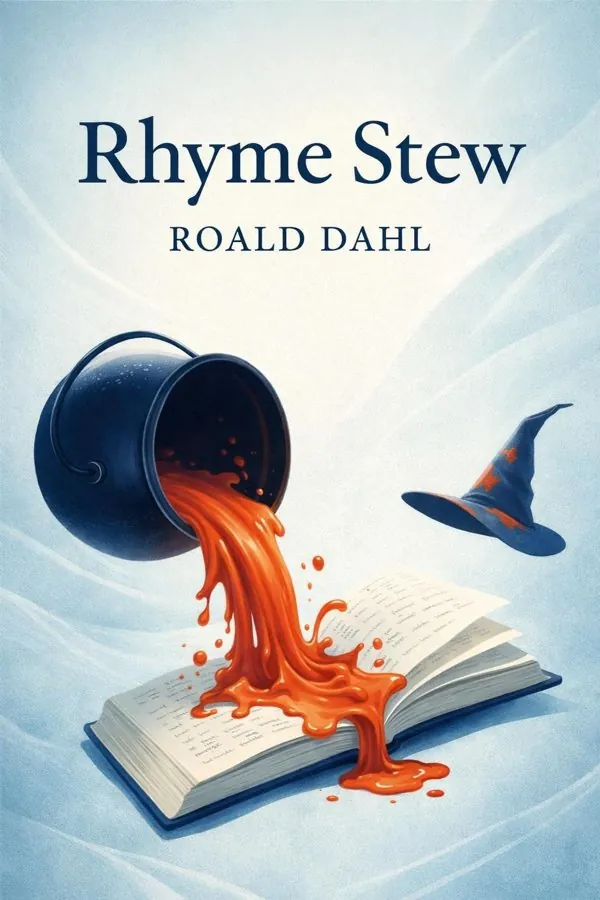
Rhyme Stew: Summary & Key Insights
by Roald Dahl
 10 min9 chaptersAudio available
Key Takeaways from Rhyme Stew
The stories we know best are often the easiest to stop really seeing.
Fairy tales often pretend to be moral instruction, but their real power lies in how brutally they simplify the world.
Laughter is often the quickest way to reveal what society wants to hide.
A joke lands harder when the language itself seems to be enjoying the trick.
Many traditional tales warn against temptation, but Rhyme Stew is more interested in exposing how irresistible temptation really is.
What Is Rhyme Stew About?
Rhyme Stew by Roald Dahl is a classics book spanning 9 pages. What happens when the comforting rhythms of childhood are handed over to a writer with a taste for mischief, satire, and the macabre? In Rhyme Stew, Roald Dahl takes the familiar world of nursery rhymes and fairy tales and turns it into something sharper, stranger, and distinctly adult. This short collection of poems revisits beloved characters and stories, but instead of sweet morals and tidy endings, readers get double meanings, comic violence, sexual innuendo, and gleeful reversals of expectation. The result is not merely parody for parody’s sake. Dahl uses these recognizable tales to expose hypocrisy, mock social pretensions, and remind us that many “innocent” stories were never as innocent as we pretend. The book matters because it shows Dahl at his most playful and subversive, working in miniature but with total control of rhythm, tone, and surprise. Best known for children’s classics like Matilda and Charlie and the Chocolate Factory, Dahl was equally gifted at writing for adults, especially when blending humor with cruelty and delight with discomfort. Paired with Quentin Blake’s energetic illustrations, Rhyme Stew becomes a wickedly entertaining demonstration of how old stories can still scandalize, amuse, and reveal uncomfortable truths.
This FizzRead summary covers all 9 key chapters of Rhyme Stew in approximately 10 minutes, distilling the most important ideas, arguments, and takeaways from Roald Dahl's work. Also available as an audio summary and Key Quotes Podcast.
Rhyme Stew
What happens when the comforting rhythms of childhood are handed over to a writer with a taste for mischief, satire, and the macabre? In Rhyme Stew, Roald Dahl takes the familiar world of nursery rhymes and fairy tales and turns it into something sharper, stranger, and distinctly adult. This short collection of poems revisits beloved characters and stories, but instead of sweet morals and tidy endings, readers get double meanings, comic violence, sexual innuendo, and gleeful reversals of expectation. The result is not merely parody for parody’s sake. Dahl uses these recognizable tales to expose hypocrisy, mock social pretensions, and remind us that many “innocent” stories were never as innocent as we pretend.
The book matters because it shows Dahl at his most playful and subversive, working in miniature but with total control of rhythm, tone, and surprise. Best known for children’s classics like Matilda and Charlie and the Chocolate Factory, Dahl was equally gifted at writing for adults, especially when blending humor with cruelty and delight with discomfort. Paired with Quentin Blake’s energetic illustrations, Rhyme Stew becomes a wickedly entertaining demonstration of how old stories can still scandalize, amuse, and reveal uncomfortable truths.
Who Should Read Rhyme Stew?
This book is perfect for anyone interested in classics and looking to gain actionable insights in a short read. Whether you're a student, professional, or lifelong learner, the key ideas from Rhyme Stew by Roald Dahl will help you think differently.
- ✓Readers who enjoy classics and want practical takeaways
- ✓Professionals looking to apply new ideas to their work and life
- ✓Anyone who wants the core insights of Rhyme Stew in just 10 minutes
Want the full summary?
Get instant access to this book summary and 100K+ more with Fizz Moment.
Get Free SummaryAvailable on App Store • Free to download
Key Chapters
The stories we know best are often the easiest to stop really seeing. That is the starting point of Rhyme Stew: Roald Dahl recognizes that nursery rhymes live in our memory as sounds before they live as meanings, and he uses parody to wake them up again. By taking old verses that feel harmless, repetitive, and comforting, he injects them with adult wit, social bite, and comic menace. The effect is immediate. The reader is forced to compare the clean, polished version remembered from childhood with the unruly, unfiltered version Dahl offers in its place.
This parody works because it depends on recognition. Dahl does not need to build a world from scratch. He borrows the structure, rhythm, and stock figures of traditional rhymes, then twists them just enough to create surprise. That surprise becomes the joke, but also the point. We begin to notice how formulaic the originals are, how much authority they carried, and how easily their messages can be reshaped. A familiar rhyme becomes a tool for exposing class vanity, sexual prudery, greed, or foolishness.
In practical terms, this is a lesson in creative transformation. Dahl shows that originality does not always mean inventing new material; sometimes it means seeing old material from a new angle. Teachers, writers, and performers can apply this by revisiting common stories and asking what assumptions they contain. What happens if the villain is more sensible than the hero? What if the moral is backward? What if the rhyme reveals the absurdity of adult society rather than instructing children?
The actionable takeaway is simple: take one story or rhyme you think you know by heart, rewrite it from an unexpected perspective, and see what hidden meanings emerge.
Fairy tales often pretend to be moral instruction, but their real power lies in how brutally they simplify the world. Rhyme Stew pushes back against that simplicity. Dahl takes classic tales with rigid roles—innocent maiden, wicked villain, noble rescuer—and cheerfully dismantles them. His rewritings remind us that the old stories were never neutral; they taught obedience, rewarded conformity, and often relied on simplistic ideas about beauty, class, virtue, and power. By subverting them, Dahl turns inherited narratives into a site of rebellion.
This subversion operates through reversal. Heroes are exposed as vain, foolish, or opportunistic. Heroines may prove less passive than expected. Villains are no longer the only dangerous figures in the story. Most importantly, endings no longer offer the comfort of moral neatness. Instead of the usual reward-for-goodness structure, Dahl invites chaos, irony, and embarrassment. That change matters because it breaks the automatic trust readers place in familiar plots.
Beyond its humor, this technique has broader relevance. We all inherit stories about how life is supposed to work: good people succeed, love solves everything, authority deserves respect, and appearances reflect character. Dahl reveals how fragile those assumptions are. In workplaces, families, politics, and culture, the same fairy-tale logic often persists in subtler forms. We still divide people into saints and monsters, still expect tidy endings, still mistake convention for truth.
Readers can apply this insight by examining the “scripts” they live by. If you tell yourself that success must follow one approved path or that certain roles belong to certain people, you may be living inside an inherited fairy tale. The actionable takeaway: identify one personal or cultural story you accept without question, then rewrite its ending in a way that feels more honest.
Laughter is often the quickest way to reveal what society wants to hide. In Rhyme Stew, Dahl uses comic verse not simply to amuse but to uncover hypocrisy, especially the kind wrapped in respectability. The book repeatedly contrasts polished surfaces with unruly desires beneath them. Characters who should embody virtue often turn out to be selfish, lustful, vain, or absurd. Institutions of morality are not treated with reverence but with suspicion, because Dahl understands that official goodness can easily become a performance.
This makes the poems more than naughty jokes. Their humor depends on the gap between what people claim to be and what they actually are. That gap is central to satire. Dahl exaggerates it for effect, but the underlying observation is familiar: adults demand innocence while consuming scandal, preach restraint while chasing indulgence, and teach rigid morals that they themselves ignore. By placing such contradictions inside old rhymes and tales, he highlights how moral instruction has always been unstable.
The practical value of this idea lies in learning to detect double standards. In everyday life, hypocrisy appears in workplaces that preach well-being while rewarding burnout, public figures who condemn behavior they privately practice, or social circles that celebrate honesty only when it is convenient. Dahl’s poems encourage readers to look past slogans and polished language. Comic exaggeration trains skepticism.
At the same time, the book invites self-reflection. It is easy to laugh at hypocrisy in others; harder to recognize it in ourselves. Where do we perform virtue rather than live it? Where do we judge others for impulses we excuse in private? Humor softens the sting, but the question remains serious.
The actionable takeaway: the next time a person, rule, or custom presents itself as unquestionably moral, ask what hidden motives or contradictions might be sitting just behind the curtain.
A joke lands harder when the language itself seems to be enjoying the trick. One of the greatest pleasures of Rhyme Stew is Dahl’s command of sound, rhyme, rhythm, and verbal surprise. He writes in a style that feels light on the page but is carefully engineered. The bounce of a line lulls the reader into familiarity, then a sudden twist in wording, tone, or image delivers the punch. This is why the poems feel so memorable: the music of the language carries the subversion.
Dahl’s wordplay is not decorative. It is central to the book’s effect. By using strong rhythms borrowed from nursery traditions, he creates the expectation of innocence. Then he fills that rhythm with irreverence, dark comedy, and adult implication. The contrast produces delight. Quentin Blake’s illustrations reinforce this energy, but the poems themselves already move with theatrical precision. Dahl knows when to repeat, when to escalate, when to rhyme neatly, and when to let a jarring phrase disrupt the flow.
There is a practical lesson here for anyone who communicates, writes, or teaches: form shapes reception. People remember ideas better when they are embedded in pattern, surprise, and sound. Whether you are telling a story, writing a speech, or making a point in conversation, rhythm and phrasing matter. A well-timed turn of language can make criticism more palatable, comedy more effective, and meaning more vivid.
Readers can even use Dahl’s technique as an exercise. Take a dull statement and rewrite it with stronger cadence, sharper contrast, or a playful reversal. Notice how much more persuasive or entertaining it becomes. The actionable takeaway: if you want your words to stick, focus not just on what you say but on the rhythm, texture, and surprise of how you say it.
Many traditional tales warn against temptation, but Rhyme Stew is more interested in exposing how irresistible temptation really is. Across the collection, desire appears in many forms: greed, vanity, appetite, lust, ambition, curiosity, and the wish to escape boredom or restraint. Dahl treats these impulses with a combination of mockery and recognition. His characters are funny not because they are uniquely corrupt, but because they are exaggerated versions of familiar human weakness.
This focus on desire gives the poems their adult edge. Childhood stories often divide the world between good behavior and bad behavior. Dahl complicates that division by showing how desire slips through moral categories. People do not always act out of principle; they act because they want something. Sometimes that wanting is ridiculous, sometimes dangerous, and often both at once. The comic force comes from watching polite stories fail to contain impolite urges.
The idea has practical relevance because modern life still runs on managed temptation. Advertising stimulates appetite. Social media feeds vanity and comparison. Consumer culture rewards endless wanting while pretending that self-control is simple. Dahl’s poems make these dynamics laughable, but they also make them visible. They remind readers that temptation becomes more powerful when disguised as normality.
That does not mean desire must be feared. Dahl is too playful for simple moralizing. Instead, he suggests that acknowledging desire honestly is wiser than pretending purity. Once you see your own temptations clearly, you can decide how to handle them instead of being quietly ruled by them.
The actionable takeaway: choose one recurring temptation in your own life—attention, comfort, shopping, status, distraction—and observe it without excuses for a week. Awareness is the first step toward freedom.
When writers give animals human motives, they are rarely just writing about animals. In Rhyme Stew, anthropomorphic creatures function as comic mirrors. They allow Dahl to heighten appetite, cunning, fear, and stupidity in ways that feel both playful and revealing. Animals can be sly, hungry, predatory, or ridiculous without the social defenses that human characters bring. That freedom makes them ideal tools for satire.
Dahl has long been skilled at using nonhuman figures to expose human behavior, and here that talent appears in concentrated form. Animal fable has an ancient history because it simplifies moral and social conflict. But Dahl’s version is less interested in teaching a neat lesson than in showing how instincts operate beneath civilized behavior. The animal world in these poems is energetic, unruly, and often comically brutal. It reminds readers that much of what we call refinement is a thin layer over more primitive drives.
This device remains useful outside literature. People often understand difficult truths more easily through metaphor than through direct accusation. Calling a person “foxlike,” “sheepish,” or “wolfish” compresses observation into image. In leadership, education, and storytelling, symbolic characters can reveal patterns that straightforward description misses.
There is also a self-awareness lesson here. We like to think of ourselves as rational, controlled, and morally consistent, yet much of life is driven by instinctive reactions: jealousy, territoriality, mating rituals, pack behavior, fear of exclusion. Dahl’s animal figures turn those realities into comedy, making them easier to notice without becoming defensive.
The actionable takeaway: when a human situation feels confusing, try describing the people involved as animals in a fable. The comparison may expose motives and power dynamics more clearly than literal analysis.
Some truths become easier to face when they arrive laughing. Rhyme Stew thrives on dark humor: comic violence, grotesque images, cruel reversals, and gleeful bad taste. Rather than avoiding discomfort, Dahl leans into it, trusting that shock and amusement can coexist. That mixture is one reason the book feels so distinct. It does not merely entertain; it unsettles while entertaining, forcing readers to ask why they are laughing at things that, in another frame, might seem ugly or disturbing.
Dark humor works because it creates emotional complexity. The reader is pulled between delight in the cleverness and awareness of the nastiness. Dahl uses this tension expertly. His grotesque elements are stylized rather than realistic, which keeps them playful, but they still carry enough edge to provoke. This allows the poems to challenge sentimental reading habits. Childhood forms are not safe here. They are elastic enough to contain menace as well as charm.
In practical terms, dark humor can serve as a coping mechanism and a critical tool. People often use it to process fear, embarrassment, aging, social absurdity, and the unpredictability of life. Used well, it helps us confront what polite speech avoids. Used badly, it can become mere cruelty. Dahl walks that line with theatrical exaggeration, inviting readers to enjoy the transgression while recognizing its moral ambiguity.
This is especially relevant in modern culture, where comedy frequently tests the boundaries of taste. Rhyme Stew reminds us that offense is not always empty provocation; sometimes it is a way of exposing what society has repressed or disguised. The key is whether the shock reveals something real.
The actionable takeaway: when a piece of dark humor makes you laugh and wince at once, ask yourself what hidden fear, hypocrisy, or taboo that joke has brought into the open.
The old tales that shaped childhood also shaped expectations about men and women. Rhyme Stew plays with those expectations by mocking the stock roles built into fairy tales and nursery rhymes. Princes, maidens, mothers, hunters, seductresses, and fools appear in forms that undermine their traditional functions. Dahl’s treatment is not programmatic or ideological in a modern academic sense, but it is undeniably mischievous: he takes roles that once seemed fixed and reveals how theatrical they always were.
This matters because fairy tales have historically linked virtue with female beauty, male action, social obedience, and romantic reward. By distorting these patterns, Dahl exposes their artificiality. Helplessness may become calculation. Heroism may become vanity. Beauty may attract trouble rather than salvation. Respectable femininity and dominant masculinity both become targets for comic revision. The result is not a clean alternative morality, but a destabilized one.
Readers can apply this insight by noticing how many contemporary expectations still rely on old story logic. We continue to reward certain performances of femininity and masculinity, often without realizing how inherited those scripts are. In relationships, career choices, parenting, and public image, people may feel pressure to inhabit roles they never consciously chose. Dahl’s comic reversals encourage resistance to those defaults.
The lesson is not that every tradition must be discarded, but that no role should be accepted simply because it is familiar. Laughter becomes a form of liberation here. Once a role has been mocked, it loses some of its authority.
The actionable takeaway: identify one expectation about gender you have absorbed from stories, family, or culture, and ask whether it reflects your real values or merely an old script still being performed.
All Chapters in Rhyme Stew
About the Author
Roald Dahl (1916–1990) was a British novelist, poet, short-story writer, and screenwriter whose work combined imagination, menace, humor, and a deep instinct for storytelling. He became one of the most beloved children’s authors of the twentieth century through books such as Charlie and the Chocolate Factory, Matilda, The BFG, and James and the Giant Peach. Yet Dahl also wrote acclaimed fiction for adults, often marked by irony, cruelty, and macabre surprise. His style is instantly recognizable for its rhythmic language, outrageous characters, and delight in overturning authority and convention. In poetry as in prose, he excelled at mixing charm with danger. Rhyme Stew showcases that darker comic side, revealing how expertly he could subvert familiar tales while preserving their irresistible energy.
Get This Summary in Your Preferred Format
Read or listen to the Rhyme Stew summary by Roald Dahl anytime, anywhere. FizzRead offers multiple formats so you can learn on your terms — all free.
Available formats: App · Audio · PDF · EPUB — All included free with FizzRead
Download Rhyme Stew PDF and EPUB Summary
Key Quotes from Rhyme Stew
“The stories we know best are often the easiest to stop really seeing.”
“Fairy tales often pretend to be moral instruction, but their real power lies in how brutally they simplify the world.”
“Laughter is often the quickest way to reveal what society wants to hide.”
“A joke lands harder when the language itself seems to be enjoying the trick.”
“Many traditional tales warn against temptation, but Rhyme Stew is more interested in exposing how irresistible temptation really is.”
Frequently Asked Questions about Rhyme Stew
Rhyme Stew by Roald Dahl is a classics book that explores key ideas across 9 chapters. What happens when the comforting rhythms of childhood are handed over to a writer with a taste for mischief, satire, and the macabre? In Rhyme Stew, Roald Dahl takes the familiar world of nursery rhymes and fairy tales and turns it into something sharper, stranger, and distinctly adult. This short collection of poems revisits beloved characters and stories, but instead of sweet morals and tidy endings, readers get double meanings, comic violence, sexual innuendo, and gleeful reversals of expectation. The result is not merely parody for parody’s sake. Dahl uses these recognizable tales to expose hypocrisy, mock social pretensions, and remind us that many “innocent” stories were never as innocent as we pretend. The book matters because it shows Dahl at his most playful and subversive, working in miniature but with total control of rhythm, tone, and surprise. Best known for children’s classics like Matilda and Charlie and the Chocolate Factory, Dahl was equally gifted at writing for adults, especially when blending humor with cruelty and delight with discomfort. Paired with Quentin Blake’s energetic illustrations, Rhyme Stew becomes a wickedly entertaining demonstration of how old stories can still scandalize, amuse, and reveal uncomfortable truths.
More by Roald Dahl
You Might Also Like






Browse by Category
Ready to read Rhyme Stew?
Get the full summary and 100K+ more books with Fizz Moment.