
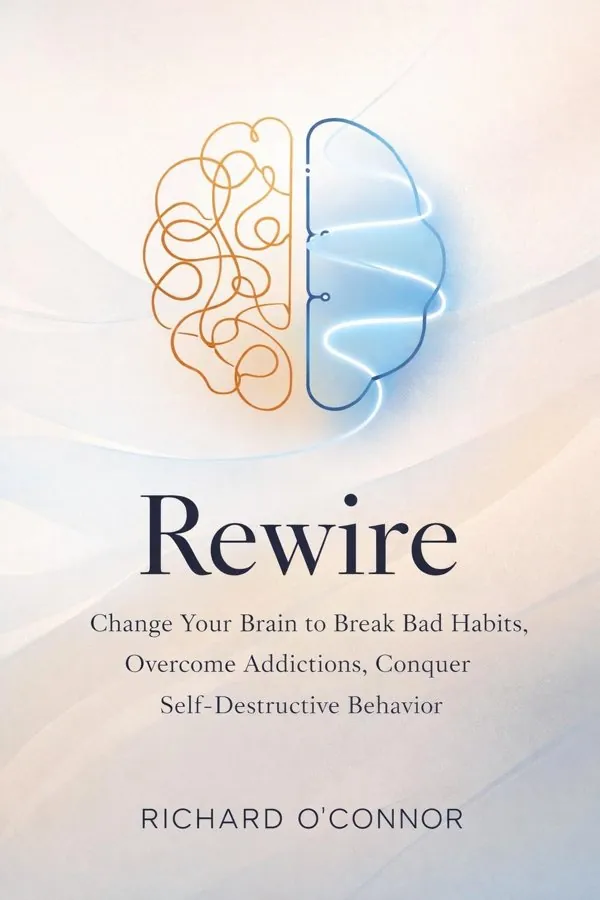
Rewire: Change Your Brain to Break Bad Habits, Overcome Addictions, Conquer Self-Destructive Behavior: Summary & Key Insights
 10 min8 chaptersAudio available
What Is Rewire: Change Your Brain to Break Bad Habits, Overcome Addictions, Conquer Self-Destructive Behavior About?
Rewire: Change Your Brain to Break Bad Habits, Overcome Addictions, Conquer Self-Destructive Behavior by Richard O’Connor is a mental_health book spanning 8 pages. In this book, psychotherapist Richard O’Connor explains how to retrain the brain to overcome self-destructive habits and behaviors. Drawing on neuroscience and psychology, he explores how automatic, unconscious patterns drive addiction, procrastination, and negative thinking, and offers practical strategies to rewire the brain for healthier, more productive living.
This FizzRead summary covers all 8 key chapters of Rewire: Change Your Brain to Break Bad Habits, Overcome Addictions, Conquer Self-Destructive Behavior in approximately 10 minutes, distilling the most important ideas, arguments, and takeaways from Richard O’Connor's work. Also available as an audio summary and Key Quotes Podcast.
Rewire: Change Your Brain to Break Bad Habits, Overcome Addictions, Conquer Self-Destructive Behavior
In this book, psychotherapist Richard O’Connor explains how to retrain the brain to overcome self-destructive habits and behaviors. Drawing on neuroscience and psychology, he explores how automatic, unconscious patterns drive addiction, procrastination, and negative thinking, and offers practical strategies to rewire the brain for healthier, more productive living.
Who Should Read Rewire: Change Your Brain to Break Bad Habits, Overcome Addictions, Conquer Self-Destructive Behavior?
This book is perfect for anyone interested in mental_health and looking to gain actionable insights in a short read. Whether you're a student, professional, or lifelong learner, the key ideas from Rewire: Change Your Brain to Break Bad Habits, Overcome Addictions, Conquer Self-Destructive Behavior by Richard O’Connor will help you think differently.
- ✓Readers who enjoy mental_health and want practical takeaways
- ✓Professionals looking to apply new ideas to their work and life
- ✓Anyone who wants the core insights of Rewire: Change Your Brain to Break Bad Habits, Overcome Addictions, Conquer Self-Destructive Behavior in just 10 minutes
Want the full summary?
Get instant access to this book summary and 100K+ more with Fizz Moment.
Get Free SummaryAvailable on App Store • Free to download
Key Chapters
Early in my clinical work, I observed that people often felt compelled to act in ways they couldn’t explain: snapping at loved ones, drifting back into addiction after a period of recovery, or sabotaging success just when it seemed within reach. Science confirms what therapy had shown me anecdotally: the brain has dual systems that sometimes compete with each other. The automatic brain — what Freud might have called the unconscious — is efficient and fast. It stores habits and responses that have worked in the past, even if they no longer serve. The conscious brain, by contrast, is slow and effortful but capable of reflection, intention, and moral choice.
When we’re stressed or tired, the automatic system easily takes over. It was designed by evolution to keep us safe by relying on established patterns, but in the modern world those patterns can become maladaptive: they push us toward overeating, multi-tasking, avoidance, and addiction. Recognizing the interplay of these two systems is vital. You can’t defeat the automatic brain by sheer rational argument; instead, you must retrain it. That’s where the concept of ‘rewiring’ begins. Awareness and conscious engagement repeatedly practiced can strengthen neural circuits that support better choices, gradually making them automatic. Just as bad habits are learned through repetition, good ones can be too.
We might like to believe that we make bad choices because of flawed willpower, but in truth, most self-destructive patterns develop through reinforcement. Every time a behavior gives us temporary relief from discomfort, the brain stamps it as a success. That mechanism is the root of habits and, ultimately, addictions. Stress and trauma amplify this cycle: under emotional distress, the brain seeks shortcuts to soothe itself. A drink, a distraction, a burst of anger — each is rewarded in the moment. The automatic mind learns to anticipate that relief. Over time, it wires those responses deeply.
It’s crucial to recognize that these behaviors aren’t purely conscious choices. The amygdala and ventral striatum — key centers for emotion and reward — drive habitual responses far faster than the conscious prefrontal cortex can intervene. This means that our so-called ‘bad habits’ are neural grooves carved by experience. They are efficient but outdated solutions to old pains. When we understand this, compassion replaces self-blame. We realize that change is a matter of creating new neural grooves, not of punishing ourselves for the old ones.
+ 6 more chapters — available in the FizzRead app
All Chapters in Rewire: Change Your Brain to Break Bad Habits, Overcome Addictions, Conquer Self-Destructive Behavior
About the Author
Richard O’Connor, Ph.D., is a psychotherapist and author known for his works on depression, self-destructive behavior, and emotional health. He has written several books integrating neuroscience and psychotherapy to help readers understand and change their mental habits.
Get This Summary in Your Preferred Format
Read or listen to the Rewire: Change Your Brain to Break Bad Habits, Overcome Addictions, Conquer Self-Destructive Behavior summary by Richard O’Connor anytime, anywhere. FizzRead offers multiple formats so you can learn on your terms — all free.
Available formats: App · Audio · PDF · EPUB — All included free with FizzRead
Download Rewire: Change Your Brain to Break Bad Habits, Overcome Addictions, Conquer Self-Destructive Behavior PDF and EPUB Summary
Key Quotes from Rewire: Change Your Brain to Break Bad Habits, Overcome Addictions, Conquer Self-Destructive Behavior
“Science confirms what therapy had shown me anecdotally: the brain has dual systems that sometimes compete with each other.”
“We might like to believe that we make bad choices because of flawed willpower, but in truth, most self-destructive patterns develop through reinforcement.”
Frequently Asked Questions about Rewire: Change Your Brain to Break Bad Habits, Overcome Addictions, Conquer Self-Destructive Behavior
Rewire: Change Your Brain to Break Bad Habits, Overcome Addictions, Conquer Self-Destructive Behavior by Richard O’Connor is a mental_health book that explores key ideas across 8 chapters. In this book, psychotherapist Richard O’Connor explains how to retrain the brain to overcome self-destructive habits and behaviors. Drawing on neuroscience and psychology, he explores how automatic, unconscious patterns drive addiction, procrastination, and negative thinking, and offers practical strategies to rewire the brain for healthier, more productive living.
You Might Also Like

Big Feelings: How to Be Okay When Things Are Not Okay
Liz Fosslien, Mollie West Duffy
10 min
Creative Arts Therapies Handbook: Art, Music and Dance Therapy Practices for Wellbeing
Susan I. Buchalter
10 min
Emotional First Aid: Healing Rejection, Guilt, Failure, and Other Everyday Hurts
Guy Winch
10 min
Lost Connections: Why You're Depressed and How to Find Hope
Johann Hari
10 min
No Time to Panic: How to Stop Worrying and Embrace Life
Matt Gutman
10 min
Overcoming Mobbing: A Recovery Guide for Workplace Aggression and Bullying
Maureen Duffy, Len Sperry
10 minBrowse by Category
Ready to read Rewire: Change Your Brain to Break Bad Habits, Overcome Addictions, Conquer Self-Destructive Behavior?
Get the full summary and 100K+ more books with Fizz Moment.