
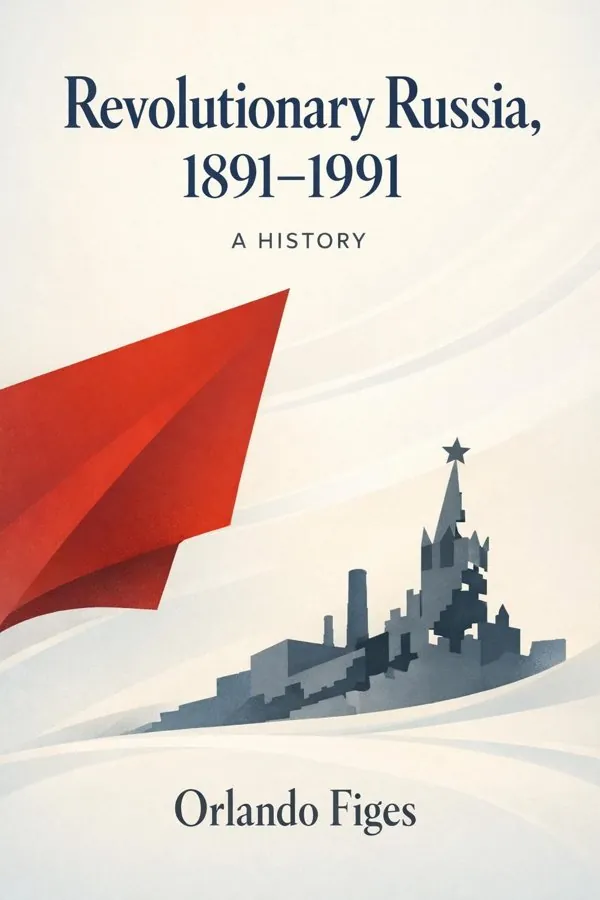
Revolutionary Russia, 1891–1991: A History: Summary & Key Insights
 10 min11 chaptersAudio available
What Is Revolutionary Russia, 1891–1991: A History About?
Revolutionary Russia, 1891–1991: A History by Orlando Figes is a world_history book spanning 11 pages. This concise history by Orlando Figes traces the evolution of revolutionary movements in Russia from the famine of 1891 through the collapse of the Soviet Union in 1991. It explores the ideological, political, and social forces that shaped the Russian Revolution, the rise of the Bolsheviks, Stalinism, and the eventual disintegration of the Soviet state. Figes presents a sweeping yet accessible narrative that connects the century-long revolutionary experience to the broader currents of Russian and world history.
This FizzRead summary covers all 11 key chapters of Revolutionary Russia, 1891–1991: A History in approximately 10 minutes, distilling the most important ideas, arguments, and takeaways from Orlando Figes's work. Also available as an audio summary and Key Quotes Podcast.
Revolutionary Russia, 1891–1991: A History
This concise history by Orlando Figes traces the evolution of revolutionary movements in Russia from the famine of 1891 through the collapse of the Soviet Union in 1991. It explores the ideological, political, and social forces that shaped the Russian Revolution, the rise of the Bolsheviks, Stalinism, and the eventual disintegration of the Soviet state. Figes presents a sweeping yet accessible narrative that connects the century-long revolutionary experience to the broader currents of Russian and world history.
Who Should Read Revolutionary Russia, 1891–1991: A History?
This book is perfect for anyone interested in world_history and looking to gain actionable insights in a short read. Whether you're a student, professional, or lifelong learner, the key ideas from Revolutionary Russia, 1891–1991: A History by Orlando Figes will help you think differently.
- ✓Readers who enjoy world_history and want practical takeaways
- ✓Professionals looking to apply new ideas to their work and life
- ✓Anyone who wants the core insights of Revolutionary Russia, 1891–1991: A History in just 10 minutes
Want the full summary?
Get instant access to this book summary and 100K+ more with Fizz Moment.
Get Free SummaryAvailable on App Store • Free to download
Key Chapters
The famine of 1891 was the beginning of the revolutionary century because it shattered Russia’s illusion of stability. As fields withered across the Volga region, the Tsarist bureaucracy failed to act decisively, revealing an incompetent and callous system. The intelligentsia rose to fill that void. Figures like Leo Tolstoy mobilized private relief efforts, while younger activists found in the disaster proof of the need for political change. The famine birthed a generation of thinkers who saw moral renewal and political revolution as intertwined acts.
Out of this awakening emerged the first coherent ideological movements—Populists who looked to the peasantry as the soul of the nation, and Marxists who saw industrial workers as the agents of transformation. With the development of Russian industry in the 1890s—the surge of railways and textile mills in Moscow and St Petersburg—a new proletarian consciousness began to appear. Underground study circles debated Marx’s texts in cramped apartments; illegal pamphlets circulated among factory hands. The seeds of revolutionary Marxism were planted amid both hardship and hope.
By 1905, this restless energy could no longer be contained. The humiliation of war against Japan, coupled with economic despair, provoked mass strikes and demonstrations. The event known as Bloody Sunday, when troops fired upon peaceful petitioners, convinced many that reform within the existing regime was impossible. Revolution, once an abstract concept, had become a living experience.
The revolution of 1905 marked Russia’s first attempt to translate discontent into political change. It was chaotic and multifaceted: workers struck, peasants seized land, and national minorities demanded autonomy. For the Tsarist regime, survival required concessions. Under pressure, Nicholas II issued the October Manifesto, promising civil liberties and an elected Duma. For a moment, it seemed that constitutional monarchy might be possible.
But this promise remained fragile. The Duma was soon constrained by imperial authority; successive prime ministers tried to balance reform with repression. The revolutionary parties—Social Democrats, Socialist Revolutionaries, and liberal Cadets—struggled to define strategy. Should they compromise, or continue to fight? In this tension lay the pattern of Russia’s future: small reforms tempered by reaction, populism undermined by autocracy.
In retrospect, 1905 was both a rehearsal and a warning. It revealed the dynamism of a society awakening politically, yet also the limitations of a system unwilling to relinquish control. I see it as the prelude to 1917: the first tremor before the earthquake.
+ 9 more chapters — available in the FizzRead app
All Chapters in Revolutionary Russia, 1891–1991: A History
About the Author
Orlando Figes is a British historian and professor known for his works on Russian history, including 'A People's Tragedy' and 'Natasha's Dance'. His research focuses on the social and cultural dimensions of the Russian Revolution and the Soviet era.
Get This Summary in Your Preferred Format
Read or listen to the Revolutionary Russia, 1891–1991: A History summary by Orlando Figes anytime, anywhere. FizzRead offers multiple formats so you can learn on your terms — all free.
Available formats: App · Audio · PDF · EPUB — All included free with FizzRead
Download Revolutionary Russia, 1891–1991: A History PDF and EPUB Summary
Key Quotes from Revolutionary Russia, 1891–1991: A History
“The famine of 1891 was the beginning of the revolutionary century because it shattered Russia’s illusion of stability.”
“The revolution of 1905 marked Russia’s first attempt to translate discontent into political change.”
Frequently Asked Questions about Revolutionary Russia, 1891–1991: A History
Revolutionary Russia, 1891–1991: A History by Orlando Figes is a world_history book that explores key ideas across 11 chapters. This concise history by Orlando Figes traces the evolution of revolutionary movements in Russia from the famine of 1891 through the collapse of the Soviet Union in 1991. It explores the ideological, political, and social forces that shaped the Russian Revolution, the rise of the Bolsheviks, Stalinism, and the eventual disintegration of the Soviet state. Figes presents a sweeping yet accessible narrative that connects the century-long revolutionary experience to the broader currents of Russian and world history.
You Might Also Like
The Age of Capital
Eric Hobsbawm
10 min
The Gulag Archipelago
Aleksandr Solzhenitsyn
10 min
Jerusalem: The Biography
Simon Sebag Montefiore
10 min
The Anglo-Saxons
James Campbell
10 min
The Boer War
Thomas Pakenham
10 min
The Industrial Revolutionaries: The Making of the Modern World 1776–1914
Gavin Weightman
10 minBrowse by Category
Ready to read Revolutionary Russia, 1891–1991: A History?
Get the full summary and 100K+ more books with Fizz Moment.