
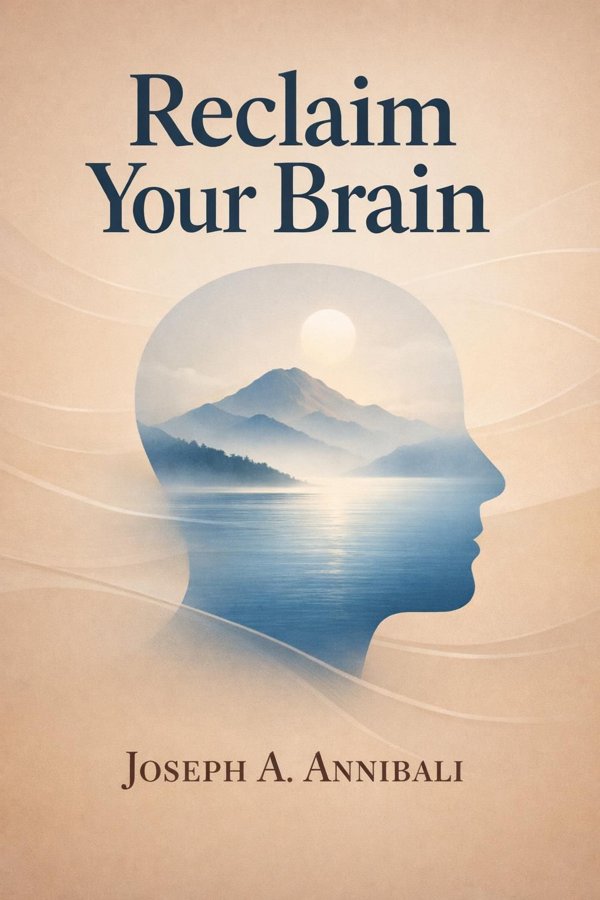
Reclaim Your Brain: How to Calm Your Thoughts, Heal Your Mind, and Bring Your Life Back Under Control: Summary & Key Insights
 10 min7 chaptersAudio available
What Is Reclaim Your Brain: How to Calm Your Thoughts, Heal Your Mind, and Bring Your Life Back Under Control About?
Reclaim Your Brain: How to Calm Your Thoughts, Heal Your Mind, and Bring Your Life Back Under Control by Joseph A. Annibali is a mental_health book spanning 7 pages. In this book, psychiatrist Joseph A. Annibali explores how chronic distraction, anxiety, and emotional turmoil stem from an overactive brain. Drawing on clinical experience and neuroscience, he offers practical strategies to quiet mental noise, improve focus, and restore emotional balance. The work combines scientific insight with compassionate guidance for readers seeking mental clarity and resilience.
This FizzRead summary covers all 7 key chapters of Reclaim Your Brain: How to Calm Your Thoughts, Heal Your Mind, and Bring Your Life Back Under Control in approximately 10 minutes, distilling the most important ideas, arguments, and takeaways from Joseph A. Annibali's work. Also available as an audio summary and Key Quotes Podcast.
Reclaim Your Brain: How to Calm Your Thoughts, Heal Your Mind, and Bring Your Life Back Under Control
In this book, psychiatrist Joseph A. Annibali explores how chronic distraction, anxiety, and emotional turmoil stem from an overactive brain. Drawing on clinical experience and neuroscience, he offers practical strategies to quiet mental noise, improve focus, and restore emotional balance. The work combines scientific insight with compassionate guidance for readers seeking mental clarity and resilience.
Who Should Read Reclaim Your Brain: How to Calm Your Thoughts, Heal Your Mind, and Bring Your Life Back Under Control?
This book is perfect for anyone interested in mental_health and looking to gain actionable insights in a short read. Whether you're a student, professional, or lifelong learner, the key ideas from Reclaim Your Brain: How to Calm Your Thoughts, Heal Your Mind, and Bring Your Life Back Under Control by Joseph A. Annibali will help you think differently.
- ✓Readers who enjoy mental_health and want practical takeaways
- ✓Professionals looking to apply new ideas to their work and life
- ✓Anyone who wants the core insights of Reclaim Your Brain: How to Calm Your Thoughts, Heal Your Mind, and Bring Your Life Back Under Control in just 10 minutes
Want the full summary?
Get instant access to this book summary and 100K+ more with Fizz Moment.
Get Free SummaryAvailable on App Store • Free to download
Key Chapters
Let’s begin where most of my patients do: with the relentless noise inside their heads. The overactive brain is characterized by excessive neural firing, particularly in regions responsible for worry, focus, and emotional regulation. When this overactivity persists, it traps you in loops of rumination and restlessness, leaving you unable to find calm or clarity.
Brain imaging has been revolutionary in showing us that these mental states correspond to visible, measurable activity. For example, an overactive anterior cingulate gyrus often drives the ‘stuckness’ of obsessive-compulsive thinking — that repetitive, circular mental process that refuses to let go. The basal ganglia, when hyperstimulated, contribute to chronic anxiety and muscle tension. The limbic system, home to emotion and memory, becomes chronically activated in those who have suffered trauma, coloring all new experiences with old emotional residue.
Understanding this is liberating. It shifts the conversation from “something is wrong with me” to “something is happening in my brain.” The distinction is profound. When you recognize that anxiety or distraction are not purely psychological weaknesses but patterns of brain overactivity, you can begin to address the root cause rather than simply fighting the symptoms.
I’ve seen teachers who couldn’t concentrate, parents consumed by guilt, executives paralyzed by perfectionism — all of them driven by one common denominator: neural circuits firing too fast for too long. The first step toward healing is awareness, learning to name and recognize the experience of an overactive brain. It’s the beginning of taking back control.
No two overactive brains look exactly alike. Just as there are multiple ways the heart can malfunction, there are distinct types of neural overactivation, each with its own emotional and behavioral signature.
Some people have *worry-driven overactivity*. Their brains are dominated by fear circuits that anticipate danger even when none exists. For them, peace feels unsafe, because their nervous systems have equated vigilance with survival. Others live with *trauma-driven overactivity* in which emotional memories are so deeply ingrained that their limbic systems react to old threats as if they were happening in real time. A slammed door or a critical remark can trigger the same neural cascade as the original wound.
Then there’s *perfectionistic overactivity* — the result of an overfiring anterior cingulate gyrus coupled with rigid thought patterns. These individuals live by ‘shoulds’ and ‘musts,’ constantly evaluating their performance and rarely allowing rest. Their self-esteem becomes chained to achievement, and every gap between ideal and reality fuels further stress.
These categories are not meant to label or limit but to illuminate. When you understand your brain’s dominant patterns, you can target interventions precisely. The chronic worrier needs calming of the basal ganglia; the trauma survivor must soothe the limbic system; the perfectionist requires rebalancing of cognitive flexibility. By naming these patterns, we begin to unhook from them.
+ 5 more chapters — available in the FizzRead app
All Chapters in Reclaim Your Brain: How to Calm Your Thoughts, Heal Your Mind, and Bring Your Life Back Under Control
About the Author
Joseph A. Annibali, M.D., is a psychiatrist and the Chief Psychiatrist at Amen Clinics. He specializes in treating attention disorders, anxiety, and mood imbalances using brain-based approaches. His work integrates neuroscience with psychotherapy to help patients achieve lasting mental health.
Get This Summary in Your Preferred Format
Read or listen to the Reclaim Your Brain: How to Calm Your Thoughts, Heal Your Mind, and Bring Your Life Back Under Control summary by Joseph A. Annibali anytime, anywhere. FizzRead offers multiple formats so you can learn on your terms — all free.
Available formats: App · Audio · PDF · EPUB — All included free with FizzRead
Download Reclaim Your Brain: How to Calm Your Thoughts, Heal Your Mind, and Bring Your Life Back Under Control PDF and EPUB Summary
Key Quotes from Reclaim Your Brain: How to Calm Your Thoughts, Heal Your Mind, and Bring Your Life Back Under Control
“Let’s begin where most of my patients do: with the relentless noise inside their heads.”
“No two overactive brains look exactly alike.”
Frequently Asked Questions about Reclaim Your Brain: How to Calm Your Thoughts, Heal Your Mind, and Bring Your Life Back Under Control
Reclaim Your Brain: How to Calm Your Thoughts, Heal Your Mind, and Bring Your Life Back Under Control by Joseph A. Annibali is a mental_health book that explores key ideas across 7 chapters. In this book, psychiatrist Joseph A. Annibali explores how chronic distraction, anxiety, and emotional turmoil stem from an overactive brain. Drawing on clinical experience and neuroscience, he offers practical strategies to quiet mental noise, improve focus, and restore emotional balance. The work combines scientific insight with compassionate guidance for readers seeking mental clarity and resilience.
You Might Also Like

Big Feelings: How to Be Okay When Things Are Not Okay
Liz Fosslien, Mollie West Duffy
10 min
Creative Arts Therapies Handbook: Art, Music and Dance Therapy Practices for Wellbeing
Susan I. Buchalter
10 min
Emotional First Aid: Healing Rejection, Guilt, Failure, and Other Everyday Hurts
Guy Winch
10 min
Lost Connections: Why You're Depressed and How to Find Hope
Johann Hari
10 min
No Time to Panic: How to Stop Worrying and Embrace Life
Matt Gutman
10 min
Overcoming Mobbing: A Recovery Guide for Workplace Aggression and Bullying
Maureen Duffy, Len Sperry
10 minBrowse by Category
Ready to read Reclaim Your Brain: How to Calm Your Thoughts, Heal Your Mind, and Bring Your Life Back Under Control?
Get the full summary and 100K+ more books with Fizz Moment.