
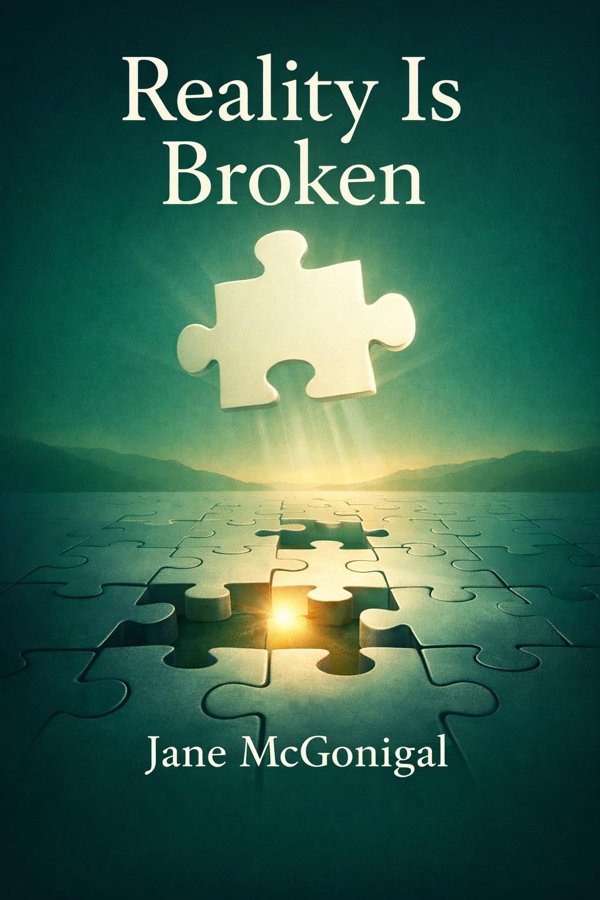
Reality Is Broken: Why Games Make Us Better and How They Can Change the World: Summary & Key Insights
 10 min10 chaptersAudio available
What Is Reality Is Broken: Why Games Make Us Better and How They Can Change the World About?
Reality Is Broken: Why Games Make Us Better and How They Can Change the World by Jane McGonigal is a popular_sci book spanning 10 pages. Reality Is Broken explores how video games can improve our lives and help solve real-world problems. Jane McGonigal argues that games fulfill genuine human needs for motivation, reward, and community, and that applying game design principles to everyday life can make us happier and more productive.
This FizzRead summary covers all 10 key chapters of Reality Is Broken: Why Games Make Us Better and How They Can Change the World in approximately 10 minutes, distilling the most important ideas, arguments, and takeaways from Jane McGonigal's work. Also available as an audio summary and Key Quotes Podcast.
Reality Is Broken: Why Games Make Us Better and How They Can Change the World
Reality Is Broken explores how video games can improve our lives and help solve real-world problems. Jane McGonigal argues that games fulfill genuine human needs for motivation, reward, and community, and that applying game design principles to everyday life can make us happier and more productive.
Who Should Read Reality Is Broken: Why Games Make Us Better and How They Can Change the World?
This book is perfect for anyone interested in popular_sci and looking to gain actionable insights in a short read. Whether you're a student, professional, or lifelong learner, the key ideas from Reality Is Broken: Why Games Make Us Better and How They Can Change the World by Jane McGonigal will help you think differently.
- ✓Readers who enjoy popular_sci and want practical takeaways
- ✓Professionals looking to apply new ideas to their work and life
- ✓Anyone who wants the core insights of Reality Is Broken: Why Games Make Us Better and How They Can Change the World in just 10 minutes
Want the full summary?
Get instant access to this book summary and 100K+ more with Fizz Moment.
Get Free SummaryAvailable on App Store • Free to download
Key Chapters
Before we can learn from games, we have to understand what they really are. A game, in its most essential form, is made up of four critical elements: a goal that focuses your attention, rules that limit your actions, a feedback system that gives you constant information about how you’re doing, and voluntary participation—the choice to engage freely in a challenging system. These elements are deceptively simple, yet together they create a unique psychological environment.
In games, meaning arises not from passive experience but from active engagement with constraints and challenges. The goal gives us direction and purpose; the rules push us to think creatively within boundaries; feedback keeps us motivated by showing progress and potential; and voluntary participation transforms obligation into adventure. That interplay awakens our most optimistic selves—the part of us that wants to exert effort, learn, and overcome.
Think about the difference between doing chores and playing a puzzle. Both require effort. But while chores often feel imposed, puzzles feel chosen. In the act of choosing, we transform work into play. This principle—voluntary effort toward clear goals and measurable progress—is at the heart of all game design, and it points to a truth about human motivation that our real-world systems often ignore. The world could be redesigned to feel more like a game, not just with points and badges, but by creating purpose and mastery in the everyday.
Games don’t just entertain us; they fulfill fundamental psychological needs that have been studied extensively in positive psychology. I draw on research from scholars such as Edward Deci and Richard Ryan, who identified three core dimensions of optimal human experience: competence, autonomy, and relatedness. These are the building blocks of intrinsic motivation—the feeling that we do something not for external rewards but because it brings satisfaction and growth in itself.
When we play games, we experience competence in its purest form. We strive for mastery, learn skills, and see measurable progress. Games give us autonomy by allowing choices that shape outcomes, empowering us even in artificial worlds. And through multiplayer or cooperative experiences, we gain relatedness—the profound sense of connection that comes from shared challenges and triumphs.
Reality often fails to support these psychological needs consistently. Workplaces can stifle autonomy; modern life can obscure clear markers of progress; social ties may feel fragmented. Games compensate for these lacks perfectly. The emotional uplift of success in a game, the joy of collaboration, even the relief of structured failure—all create circumstances that activate the best of our motivational wiring.
What this means is that games aren’t shallow distractions. They are refined psychological architectures, carefully tuned to make us happier, more engaged, and more resilient. The more we understand this design, the more we can apply it to education, workplaces, health challenges, and communities. Games are laboratories for positive human psychology—and their lessons can be replicated far beyond screens.
+ 8 more chapters — available in the FizzRead app
All Chapters in Reality Is Broken: Why Games Make Us Better and How They Can Change the World
About the Author
Jane McGonigal is an American game designer and author known for her work on alternate reality games and the use of game mechanics to improve real-world well-being. She holds a Ph.D. in performance studies and has worked with major organizations to design games that promote social change.
Get This Summary in Your Preferred Format
Read or listen to the Reality Is Broken: Why Games Make Us Better and How They Can Change the World summary by Jane McGonigal anytime, anywhere. FizzRead offers multiple formats so you can learn on your terms — all free.
Available formats: App · Audio · PDF · EPUB — All included free with FizzRead
Download Reality Is Broken: Why Games Make Us Better and How They Can Change the World PDF and EPUB Summary
Key Quotes from Reality Is Broken: Why Games Make Us Better and How They Can Change the World
“Before we can learn from games, we have to understand what they really are.”
“Games don’t just entertain us; they fulfill fundamental psychological needs that have been studied extensively in positive psychology.”
Frequently Asked Questions about Reality Is Broken: Why Games Make Us Better and How They Can Change the World
Reality Is Broken: Why Games Make Us Better and How They Can Change the World by Jane McGonigal is a popular_sci book that explores key ideas across 10 chapters. Reality Is Broken explores how video games can improve our lives and help solve real-world problems. Jane McGonigal argues that games fulfill genuine human needs for motivation, reward, and community, and that applying game design principles to everyday life can make us happier and more productive.
More by Jane McGonigal
You Might Also Like

Structures: Or Why Things Don"t Fall Down
J.E. Gordon
10 min
The Road to Wigan Pier
George Orwell
10 min
Bonk: The Curious Coupling of Science and Sex
Mary Roach
10 min
First Bite: How We Learn to Eat
Bee Wilson
10 min
In Pursuit Of The Unknown: 17 Equations That Changed The World
Ian Stewart
10 min
Napoleon's Buttons: 17 Molecules That Changed History
Penny Le Couteur and Jay Burreson
10 minBrowse by Category
Ready to read Reality Is Broken: Why Games Make Us Better and How They Can Change the World?
Get the full summary and 100K+ more books with Fizz Moment.