
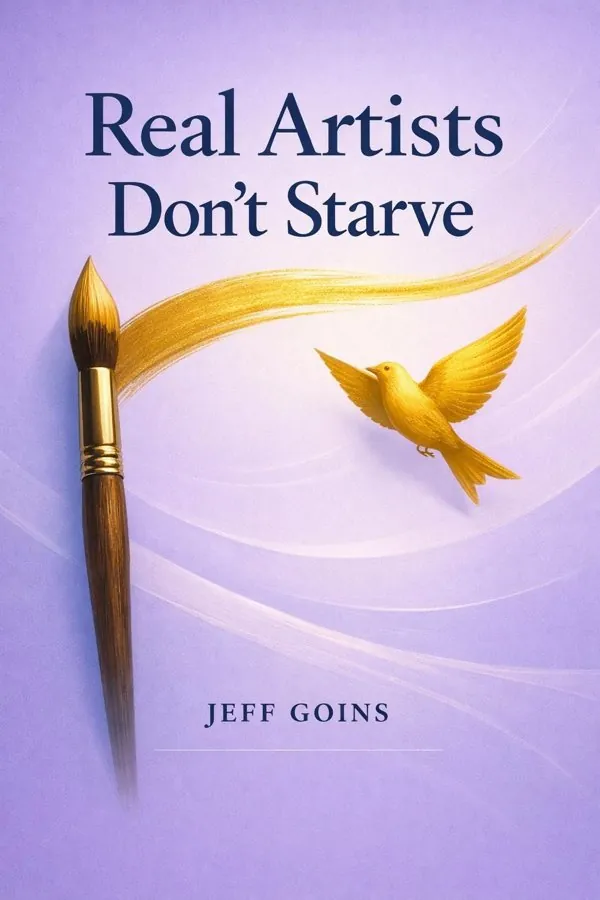
Real Artists Don't Starve: Timeless Strategies for Thriving in the New Creative Age: Summary & Key Insights
by Jeff Goins
 10 min9 chaptersAudio available
Key Takeaways from Real Artists Don't Starve: Timeless Strategies for Thriving in the New Creative Age
One of the most damaging beliefs in creative life is the idea that artistry is a gift granted to a lucky few.
The lonely-genius myth is seductive, but it is often false.
Many creators inherit the belief that money corrupts art.
Talent rarely develops in a vacuum.
A surprising number of creators sabotage themselves by treating art as a dream instead of a profession.
What Is Real Artists Don't Starve: Timeless Strategies for Thriving in the New Creative Age About?
Real Artists Don't Starve: Timeless Strategies for Thriving in the New Creative Age by Jeff Goins is a creativity book spanning 12 pages. Jeff Goins’ Real Artists Don’t Starve dismantles one of culture’s most persistent myths: that serious artists must suffer financially, socially, and emotionally to create meaningful work. Instead of romanticizing struggle, Goins argues that the most successful creators throughout history were often strategic, connected, disciplined, and commercially aware. They did not wait for inspiration in isolation. They built networks, learned from mentors, developed audiences, and treated their art like a vocation worth sustaining. Drawing on stories from figures such as Michelangelo, Shakespeare, and contemporary creators, Goins shows that prosperity and artistic integrity are not enemies. They can strengthen each other when approached wisely. The book matters because many aspiring artists, writers, musicians, and entrepreneurs still carry limiting beliefs about money, exposure, self-promotion, and creative identity. Goins offers a more empowering model: one in which creators can make great work and build a viable life around it. As an author, speaker, and entrepreneur who has spent years helping creatives navigate the realities of modern work, Goins brings both encouragement and practical credibility to this timely guide.
This FizzRead summary covers all 9 key chapters of Real Artists Don't Starve: Timeless Strategies for Thriving in the New Creative Age in approximately 10 minutes, distilling the most important ideas, arguments, and takeaways from Jeff Goins's work. Also available as an audio summary and Key Quotes Podcast.
Real Artists Don't Starve: Timeless Strategies for Thriving in the New Creative Age
Jeff Goins’ Real Artists Don’t Starve dismantles one of culture’s most persistent myths: that serious artists must suffer financially, socially, and emotionally to create meaningful work. Instead of romanticizing struggle, Goins argues that the most successful creators throughout history were often strategic, connected, disciplined, and commercially aware. They did not wait for inspiration in isolation. They built networks, learned from mentors, developed audiences, and treated their art like a vocation worth sustaining. Drawing on stories from figures such as Michelangelo, Shakespeare, and contemporary creators, Goins shows that prosperity and artistic integrity are not enemies. They can strengthen each other when approached wisely. The book matters because many aspiring artists, writers, musicians, and entrepreneurs still carry limiting beliefs about money, exposure, self-promotion, and creative identity. Goins offers a more empowering model: one in which creators can make great work and build a viable life around it. As an author, speaker, and entrepreneur who has spent years helping creatives navigate the realities of modern work, Goins brings both encouragement and practical credibility to this timely guide.
Who Should Read Real Artists Don't Starve: Timeless Strategies for Thriving in the New Creative Age?
This book is perfect for anyone interested in creativity and looking to gain actionable insights in a short read. Whether you're a student, professional, or lifelong learner, the key ideas from Real Artists Don't Starve: Timeless Strategies for Thriving in the New Creative Age by Jeff Goins will help you think differently.
- ✓Readers who enjoy creativity and want practical takeaways
- ✓Professionals looking to apply new ideas to their work and life
- ✓Anyone who wants the core insights of Real Artists Don't Starve: Timeless Strategies for Thriving in the New Creative Age in just 10 minutes
Want the full summary?
Get instant access to this book summary and 100K+ more with Fizz Moment.
Get Free SummaryAvailable on App Store • Free to download
Key Chapters
One of the most damaging beliefs in creative life is the idea that artistry is a gift granted to a lucky few. If you believe artists are simply born different, then every struggle feels like proof that you do not belong. Jeff Goins rejects this thinking. He argues that becoming an artist is not about discovering a hidden label but about embracing a disciplined identity over time. Creative people are shaped through practice, experimentation, failure, and repeated commitment.
This shift matters because identity influences behavior. When people say, “I want to write a book someday,” they often remain spectators in their own lives. But when they say, “I am a writer,” they begin organizing their routines around the work. The same is true for painters, musicians, designers, and entrepreneurs. You do not earn the title only after recognition arrives. In many cases, recognition comes after you begin acting like the person you intend to become.
Goins encourages readers to stop waiting for permission from institutions, gatekeepers, or audiences. History supports his case: many celebrated artists started as unknown apprentices, workers, or outsiders who chose the craft before the world validated them. Their greatness emerged through sustained effort, not mystical destiny.
In practical terms, this means creating consistent habits. A writer writes regularly, even without a publishing contract. A musician practices before having fans. A designer builds a portfolio before landing clients. Identity grows through evidence, and evidence comes from work repeated over time.
The actionable takeaway is simple: stop asking whether you are talented enough to be an artist. Instead, choose one creative identity you want to inhabit and prove it to yourself through a daily or weekly practice.
The lonely-genius myth is seductive, but it is often false. We imagine artists hidden away in private brilliance, producing masterpieces untouched by the outside world. Goins shows that real creative success is usually social. Great artists work in communities, learn from peers, exchange ideas, and sharpen one another through proximity. Isolation may feel noble, but collaboration is often what turns raw talent into influential work.
Throughout history, creative breakthroughs have emerged from scenes, workshops, schools, courts, salons, and circles of mutual influence. Shakespeare worked within a bustling theatrical ecosystem. Renaissance artists apprenticed, competed, and collaborated within vibrant artistic centers. Even modern creators who appear independent often depend on editors, producers, business partners, patrons, and audiences.
Collaboration does not diminish originality. It gives originality something to push against. Feedback reveals blind spots. Competition raises standards. Partnerships make larger projects possible. In today’s world, collaboration can take many forms: mastermind groups, writing circles, co-founding a creative business, finding a mentor, or building relationships online with people in your field.
This principle also counters the fear that asking for help makes you less authentic. In reality, no meaningful creative career is built entirely alone. The artist who refuses all support may preserve ego, but often limits growth. Community creates momentum, accountability, and opportunity.
A practical application is to identify your current creative isolation points. Are you making work but never sharing it? Do you lack peers who understand your field? Are you avoiding editors, collaborators, or constructive critics? Build a small circle deliberately.
The actionable takeaway: replace the fantasy of solitary genius with a strategy of intentional connection. Join or create one community this month where your work can be challenged, supported, and expanded.
Many creators inherit the belief that money corrupts art. If a project earns well, it must have become less pure, less authentic, or less meaningful. Goins challenges this assumption by showing that money is not the enemy of creativity; it is often what makes sustained creativity possible. Financial health gives artists time, tools, freedom, and stability to keep producing important work.
This does not mean chasing profit at the expense of purpose. It means seeing money as a resource rather than a moral stain. Historically, many respected artists relied on patronage, commissions, commercial work, or strategic alliances to support their craft. Michelangelo did not refuse payment to preserve integrity. He used support structures to create enduring work.
For modern creators, this principle is especially important. Writers may teach, consult, or license content. Musicians may combine streaming, live performance, merchandise, and direct fan support. Designers may balance client work with personal projects. Entrepreneurs may create products that align with their values and fund their deeper creative ambitions. The key is to make money in ways that strengthen, not suffocate, your art.
Goins’ point is not that every artist must become obsessed with monetization. It is that avoiding financial literacy leaves creators dependent, resentful, or burned out. Learning pricing, budgeting, negotiation, and business models is not selling out. It is building a foundation for longevity.
Ask yourself whether your current beliefs about money are helping or hurting your work. If you secretly think poverty proves seriousness, you may be sabotaging your future.
The actionable takeaway: choose one practical financial skill to improve this month, such as setting your rates, creating a simple budget, or identifying one income stream that supports your creative goals without compromising your values.
Talent rarely develops in a vacuum. One overlooked reason some artists rise faster than others is not superior genius but superior environment. Goins argues that every thriving creator eventually finds a “scene,” a place or network where the right conversations, standards, opportunities, and influences exist. The scene may be a physical city, a local creative community, or a digital ecosystem, but its role is the same: it accelerates growth.
A scene helps you understand what good work looks like in your field. It exposes you to current trends and timeless standards. It introduces you to collaborators, mentors, patrons, and audiences. It also challenges your assumptions. When you are the most ambitious person in your current environment, you may stop stretching. But in a vibrant scene, you encounter people whose skill and commitment force you to improve.
This principle does not mean moving to a famous city just because other artists live there. It means intentionally placing yourself where your craft can mature. For a writer, that might mean conferences, workshops, online communities, or publishing circles. For a musician, it might mean local performance spaces, producer networks, or niche fan communities. For a visual artist, it may involve galleries, studios, residencies, or online marketplaces.
Scenes also provide social proof and momentum. Opportunities often flow through relationships before they appear through formal channels. If nobody in your world takes your art seriously, staying in that environment may quietly shrink your ambition.
The actionable takeaway: map your current creative ecosystem and identify one stronger scene to enter. Attend an event, join a professional group, reach out to someone established, or spend time where serious practitioners of your craft gather.
A surprising number of creators sabotage themselves by treating art as a dream instead of a profession. They work hard in bursts, wait for the perfect moment, or assume a “real job” and creative work must remain permanently separate. Goins insists that real artists do not merely hope their craft matters someday; they build structures that allow it to become central to their working life.
Seeing art as a career changes your posture. You begin thinking in terms of systems, goals, improvement, audience, and sustainability. You stop relying only on mood. You plan projects, develop skills, meet deadlines, and learn the business side of your field. Career thinking is not the opposite of passion. It is often what protects passion from becoming fragile and inconsistent.
Goins does not encourage reckless romanticism, such as quitting all income overnight with no plan. Rather, he presents a mature vision of creative work. Many successful artists transition gradually, using side income, part-time work, or hybrid models while building credibility and demand. The difference is that they take the transition seriously. They do not pretend their calling is just a hobby while secretly wishing the world would take it seriously.
This principle is especially relevant in the new creative economy, where creators can publish, distribute, teach, and sell more directly than ever before. The barriers are lower, but so is the excuse for passivity.
A practical way to apply this is to ask: if my art were already my profession, how would I behave this week? You might schedule dedicated work hours, define a revenue target, update your portfolio, or pitch opportunities.
The actionable takeaway: choose one professional practice to adopt immediately, such as keeping work hours, setting project deadlines, or creating a simple plan for turning your creative efforts into a sustainable career.
Mastery usually begins with humility. Before artists become innovators, they are often students, assistants, imitators, and apprentices. Goins emphasizes that learning from others is not a sign of weakness but the normal path toward excellence. The creative world often glorifies originality so much that beginners feel ashamed of influence. But every great artist starts by absorbing techniques, patterns, and standards from those who came before.
Apprenticeship can take formal and informal forms. You might study under a mentor, work inside someone else’s business, assist on projects, or reverse-engineer excellent work in your field. The goal is not permanent dependence but accelerated learning. Instead of trying to invent everything from scratch, you stand on the shoulders of others.
Goins also defends what some call “creative theft,” meaning the intelligent borrowing of ideas, styles, and methods that are transformed through your own voice. Influence is inevitable. The issue is not whether you are influenced but whether you use influence consciously and ethically. Good artists absorb widely, remix thoughtfully, and eventually produce work that feels distinctly theirs.
An important extension of this principle is practicing in public. Rather than waiting until your work is flawless, share your process, experiments, and drafts. Public practice builds accountability and attracts feedback. It also helps audiences connect with your growth, not just your finished products.
In modern terms, this could mean posting sketches, essays, prototypes, songs, newsletters, or behind-the-scenes reflections. Doing so creates a living body of work and invites opportunities long before perfection arrives.
The actionable takeaway: pick one creator to study deeply, one skill to practice deliberately, and one small piece of unfinished or in-progress work to share publicly this week.
Inspiration is wonderful, but it is unreliable. If you wait to feel creative before working, your output will be inconsistent and your growth painfully slow. Goins argues that real artists work regularly, often daily, because discipline produces the conditions in which inspiration can visit more often. The professional does not worship mood; the professional builds a practice.
This principle cuts through one of the most common excuses in creative life: “I haven’t had time” or “I haven’t felt ready.” Important work usually gets made by people who show up before clarity is complete. They write clumsy pages, rehearse scales, revise bad drafts, and return to the studio even when yesterday’s progress was disappointing. Repetition develops skill, and skill creates confidence.
Daily work also compounds. A thousand words a day becomes a manuscript. One illustration a day becomes a portfolio. A song draft every week becomes an album’s worth of material. Consistency is not glamorous, but it is often the hidden engine behind breakthrough moments.
Goins’ broader message is that talent without routine remains fragile. Creative energy must be harnessed by structure. This may involve fixed hours, rituals, output goals, constraints, or environmental cues that make starting easier.
The practical application is not necessarily working all day on art. It is establishing a repeatable cadence you can sustain. For someone with a full-time job, that might mean 45 minutes each morning. For another, it may mean protected weekend blocks. The key is regularity.
The actionable takeaway: define your minimum viable creative habit. Make it small enough to sustain and specific enough to measure, then protect it for the next 30 days without negotiating with your mood.
Scarcity makes artists defensive. It encourages jealousy, comparison, and the belief that someone else’s success reduces your chances. Goins argues for an abundance mindset instead: the conviction that there is room for many voices, many audiences, and many ways to build a meaningful creative life. This mindset changes behavior. Instead of hoarding ideas or resenting peers, you become more generous, collaborative, and resilient.
Abundance pairs naturally with another key principle: own your platform. In the modern creative economy, it is risky to depend entirely on gatekeepers or borrowed channels. Real artists build direct relationships with audiences through email lists, websites, communities, memberships, and other assets they control. Social media can help, but rented platforms can change overnight. Ownership creates stability.
A platform is not merely a marketing tool. It is a bridge between your work and the people it serves. When you own that bridge, you gain freedom. You can test ideas, launch projects, gather feedback, and create sustainable revenue with less dependence on external permission. This is especially important for writers, teachers, musicians, and creators building niche audiences.
An abundance mindset also supports platform-building because it encourages service over self-importance. Instead of asking, “How do I get attention?” you ask, “How do I consistently help, move, or delight people?” That orientation builds trust, and trust compounds into opportunity.
The actionable takeaway: start thinking like a generous owner, not a fearful guest. Create or strengthen one audience asset you control, such as a mailing list, personal site, or community space, and use it to serve people consistently rather than chasing scattered attention.
The final difference between those who dream creatively and those who build lasting bodies of work is often persistence. Not brilliance. Not timing. Not perfect confidence. Persistence. Goins reminds readers that every creative path includes rejection, obscurity, financial pressure, self-doubt, and seasons where results seem absent. The starving artist myth treats suffering as proof of authenticity. Goins offers a better frame: difficulty is normal, but quitting too early is what truly destroys creative potential.
Persistence is more than stubbornness. It is the capacity to continue learning, adapting, and producing without losing sight of the larger mission. The persistent artist survives setbacks because identity is rooted in the work itself, not just in applause. A failed launch, harsh review, or missed opportunity becomes data, not destiny.
This principle ties together all the others. If you see yourself as an artist, cultivate community, respect money, find the right scene, learn through apprenticeship, practice publicly, work consistently, and build a platform, then persistence becomes far more sustainable. You are no longer relying on passion alone. You have systems, relationships, and momentum.
In practical life, persistence may mean submitting again after rejection, revising a project instead of abandoning it, continuing to create while holding another job, or staying committed to a body of work that grows slowly. Long careers are often built by those willing to remain in the game longer than others.
The actionable takeaway: define what persistence will look like for you in concrete terms. Decide now how you will respond to rejection, slow growth, or uncertainty, and commit to a time horizon long enough for your craft and career to mature.
All Chapters in Real Artists Don't Starve: Timeless Strategies for Thriving in the New Creative Age
About the Author
Jeff Goins is an American author, speaker, entrepreneur, and educator best known for his work on creativity, writing, calling, and purposeful work. Over the years, he has written several bestselling books that help aspiring creators turn artistic ambition into a sustainable life and career. His work often explores the intersection of craft, identity, discipline, and business, making him a trusted voice for writers, freelancers, and creative professionals. In addition to writing, Goins has built online communities, taught courses, and spoken to audiences about how to pursue meaningful work without waiting for permission. His perspective is shaped by both historical research and hands-on experience as a working creator, which gives his advice a practical and encouraging tone. He is widely respected for challenging limiting myths about art and success.
Get This Summary in Your Preferred Format
Read or listen to the Real Artists Don't Starve: Timeless Strategies for Thriving in the New Creative Age summary by Jeff Goins anytime, anywhere. FizzRead offers multiple formats so you can learn on your terms — all free.
Available formats: App · Audio · PDF · EPUB — All included free with FizzRead
Download Real Artists Don't Starve: Timeless Strategies for Thriving in the New Creative Age PDF and EPUB Summary
Key Quotes from Real Artists Don't Starve: Timeless Strategies for Thriving in the New Creative Age
“One of the most damaging beliefs in creative life is the idea that artistry is a gift granted to a lucky few.”
“The lonely-genius myth is seductive, but it is often false.”
“Many creators inherit the belief that money corrupts art.”
“One overlooked reason some artists rise faster than others is not superior genius but superior environment.”
“A surprising number of creators sabotage themselves by treating art as a dream instead of a profession.”
Frequently Asked Questions about Real Artists Don't Starve: Timeless Strategies for Thriving in the New Creative Age
Real Artists Don't Starve: Timeless Strategies for Thriving in the New Creative Age by Jeff Goins is a creativity book that explores key ideas across 9 chapters. Jeff Goins’ Real Artists Don’t Starve dismantles one of culture’s most persistent myths: that serious artists must suffer financially, socially, and emotionally to create meaningful work. Instead of romanticizing struggle, Goins argues that the most successful creators throughout history were often strategic, connected, disciplined, and commercially aware. They did not wait for inspiration in isolation. They built networks, learned from mentors, developed audiences, and treated their art like a vocation worth sustaining. Drawing on stories from figures such as Michelangelo, Shakespeare, and contemporary creators, Goins shows that prosperity and artistic integrity are not enemies. They can strengthen each other when approached wisely. The book matters because many aspiring artists, writers, musicians, and entrepreneurs still carry limiting beliefs about money, exposure, self-promotion, and creative identity. Goins offers a more empowering model: one in which creators can make great work and build a viable life around it. As an author, speaker, and entrepreneur who has spent years helping creatives navigate the realities of modern work, Goins brings both encouragement and practical credibility to this timely guide.
More by Jeff Goins
You Might Also Like
Dimensions Of Creativity
Margaret A. Boden
10 min
How to Fly a Horse: The Secret History of Creation, Invention, and Discovery
Kevin Ashton
10 min
Imagine: How Creativity Works
Jonah Lehrer
10 min
The Accidental Creative: How to Be Brilliant at a Moment's Notice
Todd Henry
10 min
The Origins of Creativity
Edward O. Wilson
10 min
Wired to Create: Unraveling the Mysteries of the Creative Mind
Scott Barry Kaufman, Carolyn Gregoire
10 minBrowse by Category
Ready to read Real Artists Don't Starve: Timeless Strategies for Thriving in the New Creative Age?
Get the full summary and 100K+ more books with Fizz Moment.