
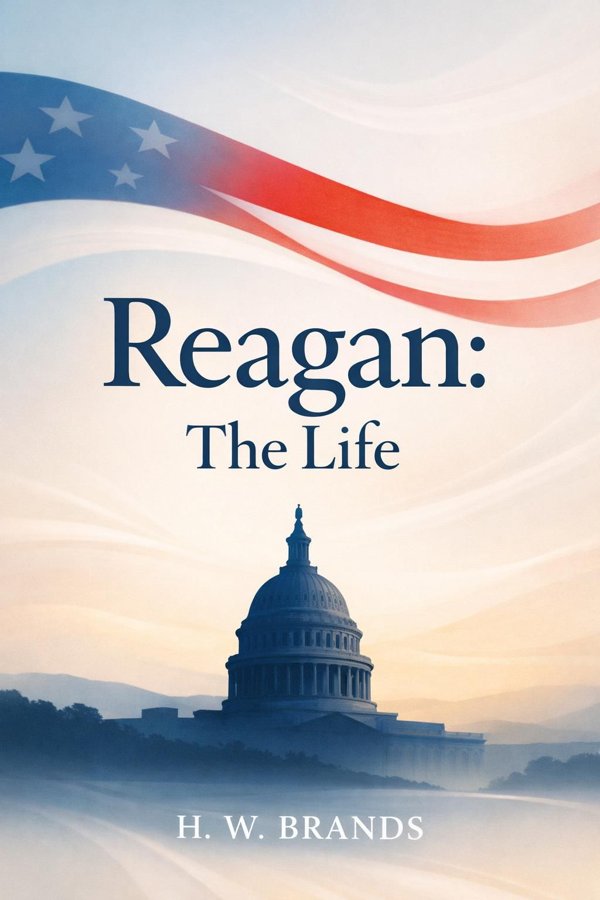
Reagan: The Life: Summary & Key Insights
by H. W. Brands
 10 min9 chaptersAudio available
Key Takeaways from Reagan: The Life
A political worldview often starts long before politics enters the picture.
Before Ronald Reagan mastered political messaging, he mastered something even more basic: holding attention.
Political transformation is rarely sudden, even when it later looks inevitable.
A movement grows when someone gives it a voice people can repeat.
Campaign rhetoric may win attention, but governing tests whether conviction can survive complexity.
What Is Reagan: The Life About?
Reagan: The Life by H. W. Brands is a biographies book spanning 6 pages. Ronald Reagan remains one of the most consequential and debated figures in modern American history, and Reagan: The Life by H. W. Brands sets out to explain not just what he did, but how he became the man who did it. This sweeping biography follows Reagan from his modest Midwestern upbringing in Illinois to his years as a radio announcer, Hollywood actor, union leader, governor of California, and finally the 40th president of the United States. Along the way, Brands shows how Reagan’s optimism, discipline, political instincts, and gift for communication helped him reshape American conservatism and alter the course of the Cold War. What makes this book especially valuable is its balance: it neither worships nor dismisses Reagan, but instead places him in the broader currents of 20th-century America. Brands, an accomplished historian and two-time Pulitzer Prize finalist, brings clarity, narrative energy, and historical depth to a life that often seemed larger than politics itself. The result is a biography that helps readers understand Reagan’s legacy and the America he helped redefine.
This FizzRead summary covers all 9 key chapters of Reagan: The Life in approximately 10 minutes, distilling the most important ideas, arguments, and takeaways from H. W. Brands's work. Also available as an audio summary and Key Quotes Podcast.
Reagan: The Life
Ronald Reagan remains one of the most consequential and debated figures in modern American history, and Reagan: The Life by H. W. Brands sets out to explain not just what he did, but how he became the man who did it. This sweeping biography follows Reagan from his modest Midwestern upbringing in Illinois to his years as a radio announcer, Hollywood actor, union leader, governor of California, and finally the 40th president of the United States. Along the way, Brands shows how Reagan’s optimism, discipline, political instincts, and gift for communication helped him reshape American conservatism and alter the course of the Cold War. What makes this book especially valuable is its balance: it neither worships nor dismisses Reagan, but instead places him in the broader currents of 20th-century America. Brands, an accomplished historian and two-time Pulitzer Prize finalist, brings clarity, narrative energy, and historical depth to a life that often seemed larger than politics itself. The result is a biography that helps readers understand Reagan’s legacy and the America he helped redefine.
Who Should Read Reagan: The Life?
This book is perfect for anyone interested in biographies and looking to gain actionable insights in a short read. Whether you're a student, professional, or lifelong learner, the key ideas from Reagan: The Life by H. W. Brands will help you think differently.
- ✓Readers who enjoy biographies and want practical takeaways
- ✓Professionals looking to apply new ideas to their work and life
- ✓Anyone who wants the core insights of Reagan: The Life in just 10 minutes
Want the full summary?
Get instant access to this book summary and 100K+ more with Fizz Moment.
Get Free SummaryAvailable on App Store • Free to download
Key Chapters
A political worldview often starts long before politics enters the picture. In Ronald Reagan’s case, the foundations of his public life were laid in small-town Illinois, where ideas about character, self-reliance, faith, and optimism became part of his identity long before he entered office. H. W. Brands shows that Reagan’s early life in Tampico, Galesburg, Monmouth, and especially Dixon was not merely background material; it was the emotional and moral template for the man he later became.
Reagan grew up with two contrasting parental influences. His father, Jack, was charming, sociable, and often unstable because of alcoholism. His mother, Nelle, offered moral steadiness, religious conviction, and a belief in the dignity of every person. From this combination, Reagan seems to have drawn both sympathy and discipline. He learned to admire resilience, to dislike self-pity, and to see life as a contest best met with cheerfulness rather than bitterness. Brands presents these years as critical to understanding Reagan’s later style: he preferred hopeful narratives to tragic ones, broad moral language to technical policy detail, and confidence to ideological anxiety.
Even Reagan’s work as a lifeguard in Dixon mattered symbolically. He reportedly saved dozens of swimmers, and the experience reinforced an image of himself as calm under pressure and responsible for others. His years at Eureka College also sharpened his ability to speak, organize, and lead. He was not yet a conservative icon, but he was already practicing persuasion, performance, and self-command.
For modern readers, this section offers a practical reminder: early values shape later leadership. Whether in politics, business, or personal life, the habits formed in ordinary environments can define how someone responds when power arrives. Actionable takeaway: identify the childhood values or formative experiences that still guide your decisions, and consciously strengthen the ones worth carrying forward.
Before Ronald Reagan mastered political messaging, he mastered something even more basic: holding attention. Brands emphasizes that Reagan’s success as a communicator did not appear by accident in the White House. It was built through radio booths, film sets, public appearances, and years of learning how audiences listen, what they remember, and which stories move them.
Reagan began as a sports announcer in Iowa, where he often had to recreate games from telegraphed updates. This required imagination, timing, and verbal precision. He learned to transform sparse facts into vivid narrative, a skill that later helped him explain policy in human terms. In Hollywood, he refined his public presence further. Though he never became a top-tier star, he became a familiar, reliable screen figure with an affable persona that audiences trusted. That trust later translated into politics.
Brands also shows how Reagan’s acting career shaped his method, not just his image. He knew where to place emphasis, how to simplify complex ideas, and how to speak as if directly to one person even when addressing millions. His work with General Electric, where he toured factories and gave speeches to workers and executives, sharpened this even more. These talks became a laboratory for his political language.
The practical lesson is that communication is not decoration added after ideas are formed; it is often how ideas become influential. Reagan’s example suggests that leaders who cannot narrate their beliefs struggle to build durable support. In everyday life, this applies to presentations, teaching, management, and advocacy. Facts matter, but memorable framing matters too.
Actionable takeaway: take one complex belief you hold and practice explaining it as a short, vivid story instead of a list of points. If people can picture it, they are far more likely to remember it.
Political transformation is rarely sudden, even when it later looks inevitable. One of the most revealing parts of Brands’s biography is his account of Reagan’s gradual movement from New Deal Democrat to conservative Republican. This shift was not a theatrical conversion but a layered evolution driven by work, ideology, anti-communism, and disillusionment with growing government power.
In his early adult years, Reagan supported Franklin Roosevelt and accepted many assumptions of mainstream liberalism. But several experiences began to alter his thinking. His time in Hollywood brought him into labor politics through the Screen Actors Guild, where he served as president during a tense period marked by internal conflict, anti-communist anxieties, and power struggles. These encounters strengthened his suspicion that organized political movements could be manipulated by coercive ideologies. Meanwhile, his speaking role for General Electric exposed him to business leaders and workers frustrated by regulation, taxation, and bureaucratic expansion.
Brands presents Reagan’s anti-communism as central, not secondary, to his political identity. Reagan saw the Cold War not merely as a strategic contest but as a moral struggle between freedom and coercion. This conviction pushed him toward a broader defense of individual liberty, free enterprise, and limited government. By the time he delivered his famous 1964 speech, “A Time for Choosing,” he had become one of conservatism’s clearest and most persuasive voices.
The broader application is that durable beliefs often emerge where personal experience meets public events. Reagan changed politically because he interpreted his experiences through a moral framework and then articulated that framework with increasing confidence. For readers, this is a reminder to examine not only what you believe, but why your beliefs changed.
Actionable takeaway: map one major opinion you hold today and trace the events, influences, and experiences that formed it. You will better understand both your convictions and your blind spots.
A movement grows when someone gives it a voice people can repeat. Brands makes clear that Reagan was not conservatism’s sole creator, but he was one of its greatest translators. He took ideas that might have remained confined to policy circles and made them feel morally urgent, accessible, and emotionally coherent to millions of Americans.
His 1964 speech supporting Barry Goldwater marked a turning point. The speech did more than raise Reagan’s political profile; it revealed his special ability to present conservatism not as nostalgia or elite theory, but as common sense rooted in freedom, responsibility, and national confidence. He opposed excessive taxation, centralized authority, and accommodation with communism, but his message worked because he framed these issues around ordinary citizens rather than institutions. He spoke about what government should not take away, what citizens should be trusted to do, and what kind of country America could still become.
Brands suggests that Reagan’s real talent was synthesis. He fused anti-communism, free-market ideals, patriotism, and moral clarity into a political identity broad enough to energize activists and reassuring enough to attract moderates. In doing so, he helped transform conservatism from a reactive faction into a governing philosophy.
This has practical relevance beyond politics. In any organization, community, or cause, ideas spread when they are translated into language that aligns with people’s lived experience. Technical correctness alone rarely inspires commitment. The communicator who can connect abstract principles to daily life often becomes the movement’s most important figure.
Actionable takeaway: if you want others to support an idea, stop leading with jargon. Explain how the idea changes real lives, solves visible problems, or protects values people already care about.
Campaign rhetoric may win attention, but governing tests whether conviction can survive complexity. Brands’s treatment of Reagan’s years as governor of California shows a figure often caricatured as simple becoming more seasoned, pragmatic, and strategic. The governorship was where Reagan learned that ideology must operate in a world of budgets, legislatures, protest movements, and competing interests.
Elected in 1966 amid rising public frustration with unrest, taxes, and liberal governance, Reagan entered office as a conservative outsider. Yet once in Sacramento, he discovered that governing required negotiation and adjustment. He had to confront fiscal pressures, student protests, welfare policy, and the realities of state administration. Brands is careful to show both sides of this period. Reagan remained rhetorically committed to limited government, but he also signed tax increases when necessary and made compromises that disappointed some allies.
This tension is important because it reveals Reagan as more than an ideologue. He valued principle, but he also understood timing, optics, and achievable outcomes. His handling of campus unrest and welfare reform showcased his instinct for symbolic politics, while his broader governing experience prepared him for the presidency by teaching him how to delegate, absorb criticism, and maintain a steady public narrative.
For readers, the lesson is that leadership maturity often comes from confronting constraints without surrendering identity. Effective leaders do not confuse compromise with betrayal, nor do they let tactical flexibility erase strategic purpose. Reagan’s governorship illustrates how public success can depend on balancing ideals with institutional realities.
Actionable takeaway: in your own work, define your non-negotiable principles, then distinguish them from the methods you can adapt. Clarity about that difference makes you both steadier and more effective.
Not all strong leaders look managerial in the conventional sense. Brands argues that Reagan’s presidency confounded critics because his strengths were not rooted in policy micromanagement but in vision, tone, prioritization, and trust in subordinates. He governed less like a technician and more like a strategic narrator of national purpose.
When Reagan entered the White House in 1981, the United States faced inflation, stagnant growth, declining public confidence, and international unease. He responded with a broad program: tax cuts, deregulation, anti-inflation policies, military buildup, and a rhetorical campaign to restore faith in American possibility. Supporters saw boldness; critics saw oversimplification. Brands allows both interpretations but shows why Reagan’s approach resonated. He believed that politics was not only about administration but about restoring belief in the nation’s direction.
Reagan’s delegation style remains one of the most discussed features of his presidency. He was less immersed in bureaucratic detail than many predecessors, but Brands suggests this was partly intentional. Reagan focused on major goals, relied heavily on advisors, and preserved his energy for decisions, messaging, and public persuasion. This brought both benefits and risks. It helped maintain strategic coherence, but it also left room for staff struggles and blind spots.
The practical takeaway is that leadership comes in different forms. Some leaders excel through direct control; others through clarity of mission and emotional steadiness. Reagan’s model shows that if a leader sets priorities clearly and communicates them effectively, delegation can become a force multiplier rather than a weakness.
Actionable takeaway: identify the few outcomes that matter most in your role, communicate them repeatedly, and delegate everything else with clear accountability. Focus is often more powerful than constant supervision.
History often turns when confidence and adaptability appear together. Brands portrays Reagan’s Cold War leadership as a combination of ideological firmness and unexpected pragmatism. Reagan entered office convinced that the Soviet Union represented a profound moral and geopolitical challenge, yet he also proved willing to negotiate when conditions changed.
Early in his presidency, Reagan expanded defense spending, endorsed a tougher strategic posture, and rejected the assumption that coexistence required permanent concession. His rhetoric, including calling the Soviet Union an “evil empire,” alarmed critics who feared escalation. But Brands argues that this language reflected Reagan’s genuine moral framework: he believed communism was not simply a competing system but a denial of human freedom.
What makes the story more complex is what happened when Mikhail Gorbachev emerged. Reagan recognized an opportunity and pursued arms talks with seriousness. The summits at Geneva, Reykjavik, Washington, and Moscow demonstrated his ability to move from confrontation to negotiation without abandoning his core beliefs. Brands presents this as one of Reagan’s defining strengths. He could be uncompromising about ends while flexible about means.
This pattern matters beyond diplomacy. In conflict resolution, business strategy, or organizational change, success often depends on knowing what must be defended and where adjustment is possible. Reagan did not abandon anti-communism when he negotiated; he used negotiation to advance his larger objective.
Actionable takeaway: when facing a major conflict, separate your ultimate goal from your preferred tactic. Hold tightly to the goal, but remain willing to change the method if circumstances create a better path.
A polished public persona can be a political asset, but it can also mislead observers into thinking they fully understand the person behind it. Brands repeatedly returns to this paradox in Reagan’s life. Reagan seemed open, relaxed, and easily readable, yet he also maintained a deep inner privacy that frustrated friends, family, aides, and historians alike.
His genial style made him appear uncomplicated. He told stories, laughed easily, projected optimism, and rarely indulged public bitterness. This created extraordinary political advantages. Voters often felt they knew him and trusted his intentions. But Brands shows that Reagan’s emotional reserve was equally real. He compartmentalized, avoided unnecessary self-exposure, and often kept even close associates at a distance. His relationships with his children could be strained, and his marriage to Nancy Reagan, though intimate and politically important, also reinforced a cocoon around him.
This duality matters because it shaped both his success and the misunderstandings around him. Critics underestimated him because they mistook simplicity of style for simplicity of mind. Admirers sometimes projected onto him a personal transparency that was not fully there. Brands’s portrait reminds readers that charisma often includes crafted distance.
In practical terms, this insight applies to modern leadership and public life, especially in an age of constant visibility. Authenticity does not mean total disclosure, and likability does not equal full access. Healthy boundaries can preserve focus, but excessive insulation can create blind spots.
Actionable takeaway: examine the gap between how others perceive you and how you actually operate. Use public clarity to build trust, but create intentional channels for honest feedback so your image does not become a barrier to reality.
The meaning of a presidency is never settled by election night. Brands concludes Reagan’s story by showing how legacy emerges from both tangible outcomes and the stories a nation tells about them. Reagan left office as a deeply influential figure because he changed policy, reoriented political language, and reshaped what many Americans believed conservatism could achieve.
Economically, his presidency remains debated. Supporters credit him with restoring growth, curbing inflation, and reviving entrepreneurial confidence. Critics point to deficits, inequality, and social costs. On foreign policy, he is widely associated with a more assertive American posture and with helping create conditions that accelerated the Cold War’s end, though historians continue to debate the extent and mechanism of that influence. Brands does not flatten these disputes. Instead, he shows that Reagan’s enduring power lies partly in his ability to leave behind a compelling interpretation of his own era: America as a nation renewed by confidence, liberty, and strength.
The final chapters, including Reagan’s farewell and the tragedy of Alzheimer’s disease, add human poignancy to the political story. The man who had long embodied voice, memory, and performance gradually lost the very faculties that had defined him. Yet even in decline, his symbolic place in American life remained powerful.
For readers, the broader lesson is that influence lasts when action and meaning reinforce each other. Results matter, but so does the framework through which people understand those results. Actionable takeaway: if you want your work to have lasting impact, focus not only on what you accomplish, but also on how you explain its purpose and significance to others.
All Chapters in Reagan: The Life
About the Author
H. W. Brands is an acclaimed American historian, biographer, and public intellectual known for bringing major figures and turning points in U.S. history to life. He has written numerous books on presidents, founders, and transformative eras in American political development, earning a reputation for combining rigorous research with highly readable prose. Brands is a professor at the University of Texas at Austin and has been a finalist for the Pulitzer Prize twice. His work often explores how individual leaders both shape and are shaped by broader historical forces, making him especially well suited to write about Ronald Reagan. In Reagan: The Life, Brands applies his trademark strengths: narrative clarity, historical balance, and the ability to place one person’s story within the wider sweep of American history.
Get This Summary in Your Preferred Format
Read or listen to the Reagan: The Life summary by H. W. Brands anytime, anywhere. FizzRead offers multiple formats so you can learn on your terms — all free.
Available formats: App · Audio · PDF · EPUB — All included free with FizzRead
Download Reagan: The Life PDF and EPUB Summary
Key Quotes from Reagan: The Life
“A political worldview often starts long before politics enters the picture.”
“Before Ronald Reagan mastered political messaging, he mastered something even more basic: holding attention.”
“Political transformation is rarely sudden, even when it later looks inevitable.”
“A movement grows when someone gives it a voice people can repeat.”
“Campaign rhetoric may win attention, but governing tests whether conviction can survive complexity.”
Frequently Asked Questions about Reagan: The Life
Reagan: The Life by H. W. Brands is a biographies book that explores key ideas across 9 chapters. Ronald Reagan remains one of the most consequential and debated figures in modern American history, and Reagan: The Life by H. W. Brands sets out to explain not just what he did, but how he became the man who did it. This sweeping biography follows Reagan from his modest Midwestern upbringing in Illinois to his years as a radio announcer, Hollywood actor, union leader, governor of California, and finally the 40th president of the United States. Along the way, Brands shows how Reagan’s optimism, discipline, political instincts, and gift for communication helped him reshape American conservatism and alter the course of the Cold War. What makes this book especially valuable is its balance: it neither worships nor dismisses Reagan, but instead places him in the broader currents of 20th-century America. Brands, an accomplished historian and two-time Pulitzer Prize finalist, brings clarity, narrative energy, and historical depth to a life that often seemed larger than politics itself. The result is a biography that helps readers understand Reagan’s legacy and the America he helped redefine.
You Might Also Like

An American Marriage
Tayari Jones
10 min
Benjamin Franklin: An American Life
Walter Isaacson
10 min
I Know Why The Caged Bird Sings
Maya Angelou
10 min
Long Walk to Freedom
Nelson Mandela
10 min
Persepolis
Marjane Satrapi
10 min
Surely You're Joking, Mr. Feynman!
Richard P. Feynman
10 minBrowse by Category
Ready to read Reagan: The Life?
Get the full summary and 100K+ more books with Fizz Moment.