
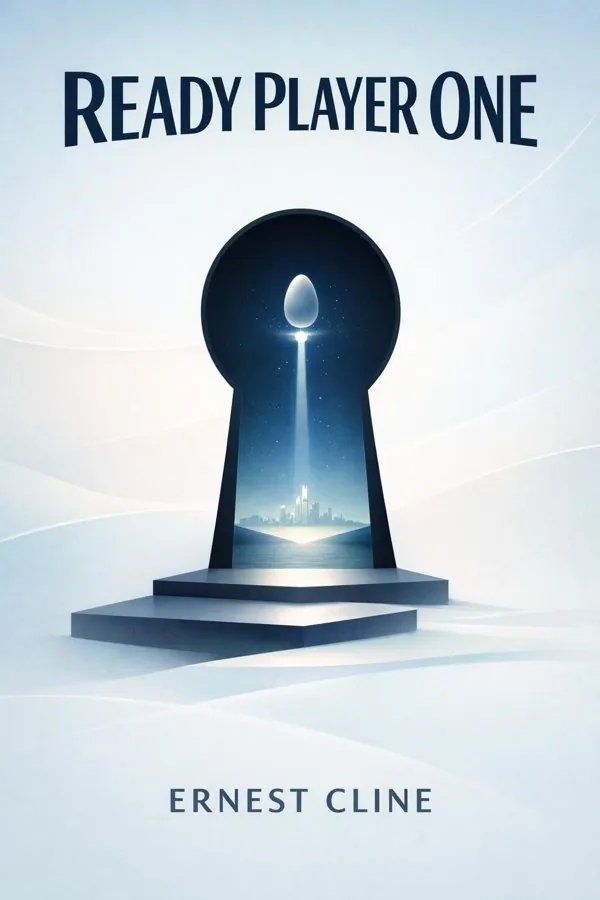
Ready Player One: Summary & Key Insights
by Ernest Cline
 10 min10 chaptersAudio available
Key Takeaways from Ready Player One
In 2045, the physical world has been hollowed out by energy shortages, economic collapse, overcrowding, and environmental decline.
A second powerful idea in Ready Player One is that mastery often belongs not to the strongest or richest, but to the person who has paid the closest attention.
An important turning point in the novel begins with a paradox: Wade is almost invisible in the real world, yet his knowledge makes him dangerous in the virtual one.
One of the novel’s most appealing and instructive lessons is that even in a contest built around individual victory, no one wins alone.
A central tension in Ready Player One is the clash between passionate users and an organization that sees culture only as an asset to be monetized.
What Is Ready Player One About?
Ready Player One by Ernest Cline is a scifi_fantasy book spanning 6 pages. What happens when a broken world offers one perfect escape—and then turns that escape into the most important contest in human history? Ernest Cline’s Ready Player One imagines a near-future 2045 in which economic collapse, environmental ruin, and social fragmentation have made real life feel almost unlivable. In response, humanity pours itself into the OASIS, a vast virtual reality universe where people study, work, socialize, and reinvent themselves. When OASIS creator James Halliday dies, he leaves behind a final challenge: a hidden Easter egg that will grant the winner immense wealth and control of the platform itself. The contest draws millions, but it is Wade Watts—a poor teenager with deep knowledge of Halliday’s beloved 1980s culture—who becomes one of its most promising hunters. More than a fast-moving adventure, the novel explores identity, obsession, corporate power, friendship, and the uneasy relationship between technology and reality. Cline writes with the passion of a devoted gamer and pop-culture historian, giving the story both imaginative scale and lived-in specificity. Ready Player One matters because beneath its spectacle lies a serious question: if virtual worlds become better than real life, what kind of humanity will remain outside the headset?
This FizzRead summary covers all 10 key chapters of Ready Player One in approximately 10 minutes, distilling the most important ideas, arguments, and takeaways from Ernest Cline's work. Also available as an audio summary and Key Quotes Podcast.
Ready Player One
What happens when a broken world offers one perfect escape—and then turns that escape into the most important contest in human history? Ernest Cline’s Ready Player One imagines a near-future 2045 in which economic collapse, environmental ruin, and social fragmentation have made real life feel almost unlivable. In response, humanity pours itself into the OASIS, a vast virtual reality universe where people study, work, socialize, and reinvent themselves. When OASIS creator James Halliday dies, he leaves behind a final challenge: a hidden Easter egg that will grant the winner immense wealth and control of the platform itself. The contest draws millions, but it is Wade Watts—a poor teenager with deep knowledge of Halliday’s beloved 1980s culture—who becomes one of its most promising hunters. More than a fast-moving adventure, the novel explores identity, obsession, corporate power, friendship, and the uneasy relationship between technology and reality. Cline writes with the passion of a devoted gamer and pop-culture historian, giving the story both imaginative scale and lived-in specificity. Ready Player One matters because beneath its spectacle lies a serious question: if virtual worlds become better than real life, what kind of humanity will remain outside the headset?
Who Should Read Ready Player One?
This book is perfect for anyone interested in scifi_fantasy and looking to gain actionable insights in a short read. Whether you're a student, professional, or lifelong learner, the key ideas from Ready Player One by Ernest Cline will help you think differently.
- ✓Readers who enjoy scifi_fantasy and want practical takeaways
- ✓Professionals looking to apply new ideas to their work and life
- ✓Anyone who wants the core insights of Ready Player One in just 10 minutes
Want the full summary?
Get instant access to this book summary and 100K+ more with Fizz Moment.
Get Free SummaryAvailable on App Store • Free to download
Key Chapters
The first major insight of Ready Player One is unsettlingly simple: when reality becomes too painful, people do not always fight to repair it—they often flee into something more bearable. In 2045, the physical world has been hollowed out by energy shortages, economic collapse, overcrowding, and environmental decline. For millions, daily life means poverty, insecurity, and decaying infrastructure. Against that bleak backdrop, the OASIS is not just entertainment. It is school, marketplace, social network, workplace, and emotional refuge all at once.
Ernest Cline uses this contrast to show how technology can become both salvation and sedative. The OASIS gives people access to education, connection, and possibility that their physical circumstances deny them. A teenager trapped in a trailer stack can attend virtual classes on distant planets. A poor user can build a respected identity through knowledge and skill. Yet the same system also enables avoidance. The more unbearable reality becomes, the easier it is to substitute digital achievement for real-world change.
This idea resonates far beyond the novel. Social media, gaming, virtual communities, and immersive entertainment already shape how people cope with stress, loneliness, and inequality. Digital spaces can empower, but they can also absorb attention that might otherwise go toward civic action, personal growth, or direct relationships.
Cline does not condemn virtual life outright. Instead, he asks readers to notice the tradeoff. The OASIS is wonderful because reality is failing. That is the moral warning built into the story’s premise.
Actionable takeaway: enjoy digital escape, but regularly ask yourself what real-world problem, need, or emotion you may be postponing by logging in.
A second powerful idea in Ready Player One is that mastery often belongs not to the strongest or richest, but to the person who has paid the closest attention. Before his death, OASIS creator James Halliday hides an Easter egg inside the virtual universe. To find it, players must solve clues rooted in his life, habits, obsessions, and especially his devotion to 1980s games, movies, music, and television. This turns the hunt into far more than a scavenger game. It becomes an act of interpretation.
Wade Watts succeeds early not because he has money, political influence, or superior equipment, but because he has studied Halliday with extraordinary care. He has consumed Halliday’s favorite media, memorized his biography, and learned to think like a fan, historian, and puzzle solver at once. The novel suggests that in an age of distraction, close reading and sustained curiosity are rare competitive advantages.
This idea applies in practical ways. In work and learning, people often chase shortcuts, credentials, or surface familiarity. Cline reminds us that real breakthroughs come from depth. The best salesperson studies the customer’s true incentives. The best designer learns the history of user behavior. The best student understands first principles rather than memorizing answers.
The Halliday contest also shows that creators leave patterns behind. To understand any system—a company, a community, an artistic body of work—you need to understand the values, fears, and nostalgia of the person who built it.
Actionable takeaway: when facing a difficult problem, stop searching for hacks and start studying the structure, history, and psychology behind it with obsessive attention.
An important turning point in the novel begins with a paradox: Wade is almost invisible in the real world, yet his knowledge makes him dangerous in the virtual one. He grows up in the Stacks, a chaotic vertical sprawl of trailer homes outside Oklahoma City. Orphaned, poor, and emotionally isolated, he has little social power. His avatar, Parzival, becomes the vessel for his ambition, intelligence, and hope. The discovery of the Copper Key marks the moment when private obsession becomes public consequence.
Wade finds the first key by recognizing what others overlook. He does not brute-force the challenge; he solves it through pattern recognition, patience, and cultural fluency. Cline uses this breakthrough to emphasize that talent can emerge from marginal places. The world assumes advantage follows wealth, but the contest exposes another truth: a person with enough dedication can outperform institutions, at least for a time.
Yet this victory also changes Wade’s life in dangerous ways. Fame arrives instantly. Other gunters study him. Media attention increases. Corporate enemies notice him. Success, the novel suggests, is rarely a clean reward; it is also an escalation of pressure and vulnerability.
This dynamic is recognizable in modern life. A student posts one breakthrough idea online and suddenly faces scrutiny. A startup gets traction and attracts powerful competitors. A creator’s first success can create expectation as much as freedom.
Wade’s Copper Key triumph teaches that expertise matters most when paired with readiness for what comes next. Winning the first round is not the same as surviving the game.
Actionable takeaway: when your preparation finally creates an opening, do not celebrate only the win—prepare immediately for the responsibilities and risks that visibility brings.
One of the novel’s most appealing and instructive lessons is that even in a contest built around individual victory, no one wins alone. Wade may begin as a lone hunter, but the deeper he goes into Halliday’s challenge, the more essential his relationships become. Aech, Art3mis, Shoto, and Daito are not side decorations to his quest; they are part of the reason the quest remains morally meaningful. Together they form a community of talent, loyalty, and shared obsession.
Cline pushes back against the myth of the solitary genius. Wade is clever, but he is also impulsive, proud, and emotionally immature. His friends broaden his understanding, challenge his assumptions, and help him endure fear and grief. Their alliance is practical—they exchange clues, skills, and strategy—but it is also emotional. In a world where avatars can hide appearance, age, and status, trust becomes a hard-earned currency.
The story also highlights how online relationships can be genuine, even before they become physical. The High Five first connect through avatars and handles, yet their bonds are real because they are built on commitment, sacrifice, and honesty under pressure. At the same time, the novel does not romanticize digital friendship completely. Misunderstandings, insecurity, and projection still distort connection.
In real life, ambitious people often isolate themselves, believing that collaboration dilutes credit or slows progress. Ready Player One argues the opposite. A strong network improves resilience, creativity, and judgment. The best teams are not made of identical people; they are built from complementary strengths and shared values.
Actionable takeaway: treat trusted collaborators as part of your strategy, not a distraction from it, and invest in relationships before a crisis forces you to need them.
A central tension in Ready Player One is the clash between passionate users and an organization that sees culture only as an asset to be monetized. Innovative Online Industries, or IOI, enters Halliday’s contest not out of wonder, curiosity, or respect for the OASIS, but because it wants ownership. Its goal is chillingly practical: control the platform, flood it with advertising, monetize access, and turn a shared digital world into a machine for extraction.
This makes IOI more than a villainous corporation. It represents a recurring modern danger: when systems that shape public life are controlled by actors whose only priority is scale and profit. The OASIS is effectively society’s infrastructure. People learn, earn, and connect there. To own it is to own the architecture of everyday experience.
Cline shows how corporate power differs from personal obsession. Halliday was eccentric, flawed, and emotionally stunted, but he built the OASIS from imagination. IOI approaches it as a spreadsheet. It employs armies of indentured clue-solvers, weaponizes surveillance, and uses violence in the physical world to gain leverage in the virtual one. The message is clear: technology is never neutral once concentrated in the hands of institutions with unchecked incentives.
Readers can easily connect this to current debates around platforms, data ownership, digital monopolies, subscription lock-in, and algorithmic control. The novel dramatizes what happens when a space people depend on becomes vulnerable to private capture.
Actionable takeaway: whenever you rely heavily on a digital platform, ask who controls it, how they make money, and what could happen if profit overtakes the public good.
Ready Player One understands something many stories about virtual life miss: online identity is not simply fake. It is a mixture of revelation and concealment. In the OASIS, users can redesign their bodies, genders, appearances, and social signals. This gives people freedom from prejudice and limitation. It lets them experiment, protect themselves, and become who they feel they are rather than what the physical world assumes they must be.
The novel explores this especially through Wade’s interactions with Aech and Art3mis. He forms strong emotional assumptions based on avatars and performances, then discovers that reality is more complicated. These reveals are not cheap twists; they underscore the gap between projected identity and lived experience. Aech’s case in particular shows how the virtual world can offer relief from racial, gendered, and bodily stereotypes that shape treatment in real life.
At the same time, the story warns that projection can become a trap. Wade imagines he fully understands Art3mis because of their digital connection, but much of what he loves is filtered through fantasy. The more intensely he invests in the avatar, the more he risks misunderstanding the person.
This has clear relevance today. People curate versions of themselves across apps, games, and social platforms. Those versions may be strategic, aspirational, protective, or deeply authentic. The challenge is learning to respect digital self-expression without confusing it for complete knowledge of another human being.
Actionable takeaway: allow online spaces to expand how you express yourself, but stay humble about what you know of others until trust has been tested beyond the screen.
As the hunt advances toward the Jade Key, the novel shifts from game-like exhilaration into something darker and more emotionally costly. The contest is no longer just a puzzle competition among hobbyists. By this stage, corporate surveillance, targeted violence, and public pressure have transformed Halliday’s riddle into a life-and-death struggle. Wade and his allies begin to understand that winning is not only about claiming wealth; it is about preventing catastrophe.
The Jade Key section matters because it deepens the meaning of risk. Early success can feel glamorous, especially in public competitions where recognition arrives fast. But Cline shows that prolonged conflict exposes character more than opening victories do. Wade must make choices under stress, confront grief, and recognize that his decisions affect others. The death of key allies and the brutality of IOI tear away any lingering illusion that this is merely a nostalgic adventure.
This phase of the story also demonstrates how pressure clarifies values. Some people become more ruthless when the stakes rise. Others become more loyal. Wade does both at different moments, which makes him human rather than idealized. He stumbles, learns, and slowly realizes that obsession without moral clarity can destroy the very world he hopes to save.
In practical terms, the Jade Key arc speaks to any long-term goal: building a company, pursuing a degree, leading a team, or surviving a crisis. The middle stretch is where enthusiasm fades and true priorities are tested.
Actionable takeaway: when a project becomes harder and more dangerous than expected, pause to redefine not only how you will continue, but what ethical lines you refuse to cross.
One of the novel’s strongest lessons is that final victories often require more than talent—they require courage, planning, and willingness to endure personal cost. By the time the hunt reaches the Crystal Key, Wade understands that solving Halliday’s puzzles from a safe distance will not be enough. He undertakes a dangerous infiltration of IOI, exposing himself to surveillance, capture, and physical harm in order to gain information from inside the system threatening the OASIS.
This part of the novel expands the story from puzzle-solving into resistance. Wade must become strategic rather than merely brilliant. He studies institutional weaknesses, uses deception carefully, collaborates with allies, and accepts that meaningful action may involve sacrifice. Cline makes clear that heroism is not about fearlessness. It is about moving forward despite fear because the alternative is surrender.
The final battle also reinforces the value of collective action. No single member of the High Five could defeat IOI alone. Their different strengths—technical skill, combat ability, emotional loyalty, and intelligence—become decisive when coordinated. The climax therefore rewards preparation, trust, and persistence more than raw power.
Outside fiction, this idea applies to any fight against entrenched systems. Whether the issue is bureaucracy, monopolistic competition, or toxic culture, change often demands inside knowledge, disciplined strategy, and shared risk. Outperforming a powerful opponent is rarely glamorous; it is methodical and exhausting.
Actionable takeaway: when facing a stronger adversary, do not rely on brilliance alone—combine research, teamwork, and calculated sacrifice to create leverage where none seems available.
James Halliday is easy to misread as a benevolent wizard who leaves a fun treasure hunt behind. In reality, one of Ready Player One’s richest ideas is that visionary creators often leave mixed legacies. Halliday built the OASIS, a platform of extraordinary imagination that gave meaning, education, and possibility to billions. Yet he was also lonely, emotionally limited, socially awkward, and trapped by regret. His contest reflects both his brilliance and his failures.
The novel gradually reveals that Halliday’s obsession with the past was not harmless nostalgia alone. It was also avoidance. He encoded his interior life into games because games were easier for him than vulnerability. The contest forces players to know him, but it also traps them inside the architecture of his unfinished emotions. In that sense, the Easter egg hunt is a monument to genius and a confession of inadequacy.
This complexity matters because modern culture often treats founders as either heroes or villains. Cline offers something more truthful. Builders can create transformative systems while remaining emotionally underdeveloped. Their products can enrich society and still transmit their blind spots.
For readers, Halliday becomes a case study in the limits of achievement. Success, wealth, and influence cannot compensate for neglected relationships or unresolved fear. The ability to build a world is not the same as the ability to live wisely inside one.
Actionable takeaway: admire creators for what they make, but do not confuse innovation with emotional maturity; learn from both their accomplishments and the relationships they failed to sustain.
The final and most important insight of Ready Player One is that even the greatest virtual world cannot replace embodied life. For much of the novel, the OASIS appears superior to reality in nearly every way. It is safer, richer, more customizable, and more rewarding. But by the end, Wade comes to understand what Halliday himself learned too late: reality, for all its pain and imperfection, is the only place where life is fully real.
This conclusion does not reject technology. It reframes it. The OASIS can educate, delight, connect, and empower. It can even preserve culture and expand identity. But it cannot substitute for touch, mortality, accountability, and unedited human presence. Virtual life can simulate fulfillment while quietly eroding the habits needed for actual intimacy.
Cline’s ending matters because it resists the temptation to make digital transcendence the final answer. Wade wins the contest, but the deeper victory is his changed perspective. He begins to see that love, friendship, and responsibility require showing up beyond the avatar. The choice to close the OASIS two days a week symbolizes this shift: healthy systems must leave room for reality instead of replacing it.
This is perhaps the book’s most relevant message today. As screens become more immersive and personalized, the challenge is not avoiding technology entirely. It is using it without surrendering the physical world, where consequences, care, and community remain irreplaceable.
Actionable takeaway: build intentional limits around digital immersion so that your best energy still reaches your body, your relationships, and the world directly in front of you.
All Chapters in Ready Player One
About the Author
Ernest Cline is an American novelist, screenwriter, and spoken-word performer known for blending science fiction, gaming culture, and nostalgia into high-energy stories. Born in 1972, he developed a reputation for writing that celebrates classic arcade games, fantasy role-playing, movies, and the pop culture of the 1980s. He rose to international prominence with Ready Player One, a bestselling novel that captured the imagination of readers interested in virtual reality and digital culture. Cline later wrote Armada and the sequel Ready Player Two, continuing to explore how technology reshapes identity, power, and everyday life. He also co-wrote the screenplay for the film adaptation of Ready Player One, directed by Steven Spielberg. His work stands out for making geek culture emotionally resonant, adventurous, and accessible to a broad audience.
Get This Summary in Your Preferred Format
Read or listen to the Ready Player One summary by Ernest Cline anytime, anywhere. FizzRead offers multiple formats so you can learn on your terms — all free.
Available formats: App · Audio · PDF · EPUB — All included free with FizzRead
Download Ready Player One PDF and EPUB Summary
Key Quotes from Ready Player One
“The first major insight of Ready Player One is unsettlingly simple: when reality becomes too painful, people do not always fight to repair it—they often flee into something more bearable.”
“A second powerful idea in Ready Player One is that mastery often belongs not to the strongest or richest, but to the person who has paid the closest attention.”
“An important turning point in the novel begins with a paradox: Wade is almost invisible in the real world, yet his knowledge makes him dangerous in the virtual one.”
“One of the novel’s most appealing and instructive lessons is that even in a contest built around individual victory, no one wins alone.”
“A central tension in Ready Player One is the clash between passionate users and an organization that sees culture only as an asset to be monetized.”
Frequently Asked Questions about Ready Player One
Ready Player One by Ernest Cline is a scifi_fantasy book that explores key ideas across 10 chapters. What happens when a broken world offers one perfect escape—and then turns that escape into the most important contest in human history? Ernest Cline’s Ready Player One imagines a near-future 2045 in which economic collapse, environmental ruin, and social fragmentation have made real life feel almost unlivable. In response, humanity pours itself into the OASIS, a vast virtual reality universe where people study, work, socialize, and reinvent themselves. When OASIS creator James Halliday dies, he leaves behind a final challenge: a hidden Easter egg that will grant the winner immense wealth and control of the platform itself. The contest draws millions, but it is Wade Watts—a poor teenager with deep knowledge of Halliday’s beloved 1980s culture—who becomes one of its most promising hunters. More than a fast-moving adventure, the novel explores identity, obsession, corporate power, friendship, and the uneasy relationship between technology and reality. Cline writes with the passion of a devoted gamer and pop-culture historian, giving the story both imaginative scale and lived-in specificity. Ready Player One matters because beneath its spectacle lies a serious question: if virtual worlds become better than real life, what kind of humanity will remain outside the headset?
More by Ernest Cline
You Might Also Like
Red Rising
Pierce Brown
10 min
Stranger in a Strange Land
Robert A. Heinlein
10 min
AI Valley
Chen Qiufan
10 min
Bloodchild
Octavia E. Butler
10 min
Do Androids Dream of Electric Sheep?
Philip K. Dick
10 min
Jujutsu Kaisen, Vol. 24
Gege Akutami
10 minBrowse by Category
Ready to read Ready Player One?
Get the full summary and 100K+ more books with Fizz Moment.