
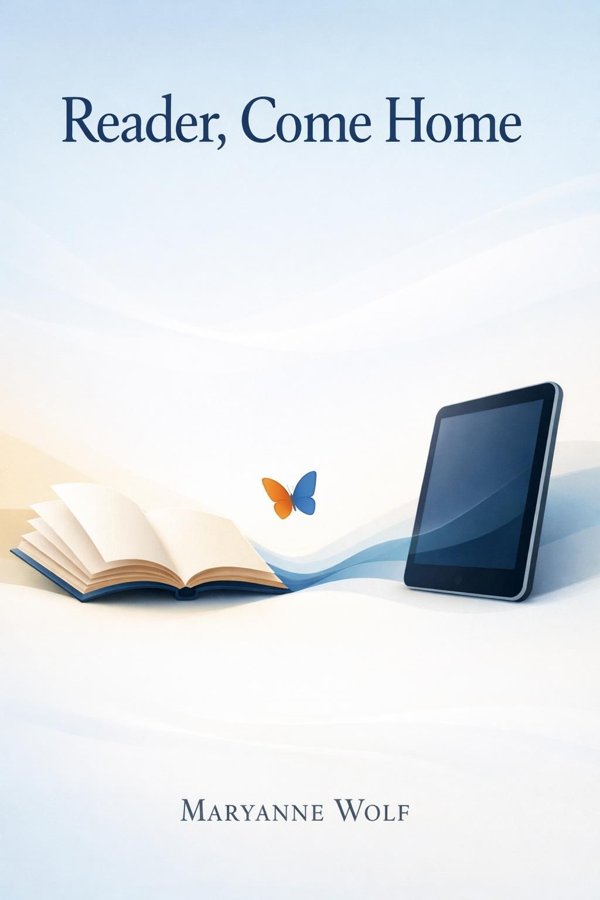
Reader, Come Home: The Reading Brain in a Digital World: Summary & Key Insights
 10 min9 chaptersAudio available
What Is Reader, Come Home: The Reading Brain in a Digital World About?
Reader, Come Home: The Reading Brain in a Digital World by Maryanne Wolf is a neuroscience book spanning 9 pages. In this thought-provoking work, cognitive neuroscientist Maryanne Wolf explores how the digital age is reshaping the human reading brain. Drawing on decades of research in neuroscience, education, and literature, she examines the profound cognitive and emotional consequences of moving from deep reading to digital skimming. Wolf calls for a 'bi-literate' reading brain that can balance the speed of digital reading with the depth of traditional reading, preserving empathy, critical thinking, and reflection in an age of information overload.
This FizzRead summary covers all 9 key chapters of Reader, Come Home: The Reading Brain in a Digital World in approximately 10 minutes, distilling the most important ideas, arguments, and takeaways from Maryanne Wolf's work. Also available as an audio summary and Key Quotes Podcast.
Reader, Come Home: The Reading Brain in a Digital World
In this thought-provoking work, cognitive neuroscientist Maryanne Wolf explores how the digital age is reshaping the human reading brain. Drawing on decades of research in neuroscience, education, and literature, she examines the profound cognitive and emotional consequences of moving from deep reading to digital skimming. Wolf calls for a 'bi-literate' reading brain that can balance the speed of digital reading with the depth of traditional reading, preserving empathy, critical thinking, and reflection in an age of information overload.
Who Should Read Reader, Come Home: The Reading Brain in a Digital World?
This book is perfect for anyone interested in neuroscience and looking to gain actionable insights in a short read. Whether you're a student, professional, or lifelong learner, the key ideas from Reader, Come Home: The Reading Brain in a Digital World by Maryanne Wolf will help you think differently.
- ✓Readers who enjoy neuroscience and want practical takeaways
- ✓Professionals looking to apply new ideas to their work and life
- ✓Anyone who wants the core insights of Reader, Come Home: The Reading Brain in a Digital World in just 10 minutes
Want the full summary?
Get instant access to this book summary and 100K+ more with Fizz Moment.
Get Free SummaryAvailable on App Store • Free to download
Key Chapters
Human beings did not evolve to read; we invented reading as a cultural adaptation that changed the very structure of our brains. In tracing the history of this transformation, I begin with the spoken word—with societies that lived by oral traditions, where memory and rhythm sustained the transmission of knowledge and wisdom. When writing systems emerged, from cuneiform to hieroglyphs, they demanded new neural coordination: visual areas had to collaborate with language centers in an unprecedented way. Thus, the reading brain was born—a brain that learns to convert visual symbols into semantic and emotional meaning.
With the advent of alphabetic scripts came an explosion of cognitive possibilities. The Greeks and Romans recognized that writing could preserve complex arguments and philosophical reflections. In this era, reading gradually shifted from communal recitation to individual contemplation, paving the way for analytical thought. The printing press then revolutionized not only education and communication but also consciousness itself. It enabled deep, solitary reading—the kind that encourages internal dialogue, inference, and the slow formation of personal insight.
Each technological leap reshaped our mental processes. The transition from oral to print cultures created an environment where sustained attention and complex reasoning flourished. But now, we stand at another turning point: the migration from print to digital mediums. Just as the invention of writing altered how humans thought, so too will this latest revolution. History teaches us that every medium changes the balance between attention, memory, and imagination. The question we face is whether we will direct that change wisely or let it erode the capacities we cherish most.
In my research, I have seen how reading recruits and integrates multiple networks in the brain—visual, linguistic, auditory, cognitive, and emotional. Deep reading, in particular, activates a unique constellation of circuits that support inference, critical analysis, and empathy. When we read a complex text, neural pathways link perception to reasoning, enabling us to form hypotheses, evaluate evidence, and imagine possibilities beyond ourselves.
This process is far more than decoding words; it is a kind of internal voyage. As we dwell in a text, we enter the world of another mind—the writer’s—and weave it with our own experiences. This imaginative empathy is not ornamental; it is foundational to moral reasoning and civil discourse. Our capacity to pause, reflect, and make connections depends on a reading brain trained in sustained, structured engagement.
Neuroscientifically, this requires time and repetition. The deep reading circuit develops gradually, reinforced by early exposure to print and by the habit of reading challenging, layered texts. As we learn to read more deeply, cortical connections grow stronger; the brain learns to integrate sensory and semantic information seamlessly. But this neural achievement is fragile. If we read constantly in superficial bursts—skimming, scanning, multitasking—the pathways for deep thought may weaken. The brain adapts, but in doing so, it may sacrifice complexity for speed. My concern is not merely theoretical: it is an urgent question about what kind of minds we are shaping, especially in our children, whose neural circuits are still forming.
+ 7 more chapters — available in the FizzRead app
All Chapters in Reader, Come Home: The Reading Brain in a Digital World
About the Author
Maryanne Wolf is an American cognitive neuroscientist and scholar known for her research on the reading brain, dyslexia, and literacy development. She is the author of several influential books, including 'Proust and the Squid', and has served as director of the Center for Reading and Language Research at Tufts University.
Get This Summary in Your Preferred Format
Read or listen to the Reader, Come Home: The Reading Brain in a Digital World summary by Maryanne Wolf anytime, anywhere. FizzRead offers multiple formats so you can learn on your terms — all free.
Available formats: App · Audio · PDF · EPUB — All included free with FizzRead
Download Reader, Come Home: The Reading Brain in a Digital World PDF and EPUB Summary
Key Quotes from Reader, Come Home: The Reading Brain in a Digital World
“Human beings did not evolve to read; we invented reading as a cultural adaptation that changed the very structure of our brains.”
“In my research, I have seen how reading recruits and integrates multiple networks in the brain—visual, linguistic, auditory, cognitive, and emotional.”
Frequently Asked Questions about Reader, Come Home: The Reading Brain in a Digital World
Reader, Come Home: The Reading Brain in a Digital World by Maryanne Wolf is a neuroscience book that explores key ideas across 9 chapters. In this thought-provoking work, cognitive neuroscientist Maryanne Wolf explores how the digital age is reshaping the human reading brain. Drawing on decades of research in neuroscience, education, and literature, she examines the profound cognitive and emotional consequences of moving from deep reading to digital skimming. Wolf calls for a 'bi-literate' reading brain that can balance the speed of digital reading with the depth of traditional reading, preserving empathy, critical thinking, and reflection in an age of information overload.
More by Maryanne Wolf
You Might Also Like
Anxious
Joseph LeDoux
10 min
Hallucinations
Oliver Sacks
10 min
The Biological Mind: How Brain, Body, and Environment Collaborate to Make Us Who We Are
Alan Jasanoff
10 min
The Feeling of Life Itself: Why Consciousness Is Widespread but Can't Be Computed
Christof Koch
10 min
The No-Nonsense Meditation Book
Steven Laureys
10 min
A General Theory of Love
Thomas Lewis, Fari Amini, Richard Lannon
10 minBrowse by Category
Ready to read Reader, Come Home: The Reading Brain in a Digital World?
Get the full summary and 100K+ more books with Fizz Moment.