
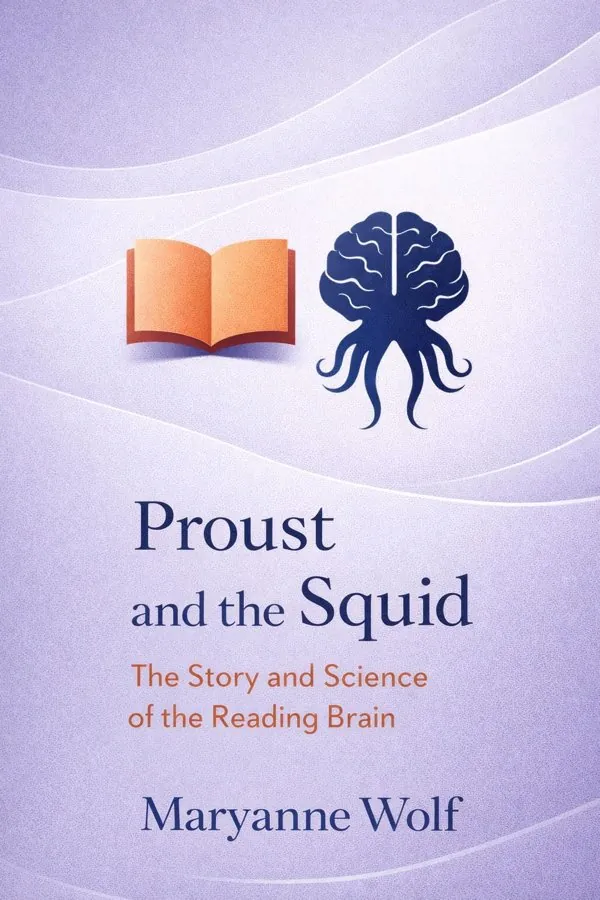
Proust and the Squid: The Story and Science of the Reading Brain: Summary & Key Insights
 10 min9 chaptersAudio available
Key Takeaways from Proust and the Squid: The Story and Science of the Reading Brain
One of the book’s most powerful insights is that reading is not natural in the same way that speaking is.
A remarkable paradox sits at the center of Wolf’s argument: the human brain was never designed to read, yet it learns to do so by repurposing older neural systems.
Not all writing systems ask the brain to do the same work.
Reading development is not a switch that flips on; it is a long construction project.
Few parts of Wolf’s book are more important than her treatment of dyslexia.
What Is Proust and the Squid: The Story and Science of the Reading Brain About?
Proust and the Squid: The Story and Science of the Reading Brain by Maryanne Wolf is a neuroscience book spanning 8 pages. Reading feels so natural to literate adults that it is easy to forget how astonishing it really is. Human beings did not evolve with a built-in reading instinct, yet in just a few thousand years we created writing systems and taught our brains to turn symbols into language, thought, memory, and imagination. In Proust and the Squid, Maryanne Wolf tells the story of this transformation with rare clarity and ambition, combining history, linguistics, neuroscience, psychology, and education into one compelling narrative. Wolf argues that reading is one of humanity’s greatest cultural inventions because it literally reshapes the brain. The circuits that enable us to read are assembled from older neural systems for vision, speech, attention, and meaning, and their success depends on how well these systems learn to work together. This insight helps explain both the miracle of literacy and the struggles of dyslexia. It also raises urgent questions about what happens when digital media changes the pace and style of reading. As a leading cognitive neuroscientist and expert on reading development, Wolf brings both scientific authority and humane concern to a subject that affects every child, every classroom, and every thinking adult.
This FizzRead summary covers all 9 key chapters of Proust and the Squid: The Story and Science of the Reading Brain in approximately 10 minutes, distilling the most important ideas, arguments, and takeaways from Maryanne Wolf's work. Also available as an audio summary and Key Quotes Podcast.
Proust and the Squid: The Story and Science of the Reading Brain
Reading feels so natural to literate adults that it is easy to forget how astonishing it really is. Human beings did not evolve with a built-in reading instinct, yet in just a few thousand years we created writing systems and taught our brains to turn symbols into language, thought, memory, and imagination. In Proust and the Squid, Maryanne Wolf tells the story of this transformation with rare clarity and ambition, combining history, linguistics, neuroscience, psychology, and education into one compelling narrative.
Wolf argues that reading is one of humanity’s greatest cultural inventions because it literally reshapes the brain. The circuits that enable us to read are assembled from older neural systems for vision, speech, attention, and meaning, and their success depends on how well these systems learn to work together. This insight helps explain both the miracle of literacy and the struggles of dyslexia. It also raises urgent questions about what happens when digital media changes the pace and style of reading. As a leading cognitive neuroscientist and expert on reading development, Wolf brings both scientific authority and humane concern to a subject that affects every child, every classroom, and every thinking adult.
Who Should Read Proust and the Squid: The Story and Science of the Reading Brain?
This book is perfect for anyone interested in neuroscience and looking to gain actionable insights in a short read. Whether you're a student, professional, or lifelong learner, the key ideas from Proust and the Squid: The Story and Science of the Reading Brain by Maryanne Wolf will help you think differently.
- ✓Readers who enjoy neuroscience and want practical takeaways
- ✓Professionals looking to apply new ideas to their work and life
- ✓Anyone who wants the core insights of Proust and the Squid: The Story and Science of the Reading Brain in just 10 minutes
Want the full summary?
Get instant access to this book summary and 100K+ more with Fizz Moment.
Get Free SummaryAvailable on App Store • Free to download
Key Chapters
One of the book’s most powerful insights is that reading is not natural in the same way that speaking is. Children are born prepared to acquire spoken language if they grow up in a normal linguistic environment, but no child is born with a prewired reading module. Reading had to be invented by cultures, and then taught painstakingly from one generation to the next.
Wolf traces how early societies created systems to preserve language across time and distance. Sumerian cuneiform, Egyptian hieroglyphs, and Chinese characters were all ingenious attempts to represent meaning visually. Over time, many systems became more efficient by linking marks not only to ideas but also to sounds. The alphabet was especially revolutionary because it reduced language into a manageable set of units that could be recombined endlessly. This made literacy more portable and more teachable.
The larger point is that reading solved a human problem: how to store thought outside the mind. Writing allowed laws, stories, trade records, and sacred texts to endure beyond the moment of speech. Once reading spread, it changed civilization by expanding memory, reasoning, and cultural continuity.
In practical terms, this perspective helps us appreciate that literacy is not automatic. Schools, families, and societies must intentionally build it. When a child struggles to read, the issue is not laziness or lack of intelligence; it may reflect the difficulty of mastering one of humanity’s most demanding learned skills.
Actionable takeaway: Treat reading as a complex cultural achievement, not a simple milestone, and support it with explicit teaching, patience, and rich language exposure.
A remarkable paradox sits at the center of Wolf’s argument: the human brain was never designed to read, yet it learns to do so by repurposing older neural systems. Reading depends on what neuroscientists sometimes call neural plasticity, the brain’s ability to reorganize itself in response to new demands.
Before writing existed, the brain already excelled at visual recognition, auditory processing, motor sequencing, attention, and language comprehension. Reading recruits these existing capacities and links them into a new circuit. Visual areas identify letters and patterns, language areas process sounds and meanings, attentional systems keep the sequence organized, and memory helps retain and integrate what has been decoded. None of these systems evolved for reading alone, but together they can become a fluent reading network.
This recycled architecture explains why reading is both flexible and fragile. It is flexible because different writing systems can be learned by the same species. It is fragile because the coordination required is intricate; if timing, perception, or language mapping breaks down, reading suffers.
A practical example is phonics instruction. Teaching children how letters map onto sounds is effective because it helps forge the brain’s new links between visual symbols and spoken language. Likewise, repeated reading strengthens speed and automaticity, freeing attention for comprehension.
Wolf’s insight also matters for adults. The way we read repeatedly shapes the pathways we use most. Deep, sustained reading builds one kind of circuit; skimming fragmented text builds another.
Actionable takeaway: Strengthen reading by practicing the specific connections it requires, especially the link between visual symbols, sounds, and meaning through regular, focused reading.
Not all writing systems ask the brain to do the same work. Wolf shows that the path into literacy differs depending on whether a language uses alphabetic letters, syllabic signs, or logographic characters. The reading brain is universal in its plasticity, but the exact circuit it builds reflects the demands of the script it learns.
Alphabetic systems such as English rely heavily on connecting letters and letter combinations to phonemes, the smallest units of sound. This can be efficient, but in English it is complicated by inconsistent spelling patterns. A language like Italian, with more regular sound-letter correspondences, is usually easier to decode. In contrast, Chinese demands strong visual pattern recognition and knowledge of character meanings alongside phonological information. Ancient scripts evolved under different pressures and therefore trained different cognitive habits.
These differences matter for education. A child learning to read English often needs systematic support in phonological awareness and decoding because English is riddled with irregularities. A child learning Chinese may need much more visual memorization and morphological awareness. The brain adapts, but it adapts to what the writing system requires.
Wolf’s broader point is that literacy is never abstract. It is always embedded in a language, a history, and a culture. What counts as fluent reading in one language may involve different strengths than fluent reading in another.
For parents and teachers, this means reading instruction should fit the structure of the language rather than relying on one-size-fits-all methods. Even bilingual children may need different strategies in each language they read.
Actionable takeaway: Match reading practice and instruction to the specific demands of the writing system rather than assuming all literacy develops in the same way.
Reading development is not a switch that flips on; it is a long construction project. Wolf describes how children gradually assemble the reading circuit through stages that move from awareness of sounds and print to fluency, comprehension, and critical thought. What looks effortless in a skilled adult is, in a child, the result of thousands of repetitions and carefully supported breakthroughs.
At first, young children learn that spoken words can be broken into smaller units. This phonological awareness is essential because alphabetic reading depends on hearing the sounds inside words. They also learn that print carries meaning and that marks on a page correspond to language. Next comes decoding: linking letters to sounds and blending those sounds into words. With practice, word recognition becomes increasingly automatic. Only when enough mental energy is freed from basic decoding can children devote attention to inference, interpretation, and reflection.
Wolf emphasizes that this process is deeply influenced by early experience. Rich conversation, being read to aloud, exposure to vocabulary, playful language games, and print-rich environments all help prepare the brain. Children need both explicit instruction and emotional engagement. A child who sees reading as meaningful and pleasurable is more likely to persist through difficulty.
Practically, this means adults should not rush children straight to performance. Fluency grows from foundations. Asking a child to focus on comprehension before decoding is stable can create frustration. Conversely, drilling mechanics without stories and curiosity can drain motivation.
Actionable takeaway: Support reading development in sequence by nurturing sound awareness, decoding, fluency, and meaning together, while keeping reading emotionally rewarding.
Few parts of Wolf’s book are more important than her treatment of dyslexia. She argues that dyslexia should not be misunderstood as a sign of low intelligence or poor effort. Instead, it often reflects differences in how the brain processes the rapid coordination of sound, print, naming, and timing required for reading.
Because reading is built from multiple neural systems, there are several points where the process can become disrupted. Some individuals struggle with phonological processing, making it harder to break words into sounds. Others have difficulty with rapid automatized naming, orthographic recognition, or processing speed. These differences can slow or distort the formation of the reading circuit. A bright, imaginative child may therefore appear behind in school simply because the route into print is harder to establish.
Wolf also highlights an encouraging truth: when dyslexia is identified early and taught appropriately, many children make major gains. Interventions that are explicit, structured, multisensory, and intensive can strengthen weaker links in the circuit. The key is early recognition rather than waiting for failure to accumulate.
Equally important is preserving the child’s self-concept. Many dyslexic readers develop compensatory strengths in reasoning, creativity, or problem solving. If adults focus only on deficits, they may miss the whole person. A supportive environment can prevent avoidable shame.
In practical settings, warning signs include persistent trouble with rhyming, letter-sound matching, word retrieval, and slow, effortful decoding. These should trigger support, not blame.
Actionable takeaway: Treat persistent reading struggles as a signal for assessment and targeted instruction, while protecting confidence and recognizing the learner’s broader strengths.
Wolf makes a subtle but crucial distinction: decoding words is not the same as truly reading. Real reading culminates in comprehension, inference, empathy, and insight. Yet these higher forms of understanding depend on fluency, because the brain has limited attentional resources. If too much energy is spent identifying words, too little remains for reflection.
This is why fluency matters so much. In expert readers, word recognition becomes fast and automatic, allowing the mind to move beyond the surface of text. Readers can connect ideas across sentences, detect tone, evaluate arguments, and imagine other perspectives. Wolf links this to the title’s reference to Proust, whose writing evokes the deep interior experiences made possible by literary reading. The mature reading brain can enter states of analysis and contemplation that reshape consciousness itself.
A practical example is the difference between a child who slowly sounds out every word and one who reads a paragraph smoothly. The first may reach the end with little memory of what was said. The second can ask what the paragraph means, why it matters, and how it connects to earlier ideas. The same applies to adults reading difficult nonfiction: if terminology and syntax remain too effortful, understanding stays shallow.
For educators, this means instruction should not stop at accuracy. Repeated oral reading, vocabulary development, and guided discussion all help bridge mechanics and meaning. For adults, sustained reading practice in books rather than only snippets can preserve the ability to follow long arguments.
Actionable takeaway: Build fluency deliberately, because automatic word recognition is the gateway to richer comprehension, critical thought, and empathy.
At its highest level, reading does more than transfer information; it changes the quality of thought. Wolf argues that the reading brain, once fully developed, supports forms of attention and introspection that are central to human culture. Through reading, we do not simply decode symbols. We rehearse perspective-taking, weigh arguments, and enter minds other than our own.
This is where the book becomes especially profound. Deep reading invites the reader to pause, infer, compare, question, and feel. A novel can teach empathy by making us inhabit another person’s inner life. A philosophical essay can train patience with complexity. A historical account can reveal the contingency of our assumptions. These experiences depend on more than speed; they depend on a style of reading that leaves room for reflection.
Wolf’s concern is that many readers equate literacy with functional competence alone. But a society that can scan headlines yet cannot sustain attention on a difficult text risks losing some of the cognitive and moral benefits that reading once cultivated. The mature reading brain is not merely efficient. It is contemplative.
Practically, readers can cultivate this by choosing texts worth lingering over, annotating passages, discussing books with others, and rereading sections that provoke thought. Teachers can ask students not only what a text says, but how it asks them to think and feel.
The benefit extends beyond literature. Deep reading improves judgment in law, medicine, citizenship, and leadership because these fields require nuance, interpretation, and ethical imagination.
Actionable takeaway: Make space for slow, reflective reading of challenging texts to strengthen empathy, nuance, and independent thinking.
One of Wolf’s most forward-looking arguments is that how we read shapes who we become, and digital environments may be altering that process. Screens themselves are not the enemy; the issue is the style of reading they often encourage. Online reading frequently rewards speed, multitasking, skimming, hyperlink hopping, and rapid decision-making rather than sustained attention.
Because the brain is plastic, repeated habits strengthen certain pathways at the expense of others. If a reader spends most of the day scanning fragmented text, shifting between tabs, and reacting to notifications, the brain may become more efficient at rapid filtering but less practiced at deep comprehension. This does not mean digital tools are worthless. They are superb for search, navigation, breadth, and access. But they may not naturally support the slower processes required for analysis, memory consolidation, and contemplation.
Wolf’s warning is especially important for children, whose reading circuits are still developing. If early literacy becomes too dominated by distraction-heavy media, some children may never fully build the patience and fluency needed for immersive reading. Adults are not immune either. Many notice that they can consume far more text online than before, yet struggle to stay with a demanding book.
The practical response is balance, not panic. Use digital media strategically for convenience and information gathering, while preserving dedicated time for uninterrupted print or distraction-free long-form reading. Simple habits such as silencing notifications, reading offline, and scheduling deep-reading sessions can help.
Actionable takeaway: Protect your capacity for deep reading by balancing digital efficiency with regular periods of sustained, distraction-free engagement with longer texts.
A central implication of Wolf’s work is that good reading instruction must be grounded in how the brain actually learns. Because reading is learned rather than biologically guaranteed, educational systems cannot assume that exposure alone will produce literacy for everyone. Some children infer patterns quickly; others need explicit, systematic guidance. Effective education respects this diversity instead of treating variation as failure.
Wolf’s interdisciplinary approach bridges a gap that often harms students: the divide between science and classroom practice. Neuroscience can reveal the components of reading, psychology can map developmental stages, and education can translate these findings into instruction. When these fields work together, schools are better equipped to help both typical and struggling readers.
This has practical consequences for curriculum and policy. Early screening matters. Teacher training in phonological development and dyslexia matters. So do oral language development, vocabulary building, and access to rich literature. Schools should avoid false choices between skills and meaning, or between remediation and enjoyment. Children need both structured foundations and inspiring content.
The same principle applies at home. Parents can support reading without becoming specialists by reading aloud, noticing patterns of struggle early, and normalizing the fact that children learn differently. A child who needs more repetition is not broken; that child simply needs instruction aligned with the brain’s needs.
Wolf’s humane message is that literacy should be treated as both a scientific and moral priority. A society that understands how reading develops can intervene earlier, teach better, and preserve more human potential.
Actionable takeaway: Advocate for evidence-based reading instruction that combines early assessment, explicit teaching, and respect for individual learning differences.
All Chapters in Proust and the Squid: The Story and Science of the Reading Brain
About the Author
Maryanne Wolf is a cognitive neuroscientist and leading expert on reading, language development, and dyslexia. Her work has focused on how the brain learns to read, why some children struggle to develop fluent literacy, and how educational practice can be improved through neuroscience. She has served in major academic and research leadership roles, including directing the Center for Reading and Language Research at Tufts University, and she has taught and conducted research at several prominent institutions. Wolf is widely recognized for making complex scientific ideas accessible to educators, parents, and general readers. Her writing consistently bridges brain science, child development, and the cultural importance of literacy. In addition to her research on dyslexia, she has become an influential voice on how digital media may be reshaping the reading brain and our capacity for deep attention.
Get This Summary in Your Preferred Format
Read or listen to the Proust and the Squid: The Story and Science of the Reading Brain summary by Maryanne Wolf anytime, anywhere. FizzRead offers multiple formats so you can learn on your terms — all free.
Available formats: App · Audio · PDF · EPUB — All included free with FizzRead
Download Proust and the Squid: The Story and Science of the Reading Brain PDF and EPUB Summary
Key Quotes from Proust and the Squid: The Story and Science of the Reading Brain
“One of the book’s most powerful insights is that reading is not natural in the same way that speaking is.”
“A remarkable paradox sits at the center of Wolf’s argument: the human brain was never designed to read, yet it learns to do so by repurposing older neural systems.”
“Not all writing systems ask the brain to do the same work.”
“Reading development is not a switch that flips on; it is a long construction project.”
“Few parts of Wolf’s book are more important than her treatment of dyslexia.”
Frequently Asked Questions about Proust and the Squid: The Story and Science of the Reading Brain
Proust and the Squid: The Story and Science of the Reading Brain by Maryanne Wolf is a neuroscience book that explores key ideas across 9 chapters. Reading feels so natural to literate adults that it is easy to forget how astonishing it really is. Human beings did not evolve with a built-in reading instinct, yet in just a few thousand years we created writing systems and taught our brains to turn symbols into language, thought, memory, and imagination. In Proust and the Squid, Maryanne Wolf tells the story of this transformation with rare clarity and ambition, combining history, linguistics, neuroscience, psychology, and education into one compelling narrative. Wolf argues that reading is one of humanity’s greatest cultural inventions because it literally reshapes the brain. The circuits that enable us to read are assembled from older neural systems for vision, speech, attention, and meaning, and their success depends on how well these systems learn to work together. This insight helps explain both the miracle of literacy and the struggles of dyslexia. It also raises urgent questions about what happens when digital media changes the pace and style of reading. As a leading cognitive neuroscientist and expert on reading development, Wolf brings both scientific authority and humane concern to a subject that affects every child, every classroom, and every thinking adult.
More by Maryanne Wolf

You Might Also Like
Anxious
Joseph LeDoux
10 min
Hallucinations
Oliver Sacks
10 min
The Biological Mind: How Brain, Body, and Environment Collaborate to Make Us Who We Are
Alan Jasanoff
10 min
The Feeling of Life Itself: Why Consciousness Is Widespread but Can't Be Computed
Christof Koch
10 min
The No-Nonsense Meditation Book
Steven Laureys
10 min
A General Theory of Love
Thomas Lewis, Fari Amini, Richard Lannon
10 minBrowse by Category
Ready to read Proust and the Squid: The Story and Science of the Reading Brain?
Get the full summary and 100K+ more books with Fizz Moment.