
Michael Suk-Young Chwe Books
Michael Suk-Young Chwe is a professor of political science at the University of California, Los Angeles. His research focuses on game theory, social coordination, and cultural analysis.
Known for: Rational Ritual
Books by Michael Suk-Young Chwe
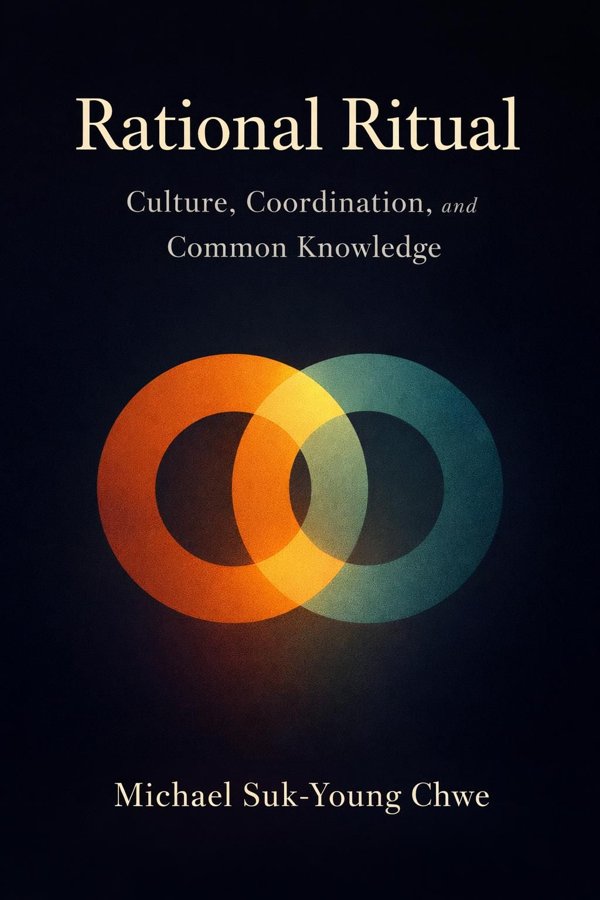
Rational Ritual
Rational Ritual: Culture, Coordination, and Common Knowledge is a strikingly original book that explains why public ceremonies, media events, and shared cultural practices matter so much in social life. Michael Suk-Young Chwe argues that rituals are not merely symbolic leftovers from tradition or irrational displays of emotion. They are highly effective tools for creating common knowledge: not just information that many people possess, but information that everyone knows others possess as well. That difference, Chwe shows, is what makes coordinated action possible. Drawing on game theory, economics, sociology, anthropology, and political theory, Chwe offers a framework for understanding how people align behavior without direct negotiation. From festivals and political rallies to advertising and mass entertainment, public events help individuals become mutually aware of what others are seeing, thinking, and expecting. This insight helps explain everything from market behavior to protest movements and social norms. The book matters because it gives culture a rational structure without reducing it to cold calculation. Chwe, a leading political scientist and theorist of coordination, shows that ritual and reason are not opposites. In many cases, ritual is precisely what makes rational coordination possible.
Read SummaryKey Insights from Michael Suk-Young Chwe
Common Knowledge Changes Everything
Most social problems are not caused by ignorance alone, but by uncertainty about what other people know. That is the powerful starting point of Rational Ritual. Chwe distinguishes between simple knowledge and common knowledge. It is one thing for you to know a fact, and for me to know it too. It is ...
From Rational Ritual
Coordination Matters More Than Competition
We often imagine social life as a contest of individual interests, yet many of our most important choices depend on alignment rather than rivalry. Chwe uses game theory to shift attention from competitive situations to coordination problems, where the best outcome depends on people choosing in sync....
From Rational Ritual
Rituals Create Mutual Awareness
A ritual may look ornamental from the outside, but its social function can be intensely practical. Chwe argues that rituals are powerful because they create common knowledge among participants. A public ceremony does not merely express values; it makes those values visible, jointly witnessed, and th...
From Rational Ritual
Mass Media Amplifies Common Knowledge
Not all communication is equal. A message sent privately informs, but a message broadcast publicly can coordinate. Chwe uses examples such as the Super Bowl to show that mass media can create extraordinary levels of common knowledge. A huge audience watches the same event at the same time, and cruci...
From Rational Ritual
Publicity Can Shift Political Power
Power often depends on keeping people uncertain about one another. Chwe shows that rulers, elites, and dominant institutions benefit when individuals remain isolated in their knowledge. If people each privately resent authority but believe others accept it, they may stay passive. Public rituals and ...
From Rational Ritual
Culture Can Be Rationally Explained
One of the boldest claims in Rational Ritual is that culture does not have to be understood as the opposite of rationality. Chwe rejects the familiar split between rational choice on one side and ritual, emotion, or symbolism on the other. He argues that many cultural practices make sense precisely ...
From Rational Ritual
About Michael Suk-Young Chwe
Michael Suk-Young Chwe is a professor of political science at the University of California, Los Angeles. His research focuses on game theory, social coordination, and cultural analysis. He is known for applying mathematical reasoning to social and cultural contexts, including literature and media.

Frequently Asked Questions
Michael Suk-Young Chwe is a professor of political science at the University of California, Los Angeles. His research focuses on game theory, social coordination, and cultural analysis.
Read Michael Suk-Young Chwe's books in 15 minutes
Get AI-powered summaries with key insights from 1 book by Michael Suk-Young Chwe.