
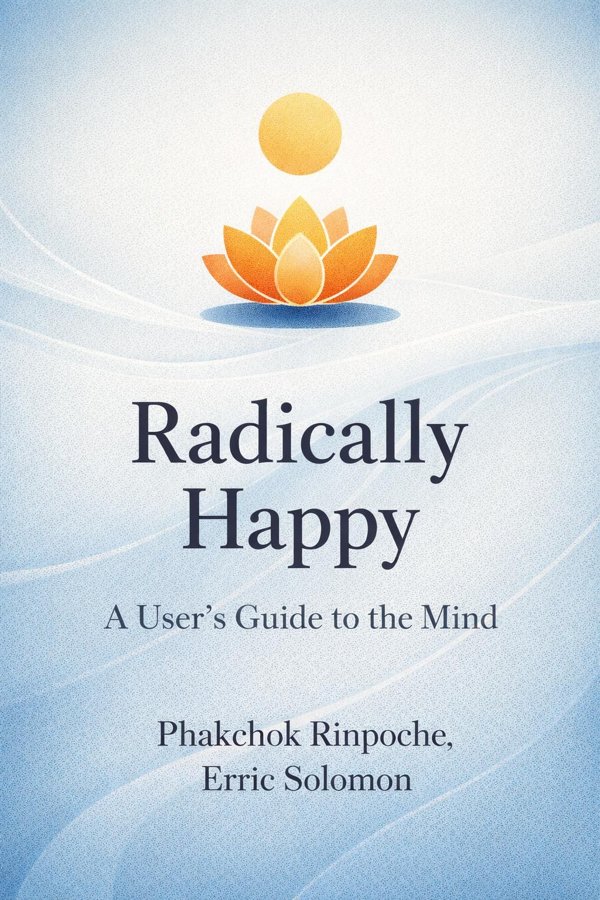
Radically Happy: A User’s Guide to the Mind: Summary & Key Insights
by Phakchok Rinpoche, Erric Solomon
 10 min12 chaptersAudio available
What Is Radically Happy: A User’s Guide to the Mind About?
Radically Happy: A User’s Guide to the Mind by Phakchok Rinpoche, Erric Solomon is a eastern_wisdom book spanning 12 pages. Radically Happy: A User’s Guide to the Mind offers a practical approach to cultivating genuine happiness through mindfulness and compassion. Drawing from ancient Tibetan Buddhist wisdom and modern psychology, Phakchok Rinpoche and Erric Solomon present accessible exercises and reflections to help readers transform everyday experiences into opportunities for joy and awareness.
This FizzRead summary covers all 12 key chapters of Radically Happy: A User’s Guide to the Mind in approximately 10 minutes, distilling the most important ideas, arguments, and takeaways from Phakchok Rinpoche, Erric Solomon's work. Also available as an audio summary and Key Quotes Podcast.
Radically Happy: A User’s Guide to the Mind
Radically Happy: A User’s Guide to the Mind offers a practical approach to cultivating genuine happiness through mindfulness and compassion. Drawing from ancient Tibetan Buddhist wisdom and modern psychology, Phakchok Rinpoche and Erric Solomon present accessible exercises and reflections to help readers transform everyday experiences into opportunities for joy and awareness.
Who Should Read Radically Happy: A User’s Guide to the Mind?
This book is perfect for anyone interested in eastern_wisdom and looking to gain actionable insights in a short read. Whether you're a student, professional, or lifelong learner, the key ideas from Radically Happy: A User’s Guide to the Mind by Phakchok Rinpoche, Erric Solomon will help you think differently.
- ✓Readers who enjoy eastern_wisdom and want practical takeaways
- ✓Professionals looking to apply new ideas to their work and life
- ✓Anyone who wants the core insights of Radically Happy: A User’s Guide to the Mind in just 10 minutes
Want the full summary?
Get instant access to this book summary and 100K+ more with Fizz Moment.
Get Free SummaryAvailable on App Store • Free to download
Key Chapters
Everything begins with the mind. Our experiences—joys and sorrows alike—arise not from external situations but from how we interpret them. The mind, as I often remind students, is like a lens: when it’s clouded by habitual thoughts and emotions, whatever we look at becomes distorted. When it’s clear, the same world shines differently.
In our culture, we often think of the mind as our thoughts or our intellect. But in reality, the mind is more like a dynamic space in which thoughts appear and dissolve. The problem is that we habitually identify with each thought that arises: ‘I am sad,’ ‘I am excited,’ ‘this is bad,’ ‘this is good.’ We build narratives around them and let them define us. This constant mental conditioning, built from years of reinforced habits, shapes our perception of self and world.
Through mindfulness, we begin to see that the mind’s nature is fluid. As we watch our thoughts without clinging, we recognize that none of them are permanent. Erric often describes it like watching clouds pass across a blue sky—the sky itself doesn’t change. Likewise, awareness remains untouched.
Once we truly understand this, we see the mind’s freedom. We aren’t bound to our reactive patterns; we simply haven’t trained ourselves to notice the space between perception and response. This chapter is a gentle invitation: observe your mind, patiently and without judgment, and begin discovering the enormous capacity for clarity that’s always been here.
If happiness is natural to the mind, why do we suffer so much? Suffering, I explain, isn’t a punishment or flaw—it’s the consequence of misunderstanding reality. In Buddhist terms, we speak of attachment, aversion, and ignorance. Attachment makes us grasp at what we desire; aversion makes us push away what we dislike; ignorance makes us believe that these fleeting experiences define us. When these three poisons rule our reactions, life becomes exhausting.
Think about how attachment manifests. We chase pleasure, success, recognition, love—all beautiful experiences, but temporary ones. When they change, or when we lose them, pain arises. Likewise, aversion drives us to avoid discomfort, failure, or criticism. But every attempt to resist reality deepens our frustration. The root of all this is ignorance: not recognizing that both pleasure and pain are transient appearances within the flow of awareness.
This doesn’t mean we should suppress feelings or pretend indifference. Rather, the key is to see clearly what’s happening—to perceive directly how our mind creates suffering. By looking honestly at our patterns, we find freedom hidden within discomfort itself. Once you know that emotions are movements of mind, not immutable truths, a space opens. That space is the beginning of compassion—for yourself and for others.
+ 10 more chapters — available in the FizzRead app
All Chapters in Radically Happy: A User’s Guide to the Mind
About the Authors
Phakchok Rinpoche is a Tibetan Buddhist master of the Nyingma and Kagyu traditions, known for his teachings on meditation and compassion. Erric Solomon is a former Silicon Valley technologist turned meditation teacher who integrates Buddhist principles with contemporary life practices.
Get This Summary in Your Preferred Format
Read or listen to the Radically Happy: A User’s Guide to the Mind summary by Phakchok Rinpoche, Erric Solomon anytime, anywhere. FizzRead offers multiple formats so you can learn on your terms — all free.
Available formats: App · Audio · PDF · EPUB — All included free with FizzRead
Download Radically Happy: A User’s Guide to the Mind PDF and EPUB Summary
Key Quotes from Radically Happy: A User’s Guide to the Mind
“Our experiences—joys and sorrows alike—arise not from external situations but from how we interpret them.”
“If happiness is natural to the mind, why do we suffer so much?”
Frequently Asked Questions about Radically Happy: A User’s Guide to the Mind
Radically Happy: A User’s Guide to the Mind by Phakchok Rinpoche, Erric Solomon is a eastern_wisdom book that explores key ideas across 12 chapters. Radically Happy: A User’s Guide to the Mind offers a practical approach to cultivating genuine happiness through mindfulness and compassion. Drawing from ancient Tibetan Buddhist wisdom and modern psychology, Phakchok Rinpoche and Erric Solomon present accessible exercises and reflections to help readers transform everyday experiences into opportunities for joy and awareness.
You Might Also Like

A New Earth
Eckhart Tolle
10 min
The Daily Stoic
Ryan Holiday, Stephen Hanselman
10 min
Buddhism: Plain and Simple
Steve Hagen
10 min
Enchiridion
Epictetus
10 min
The Book of Tea
Kakuzō Okakura
10 min
The Light We Give: How Sikh Wisdom Can Transform Your Life
Simran Jeet Singh
10 minBrowse by Category
Ready to read Radically Happy: A User’s Guide to the Mind?
Get the full summary and 100K+ more books with Fizz Moment.