
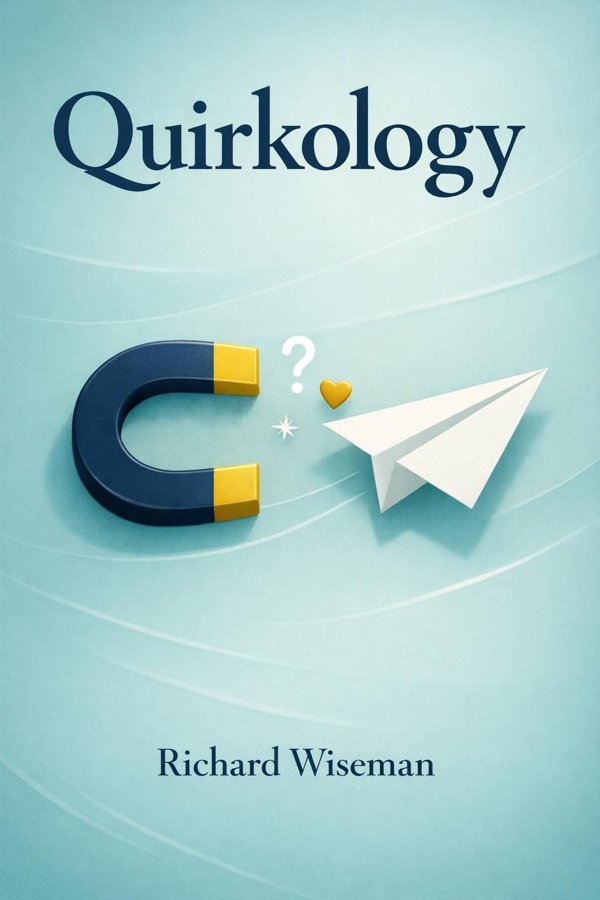
Quirkology: The Curious Science of Everyday Lives: Summary & Key Insights
 10 min9 chaptersAudio available
Key Takeaways from Quirkology: The Curious Science of Everyday Lives
What if luck is not a mysterious force, but a pattern of thinking and behaving?
Deception is rarely as polished as people think.
When life feels unpredictable, the human mind starts looking for patterns everywhere.
Romantic chemistry often feels mysterious, yet Wiseman shows that attraction is shaped by recognizable psychological forces.
People often think laughter is a response to jokes, but much of it has surprisingly little to do with formal humor.
What Is Quirkology: The Curious Science of Everyday Lives About?
Quirkology: The Curious Science of Everyday Lives by Richard Wiseman is a popular_sci book spanning 8 pages. Quirkology: The Curious Science of Everyday Lives examines the surprising psychology hidden inside ordinary behavior. Rather than focusing on mental illness or abstract theories, Richard Wiseman turns his attention to the strange patterns that shape everyday life: why some people seem lucky, how liars reveal themselves, what makes us laugh, why we fall in love, and how small social cues influence our choices. The result is a lively tour through the science of human quirks, showing that our routines are far less rational than we imagine. What makes the book especially valuable is Wiseman’s method. A trained psychologist and public-facing researcher, he combines laboratory findings with real-world experiments, street observations, and clever tests that bring psychology out of the classroom and into daily life. He writes with humor, but his larger point is serious: understanding human behavior can help us make better decisions, become more perceptive, and challenge false beliefs about ourselves. Quirkology matters because it reveals that the invisible forces guiding our lives are often understandable, testable, and changeable once we learn to see them.
This FizzRead summary covers all 9 key chapters of Quirkology: The Curious Science of Everyday Lives in approximately 10 minutes, distilling the most important ideas, arguments, and takeaways from Richard Wiseman's work. Also available as an audio summary and Key Quotes Podcast.
Quirkology: The Curious Science of Everyday Lives
Quirkology: The Curious Science of Everyday Lives examines the surprising psychology hidden inside ordinary behavior. Rather than focusing on mental illness or abstract theories, Richard Wiseman turns his attention to the strange patterns that shape everyday life: why some people seem lucky, how liars reveal themselves, what makes us laugh, why we fall in love, and how small social cues influence our choices. The result is a lively tour through the science of human quirks, showing that our routines are far less rational than we imagine.
What makes the book especially valuable is Wiseman’s method. A trained psychologist and public-facing researcher, he combines laboratory findings with real-world experiments, street observations, and clever tests that bring psychology out of the classroom and into daily life. He writes with humor, but his larger point is serious: understanding human behavior can help us make better decisions, become more perceptive, and challenge false beliefs about ourselves. Quirkology matters because it reveals that the invisible forces guiding our lives are often understandable, testable, and changeable once we learn to see them.
Who Should Read Quirkology: The Curious Science of Everyday Lives?
This book is perfect for anyone interested in popular_sci and looking to gain actionable insights in a short read. Whether you're a student, professional, or lifelong learner, the key ideas from Quirkology: The Curious Science of Everyday Lives by Richard Wiseman will help you think differently.
- ✓Readers who enjoy popular_sci and want practical takeaways
- ✓Professionals looking to apply new ideas to their work and life
- ✓Anyone who wants the core insights of Quirkology: The Curious Science of Everyday Lives in just 10 minutes
Want the full summary?
Get instant access to this book summary and 100K+ more with Fizz Moment.
Get Free SummaryAvailable on App Store • Free to download
Key Chapters
What if luck is not a mysterious force, but a pattern of thinking and behaving? One of Richard Wiseman’s most famous findings is that people who describe themselves as lucky are not necessarily favored by fate. Instead, they tend to notice more opportunities, respond more openly to unexpected events, and recover more quickly from setbacks. In other words, luck often grows out of mindset.
Wiseman’s research suggests that “lucky” people share several habits. They are more relaxed, which helps them spot chances that anxious people miss. They talk to more people, explore unfamiliar situations, and trust useful hunches without becoming reckless. They also reinterpret bad experiences in ways that keep them moving forward. An unlucky person may see one disappointment as proof that life is against them; a lucky person sees it as temporary, or even as a hidden blessing.
This idea matters because many people trap themselves inside a narrative of misfortune. If you believe nothing ever goes your way, you become cautious, narrow your attention, and stop taking social or professional risks. Ironically, that behavior creates worse outcomes and confirms the belief. Luck, then, becomes self-reinforcing in both directions.
In practical terms, luck can be cultivated. Attend events you would normally skip. Speak to strangers. Leave space in your schedule for serendipity. When something goes wrong, ask what new path it may open. The key lesson is simple but powerful: instead of waiting for luck to arrive, build the habits that make fortunate outcomes more likely.
Deception is rarely as polished as people think. Most liars focus intensely on the story they are telling, but they often forget that communication includes tone, timing, facial expression, and inconsistency. Wiseman explores lying not as a moral failure alone, but as a psychological performance that places strain on the mind. Because lying requires suppressing the truth, inventing details, and monitoring the listener’s reaction all at once, deception often produces subtle signs of effort.
Popular culture teaches us to search for one magical “tell,” such as avoiding eye contact. Wiseman’s work is more careful. There is no single universal cue that reliably exposes every lie. Some liars stare too little, others too much. Some speak less, others overcompensate. What matters is clusters of behavior: hesitation, mismatch between emotion and words, overly rigid storytelling, or changes from a person’s normal style.
The deeper insight is that humans are not as skilled at spotting lies as they assume. We are easily swayed by confidence, familiarity, and first impressions. This has consequences in hiring, relationships, politics, and the justice system. It also reminds us to be humble about our judgments.
A practical application is to listen for structure, not drama. Ask open questions. Request the same event in reverse order. Compare later retellings with earlier ones. Most importantly, establish a person’s normal communication pattern before making conclusions. The actionable takeaway: do not trust stereotypes about lying; pay attention to consistency, cognitive strain, and context instead.
When life feels unpredictable, the human mind starts looking for patterns everywhere. That is the psychological soil in which superstition grows. Wiseman shows that beliefs in lucky charms, signs, rituals, and fate are not merely relics of the irrational past. They remain attractive because they offer comfort, control, and meaning in situations where outcomes are uncertain.
At the heart of superstition is a perfectly understandable mental habit: we notice coincidences and then build stories around them. Wear a certain shirt and receive good news, and suddenly the shirt feels lucky. Knock on wood after avoiding disaster, and the gesture gains emotional power. Once a ritual becomes linked with relief or success, people repeat it, often without examining whether it truly changes anything.
Wiseman does not simply mock superstition. He reveals why intelligent people can fall for it. The brain is designed to detect connections, but it is not always good at distinguishing real causes from accidental associations. This tendency can make us vulnerable not just to harmless rituals, but also to pseudoscience, gambling illusions, and exaggerated beliefs about fate.
At the same time, some rituals can improve confidence even when they have no supernatural force. A pre-performance routine may calm nerves and sharpen focus. The danger comes when symbolic acts replace evidence-based thinking.
The practical lesson is to ask a simple question whenever a belief feels compelling: what is the actual mechanism, and what evidence supports it? Keep the rituals that help you focus, but do not confuse emotional reassurance with proof.
Romantic chemistry often feels mysterious, yet Wiseman shows that attraction is shaped by recognizable psychological forces. Physical appearance matters, but it is far from the whole story. Timing, familiarity, confidence, perceived similarity, body language, and even shared laughter all influence whether one person feels drawn to another.
One important idea is that attraction frequently grows from proximity and repeated exposure. We tend to like people who feel familiar, especially when those interactions are positive and low-pressure. Similarity also matters more than many people expect. Shared values, habits, humor, and lifestyle often create stronger long-term bonds than dramatic opposites-attract fantasies.
Wiseman also highlights the role of self-presentation. People are influenced not just by what someone looks like, but by whether they seem warm, attentive, and interested. A person who asks thoughtful questions, mirrors social energy, and appears relaxed often comes across as more attractive than someone conventionally good-looking but distant. Confidence can be magnetic, but it works best when paired with kindness rather than arrogance.
This perspective has practical value because it shifts attention away from insecurity and toward behavior. You may not control every first impression, but you can improve how you connect. Be fully present in conversation. Find shared ground. Use humor naturally. Choose environments where repeated contact is possible.
The actionable takeaway is reassuring: lasting attraction is less about chasing perfection and more about creating familiarity, warmth, and authentic connection.
Most people like to believe they make decisions by weighing evidence and choosing carefully. Wiseman shows that reality is messier. Our choices are constantly shaped by framing, habit, emotion, context, and mental shortcuts. We do not simply respond to facts; we respond to how those facts are presented, what we expect, and what feels easy in the moment.
This is why small changes in wording, order, or environment can produce surprisingly large effects. A product seems more appealing when labeled as avoiding a loss than creating a gain. A person may cling to a bad plan simply because they have already invested time or money in it. We often confuse confidence with correctness and familiarity with truth.
The unsettling implication is that irrationality is not rare. It is built into everyday cognition. Yet Wiseman’s tone is not cynical. These biases do not mean people are foolish; they mean the brain is adapted for speed and practicality, not perfect logic. The problem arises when we remain unaware of the shortcuts guiding us.
This insight can improve personal and professional decision-making. If you know framing affects judgment, you can review options from multiple angles. If you know sunk costs trap people, you can ask whether you would make the same choice if starting fresh today. If you know mood influences choices, you can delay major decisions when stressed.
The actionable takeaway is to build pauses into important choices. Slow down, reframe the question, and seek disconfirming evidence before deciding.
One of the book’s most refreshing ideas is that psychology does not belong only in universities. Wiseman treats everyday life as a living laboratory, full of opportunities to test assumptions about behavior. Instead of relying solely on formal academic settings, he brings experiments into streets, offices, homes, and public spaces, showing that real insight often emerges from ordinary situations.
This approach matters because people are notoriously bad at understanding themselves through introspection alone. We say one thing and do another. We explain our choices after the fact. We trust intuitions that are often incomplete. Simple experiments can reveal the gap between what we believe and how we actually behave.
The spirit of quirkology is playful but disciplined. Ask a question, make an observation, change one variable, and see what happens. Do people smile back more when greeted warmly? Does a different layout change what people choose? Are first impressions altered by one small cue? By testing rather than assuming, we become better observers of human nature.
This idea is empowering because it turns psychology into a practical habit. You do not need a research lab to become more curious and evidence-minded. You can run small experiments in your routines, communication style, productivity, and relationships.
The actionable takeaway: stop treating your assumptions as facts. Pick one daily belief about behavior, test it in a simple way, and let observation teach you something new.
A striking theme running through Wiseman’s work is that expectations do not merely color experience; they can help create it. When people believe they are capable, attractive, persuasive, or lucky, that belief often changes how they behave. They speak differently, take more initiative, recover faster from rejection, and project an ease that invites positive responses. Confidence can therefore become self-fulfilling.
This does not mean blind optimism guarantees success. Empty confidence can collapse when tested by reality. But realistic positive expectation has powerful behavioral consequences. If you assume a conversation will go badly, you may become tense and guarded, making the encounter awkward. If you expect opportunities to appear, you are more likely to notice and pursue them. The expectation shifts attention, effort, and resilience.
Wiseman’s contribution is to show this dynamic in a grounded way. Confidence is not magic; it is a practical psychological lever. It influences body language, persistence, and interpretation. It also shapes how others respond, because people often read calmness and engagement as signs of competence.
This insight is useful in work, dating, public speaking, and creativity. You can increase functional confidence by preparing well, using small early wins, rehearsing success, and changing posture or routine to interrupt anxiety. The goal is not to pretend perfection, but to act in ways that support a more resourceful state.
The actionable takeaway: create conditions that help confidence grow through evidence—prepare, start small, and act as though useful possibilities exist until your results begin to support the belief.
All Chapters in Quirkology: The Curious Science of Everyday Lives
About the Author
Richard Wiseman is a British psychologist, author, and professor best known for bringing psychological science into everyday life. Trained as an academic researcher, he gained wide recognition for his work on luck, deception, belief, humor, and self-help, often using inventive real-world experiments to explore how people think and behave. Wiseman has taught and conducted research at the University of Hertfordshire and has become one of the most visible communicators of psychology to general audiences. His books, talks, media appearances, and public demonstrations are known for blending scientific credibility with wit and accessibility. Rather than treating psychology as a remote academic discipline, he presents it as a practical tool for understanding ordinary experience. That ability to combine evidence, curiosity, and entertainment has made him a leading voice in popular psychology.
Get This Summary in Your Preferred Format
Read or listen to the Quirkology: The Curious Science of Everyday Lives summary by Richard Wiseman anytime, anywhere. FizzRead offers multiple formats so you can learn on your terms — all free.
Available formats: App · Audio · PDF · EPUB — All included free with FizzRead
Download Quirkology: The Curious Science of Everyday Lives PDF and EPUB Summary
Key Quotes from Quirkology: The Curious Science of Everyday Lives
“What if luck is not a mysterious force, but a pattern of thinking and behaving?”
“Deception is rarely as polished as people think.”
“When life feels unpredictable, the human mind starts looking for patterns everywhere.”
“Romantic chemistry often feels mysterious, yet Wiseman shows that attraction is shaped by recognizable psychological forces.”
“People often think laughter is a response to jokes, but much of it has surprisingly little to do with formal humor.”
Frequently Asked Questions about Quirkology: The Curious Science of Everyday Lives
Quirkology: The Curious Science of Everyday Lives by Richard Wiseman is a popular_sci book that explores key ideas across 9 chapters. Quirkology: The Curious Science of Everyday Lives examines the surprising psychology hidden inside ordinary behavior. Rather than focusing on mental illness or abstract theories, Richard Wiseman turns his attention to the strange patterns that shape everyday life: why some people seem lucky, how liars reveal themselves, what makes us laugh, why we fall in love, and how small social cues influence our choices. The result is a lively tour through the science of human quirks, showing that our routines are far less rational than we imagine. What makes the book especially valuable is Wiseman’s method. A trained psychologist and public-facing researcher, he combines laboratory findings with real-world experiments, street observations, and clever tests that bring psychology out of the classroom and into daily life. He writes with humor, but his larger point is serious: understanding human behavior can help us make better decisions, become more perceptive, and challenge false beliefs about ourselves. Quirkology matters because it reveals that the invisible forces guiding our lives are often understandable, testable, and changeable once we learn to see them.
More by Richard Wiseman
You Might Also Like

Structures: Or Why Things Don"t Fall Down
J.E. Gordon
10 min
The Road to Wigan Pier
George Orwell
10 min
Bonk: The Curious Coupling of Science and Sex
Mary Roach
10 min
First Bite: How We Learn to Eat
Bee Wilson
10 min
In Pursuit Of The Unknown: 17 Equations That Changed The World
Ian Stewart
10 min
Napoleon's Buttons: 17 Molecules That Changed History
Penny Le Couteur and Jay Burreson
10 minBrowse by Category
Ready to read Quirkology: The Curious Science of Everyday Lives?
Get the full summary and 100K+ more books with Fizz Moment.