
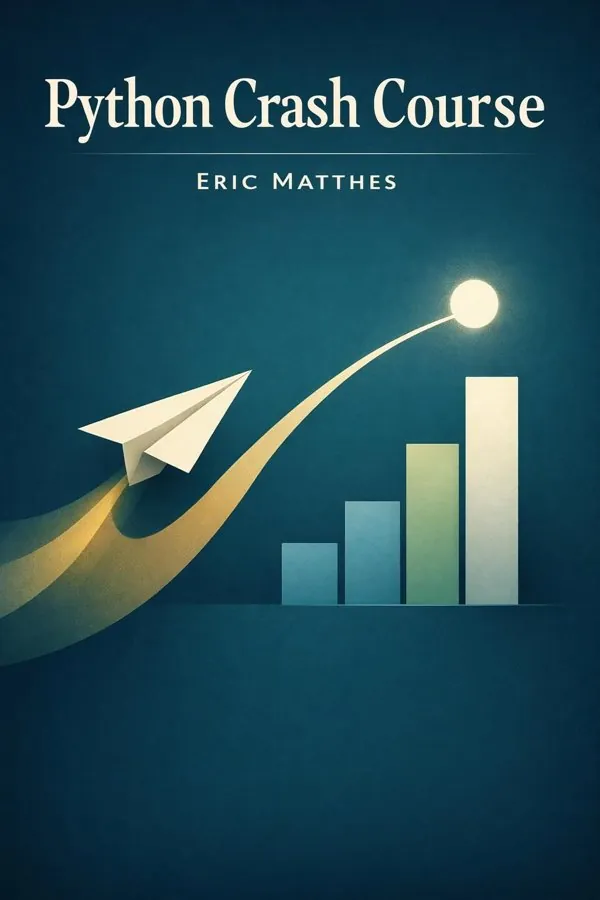
Python Crash Course: Summary & Key Insights
by Eric Matthes
 10 min9 chaptersAudio available
Key Takeaways from Python Crash Course
Every programming journey begins with a deceptively simple challenge: turning curiosity into consistency.
The fastest way to lose motivation in programming is to treat learning as memorization instead of problem-solving.
Good code is not just code that works; it is code you can understand, extend, and trust.
Programming becomes far less frustrating when you stop seeing errors as failure and start seeing them as feedback.
Knowledge becomes real when it is used to build something larger than an exercise.
What Is Python Crash Course About?
Python Crash Course by Eric Matthes is a non-fiction book published in 2015 spanning 3 pages. Python Crash Course by Eric Matthes is a hands-on introduction to programming that teaches Python by moving quickly from core concepts to real, working projects. Rather than overwhelming beginners with abstract theory, the book shows how programming becomes useful when you can write scripts, organize data, solve problems, and build things you care about. Readers begin with the basics—variables, lists, loops, functions, classes, and files—and then apply those skills to projects such as an arcade-style game, data visualizations, and a simple web application. That structure is what makes the book matter: it helps learners cross the difficult gap between understanding syntax and actually creating software. Matthes writes with the clarity of an experienced teacher who knows where beginners get stuck and how to guide them forward without intimidation. A longtime math and science educator who has taught programming to both teenagers and adults, he brings patience, practical sequencing, and strong examples to every chapter. The result is not just a beginner’s guide to Python, but a blueprint for learning how to think like a programmer.
This FizzRead summary covers all 9 key chapters of Python Crash Course in approximately 10 minutes, distilling the most important ideas, arguments, and takeaways from Eric Matthes's work. Also available as an audio summary and Key Quotes Podcast.
Python Crash Course
Python Crash Course by Eric Matthes is a hands-on introduction to programming that teaches Python by moving quickly from core concepts to real, working projects. Rather than overwhelming beginners with abstract theory, the book shows how programming becomes useful when you can write scripts, organize data, solve problems, and build things you care about. Readers begin with the basics—variables, lists, loops, functions, classes, and files—and then apply those skills to projects such as an arcade-style game, data visualizations, and a simple web application. That structure is what makes the book matter: it helps learners cross the difficult gap between understanding syntax and actually creating software. Matthes writes with the clarity of an experienced teacher who knows where beginners get stuck and how to guide them forward without intimidation. A longtime math and science educator who has taught programming to both teenagers and adults, he brings patience, practical sequencing, and strong examples to every chapter. The result is not just a beginner’s guide to Python, but a blueprint for learning how to think like a programmer.
Who Should Read Python Crash Course?
This book is perfect for anyone interested in non-fiction and looking to gain actionable insights in a short read. Whether you're a student, professional, or lifelong learner, the key ideas from Python Crash Course by Eric Matthes will help you think differently.
- ✓Readers who enjoy non-fiction and want practical takeaways
- ✓Professionals looking to apply new ideas to their work and life
- ✓Anyone who wants the core insights of Python Crash Course in just 10 minutes
Want the full summary?
Get instant access to this book summary and 100K+ more with Fizz Moment.
Get Free SummaryAvailable on App Store • Free to download
Key Chapters
Every programming journey begins with a deceptively simple challenge: turning curiosity into consistency. Python Crash Course understands that the first barrier is rarely intelligence; it is confusion. New learners often feel overwhelmed by tools, terminology, and syntax before they write anything meaningful. Eric Matthes addresses that directly by making the opening chapters practical, structured, and reassuring. He starts with environment setup, simple programs, and the core building blocks of Python so readers can experience progress immediately.
The early lessons introduce variables, strings, numbers, lists, loops, conditionals, dictionaries, user input, functions, and classes. What makes this section effective is that each concept is presented not as isolated theory, but as a tool for solving small problems. A variable stores information you want to reuse. A loop saves you from repeating work. A function helps you organize logic. A class lets you model more complex behavior. Instead of treating code as something mysterious, Matthes shows that programs are built from manageable, understandable parts.
Practical examples keep the material grounded. You might create a guest list, process a set of names, ask users questions, or organize data into dictionaries. These are modest exercises, but they teach a crucial lesson: programming is largely about breaking problems into steps. As the chapters progress, readers begin to see patterns. Inputs lead to decisions; decisions lead to actions; actions can be repeated, grouped, and refined.
The deeper value of this foundation is confidence. Once you understand the basic grammar of Python, the language stops feeling like a wall and starts feeling like a toolkit. Actionable takeaway: master the fundamentals by writing small scripts daily, because consistency with basics is what makes advanced programming possible.
The fastest way to lose motivation in programming is to treat learning as memorization instead of problem-solving. Python Crash Course avoids that trap by teaching readers to think in terms of tasks and outcomes. Syntax matters, but syntax alone does not create skill. What creates skill is using code to answer questions, automate repetitive work, and test ideas. Matthes repeatedly frames programming as a practical activity: you are not just learning commands, you are learning how to turn a messy goal into logical steps.
This mindset shows up throughout the book’s exercises. Instead of presenting concepts in abstraction, the book asks readers to print messages, manipulate lists, generate number sequences, process dictionaries, and gather user input. These tasks are simple enough for beginners yet rich enough to develop intuition. A loop is easier to understand when it helps you display every item in a pizza topping list. A conditional becomes meaningful when it helps you respond differently to different users. A function becomes useful when it saves you from rewriting the same logic over and over.
The book also trains an essential habit of programmers: iteration. Your first attempt rarely works perfectly, and that is normal. Small programs let you test assumptions quickly, notice errors, and make improvements without fear. This repeated cycle of write, run, inspect, and revise develops resilience along with technical ability.
In practice, this approach prepares readers for real-world programming, where the goal is rarely to show off knowledge and usually to solve a concrete problem efficiently. Actionable takeaway: whenever you learn a new Python feature, immediately use it in a tiny personal project so the idea becomes a skill rather than a fact.
Good code is not just code that works; it is code you can understand, extend, and trust. One of the most important transitions for beginners is moving from short scripts to organized programs, and Python Crash Course handles that shift with care. Matthes introduces functions and classes as tools for clarity, not as advanced decorations. He shows that as programs grow, structure becomes necessary.
Functions help readers package a task into a reusable unit. If you need to greet users, validate input, format output, or repeat a calculation, a function keeps that logic in one place. This reduces duplication and makes code easier to update. For example, if a game needs to update positions every frame or a data program needs to clean entries before plotting them, placing that logic in functions creates cleaner, more readable code. Beginners quickly discover that organized code feels less intimidating than large blocks of repeated instructions.
Classes take that idea further by modeling objects with attributes and behavior. Instead of tracking related values separately, you can create a blueprint for things such as a car, a user, or a game character. This introduces object-oriented thinking in an approachable way. Readers learn that a class can represent both data and actions, making more complex programs easier to reason about. In projects later in the book, classes become especially valuable for managing game settings, player behavior, and application data.
This section matters because many beginners can write code line by line but struggle to design programs that scale beyond toy examples. Matthes helps bridge that gap. Actionable takeaway: as soon as a script starts repeating itself or becoming hard to follow, refactor it by creating functions for repeated tasks and classes for related data and behavior.
Programming becomes far less frustrating when you stop seeing errors as failure and start seeing them as feedback. One of the quiet strengths of Python Crash Course is that it normalizes the debugging process. Beginners often assume that experienced programmers write perfect code on the first try, but Matthes makes clear that troubleshooting is part of the craft. Learning Python means learning how to interpret error messages, inspect assumptions, and correct mistakes methodically.
The book introduces debugging as a practical skill rather than a mysterious talent. Syntax errors teach you to read carefully. Logic errors teach you to compare what your code did with what you expected. Tracebacks become useful clues instead of threats. You learn to examine variable values, simplify the problem, and test smaller parts of the program one at a time. This mindset helps readers stay calm when a script crashes or produces the wrong output.
Testing also reinforces discipline. Instead of hoping a program works, you verify that it works. Even basic checks—trying different inputs, edge cases, or unexpected values—make code more reliable. In larger projects, this habit becomes essential. A game should respond predictably. A visualization should represent data accurately. A web app should handle user actions cleanly.
The broader lesson is psychological as much as technical. Persistence matters more than perfection. Every bug teaches you something about the language, your assumptions, or your design. That is how programmers improve. Matthes gives beginners permission to struggle productively, which is one of the most valuable gifts a teacher can offer. Actionable takeaway: when something breaks, resist random changes—read the error, isolate the issue, test one fix at a time, and treat debugging as part of learning.
Knowledge becomes real when it is used to build something larger than an exercise. That is the turning point in Python Crash Course. After establishing the language fundamentals, the book shifts into project-based learning, where readers apply what they know to create complete programs. This second half is powerful because it answers the question every beginner eventually asks: now that I know loops and functions, what can I actually make?
Matthes presents three major projects that transform abstract skills into visible results. The first is a game, Alien Invasion, built with Pygame. Here readers manage graphics, user input, moving objects, collisions, scorekeeping, and game states. Suddenly loops are not just loops; they drive animation. Classes are not just class definitions; they organize ships, bullets, and aliens. Conditionals control gameplay, and settings shape the user experience.
The next project focuses on data visualization. Readers work with libraries such as Matplotlib and learn to represent information visually. This broadens the definition of programming: code can entertain, but it can also explain, reveal patterns, and support decisions. The final major project introduces web development with Django, showing how Python can power interactive applications users access through a browser.
The genius of these projects is not only their variety but their cumulative effect. They show that the same core concepts can be adapted to very different domains. Once learners see that connection, they stop thinking of Python as a chapter-based subject and start seeing it as a versatile creative tool. Actionable takeaway: complete at least one end-to-end project after learning the basics, because full projects are what convert understanding into capability.
A simple game can teach more about programming structure than dozens of isolated examples. In Python Crash Course, the Alien Invasion project is more than a fun exercise; it is a lesson in how software systems come together. Games require movement, timing, user input, state management, visual feedback, and repeated updates. That makes them ideal for teaching how many small programming concepts must cooperate inside one coherent application.
As readers build the game, they learn how to break a larger goal into components: a ship object, bullets, enemies, settings, score displays, and event handling. Each part has a role, and the program works only when those roles are coordinated. This gives beginners an intuitive understanding of software architecture. The game loop repeatedly checks for input, updates game objects, and redraws the screen. That cycle demonstrates how programs can respond continuously to a changing environment.
The project also introduces the practical use of third-party libraries. Pygame handles graphics and input, allowing readers to focus on logic without having to build a game engine from scratch. This is an important professional lesson: real programmers often build on existing tools rather than reinventing everything themselves.
Perhaps most importantly, the game creates motivation. Watching your own code generate movement, action, and challenge is exciting. It gives immediate proof that your skills are growing. Even learners who never plan to make games gain valuable experience in event-driven programming, object management, and iterative improvement. Actionable takeaway: use a playful project like a game to practice program structure, because engaging projects make complex concepts easier to absorb and remember.
Code is not only for computation; it is also for communication. One of the most eye-opening sections of Python Crash Course is the move into data visualization. Many beginners assume programming is mainly about text-based scripts or software tools, but Matthes expands that view by showing how Python can turn raw numbers into meaningful images. A chart or graph often reveals trends faster than a page of output ever could.
In this part of the book, readers work with libraries such as Matplotlib and learn to generate plots, customize visuals, and present data clearly. The lesson is bigger than any single chart type. Data visualization teaches that information becomes more useful when it is structured, filtered, and displayed thoughtfully. Whether you are tracking weather patterns, population changes, website activity, or scientific measurements, Python can help convert data into insight.
The examples also introduce an important workflow: gather data, inspect it, clean it if necessary, and then visualize it. That process reflects real analytical work. You are not simply producing pretty graphics; you are asking questions and designing representations that help answer them. This encourages a more mature programming mindset, one oriented toward exploration and interpretation.
For readers who may not care about games or web apps, this section opens another door. Python becomes relevant to students, analysts, researchers, and professionals who need to understand information and explain it to others. Actionable takeaway: choose a dataset that interests you—sports, finance, health, climate, or personal habits—and build one simple visualization to practice turning data into a clear story.
The moment your code becomes something other people can use, programming starts to feel truly powerful. Python Crash Course introduces web development through Django, giving readers a first look at how Python can move beyond scripts on a personal computer and into interactive applications accessed through a browser. This section broadens the learner’s imagination: Python is not just a learning language, but a framework for building services, tools, and experiences for real users.
Matthes uses Django to teach core web concepts in a beginner-friendly way. Readers see how data models define what an application stores, views handle requests and responses, templates shape what users see, and URLs connect browser actions to application logic. Even if the details are new, the structure is presented clearly enough that readers can follow the flow from database to page. This demystifies web development, which often feels inaccessible to beginners.
The project-based approach matters again here. Rather than discussing websites in theory, the book helps readers build a working application. That experience teaches more than terminology ever could. You begin to understand that modern apps are collections of components working together: data storage, user interaction, presentation, and business logic.
This section also hints at the possibilities beyond the book. Once you can create a basic Django project, you can imagine building journals, dashboards, portfolios, educational tools, or business applications. What once seemed reserved for professional developers becomes approachable. Actionable takeaway: if you want to deepen your Python skills, build a tiny Django app for a real need in your life, even if it serves only one user: you.
The most important programming lesson is that no single book can finish the journey. Python Crash Course succeeds not because it teaches everything, but because it teaches enough of the right things to help readers keep going independently. Matthes frames learning Python as the beginning of a longer process of exploration, practice, and project-building. That perspective is essential. Many beginners quit after finishing a tutorial because they mistake completion for mastery and then feel lost when facing a blank screen.
The book prepares readers for what comes next by developing transferable habits. You learn how to read documentation, experiment with libraries, debug your own code, and break large goals into smaller steps. You also see that Python connects to many domains: automation, games, web development, data analysis, science, and education. This breadth gives learners options. You do not have to love every project in the book; you only need one path that sparks your interest enough to continue.
A valuable implication of the book is that progress in programming comes from building a portfolio of experience. Each small script, failed experiment, and completed project adds to your capability. Over time, patterns repeat, confidence grows, and unfamiliar problems become manageable. The beginner eventually becomes intermediate not through a single leap, but through accumulated reps.
Matthes leaves readers with momentum rather than dependence. That is excellent teaching. The goal is not to stay inside one book forever, but to use it as a launchpad into lifelong learning. Actionable takeaway: after finishing the book, choose one direction—automation, web apps, data, or games—and complete three progressively harder projects in that area.
All Chapters in Python Crash Course
About the Author
Eric Matthes is an educator and author best known for making Python programming accessible to beginners. Based in Alaska, he has taught math, science, and programming to both high school students and adult learners, giving him deep experience in explaining technical ideas clearly and patiently. That classroom background shapes his writing style: practical, encouraging, and carefully paced for people who may be learning to code for the first time. Matthes is widely recognized for Python Crash Course, a book that combines straightforward instruction with project-based learning to help readers move from basic syntax to real applications. His work stands out for reducing intimidation without lowering standards, making programming feel approachable while still building strong habits and useful skills.
Get This Summary in Your Preferred Format
Read or listen to the Python Crash Course summary by Eric Matthes anytime, anywhere. FizzRead offers multiple formats so you can learn on your terms — all free.
Available formats: App · Audio · PDF · EPUB — All included free with FizzRead
Download Python Crash Course PDF and EPUB Summary
Key Quotes from Python Crash Course
“Every programming journey begins with a deceptively simple challenge: turning curiosity into consistency.”
“The fastest way to lose motivation in programming is to treat learning as memorization instead of problem-solving.”
“Good code is not just code that works; it is code you can understand, extend, and trust.”
“Programming becomes far less frustrating when you stop seeing errors as failure and start seeing them as feedback.”
“Knowledge becomes real when it is used to build something larger than an exercise.”
Frequently Asked Questions about Python Crash Course
Python Crash Course by Eric Matthes is a non-fiction book that explores key ideas across 9 chapters. Python Crash Course by Eric Matthes is a hands-on introduction to programming that teaches Python by moving quickly from core concepts to real, working projects. Rather than overwhelming beginners with abstract theory, the book shows how programming becomes useful when you can write scripts, organize data, solve problems, and build things you care about. Readers begin with the basics—variables, lists, loops, functions, classes, and files—and then apply those skills to projects such as an arcade-style game, data visualizations, and a simple web application. That structure is what makes the book matter: it helps learners cross the difficult gap between understanding syntax and actually creating software. Matthes writes with the clarity of an experienced teacher who knows where beginners get stuck and how to guide them forward without intimidation. A longtime math and science educator who has taught programming to both teenagers and adults, he brings patience, practical sequencing, and strong examples to every chapter. The result is not just a beginner’s guide to Python, but a blueprint for learning how to think like a programmer.
You Might Also Like
Browse by Category
Ready to read Python Crash Course?
Get the full summary and 100K+ more books with Fizz Moment.