
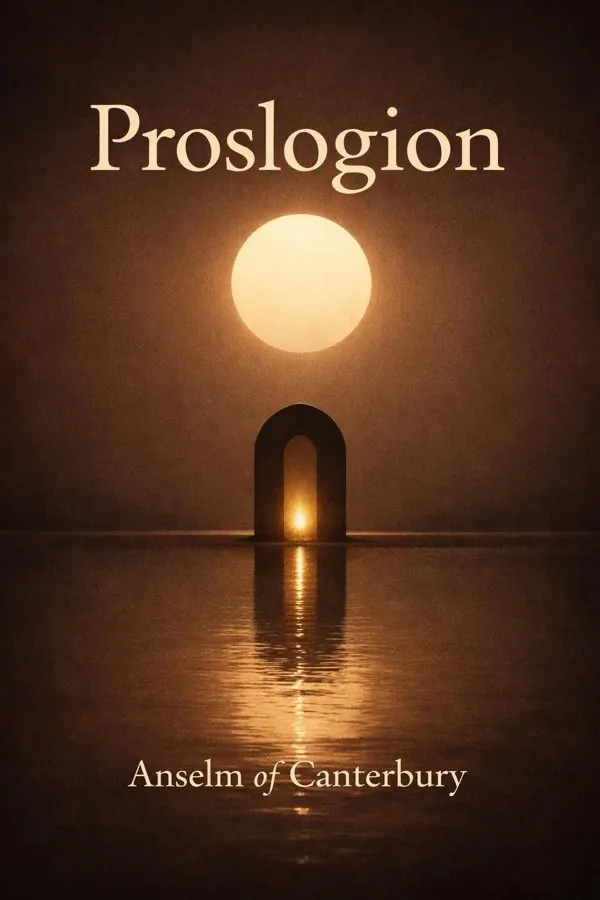
Proslogion: Summary & Key Insights
 10 min10 chaptersAudio available
Key Takeaways from Proslogion
Great works often begin in dissatisfaction, not confidence.
The most surprising thing about Proslogion is that it begins not with logic but with prayer.
Sometimes a definition is not merely descriptive but explosive.
The ontological argument is powerful because it challenges a hidden assumption: that existence is always separate from thought.
Every strong argument invites resistance, and Anselm anticipates it.
What Is Proslogion About?
Proslogion by Anselm of Canterbury is a western_phil book spanning 10 pages. Anselm of Canterbury’s Proslogion is one of the most influential short works in the history of philosophy and Christian theology. Written in the eleventh century, it sets out a daring project: to seek a single line of reasoning that can lead the mind toward certainty about God. At the center of the book is Anselm’s famous ontological argument, built around the definition of God as “that than which nothing greater can be conceived.” Yet Proslogion is far more than a clever proof. It is a spiritual meditation, a prayer, and a model of how faith and reason can work together rather than against each other. What makes the book endure is its unusual combination of intellectual rigor and devotional intensity. Anselm does not reason about God from a distance; he reasons as someone who believes, doubts, longs, and seeks understanding. As a Benedictine monk and later Archbishop of Canterbury, he wrote with both philosophical precision and deep religious seriousness. For readers interested in philosophy of religion, medieval thought, or the enduring question of whether reason can speak meaningfully about ultimate reality, Proslogion remains essential reading.
This FizzRead summary covers all 10 key chapters of Proslogion in approximately 10 minutes, distilling the most important ideas, arguments, and takeaways from Anselm of Canterbury's work. Also available as an audio summary and Key Quotes Podcast.
Proslogion
Anselm of Canterbury’s Proslogion is one of the most influential short works in the history of philosophy and Christian theology. Written in the eleventh century, it sets out a daring project: to seek a single line of reasoning that can lead the mind toward certainty about God. At the center of the book is Anselm’s famous ontological argument, built around the definition of God as “that than which nothing greater can be conceived.” Yet Proslogion is far more than a clever proof. It is a spiritual meditation, a prayer, and a model of how faith and reason can work together rather than against each other.
What makes the book endure is its unusual combination of intellectual rigor and devotional intensity. Anselm does not reason about God from a distance; he reasons as someone who believes, doubts, longs, and seeks understanding. As a Benedictine monk and later Archbishop of Canterbury, he wrote with both philosophical precision and deep religious seriousness. For readers interested in philosophy of religion, medieval thought, or the enduring question of whether reason can speak meaningfully about ultimate reality, Proslogion remains essential reading.
Who Should Read Proslogion?
This book is perfect for anyone interested in western_phil and looking to gain actionable insights in a short read. Whether you're a student, professional, or lifelong learner, the key ideas from Proslogion by Anselm of Canterbury will help you think differently.
- ✓Readers who enjoy western_phil and want practical takeaways
- ✓Professionals looking to apply new ideas to their work and life
- ✓Anyone who wants the core insights of Proslogion in just 10 minutes
Want the full summary?
Get instant access to this book summary and 100K+ more with Fizz Moment.
Get Free SummaryAvailable on App Store • Free to download
Key Chapters
Great works often begin in dissatisfaction, not confidence. Anselm tells us that after completing his earlier Monologion, he remained uneasy. That book had assembled many arguments about God from the goodness, order, and gradations visible in the world. But Anselm wanted something more elegant and more secure: one single proof that would stand on its own and illuminate the whole question of God’s existence.
This desire matters because it reveals the ambition of Proslogion. Anselm is not merely adding one argument to many others; he is trying to discover whether reason can find a foundational insight from which everything else follows. Instead of moving outward from the world to God, he turns inward to thought itself. He asks what we mean when we think of God, and whether that very concept carries implications about existence.
This move changed the history of philosophy. It shifted debate from observation of the external world to analysis of concepts, necessity, and the structure of rational thought. Even those who reject Anselm’s conclusion must grapple with the method he pioneered.
In practical terms, his preface teaches a valuable lesson about serious inquiry. When our explanations feel scattered, it can be useful to step back and ask whether there is a deeper unifying principle underneath them. Students do this in research, leaders do it in strategy, and individuals do it in self-reflection.
Actionable takeaway: when faced with many partial explanations, pause and ask, “What is the one underlying insight that would make sense of all the rest?”
The most surprising thing about Proslogion is that it begins not with logic but with prayer. Anselm does not approach God as a detached analyst approaching a puzzle. He approaches as a seeker asking for light. Before arguing, he asks for the ability to understand. This sets the tone for the whole work: reason is real and powerful, but it is exercised within humility.
For Anselm, human understanding is not self-sufficient. The mind is capable of truth, yet it is limited, distracted, and clouded by weakness. Prayer becomes the discipline of reorienting the self toward what matters most. The opening meditation is therefore not ornamental. It expresses a central conviction: the deepest truths are not grasped by technique alone, but by a rightly ordered soul.
This has philosophical significance. Anselm’s method is often summarized as “faith seeking understanding.” He does not mean blind belief replacing thought. He means that trust, commitment, and desire can create the conditions for better reasoning. In modern terms, our intellectual habits are shaped by our moral and emotional posture. Arrogance narrows inquiry; humility enlarges it.
There is also a practical application beyond religion. Before entering a difficult conversation, beginning a creative project, or wrestling with a major life decision, it helps to quiet the mind and clarify one’s aim. Whether through prayer, silence, journaling, or reflection, we often think better when we first become inwardly attentive.
Actionable takeaway: before tackling a difficult question, spend a few minutes cultivating focus and humility so your reasoning begins from clarity rather than agitation.
Sometimes a definition is not merely descriptive but explosive. Anselm’s most famous phrase defines God as “that than which nothing greater can be conceived.” This is the conceptual core of Proslogion. Instead of beginning with physical evidence or inherited formulas, Anselm asks us to consider what the word “God” must mean if it refers to the highest possible being.
The brilliance of the definition lies in its precision. God is not just very powerful, very wise, or very good. God is the greatest conceivable being, lacking nothing that would make a being greater. This allows Anselm to move from ordinary religious language to rigorous philosophical analysis. If we understand the concept, he argues, we must examine what follows from it.
This idea also raises an enduring philosophical question: can some concepts carry necessary implications? We routinely distinguish between greater and lesser forms of excellence. A being that is dependent appears less perfect than one that exists through itself. A goodness that can fail seems less complete than one that cannot. Anselm gathers these intuitions into a single idea of maximal greatness.
In daily life, the broader lesson is about conceptual clarity. We often debate justice, freedom, success, or love without first asking what we mean by them at their fullest. Anselm reminds us that progress in thinking often begins with sharpening the central concept.
Even if one questions the theological conclusion, the method remains useful: define carefully before you argue. A vague idea produces vague reasoning; a precise idea forces serious thought.
Actionable takeaway: when discussing any big idea, define the highest or fullest version of it first before evaluating whether it is real or attainable.
The ontological argument is powerful because it challenges a hidden assumption: that existence is always separate from thought. Anselm asks us to imagine someone who understands the phrase “that than which nothing greater can be conceived.” Even the skeptic, whom Anselm calls “the fool,” can grasp the idea in the mind. But, Anselm argues, a being that exists in reality is greater than one that exists only as an idea. Therefore, if God existed only in the mind, we could conceive of something greater: the same being existing in reality. That is impossible if God is truly the greatest conceivable being. So God must exist not only in thought but in reality.
Whether one accepts this reasoning or not, it remains one of the most discussed arguments in philosophy. It is concise, elegant, and deeply provocative. Its influence can be seen in later thinkers from Descartes to Kant and beyond.
The practical importance of this chapter is not that it gives everyone instant certainty. Rather, it trains readers to examine assumptions hidden inside language and concepts. Many disagreements survive because people do not notice what their definitions imply. In business, ethics, and law, conceptual inconsistency can quietly undermine an entire position.
A simple analogy helps. If you define a “perfect security system” but then describe one that can fail at a critical moment, your definition and your description conflict. Anselm’s argument operates by exposing that kind of inconsistency in the idea of God existing only mentally.
Actionable takeaway: test your core beliefs by asking whether your conclusions are consistent with the definitions you started with.
Every strong argument invites resistance, and Anselm anticipates it. He refers to the biblical “fool” who says in his heart that there is no God, and he asks how such a person can deny God while still understanding what is being denied. The key issue is the difference between hearing words and grasping what they signify. The fool can understand the phrase “that than which nothing greater can be conceived,” and that understanding is enough for the argument to begin.
Anselm’s response is subtle. He does not claim that merely uttering a sentence forces belief. Instead, he claims that once the concept is genuinely understood, denial becomes unstable. To deny the existence of the greatest conceivable being while understanding what such greatness entails creates a contradiction.
This chapter matters because it shows Anselm wrestling with misunderstanding, not just unbelief. Often the real barrier in argument is not refusal but confusion. People may use the same words while imagining different things. Anselm therefore presses readers to move from superficial familiarity to actual comprehension.
This has obvious modern relevance. Public debates about democracy, morality, science, or religion often collapse because participants never clarify the meaning of the terms they are contesting. Productive disagreement requires shared understanding of the issue before judgment can be made.
A practical example: in a workplace conflict, two people may argue about “fairness” while meaning entirely different things, such as equal treatment versus outcome-based support. Clarifying concepts can dissolve false disputes or reveal the real issue.
Actionable takeaway: before rejecting an idea, make sure you can state it in its strongest and clearest form, not merely in a familiar slogan.
Anselm does not stop at the claim that God exists. He goes further and argues that God exists necessarily. This is one of the most important developments in Proslogion. A being that can fail to exist, or that depends on something else for its existence, is less great than a being that cannot not exist. Therefore the greatest conceivable being must possess necessary existence, not contingent existence.
This distinction between contingent and necessary existence became central to later metaphysics. Contingent things are the kinds of things that might or might not have existed: trees, stars, nations, technologies, and human lives. Necessary being, by contrast, would exist in a deeper, non-derivative way. Anselm is saying that God is not simply one item among others in the universe. God is not a very impressive object inside reality but the kind of reality whose nonexistence is impossible.
This matters because it reshapes what the word “God” means. The issue is not whether there is a superhuman force somewhere. The issue is whether ultimate reality is self-existent and unsurpassable.
In practical thinking, the underlying lesson is to distinguish what is dependent from what is foundational. In personal life, moods are contingent; values may be more basic. In organizations, policies are contingent; mission may be foundational. Confusion happens when we treat temporary features as if they were ultimate.
Anselm urges us to ask not only “Does this exist?” but “How does it exist?” Is it fragile, borrowed, and conditional, or stable and explanatory?
Actionable takeaway: when evaluating any important belief or commitment, distinguish between what is secondary and changeable and what you take to be fundamental.
Once Anselm establishes God as the greatest conceivable being, a series of divine attributes follows. God must be supremely just, truthful, powerful, wise, good, and blessed. These are not random additions. They flow from the idea of maximal greatness. If wisdom is better than ignorance, then the greatest conceivable being must be perfectly wise. If goodness is better than cruelty, then God must be perfectly good.
Anselm’s treatment of the divine attributes is philosophically rich because it unites them. God is not powerful at the expense of goodness, or just at the expense of mercy. In creatures, qualities can pull against one another because we are limited. But in God, perfection means harmony. The divine nature is simple and complete, not a bundle of competing traits.
This is still relevant today because many people think of greatness in one-dimensional terms: strength without compassion, intelligence without integrity, efficiency without justice. Anselm offers a more demanding standard. Real excellence includes moral perfection, not just capability.
There is a practical lesson here for leadership and character. A successful manager who lacks honesty is not truly admirable. A brilliant thinker without humility is incomplete. A parent who provides materially but not lovingly falls short of fullness. Human greatness, while finite, should aim at integration rather than imbalance.
Anselm also helps readers reflect on what they ultimately worship, whether or not they are religious. If our highest ideals are narrow, they deform us. If they include truth, goodness, justice, and compassion together, they elevate us.
Actionable takeaway: evaluate excellence by integrated character, not by isolated talent or power.
We usually measure life by time: before and after, growth and decay, gain and loss. Anselm insists that God is not subject to this sequence in the way creatures are. God is eternal and immutable, meaning not merely very old but beyond temporal change and not vulnerable to alteration. This protects divine perfection. What changes can improve or deteriorate, acquire or lose. But the greatest conceivable being cannot become better, because it is already perfect, and cannot become worse, because that would compromise greatness.
Anselm’s account of eternity pushes readers to imagine a mode of being unlike our own. God does not endure as one more process inside time. Rather, God is present to all times without being trapped by them. Medieval thinkers would later develop this into the idea of God’s eternal present.
The philosophical importance is enormous. It helps explain how God could be the source of all changing things while not being swept along by change. It also supports divine reliability. A changing deity might make promises and abandon them, love and then cease to love, know and then forget. Anselm’s God is faithful because God is not unstable.
Practically, the idea invites us to reflect on what in our own lives should remain steady amid change. We are not immutable, but we do need anchors: principles, promises, and commitments that should not be revised with every passing mood. In a volatile world, character requires some form of constancy.
Actionable takeaway: identify one value or commitment you want to hold steady through changing circumstances, and consciously organize decisions around it.
One of the most moving sections of Proslogion explores a question that still troubles thoughtful readers: how can God be both perfectly just and perfectly merciful? In human experience, justice and mercy often seem to compete. Strict fairness can look harsh, while mercy can look like a suspension of fairness. Anselm refuses to accept that tension as final when speaking of God.
He argues that divine mercy does not cancel divine justice because both arise from perfect goodness. God is just in punishing evil and just in forgiving, though in different ways, because every divine act is ordered by wisdom and goodness. What appears contradictory from a limited human standpoint may be reconciled in a higher unity.
This chapter is important not only theologically but morally. It challenges simplistic thinking. Mature judgment often requires holding two goods together instead of choosing one against the other. In parenting, discipline without compassion becomes cruelty; compassion without accountability becomes indulgence. In legal systems, mercy without justice erodes trust, while justice without mercy can ignore rehabilitation and context.
Anselm’s treatment encourages intellectual humility. Some tensions are not signs of irrationality but signs that reality is richer than our first categories. We may need a broader framework to see how two principles belong together.
In everyday life, the lesson is practical: when faced with a moral conflict, ask whether the real task is balance, integration, or a deeper understanding rather than simple selection.
Actionable takeaway: in your next difficult judgment, resist false either-or thinking and ask how fairness and compassion might both be honored.
Proslogion ends not in cold certainty but in longing. After reasoning about God’s existence and attributes, Anselm returns to the limits of human understanding. The mind can know something true about God, yet it cannot fully contain or comprehend God. This produces both humility and desire. We are made to seek the highest good, but our present condition leaves us with only partial vision.
This final movement is crucial. It keeps Proslogion from becoming a purely abstract exercise. Anselm’s goal is not to win a debate but to draw the soul toward beatitude, the blessed happiness found in God. Intellectual insight is valuable, but it is incomplete without transformation of desire. To know about the highest good is not yet to possess it.
This speaks deeply to modern life. Many people accumulate information yet remain restless. Achievement, entertainment, and consumption often fail to satisfy because they do not answer the deeper hunger for meaning, coherence, and ultimate fulfillment. Anselm interprets that restlessness as a sign of the soul’s orientation toward something beyond finite goods.
Even readers outside religious belief can recognize the point: human beings are not satisfied by fragments alone. We seek wholeness. We want not only facts but wisdom, not only pleasure but happiness, not only options but purpose.
Anselm leaves us with a disciplined form of aspiration. We should think rigorously, but also recognize the difference between mastery and wonder. The highest realities, if they exist, invite reverence as much as analysis.
Actionable takeaway: make space for reflection on what you ultimately desire, and ask whether your daily pursuits are aligned with that deeper end.
All Chapters in Proslogion
About the Author
Saint Anselm of Canterbury (c. 1033–1109) was a Benedictine monk, philosopher, and theologian whose work helped shape medieval scholastic thought. Born in Aosta in northern Italy, he later entered the Abbey of Bec in Normandy, where he became a respected teacher and eventually abbot. He was appointed Archbishop of Canterbury in 1093 and played a major role in church life during a politically turbulent period. Anselm is best known for his philosophical and theological works, especially Monologion and Proslogion, in which he explored the rational intelligibility of faith. His thought is often summarized by the phrase “faith seeking understanding,” reflecting his conviction that belief invites inquiry rather than suppressing it. He remains one of the central figures in Western Christian philosophy.
Get This Summary in Your Preferred Format
Read or listen to the Proslogion summary by Anselm of Canterbury anytime, anywhere. FizzRead offers multiple formats so you can learn on your terms — all free.
Available formats: App · Audio · PDF · EPUB — All included free with FizzRead
Download Proslogion PDF and EPUB Summary
Key Quotes from Proslogion
“Great works often begin in dissatisfaction, not confidence.”
“The most surprising thing about Proslogion is that it begins not with logic but with prayer.”
“Sometimes a definition is not merely descriptive but explosive.”
“The ontological argument is powerful because it challenges a hidden assumption: that existence is always separate from thought.”
“Every strong argument invites resistance, and Anselm anticipates it.”
Frequently Asked Questions about Proslogion
Proslogion by Anselm of Canterbury is a western_phil book that explores key ideas across 10 chapters. Anselm of Canterbury’s Proslogion is one of the most influential short works in the history of philosophy and Christian theology. Written in the eleventh century, it sets out a daring project: to seek a single line of reasoning that can lead the mind toward certainty about God. At the center of the book is Anselm’s famous ontological argument, built around the definition of God as “that than which nothing greater can be conceived.” Yet Proslogion is far more than a clever proof. It is a spiritual meditation, a prayer, and a model of how faith and reason can work together rather than against each other. What makes the book endure is its unusual combination of intellectual rigor and devotional intensity. Anselm does not reason about God from a distance; he reasons as someone who believes, doubts, longs, and seeks understanding. As a Benedictine monk and later Archbishop of Canterbury, he wrote with both philosophical precision and deep religious seriousness. For readers interested in philosophy of religion, medieval thought, or the enduring question of whether reason can speak meaningfully about ultimate reality, Proslogion remains essential reading.
You Might Also Like
A Little History of Philosophy
Nigel Warburton
10 min
Areopagitica
John Milton
10 min
How To Think Like A Philosopher: Essential Principles For Clear Thinking
Peter Cave
10 min
Language, Truth and Logic
A. J. Ayer
10 min
The Age of Reason
Thomas Paine
10 min
The Essays
Michel De Montaigne
10 minBrowse by Category
Ready to read Proslogion?
Get the full summary and 100K+ more books with Fizz Moment.