
Anselm of Canterbury Books
Saint Anselm of Canterbury (c. 1033–1109) was a Benedictine monk, philosopher, and theologian who served as Archbishop of Canterbury.
Known for: Proslogion
Books by Anselm of Canterbury
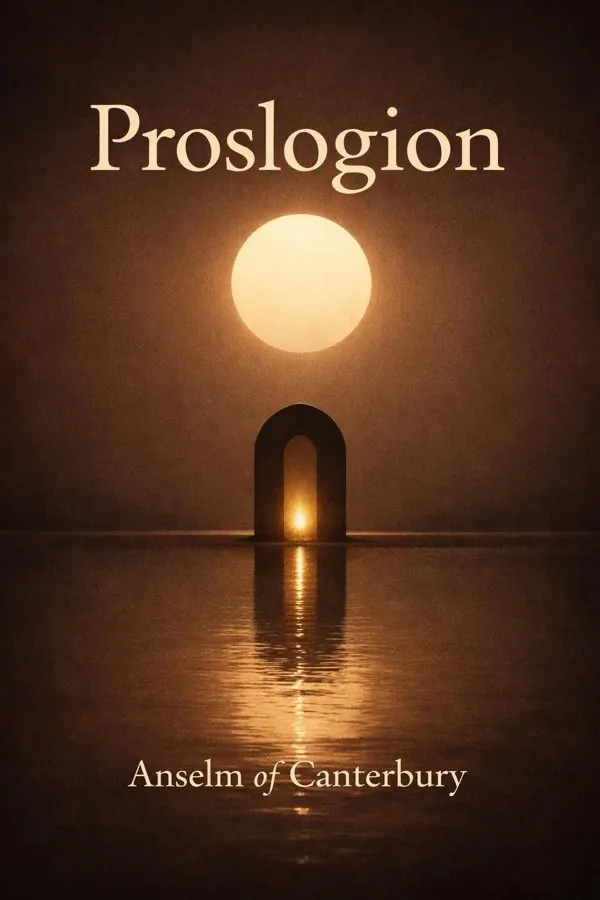
Proslogion
Anselm of Canterbury’s Proslogion is one of the most influential short works in the history of philosophy and Christian theology. Written in the eleventh century, it sets out a daring project: to seek a single line of reasoning that can lead the mind toward certainty about God. At the center of the book is Anselm’s famous ontological argument, built around the definition of God as “that than which nothing greater can be conceived.” Yet Proslogion is far more than a clever proof. It is a spiritual meditation, a prayer, and a model of how faith and reason can work together rather than against each other. What makes the book endure is its unusual combination of intellectual rigor and devotional intensity. Anselm does not reason about God from a distance; he reasons as someone who believes, doubts, longs, and seeks understanding. As a Benedictine monk and later Archbishop of Canterbury, he wrote with both philosophical precision and deep religious seriousness. For readers interested in philosophy of religion, medieval thought, or the enduring question of whether reason can speak meaningfully about ultimate reality, Proslogion remains essential reading.
Read SummaryKey Insights from Anselm of Canterbury
The Search for One Certain Proof
Great works often begin in dissatisfaction, not confidence. Anselm tells us that after completing his earlier Monologion, he remained uneasy. That book had assembled many arguments about God from the goodness, order, and gradations visible in the world. But Anselm wanted something more elegant and m...
From Proslogion
Prayer Opens the Way to Understanding
The most surprising thing about Proslogion is that it begins not with logic but with prayer. Anselm does not approach God as a detached analyst approaching a puzzle. He approaches as a seeker asking for light. Before arguing, he asks for the ability to understand. This sets the tone for the whole wo...
From Proslogion
That Than Which Nothing Greater Can Be Conceived
Sometimes a definition is not merely descriptive but explosive. Anselm’s most famous phrase defines God as “that than which nothing greater can be conceived.” This is the conceptual core of Proslogion. Instead of beginning with physical evidence or inherited formulas, Anselm asks us to consider what...
From Proslogion
From Thought to Reality
The ontological argument is powerful because it challenges a hidden assumption: that existence is always separate from thought. Anselm asks us to imagine someone who understands the phrase “that than which nothing greater can be conceived.” Even the skeptic, whom Anselm calls “the fool,” can grasp t...
From Proslogion
Answering the Fool’s Objection
Every strong argument invites resistance, and Anselm anticipates it. He refers to the biblical “fool” who says in his heart that there is no God, and he asks how such a person can deny God while still understanding what is being denied. The key issue is the difference between hearing words and grasp...
From Proslogion
Why God Must Exist Necessarily
Anselm does not stop at the claim that God exists. He goes further and argues that God exists necessarily. This is one of the most important developments in Proslogion. A being that can fail to exist, or that depends on something else for its existence, is less great than a being that cannot not exi...
From Proslogion
About Anselm of Canterbury
Saint Anselm of Canterbury (c. 1033–1109) was a Benedictine monk, philosopher, and theologian who served as Archbishop of Canterbury. He is best known for his works 'Monologion' and 'Proslogion', which laid the foundations for scholastic theology and explored the relationship between faith and reaso...
Read more
Saint Anselm of Canterbury (c. 1033–1109) was a Benedictine monk, philosopher, and theologian who served as Archbishop of Canterbury. He is best known for his works 'Monologion' and 'Proslogion', which laid the foundations for scholastic theology and explored the relationship between faith and reaso...
Saint Anselm of Canterbury (c. 1033–1109) was a Benedictine monk, philosopher, and theologian who served as Archbishop of Canterbury. He is best known for his works 'Monologion' and 'Proslogion', which laid the foundations for scholastic theology and explored the relationship between faith and reason.


Frequently Asked Questions
Saint Anselm of Canterbury (c. 1033–1109) was a Benedictine monk, philosopher, and theologian who served as Archbishop of Canterbury.
Read Anselm of Canterbury's books in 15 minutes
Get AI-powered summaries with key insights from 1 book by Anselm of Canterbury.