
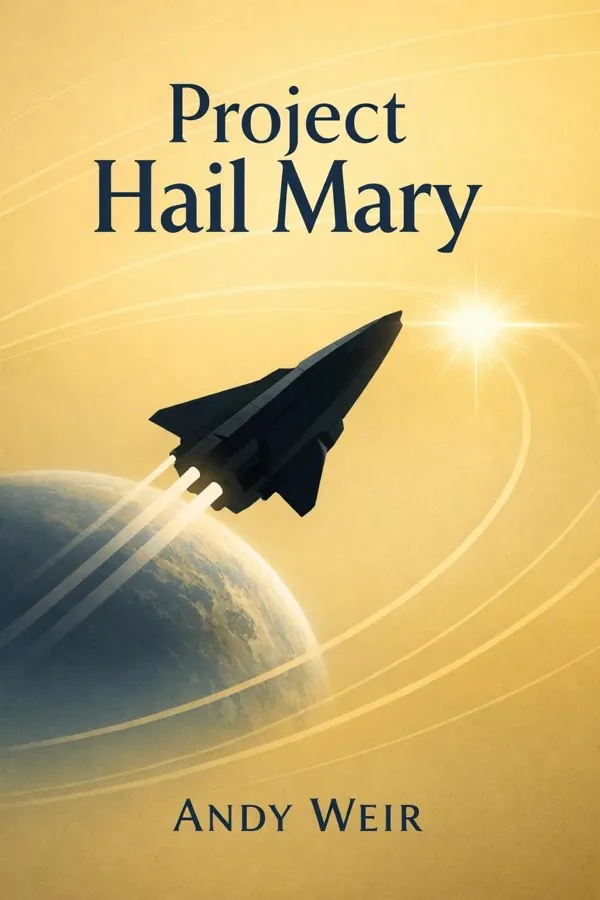
Project Hail Mary: Summary & Key Insights
by Andy Weir
 10 min8 chaptersAudio available
Key Takeaways from Project Hail Mary
Identity becomes most visible when it is stripped away.
Civilization often collapses not from one dramatic blow, but from a slow, measurable change ignored too long.
Knowledge matters most when it becomes usable under pressure.
The novel’s emotional heart arrives with a revelation both unexpected and deeply moving: Grace is not alone.
Progress often happens where confidence ends and experimentation begins.
What Is Project Hail Mary About?
Project Hail Mary by Andy Weir is a fiction book published in 2021 spanning 5 pages. What if the fate of Earth depended not on a superhero, a soldier, or a chosen one, but on a middle-school science teacher who can think clearly under pressure? That irresistible premise powers Project Hail Mary, Andy Weir’s thrilling 2021 science-fiction novel about memory, survival, and the kind of problem-solving that becomes heroic when everything is at stake. The story begins with Ryland Grace waking alone on a spaceship, disoriented and unable to remember his own name. As his memory slowly returns, so does the terrifying truth: the sun is dimming, Earth is sliding toward catastrophe, and he may be humanity’s last chance. What makes the novel stand out is its rare blend of scientific rigor, emotional warmth, and genuine suspense. Weir, best known for The Martian, has built a reputation for turning hard science into page-turning drama. Here, he expands his reach, combining astrophysics, biology, engineering, and first-contact storytelling into a novel that feels both intellectually satisfying and deeply humane. Project Hail Mary matters because beneath its cosmic stakes lies a timeless idea: survival depends on curiosity, cooperation, and the courage to keep solving the next problem.
This FizzRead summary covers all 8 key chapters of Project Hail Mary in approximately 10 minutes, distilling the most important ideas, arguments, and takeaways from Andy Weir's work. Also available as an audio summary and Key Quotes Podcast.
Project Hail Mary
What if the fate of Earth depended not on a superhero, a soldier, or a chosen one, but on a middle-school science teacher who can think clearly under pressure? That irresistible premise powers Project Hail Mary, Andy Weir’s thrilling 2021 science-fiction novel about memory, survival, and the kind of problem-solving that becomes heroic when everything is at stake. The story begins with Ryland Grace waking alone on a spaceship, disoriented and unable to remember his own name. As his memory slowly returns, so does the terrifying truth: the sun is dimming, Earth is sliding toward catastrophe, and he may be humanity’s last chance.
What makes the novel stand out is its rare blend of scientific rigor, emotional warmth, and genuine suspense. Weir, best known for The Martian, has built a reputation for turning hard science into page-turning drama. Here, he expands his reach, combining astrophysics, biology, engineering, and first-contact storytelling into a novel that feels both intellectually satisfying and deeply humane. Project Hail Mary matters because beneath its cosmic stakes lies a timeless idea: survival depends on curiosity, cooperation, and the courage to keep solving the next problem.
Who Should Read Project Hail Mary?
This book is perfect for anyone interested in fiction and looking to gain actionable insights in a short read. Whether you're a student, professional, or lifelong learner, the key ideas from Project Hail Mary by Andy Weir will help you think differently.
- ✓Readers who enjoy fiction and want practical takeaways
- ✓Professionals looking to apply new ideas to their work and life
- ✓Anyone who wants the core insights of Project Hail Mary in just 10 minutes
Want the full summary?
Get instant access to this book summary and 100K+ more with Fizz Moment.
Get Free SummaryAvailable on App Store • Free to download
Key Chapters
Identity becomes most visible when it is stripped away. Project Hail Mary opens with one of the most effective premises in modern science fiction: Ryland Grace wakes in a sterile chamber on a spacecraft, confused, weak, and surrounded by two dead crewmates. He does not know where he is, why he is there, or even who he is. This amnesia is not just a plot device. It shapes the reader’s experience, forcing us to reconstruct the mission alongside him, one clue at a time.
As Grace relearns language, mathematics, and eventually his own history, the novel turns memory into suspense. The gradual return of his past mirrors scientific discovery itself. He must observe, hypothesize, test, and revise. Even the simple act of identifying objects around him becomes an experiment in self-recovery. That structure makes the novel unusually immersive, because the reader’s knowledge grows in lockstep with the protagonist’s understanding.
This opening also establishes a larger theme: competence is built from habits, not confidence. Grace does not begin as a fearless hero. He begins as a frightened human being relying on the tiny fragments of knowledge his mind still retains. In practical terms, this reflects how real people often function in crisis. We may not feel ready, but training, systems, and disciplined thinking can carry us forward before courage catches up.
In everyday life, the lesson is surprisingly relevant. During a personal or professional crisis, clarity rarely arrives all at once. You recover by solving the immediate problem in front of you, then the next one, and then the next. Action restores identity as much as reflection does.
Actionable takeaway: When you feel overwhelmed, do not wait for total certainty. Start by naming what you know, identifying the next solvable problem, and rebuilding momentum from there.
Knowledge matters most when it becomes usable under pressure. One of the central pleasures of Project Hail Mary is watching science function not as decoration, but as the engine of survival. Grace applies biology, chemistry, physics, engineering, and statistics to nearly every obstacle he encounters. He runs experiments, interprets data, improvises tools, and revises assumptions when evidence changes. In this world, scientific thinking is not abstract brilliance. It is disciplined humility.
That distinction is important. Grace is highly capable, but he succeeds less through genius than through method. He notices patterns, tests hypotheses, and accepts being wrong as part of progress. This is why the book feels so satisfying. Solutions are earned. Problems do not disappear because the plot demands them to. They are solved through effort, iteration, and careful reasoning.
Weir also emphasizes that science is collaborative across time. Grace depends on the work of researchers back on Earth, on mission planners, and eventually on another unexpected partner. Discovery is cumulative. Even when he seems alone, he is really carrying the concentrated labor of an entire civilization.
This has obvious practical relevance. In school, work, and leadership, people often imagine expertise as having immediate answers. The novel argues the opposite. Real expertise means knowing how to investigate uncertainty without collapsing under it. For example, a project manager facing a failing launch, a doctor handling unclear symptoms, or a teacher adapting to student confusion all rely on the same core pattern: observe carefully, test small changes, learn fast.
Science here becomes a philosophy of action: reality can be understood, and understanding creates options.
Actionable takeaway: In any difficult situation, replace vague worry with a simple experimental mindset. Define the problem, gather evidence, test one informed response, and let results guide your next move.
The novel’s emotional heart arrives with a revelation both unexpected and deeply moving: Grace is not alone. He encounters Rocky, an alien from another star system who has come on a mission astonishingly similar to his own. Their species are different in body, language, senses, and culture, yet they are united by the same existential threat. This first-contact scenario transforms the book from a survival thriller into a story about trust, communication, and shared purpose.
What makes Rocky memorable is not merely that he is alien, but that he feels genuinely other while remaining profoundly relatable. He does not think like a human, perceive like a human, or speak like a human. Yet through patience and curiosity, Grace builds a bridge. Their friendship grows out of mutual problem-solving. They trade knowledge, create a shared language, and learn each other’s strengths and vulnerabilities.
Weir offers an unusually hopeful vision of first contact. Instead of conquest, fear, or misunderstanding leading inevitably to violence, the novel imagines cooperation as the natural outcome of intelligent beings facing reality honestly. This does not erase difference. It honors difference while proving that common goals can overcome radical unfamiliarity.
The applications beyond fiction are powerful. Many conflicts in teams, organizations, and societies come from assuming that difference means incompatibility. Grace and Rocky show another model: start with observation, respect the other party’s constraints, and build understanding through practical collaboration. Shared work often creates trust faster than abstract agreement.
Their bond also expands the moral frame of the novel. Saving one’s own species matters, but so does recognizing another species’ equal right to survive.
Actionable takeaway: When facing someone very different from you, begin with curiosity and a shared problem. Build trust through small acts of cooperation before expecting deep understanding.
Progress often happens where confidence ends and experimentation begins. Once Grace and Rocky join forces, the story enters its richest scientific phase: they must understand astrophage, identify its natural predator, and design a way to use that knowledge to save their worlds. The challenge is not simply to collect facts. It is to turn uncertain, incomplete knowledge into a workable solution under severe constraints.
This section highlights one of Weir’s most compelling ideas: innovation is rarely linear. Grace and Rocky face false starts, hidden variables, design failures, and unexpected consequences. Every answer generates a new question. Their success depends on creativity grounded in reality, not wishful thinking. They must make testable models, adapt to new data, and stay calm when carefully laid plans fall apart.
The novel’s scientific puzzles work because they reveal character. Grace becomes braver as he becomes more responsible. Rocky becomes more than an ally; he becomes a fellow inventor navigating the unknown. Their laboratory-style collaboration in deep space turns the abstract idea of “research” into something vivid and dramatic.
This dynamic mirrors real innovation in business, medicine, and technology. A startup searching for product-market fit, a scientist working on a vaccine, or an engineer troubleshooting a critical failure all live in the same loop: try, learn, revise, persist. The story reminds us that breakthrough thinking usually emerges from repeated encounters with failure rather than from flawless planning.
Most importantly, the book rejects the fantasy of certainty. You do not need total knowledge to make meaningful progress. You need a process robust enough to keep learning.
Actionable takeaway: Treat setbacks as information, not verdicts. When a plan fails, ask what the failure reveals, update your model, and move quickly into the next informed experiment.
Heroism becomes real when it costs something personal. As Project Hail Mary moves toward its climax, Grace confronts the central moral question of the novel: what does it truly mean to save the world? At first, salvation appears to be a technical objective—find a cure for astrophage and deliver it to Earth. But the deeper the mission goes, the more the story insists that survival is inseparable from ethical choice.
Grace is forced to decide between returning home and helping Rocky save his own species. This is where the novel becomes more than a science puzzle. It becomes a test of character. Grace, who once feared being sent on the mission at all, ultimately chooses to act with extraordinary generosity. He accepts that moral responsibility does not stop at the boundary of one’s own tribe.
This decision reshapes the title itself. A “Hail Mary” is a desperate last attempt, but in the novel it also becomes an act of faith in decency. Salvation is not only about preserving life. It is about choosing the kind of life, and the kind of person, worth preserving.
In practical terms, this idea speaks to leadership and citizenship. Many decisions involve competing loyalties: self versus team, short-term gain versus long-term principle, local interest versus broader good. Grace’s choice suggests that integrity often requires helping others even when no reward is guaranteed. The most meaningful victories are sometimes the ones that make us less comfortable but more human.
The ending lands because Grace’s sacrifice is not grandstanding. It grows naturally from his evolving relationship with Rocky and his rediscovered sense of purpose.
Actionable takeaway: When facing a hard decision, ask not only what benefits you most, but what choice reflects your deepest values and expands care beyond yourself.
Optimism is not naïveté; sometimes it is a survival skill. Despite its extinction-level stakes, Project Hail Mary is consistently funny. Grace narrates with dry wit, self-awareness, and an almost teacherly enthusiasm for explaining difficult ideas. That humor is not ornamental. It performs essential emotional work. It keeps fear from becoming paralyzing and gives the reader, and the protagonist, room to breathe.
Weir understands that people under pressure do not become solemn all the time. They joke, complain, improvise, and latch onto absurd details because that is how the mind protects itself. Grace’s voice makes the science more accessible and the danger more human. His humor does not deny the seriousness of the mission; it helps him endure it.
This tonal balance is one reason the novel appeals far beyond hard-science-fiction fans. Readers who might feel intimidated by astrophysics or molecular biology are carried along by personality, pacing, and charm. Humor becomes a bridge between technical material and emotional investment.
The broader lesson is practical. In high-stress environments, morale is not a luxury. Teams perform better when they can maintain perspective, laugh at setbacks, and preserve a sense of shared humanity. A surgeon in a difficult rotation, a startup founder during a crisis, or a family managing uncertainty all benefit from moments of levity that lower fear without lowering standards.
Project Hail Mary suggests that resilience is not grim endurance alone. It is the ability to keep curiosity, affection, and even playfulness alive in the middle of difficulty. That emotional flexibility can be as important as intelligence.
Actionable takeaway: In stressful periods, make room for humor and human connection. A lighter emotional tone can restore clarity, reduce panic, and help you keep going.
One of the book’s quietest strengths is its refusal to make greatness look glamorous. Ryland Grace is not introduced as an obvious savior. He is a scientist and former teacher with fears, flaws, and a strong instinct for self-preservation. He is intelligent, but he is also reluctant. That reluctance matters because it makes his eventual courage feel earned rather than predetermined.
Weir builds a compelling portrait of growth under pressure. Grace does not become heroic because he loses fear; he becomes heroic because he acts despite it. The flashbacks to Earth reveal a man pulled into history by circumstance, not destiny. He contributes because his knowledge becomes necessary, and over time necessity matures into responsibility.
This is an encouraging idea for readers. Many stories reserve meaningful action for exceptional people. Project Hail Mary argues that ordinary competence, ethical seriousness, and persistence can become extraordinary when circumstances demand them. The same person who once managed classrooms and labs can, under pressure, help save planets.
This has direct real-world resonance. Teachers, engineers, nurses, analysts, and countless others often underestimate how transferable their skills are. Communication, calm reasoning, patience, and the ability to learn quickly matter in more situations than people assume. A crisis may not ask whether you feel important. It may simply ask whether you can help.
By grounding heroism in teachable habits rather than innate destiny, the novel becomes more democratic and more inspiring. It suggests that preparation matters, but so does the decision to rise to a moment bigger than your comfort.
Actionable takeaway: Do not dismiss your everyday skills as small. Invest in competence, stay curious, and trust that ordinary discipline can become extraordinary value when it is most needed.
All Chapters in Project Hail Mary
About the Author
Andy Weir is an American novelist known for blending hard science, humor, and high-stakes storytelling. He developed an early passion for computing and science, and before becoming a bestselling author, he worked as a software engineer. Weir first rose to international fame with The Martian, a survival novel celebrated for its scientific realism and engaging voice. His fiction often centers on ordinary but highly capable people forced to solve extraordinary problems through logic, resilience, and improvisation. In Project Hail Mary, he expanded his signature formula by adding first-contact wonder and emotional depth to his science-driven suspense. Weir has become one of the defining popular voices in contemporary science fiction, admired for making complex scientific ideas accessible, entertaining, and deeply human.
Get This Summary in Your Preferred Format
Read or listen to the Project Hail Mary summary by Andy Weir anytime, anywhere. FizzRead offers multiple formats so you can learn on your terms — all free.
Available formats: App · Audio · PDF · EPUB — All included free with FizzRead
Download Project Hail Mary PDF and EPUB Summary
Key Quotes from Project Hail Mary
“Identity becomes most visible when it is stripped away.”
“Civilization often collapses not from one dramatic blow, but from a slow, measurable change ignored too long.”
“Knowledge matters most when it becomes usable under pressure.”
“The novel’s emotional heart arrives with a revelation both unexpected and deeply moving: Grace is not alone.”
“Progress often happens where confidence ends and experimentation begins.”
Frequently Asked Questions about Project Hail Mary
Project Hail Mary by Andy Weir is a fiction book that explores key ideas across 8 chapters. What if the fate of Earth depended not on a superhero, a soldier, or a chosen one, but on a middle-school science teacher who can think clearly under pressure? That irresistible premise powers Project Hail Mary, Andy Weir’s thrilling 2021 science-fiction novel about memory, survival, and the kind of problem-solving that becomes heroic when everything is at stake. The story begins with Ryland Grace waking alone on a spaceship, disoriented and unable to remember his own name. As his memory slowly returns, so does the terrifying truth: the sun is dimming, Earth is sliding toward catastrophe, and he may be humanity’s last chance. What makes the novel stand out is its rare blend of scientific rigor, emotional warmth, and genuine suspense. Weir, best known for The Martian, has built a reputation for turning hard science into page-turning drama. Here, he expands his reach, combining astrophysics, biology, engineering, and first-contact storytelling into a novel that feels both intellectually satisfying and deeply humane. Project Hail Mary matters because beneath its cosmic stakes lies a timeless idea: survival depends on curiosity, cooperation, and the courage to keep solving the next problem.
More by Andy Weir

You Might Also Like




Featured In
Browse by Category
Ready to read Project Hail Mary?
Get the full summary and 100K+ more books with Fizz Moment.