
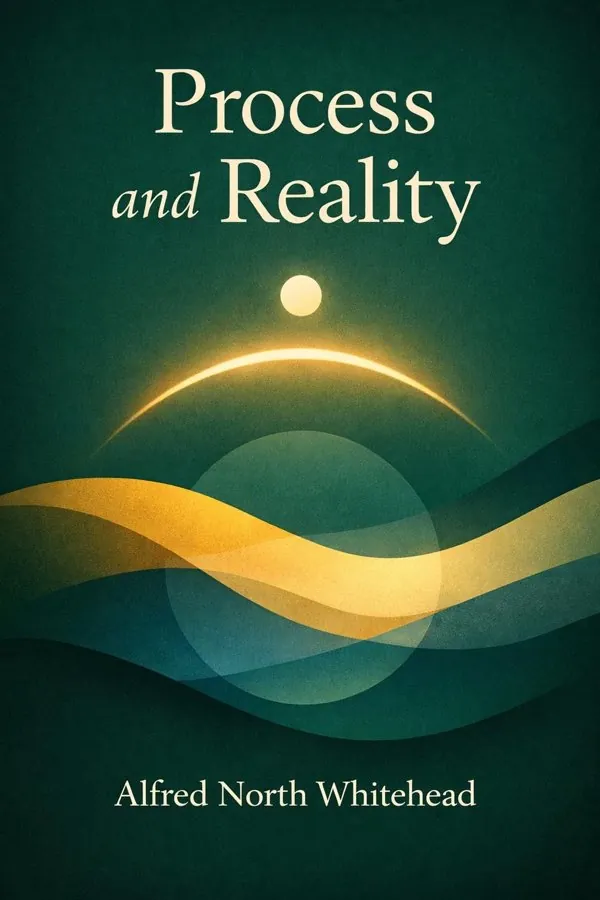
Process and Reality: An Essay in Cosmology: Summary & Key Insights
 10 min10 chaptersAudio available
Key Takeaways from Process and Reality: An Essay in Cosmology
What if the basic units of reality are not things, but events?
A philosophy matters most when it changes the questions we ask.
Chaos becomes intelligible only when we identify the principles that govern it.
We do not first exist alone and then connect; connection is built into existence from the start.
Reason is not the foundation of life; feeling is.
What Is Process and Reality: An Essay in Cosmology About?
Process and Reality: An Essay in Cosmology by Alfred North Whitehead is a western_phil book spanning 9 pages. Process and Reality: An Essay in Cosmology is Alfred North Whitehead’s most ambitious philosophical work and one of the defining texts of modern metaphysics. In it, Whitehead argues that reality is not fundamentally made of fixed substances or isolated things, but of events, relations, and ongoing processes of becoming. The world, on this view, is alive with activity: every moment emerges by taking account of what came before and contributing something new to what comes after. To express this vision, Whitehead develops a dense but powerful conceptual framework built around actual occasions, prehensions, eternal objects, creativity, and God. Why does this matter? Because Whitehead offers a serious alternative to the mechanical worldview that has shaped much of modern thought. His philosophy speaks not only to metaphysics, but also to science, ecology, psychology, theology, and systems thinking. It helps readers see reality as interconnected, dynamic, and creative. Whitehead brings unusual authority to this project: before becoming a major philosopher, he was already a distinguished mathematician and co-author of Principia Mathematica with Bertrand Russell. Process and Reality is difficult, but it rewards readers with a radically fresh way of understanding existence itself.
This FizzRead summary covers all 10 key chapters of Process and Reality: An Essay in Cosmology in approximately 10 minutes, distilling the most important ideas, arguments, and takeaways from Alfred North Whitehead's work. Also available as an audio summary and Key Quotes Podcast.
Process and Reality: An Essay in Cosmology
Process and Reality: An Essay in Cosmology is Alfred North Whitehead’s most ambitious philosophical work and one of the defining texts of modern metaphysics. In it, Whitehead argues that reality is not fundamentally made of fixed substances or isolated things, but of events, relations, and ongoing processes of becoming. The world, on this view, is alive with activity: every moment emerges by taking account of what came before and contributing something new to what comes after. To express this vision, Whitehead develops a dense but powerful conceptual framework built around actual occasions, prehensions, eternal objects, creativity, and God.
Why does this matter? Because Whitehead offers a serious alternative to the mechanical worldview that has shaped much of modern thought. His philosophy speaks not only to metaphysics, but also to science, ecology, psychology, theology, and systems thinking. It helps readers see reality as interconnected, dynamic, and creative. Whitehead brings unusual authority to this project: before becoming a major philosopher, he was already a distinguished mathematician and co-author of Principia Mathematica with Bertrand Russell. Process and Reality is difficult, but it rewards readers with a radically fresh way of understanding existence itself.
Who Should Read Process and Reality: An Essay in Cosmology?
This book is perfect for anyone interested in western_phil and looking to gain actionable insights in a short read. Whether you're a student, professional, or lifelong learner, the key ideas from Process and Reality: An Essay in Cosmology by Alfred North Whitehead will help you think differently.
- ✓Readers who enjoy western_phil and want practical takeaways
- ✓Professionals looking to apply new ideas to their work and life
- ✓Anyone who wants the core insights of Process and Reality: An Essay in Cosmology in just 10 minutes
Want the full summary?
Get instant access to this book summary and 100K+ more with Fizz Moment.
Get Free SummaryAvailable on App Store • Free to download
Key Chapters
What if the basic units of reality are not things, but events? That is Whitehead’s starting point, and it is the decisive break that powers the whole of Process and Reality. Instead of treating the world as made of enduring substances—rocks, chairs, atoms, or selves conceived as self-contained objects—Whitehead argues that the ultimate realities are “actual occasions.” These are momentary acts of becoming, pulses of experience or activity out of which the world is continually composed.
An actual occasion is not a tiny material particle. It is better understood as a concrete event that gathers the influence of the past, integrates it in its own way, and then perishes into the future as a fact for others to inherit. Reality, then, is not a warehouse of objects but a stream of interrelated happenings. Even stable things, such as a tree or a human body, are not fundamentally static entities. They are societies of many actual occasions sustaining patterns over time.
This shift has wide implications. It challenges the common habit of treating identity as fixed and independent. In daily life, we often speak as though people or institutions simply are what they are. Whitehead reminds us that they are continuously becoming through relationships, decisions, habits, and environments. A company is not just a thing; it is a sequence of events, interactions, and adaptations. A person is not merely a substance with properties; a person is a living process shaped by memory, feeling, and response.
This perspective can be practically liberating. If reality is process, then change is not accidental to existence; it is existence. To understand anything well, ask not “What static thing is this?” but “What ongoing process is happening here?” Use that question in work, relationships, and self-reflection.
A philosophy matters most when it changes the questions we ask. In Part I, Whitehead proposes a “speculative scheme,” a full set of categories meant to interpret every kind of experience without reducing some parts of reality to others. He believes traditional metaphysics has repeatedly failed because it treated abstractions as if they were concrete realities. His task is to build a conceptual framework broad enough to include science, ethics, art, religion, and ordinary life.
The speculative scheme begins from the insight that whatever is real must be describable in terms that remain coherent across the whole range of experience. Whitehead therefore replaces substance-based metaphysics with a relational one. Actual entities are the final real things. Their existence depends on how they inherit and unify other data. Each occasion is internally related to the world it arises from. The universe is thus an interconnected order of becoming rather than a collection of independent items.
Whitehead also insists that philosophy should not choose between the richness of lived experience and the precision of science. A true cosmology must make room for physical causation, emotional tone, conceptual possibility, novelty, order, value, and even divinity. This is why his system can feel unusual: it is trying to explain reality as one whole rather than dividing it into disconnected regions.
In practical terms, the speculative scheme trains readers to think systematically. In business, education, or public policy, problems are often made worse by narrow frameworks. We isolate economics from psychology, or technology from ethics, and then wonder why solutions fail. Whitehead’s lesson is that categories shape outcomes. Better categories produce better understanding.
An actionable takeaway: before solving a complex problem, examine the assumptions built into your framework. Ask whether your model captures relationships, process, and change—or only static snapshots.
Chaos becomes intelligible only when we identify the principles that govern it. Whitehead’s “categoreal scheme” is his attempt to specify the basic conditions under which any actual occasion can arise. These categories are not meant as arbitrary labels. They are metaphysical principles extracted from an analysis of experience and designed to explain how becoming is possible at all.
At the heart of the categoreal scheme is the idea that each actual occasion is both determined and self-determining. It inherits a world that is already there, yet it also unifies that inheritance in a novel way. Whitehead names the ultimate principle “creativity,” the many become one, and are increased by one. This means reality is constantly synthesizing multiplicity into new unity. Every event is a process of concrescence, a growing together of influences into one completed actuality.
The categories also make clear that relations are not secondary. An occasion is what it is through how it prehends, or feels, other things. It does not first exist and then enter relations; its very constitution is relational. Whitehead’s scheme therefore opposes the image of isolated individuals interacting from the outside. It suggests instead that interconnectedness is built into the deepest structure of existence.
This can illuminate practical situations where multiple forces converge. Consider a major life decision: choosing a career, moving cities, ending a relationship. Such choices are not made by a detached ego floating above conditions. They arise through the synthesis of memories, obligations, hopes, pressures, possibilities, and values. Whitehead’s categories help us see these moments not as random confusion but as structured acts of becoming.
The practical lesson is to respect complexity without surrendering to it. When facing an important choice, list the many influences shaping it, then ask what new unity you want to bring out of them. That is a Whiteheadian exercise in conscious concrescence.
We do not first exist alone and then connect; connection is built into existence from the start. Whitehead captures this with one of his most famous and difficult concepts: prehension. A prehension is the way an actual occasion takes account of, feels, or grasps aspects of the world. It is broader than conscious perception. Plants, cells, atoms, and human minds do not all perceive in the same way, but Whitehead argues that every actual occasion involves some mode of taking in other realities.
Prehensions can be positive or negative. A positive prehension includes something in the constitution of an occasion. A negative prehension excludes it. This helps explain how becoming is both receptive and selective. No moment arises from nowhere. Each moment inherits a past, but it does not inherit everything equally. It filters, emphasizes, omits, and integrates. In this way, prehension is the mechanism of relationality.
This idea has striking relevance beyond metaphysics. In psychology, we are shaped by far more than what we explicitly think about. Tone of voice, memory, social atmosphere, bodily states, and cultural expectations all enter into experience. In organizations, teams prehend their history: old conflicts, successes, rituals, and assumptions silently shape present decisions. Even in technology design, user experience depends on what information is included, ignored, or foregrounded.
Whitehead’s concept also encourages a more humane view of knowledge. Knowing is not just detached observation; it is participatory reception. We are always affected by what we encounter. This means wisdom involves cultivating better ways of receiving the world, not just controlling it.
Try applying this insight by reviewing a recent emotional reaction. Ask: what was I positively prehending, what was I negatively prehending, and what background influences shaped my response? Better awareness of your prehensions can improve judgment and self-understanding.
Reason is not the foundation of life; feeling is. In Whitehead’s theory, “feelings” are not merely human emotions like joy, anger, or sadness. They are the basic modes by which an actual occasion absorbs and integrates data from the world. Feeling is the concrete process of taking account of what is given. This is why Whitehead’s philosophy often sounds surprisingly experiential: reality is structured by felt relation before it is organized by explicit thought.
A feeling can be physical, conceptual, harmonious, conflicting, vague, intense, simple, or complex. Human consciousness is only a late and specialized form of a much more pervasive process. Whitehead does not collapse everything into human psychology, but he does insist that the world is not dead stuff externally colliding. There is interiority, however minimal, wherever actuality occurs. This gives his cosmology a depth often missing from mechanistic accounts.
For practical life, this matters because it challenges the split between facts and values. We often imagine that first we receive neutral data and then add subjective interpretation. Whitehead suggests that experience is already affective and selective. Meetings are not just exchanges of information; they are tonal environments. Learning is not just data transfer; it depends on attention, interest, and emotional texture. Communities are not sustained by rules alone but by shared patterns of feeling.
This also helps explain why logical arguments often fail to persuade when emotional conditions are wrong. A workplace can have excellent strategy documents and still underperform because distrust is the dominant feeling. A family can know what should be said, yet remain stuck because the emotional field prevents real hearing.
An actionable takeaway is to take emotional tone seriously as part of reality, not as an afterthought. In any group or personal situation, ask not only “What are the facts?” but also “What feelings are organizing the experience here?” Change the tone, and the possibilities may change too.
Novelty needs form, or else it dissolves into chaos. Whitehead introduces “eternal objects” to explain how definite patterns, qualities, and possibilities can enter the becoming of actual occasions. Eternal objects are pure potentials for definiteness: colors, shapes, mathematical relations, values, patterns, and forms that can be realized in the world but are not themselves actual events. They are not floating substances somewhere else; they are possibilities available for ingression into concrete reality.
When an actual occasion becomes, it does not merely inherit past facts. It also selects among possibilities. Eternal objects provide the forms by which reality becomes definite rather than vague. For example, redness is not a physical thing existing by itself, but it is a real potential that can characterize actual situations. Likewise, symmetry, rhythm, justice, elegance, and logical order are not actual occasions, yet they can shape actual experience.
This gives Whitehead a sophisticated middle path between rigid materialism and free-floating idealism. The world is not only brute fact, but neither is it only abstract form. Concrete becoming happens through the interplay of actual inheritance and conceptual possibility.
In practical settings, this clarifies the role of ideals. A business vision, a constitutional principle, a design standard, or a moral aspiration can function like an eternal object. It is not yet fully actual, but it provides form and direction to what can become actual. Innovation depends not only on reacting to present constraints but on accessing new patterns of possibility.
The lesson is to make room for form-giving possibilities in your thinking. When solving a problem, do not ask only what is happening now. Also ask what patterns, values, or structures could ingress into the situation and give it a better shape. Possibility is part of reality’s power.
Space and time are less like containers and more like conditions of relatedness. Whitehead’s doctrine of the “extensive continuum” addresses one of the hardest metaphysical questions: how can actual occasions be distinct and yet connected in a coherent world? The extensive continuum is his way of describing the relational potential for spatiotemporal ordering. It is not itself an actual thing, but the abstract field of divisibility and extension within which actual entities can have positions, connections, and relations.
Unlike classical conceptions that treat space and time as empty frameworks existing independently of events, Whitehead sees them as abstractions from the patterns of actual becoming. The world’s extension is grounded in the ways actual occasions relate, overlap, and inherit one another. This means order is real, but it is not imposed from outside process. It emerges with process itself.
Why does this matter to non-specialists? Because it changes how we think about structure. In many fields, we assume that a system is first a neutral framework and only later populated by activity. Whitehead suggests instead that frameworks are abstractions from activity. A city is not just a map with people inside it; its true structure emerges from flows of transport, habits, commerce, memory, design, and use. An online platform is not merely code architecture; it becomes what it is through patterns of engagement and relation.
This insight is especially useful in systems thinking. If structure arises from recurring relations, then improving a system requires more than redesigning formal rules. It may require reshaping interactions, timing, feedback loops, and patterns of participation.
An actionable takeaway: when you encounter a rigid structure that seems fixed, ask what relational processes are actually sustaining it. Change repeated interactions, and the underlying “space” of the system may change with them.
Stability is not the opposite of change; it is a pattern within change. Whitehead explains the apparent permanence of the natural world through the concept of “societies.” A society is a nexus of actual occasions that inherit a common pattern and thus display continuity across time. What we ordinarily call a thing—a stone, plant, animal, institution, or person—is often better understood as a society of occasions maintaining a recognizable form.
This allows Whitehead to preserve order without returning to static substance. Nature exhibits laws, regularities, and enduring objects, but these are not evidence of a fundamentally inert universe. They are recurring achievements of process. A living organism is especially significant because it maintains complex patterns of coordination while constantly changing at the level of its constituent events. The same applies to social institutions. A university or legal system persists not because it is a timeless object, but because many events keep re-enacting its form.
This idea has practical applications in leadership and cultural analysis. When trying to change an organization, people often focus on mission statements or formal hierarchies. Whitehead would direct attention to the patterned repetition that constitutes the organization as a society: routines, incentives, communication habits, symbolic gestures, and expectations. Change becomes real only when these recurrent processes shift.
It also reframes personal identity. You remain recognizably yourself not because there is a frozen essence untouched by time, but because your life sustains certain characteristic patterns through memory, embodiment, and action. Growth, then, is not betrayal of identity. It is the evolution of a living society.
The takeaway is simple and useful: if you want to preserve something valuable, identify the pattern that sustains it. If you want to transform something harmful, interrupt the pattern that keeps reproducing it.
Divinity, for Whitehead, is not a remote ruler outside the world but a participant in the process of reality. His discussion of God is one of the most influential and debated parts of Process and Reality. Whitehead argues that God has a crucial metaphysical role: to order pure possibilities and to lure the world toward richer forms of value. God is not omnipotent in the traditional sense of unilaterally controlling everything. Instead, God works persuasively, not coercively.
Whitehead describes God as having a primordial nature and a consequent nature. In the primordial nature, God envisages the realm of eternal objects and orders possibilities so that the world can become definite and meaningful. In the consequent nature, God feels the world, taking into the divine life the sufferings, achievements, and experiences of creatures. This means God is not untouched by history. The world affects God, just as God affects the world.
Whether or not a reader is religious, this framework offers a powerful alternative to images of domination. Value enters reality not through force but through invitation, relevance, and the attraction of better possibilities. In human terms, this resembles the best forms of teaching, mentoring, and leadership. The most profound influence often does not command; it calls forth.
Whitehead’s God also offers a way to think about tragedy without denying significance. Nothing is simply lost. The world’s experiences are preserved in the divine life. For many readers, this makes process philosophy spiritually compelling.
An actionable takeaway is to practice persuasive rather than coercive influence. In leadership, parenting, teaching, or friendship, ask: how can I present possibilities so that others may realize their own best becoming? That is a Whiteheadian mode of power.
The deepest truth of the universe, for Whitehead, is not matter or mind alone, but creativity. This is the culminating theme of Process and Reality. Creativity is the ultimate principle by which the many become one and are increased by one. Every actual occasion gathers a multiplicity of inherited influences into a novel unity, and that new unity then becomes part of the many available to the future. Reality advances through this continuous production of novelty.
Whitehead calls this the “creative advance into novelty.” The phrase captures both order and openness. The future is not arbitrary, because every new occasion arises from a determinate past. Yet it is not fully predetermined, because each occasion contributes its own synthesis. The world is therefore neither a machine repeating fixed patterns nor a chaos without form. It is an evolving cosmos in which novelty is real.
This has major implications for ethics, politics, and personal life. It means that genuine change is always possible, though never unconstrained. A broken culture inherits real damage, but it may still become otherwise. A person shaped by painful history is not free from that history, yet is not reducible to it. Education matters because new syntheses can occur. Art matters because it introduces fresh forms of feeling and meaning. Democracy matters because collective life can create emergent possibilities not visible in static systems.
Whitehead’s final contribution is hope without naïveté. Creativity does not guarantee progress, but it guarantees that the future is not closed.
The practical takeaway is to treat every situation as historically conditioned but not historically imprisoned. Ask, in any challenge: what inherited conditions must be faced, and what novel response can now be created? That question embodies the spirit of the creative advance.
All Chapters in Process and Reality: An Essay in Cosmology
About the Author
Alfred North Whitehead (1861–1947) was a British mathematician, logician, and philosopher whose career bridged the worlds of exact science and speculative metaphysics. He studied and taught at Cambridge, where he became known for his work in mathematics and logic. With Bertrand Russell, he co-authored Principia Mathematica, a landmark attempt to ground mathematics in formal logic. Later, after moving to Harvard, Whitehead turned increasingly to philosophy and developed what became known as process philosophy. In works such as Science and the Modern World, Religion in the Making, and Process and Reality, he argued that reality is fundamentally relational, dynamic, and creative. His thought influenced twentieth-century philosophy, theology, ecology, education, and systems theory, and he remains one of the most original metaphysical thinkers of the modern era.
Get This Summary in Your Preferred Format
Read or listen to the Process and Reality: An Essay in Cosmology summary by Alfred North Whitehead anytime, anywhere. FizzRead offers multiple formats so you can learn on your terms — all free.
Available formats: App · Audio · PDF · EPUB — All included free with FizzRead
Download Process and Reality: An Essay in Cosmology PDF and EPUB Summary
Key Quotes from Process and Reality: An Essay in Cosmology
“What if the basic units of reality are not things, but events?”
“A philosophy matters most when it changes the questions we ask.”
“Chaos becomes intelligible only when we identify the principles that govern it.”
“We do not first exist alone and then connect; connection is built into existence from the start.”
“Reason is not the foundation of life; feeling is.”
Frequently Asked Questions about Process and Reality: An Essay in Cosmology
Process and Reality: An Essay in Cosmology by Alfred North Whitehead is a western_phil book that explores key ideas across 10 chapters. Process and Reality: An Essay in Cosmology is Alfred North Whitehead’s most ambitious philosophical work and one of the defining texts of modern metaphysics. In it, Whitehead argues that reality is not fundamentally made of fixed substances or isolated things, but of events, relations, and ongoing processes of becoming. The world, on this view, is alive with activity: every moment emerges by taking account of what came before and contributing something new to what comes after. To express this vision, Whitehead develops a dense but powerful conceptual framework built around actual occasions, prehensions, eternal objects, creativity, and God. Why does this matter? Because Whitehead offers a serious alternative to the mechanical worldview that has shaped much of modern thought. His philosophy speaks not only to metaphysics, but also to science, ecology, psychology, theology, and systems thinking. It helps readers see reality as interconnected, dynamic, and creative. Whitehead brings unusual authority to this project: before becoming a major philosopher, he was already a distinguished mathematician and co-author of Principia Mathematica with Bertrand Russell. Process and Reality is difficult, but it rewards readers with a radically fresh way of understanding existence itself.
You Might Also Like
A Little History of Philosophy
Nigel Warburton
10 min
Areopagitica
John Milton
10 min
How To Think Like A Philosopher: Essential Principles For Clear Thinking
Peter Cave
10 min
Language, Truth and Logic
A. J. Ayer
10 min
The Age of Reason
Thomas Paine
10 min
The Essays
Michel De Montaigne
10 minBrowse by Category
Ready to read Process and Reality: An Essay in Cosmology?
Get the full summary and 100K+ more books with Fizz Moment.