
Alfred North Whitehead Books
Alfred North Whitehead (1861–1947) was a British mathematician and philosopher best known for his work in logic, mathematics, and metaphysics. He co-authored Principia Mathematica with Bertrand Russell and later developed process philosophy, emphasizing the dynamic and relational nature of reality.
Known for: Process and Reality: An Essay in Cosmology
Books by Alfred North Whitehead
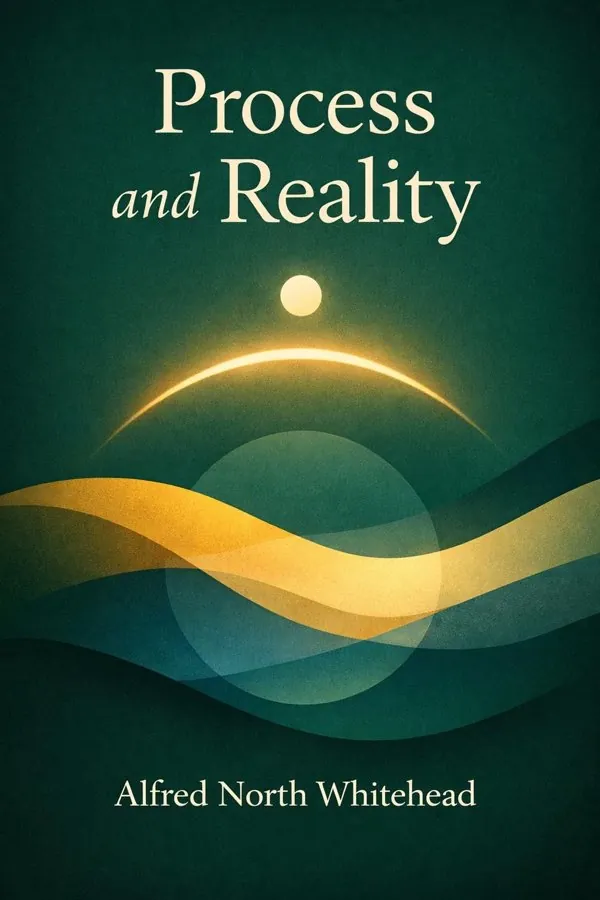
Process and Reality: An Essay in Cosmology
Process and Reality: An Essay in Cosmology is Alfred North Whitehead’s most ambitious philosophical work and one of the defining texts of modern metaphysics. In it, Whitehead argues that reality is not fundamentally made of fixed substances or isolated things, but of events, relations, and ongoing processes of becoming. The world, on this view, is alive with activity: every moment emerges by taking account of what came before and contributing something new to what comes after. To express this vision, Whitehead develops a dense but powerful conceptual framework built around actual occasions, prehensions, eternal objects, creativity, and God. Why does this matter? Because Whitehead offers a serious alternative to the mechanical worldview that has shaped much of modern thought. His philosophy speaks not only to metaphysics, but also to science, ecology, psychology, theology, and systems thinking. It helps readers see reality as interconnected, dynamic, and creative. Whitehead brings unusual authority to this project: before becoming a major philosopher, he was already a distinguished mathematician and co-author of Principia Mathematica with Bertrand Russell. Process and Reality is difficult, but it rewards readers with a radically fresh way of understanding existence itself.
Read SummaryKey Insights from Alfred North Whitehead
Reality Begins with Actual Occasions
What if the basic units of reality are not things, but events? That is Whitehead’s starting point, and it is the decisive break that powers the whole of Process and Reality. Instead of treating the world as made of enduring substances—rocks, chairs, atoms, or selves conceived as self-contained objec...
From Process and Reality: An Essay in Cosmology
The Speculative Scheme Reframes Metaphysics
A philosophy matters most when it changes the questions we ask. In Part I, Whitehead proposes a “speculative scheme,” a full set of categories meant to interpret every kind of experience without reducing some parts of reality to others. He believes traditional metaphysics has repeatedly failed becau...
From Process and Reality: An Essay in Cosmology
The Categoreal Scheme Orders Becoming
Chaos becomes intelligible only when we identify the principles that govern it. Whitehead’s “categoreal scheme” is his attempt to specify the basic conditions under which any actual occasion can arise. These categories are not meant as arbitrary labels. They are metaphysical principles extracted fro...
From Process and Reality: An Essay in Cosmology
Prehension Makes Relation Fundamental
We do not first exist alone and then connect; connection is built into existence from the start. Whitehead captures this with one of his most famous and difficult concepts: prehension. A prehension is the way an actual occasion takes account of, feels, or grasps aspects of the world. It is broader t...
From Process and Reality: An Essay in Cosmology
Feelings Build the Texture of Experience
Reason is not the foundation of life; feeling is. In Whitehead’s theory, “feelings” are not merely human emotions like joy, anger, or sadness. They are the basic modes by which an actual occasion absorbs and integrates data from the world. Feeling is the concrete process of taking account of what is...
From Process and Reality: An Essay in Cosmology
Eternal Objects Shape Possibility and Form
Novelty needs form, or else it dissolves into chaos. Whitehead introduces “eternal objects” to explain how definite patterns, qualities, and possibilities can enter the becoming of actual occasions. Eternal objects are pure potentials for definiteness: colors, shapes, mathematical relations, values,...
From Process and Reality: An Essay in Cosmology
About Alfred North Whitehead
Alfred North Whitehead (1861–1947) was a British mathematician and philosopher best known for his work in logic, mathematics, and metaphysics. He co-authored Principia Mathematica with Bertrand Russell and later developed process philosophy, emphasizing the dynamic and relational nature of reality. ...
Read more
Alfred North Whitehead (1861–1947) was a British mathematician and philosopher best known for his work in logic, mathematics, and metaphysics. He co-authored Principia Mathematica with Bertrand Russell and later developed process philosophy, emphasizing the dynamic and relational nature of reality. ...
Alfred North Whitehead (1861–1947) was a British mathematician and philosopher best known for his work in logic, mathematics, and metaphysics. He co-authored Principia Mathematica with Bertrand Russell and later developed process philosophy, emphasizing the dynamic and relational nature of reality. Whitehead’s thought has had lasting influence across philosophy, theology, and the natural sciences.


Frequently Asked Questions
Alfred North Whitehead (1861–1947) was a British mathematician and philosopher best known for his work in logic, mathematics, and metaphysics. He co-authored Principia Mathematica with Bertrand Russell and later developed process philosophy, emphasizing the dynamic and relational nature of reality.
Read Alfred North Whitehead's books in 15 minutes
Get AI-powered summaries with key insights from 1 book by Alfred North Whitehead.