
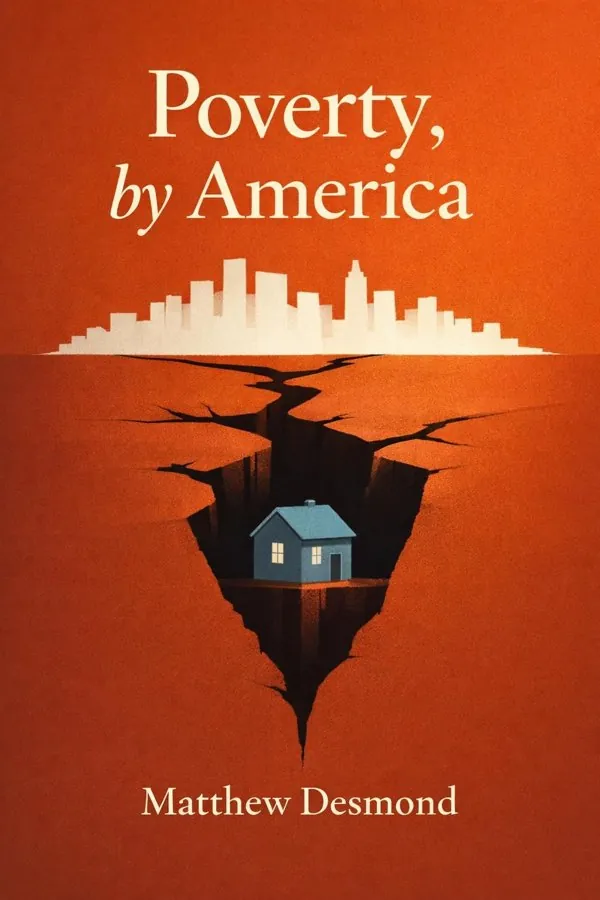
Poverty, by America: Summary & Key Insights
 10 min10 chaptersAudio available
What Is Poverty, by America About?
Poverty, by America by Matthew Desmond is a sociology book spanning 10 pages. In this powerful and deeply researched work, sociologist Matthew Desmond explores why poverty persists in the United States, one of the wealthiest nations in the world. Building on his Pulitzer Prize–winning insights from 'Evicted', Desmond argues that poverty endures not because of a lack of resources but because the affluent benefit from its existence. Through data, storytelling, and moral inquiry, he reveals how systems of housing, labor, and policy perpetuate inequality and calls for a reimagining of American social responsibility.
This FizzRead summary covers all 10 key chapters of Poverty, by America in approximately 10 minutes, distilling the most important ideas, arguments, and takeaways from Matthew Desmond's work. Also available as an audio summary and Key Quotes Podcast.
Poverty, by America
In this powerful and deeply researched work, sociologist Matthew Desmond explores why poverty persists in the United States, one of the wealthiest nations in the world. Building on his Pulitzer Prize–winning insights from 'Evicted', Desmond argues that poverty endures not because of a lack of resources but because the affluent benefit from its existence. Through data, storytelling, and moral inquiry, he reveals how systems of housing, labor, and policy perpetuate inequality and calls for a reimagining of American social responsibility.
Who Should Read Poverty, by America?
This book is perfect for anyone interested in sociology and looking to gain actionable insights in a short read. Whether you're a student, professional, or lifelong learner, the key ideas from Poverty, by America by Matthew Desmond will help you think differently.
- ✓Readers who enjoy sociology and want practical takeaways
- ✓Professionals looking to apply new ideas to their work and life
- ✓Anyone who wants the core insights of Poverty, by America in just 10 minutes
Want the full summary?
Get instant access to this book summary and 100K+ more with Fizz Moment.
Get Free SummaryAvailable on App Store • Free to download
Key Chapters
To understand the persistence of poverty in America, we must first confront the historical layers that have built this reality. Long before welfare programs or minimum wages existed, American economic policy favored accumulation for the few. From the beginnings of industrial capitalism, cheap labor was treated as a national resource—enslaved labor, then exploited immigrant workforces, later low-wage service jobs. The structures regulating markets, property, and labor were never neutral. They encoded advantages for those already positioned at the top.
After the Second World War, when prosperity became the accepted narrative, a vast network of subsidies and tax incentives was created—not for the poor but primarily for homeowners and investors. White middle-class families benefited from federal mortgage guarantees; redlining and segregation ensured black families were excluded. The policies that fueled suburban growth were economic engines of exclusion. The social contract promised upward mobility but delivered it selectively.
This history matters because it reveals that poverty was never an unintended side effect; it was a byproduct of designed inequality. Every generation has refined the mechanisms of extraction—from discriminatory housing policy to unequal education funding—turning poverty into something enduring and self-reinforcing. Recognizing these patterns is not an academic exercise; it is the first step toward dismantling them.
I use the term 'exploitation' deliberately. It describes more than hardship; it captures the asymmetry of benefit in our economy. The wealthy and the comfortable profit directly from the poverty of others. Each time a worker earns less than the value of their labor, exploitation occurs. Every time rent absorbs half a paycheck in unsafe housing, exploitation operates. It is not just systemic—it is relational.
In my research, I traced these connections through employers who keep wages low using contract labor, landlords who raise rents because alternatives are scarce, and tax structures that reward investment over income. Society’s middle class often stands quietly within this chain, benefiting indirectly from cheap goods and services but rarely seeing the cost borne by someone else’s suffering.
What makes exploitation insidious is its normalization. The economy tells us these exchanges are fair because they are voluntary. Yet when a mother chooses between paying rent and feeding her children, choice becomes a disguise for coercion. I argue that our prosperity, both individual and collective, is intertwined with exploitation—and until we face that truth, real reform will remain impossible.
+ 8 more chapters — available in the FizzRead app
All Chapters in Poverty, by America
About the Author
Matthew Desmond is an American sociologist and professor at Princeton University. He is best known for his research on poverty, housing, and public policy. His previous book, 'Evicted: Poverty and Profit in the American City', won the Pulitzer Prize for General Nonfiction in 2017. Desmond is the founder of the Eviction Lab, which studies housing instability and inequality in the United States.
Get This Summary in Your Preferred Format
Read or listen to the Poverty, by America summary by Matthew Desmond anytime, anywhere. FizzRead offers multiple formats so you can learn on your terms — all free.
Available formats: App · Audio · PDF · EPUB — All included free with FizzRead
Download Poverty, by America PDF and EPUB Summary
Key Quotes from Poverty, by America
“To understand the persistence of poverty in America, we must first confront the historical layers that have built this reality.”
“I use the term 'exploitation' deliberately.”
Frequently Asked Questions about Poverty, by America
Poverty, by America by Matthew Desmond is a sociology book that explores key ideas across 10 chapters. In this powerful and deeply researched work, sociologist Matthew Desmond explores why poverty persists in the United States, one of the wealthiest nations in the world. Building on his Pulitzer Prize–winning insights from 'Evicted', Desmond argues that poverty endures not because of a lack of resources but because the affluent benefit from its existence. Through data, storytelling, and moral inquiry, he reveals how systems of housing, labor, and policy perpetuate inequality and calls for a reimagining of American social responsibility.
More by Matthew Desmond
You Might Also Like

Between the World and Me
Ta-Nehisi Coates
10 min
Half the Sky
Nicholas D. Kristof, Sheryl WuDunn
10 min
Men Explain Things To Me
Rebecca Solnit
10 min
Rational Ritual
Michael Suk-Young Chwe
10 min
The New Jim Crow
Michelle Alexander
10 min
Beyond Culture
Edward T. Hall
10 minBrowse by Category
Ready to read Poverty, by America?
Get the full summary and 100K+ more books with Fizz Moment.