
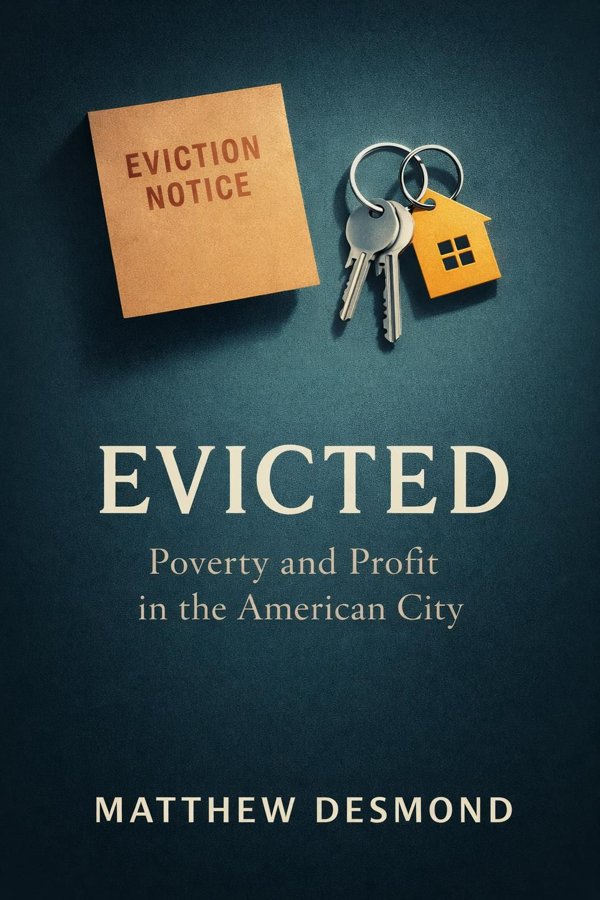
Evicted: Poverty and Profit in the American City: Summary & Key Insights
 10 min9 chaptersAudio available
Key Takeaways from Evicted: Poverty and Profit in the American City
The strongest sociology often begins with a simple but radical choice: to get close enough to reality that statistics turn back into human lives.
Poverty is often less a steady condition than a constant emergency, and Arleen’s story shows how exhausting that emergency can become.
A society reveals its moral priorities by how it treats those who are least able to withstand market pressures.
One of the book’s most unsettling insights is that poverty can be profitable.
An eviction does not end at the front door; it ripples through schools, workplaces, neighborhoods, and entire family networks.
What Is Evicted: Poverty and Profit in the American City About?
Evicted: Poverty and Profit in the American City by Matthew Desmond is a sociology book spanning 7 pages. Evicted: Poverty and Profit in the American City is a landmark work of sociology that examines what happens when housing insecurity becomes a normal part of American life. In this deeply reported book, Matthew Desmond follows eight families in Milwaukee as they struggle to pay rent, avoid displacement, and survive in a system that punishes instability with even more instability. Rather than treating eviction as a side effect of poverty, Desmond argues that it is one of poverty’s central engines. Losing a home triggers job loss, school disruption, debt, trauma, damaged health, and exclusion from future housing, creating a cycle that is brutally difficult to escape. What makes the book so powerful is its blend of rigorous research and intimate storytelling. Desmond did not study eviction from a distance; he lived in the neighborhoods he wrote about, spent time with both tenants and landlords, and traced how legal, economic, and racial inequalities shape everyday housing decisions. His authority comes not only from academic expertise but from immersive fieldwork and moral clarity. The result is a vivid, unsettling portrait of urban poverty that changes how readers understand rent, profit, and the meaning of home.
This FizzRead summary covers all 9 key chapters of Evicted: Poverty and Profit in the American City in approximately 10 minutes, distilling the most important ideas, arguments, and takeaways from Matthew Desmond's work. Also available as an audio summary and Key Quotes Podcast.
Evicted: Poverty and Profit in the American City
Evicted: Poverty and Profit in the American City is a landmark work of sociology that examines what happens when housing insecurity becomes a normal part of American life. In this deeply reported book, Matthew Desmond follows eight families in Milwaukee as they struggle to pay rent, avoid displacement, and survive in a system that punishes instability with even more instability. Rather than treating eviction as a side effect of poverty, Desmond argues that it is one of poverty’s central engines. Losing a home triggers job loss, school disruption, debt, trauma, damaged health, and exclusion from future housing, creating a cycle that is brutally difficult to escape.
What makes the book so powerful is its blend of rigorous research and intimate storytelling. Desmond did not study eviction from a distance; he lived in the neighborhoods he wrote about, spent time with both tenants and landlords, and traced how legal, economic, and racial inequalities shape everyday housing decisions. His authority comes not only from academic expertise but from immersive fieldwork and moral clarity. The result is a vivid, unsettling portrait of urban poverty that changes how readers understand rent, profit, and the meaning of home.
Who Should Read Evicted: Poverty and Profit in the American City?
This book is perfect for anyone interested in sociology and looking to gain actionable insights in a short read. Whether you're a student, professional, or lifelong learner, the key ideas from Evicted: Poverty and Profit in the American City by Matthew Desmond will help you think differently.
- ✓Readers who enjoy sociology and want practical takeaways
- ✓Professionals looking to apply new ideas to their work and life
- ✓Anyone who wants the core insights of Evicted: Poverty and Profit in the American City in just 10 minutes
Want the full summary?
Get instant access to this book summary and 100K+ more with Fizz Moment.
Get Free SummaryAvailable on App Store • Free to download
Key Chapters
The strongest sociology often begins with a simple but radical choice: to get close enough to reality that statistics turn back into human lives. Matthew Desmond’s method in Evicted is central to the book’s power. Rather than relying only on surveys, court records, or policy reports, he moved into the neighborhoods where eviction was common, rented from the same kinds of landlords his subjects dealt with, and spent long stretches of time with tenants, property owners, movers, caseworkers, and court officials. This approach allowed him to capture eviction not as a single legal event but as a lived process filled with dread, bargaining, humiliation, improvisation, and loss.
Desmond’s immersive fieldwork reveals patterns that abstract data alone can miss. He shows how a family can appear “irresponsible” from the outside while actually making impossible choices between rent, food, medicine, transportation, and childcare. He also shows that landlords are not faceless villains in every case; they operate inside economic incentives and neighborhood conditions that reward extraction and tolerate instability. By following both sides, he uncovers a housing market built on desperation.
This method matters beyond sociology. In business, policy, education, and healthcare, leaders often design solutions from a distance. Desmond’s example suggests that durable understanding requires proximity. If a city wants to reduce homelessness, if a nonprofit wants to support families, or if a journalist wants to cover inequality responsibly, they must observe daily reality where decisions are made and consequences are felt.
Actionable takeaway: when trying to understand any social problem, start by listening to people living through it and examine the system around them, not just the outcomes on paper.
Poverty is often less a steady condition than a constant emergency, and Arleen’s story shows how exhausting that emergency can become. A single mother trying to care for her sons, Arleen lives in a world where one setback can unravel everything. She is not simply poor; she is precariously housed, which means every unpaid bill, every landlord warning, and every family dispute carries the threat of displacement. Her life illustrates a brutal truth at the center of the book: when rent consumes most of a family’s income, stability becomes nearly impossible.
Desmond follows Arleen through repeated housing crises, showing how eviction is not just a move from one address to another. It is a social and emotional shock. Children lose routines, schools, neighbors, and belongings. Mothers are forced to negotiate with landlords, borrow from relatives, appeal to charities, and make impossible trade-offs just to secure another temporary roof. Arleen’s story also exposes how scarce affordable housing narrows choices. Families do not select the “best” apartment; they choose what they can get before time runs out.
Her experience is practical evidence of a broader idea: poverty is worsened when the cost of survival leaves no margin for error. This can be seen in many cities, where families spend over half their income on rent and then face crisis after crisis because they have no buffer. One missed paycheck or illness becomes catastrophic.
Actionable takeaway: if you want to understand economic hardship, look first at whether people have enough stable housing to create room for work, parenting, health, and recovery.
A society reveals its moral priorities by how it treats those who are least able to withstand market pressures. Lamar, a disabled man trying to maintain dignity and connection despite severe physical limitations, represents a population that is often overlooked in discussions of housing: the disabled poor. His story shows that vulnerability in the rental market is not only about low wages. It is also about physical dependence, stigma, limited mobility, and the fragile social networks that keep people afloat.
Desmond presents Lamar as resourceful, generous, and deeply human, resisting the stereotype that poor tenants are passive or reckless. Yet his disability makes ordinary housing barriers even more punishing. Apartments may be unsafe or poorly maintained, but alternatives are scarce. Informal support systems can help for a while, but they are unstable. What emerges is a portrait of a person trying to exercise agency in an environment designed without him in mind.
Lamar’s experience broadens the book’s argument. Eviction is not one uniform event; it interacts with disability, health, age, addiction, parenthood, and social isolation in different ways. For disabled tenants, losing housing can mean losing the practical conditions necessary to survive: access to medication, a place to recover physically, or proximity to caregivers and transport.
The lesson extends to policy and service design. Accessible housing, legal aid, rental assistance, and coordinated healthcare are not separate concerns. For many people, they are the same problem viewed from different angles. Organizations that work with disabled adults, veterans, or chronically ill residents can use Desmond’s insight to design support around housing first, not housing last.
Actionable takeaway: when evaluating poverty interventions, ask whether they reduce housing instability for people with the fewest physical and social resources.
One of the book’s most unsettling insights is that poverty can be profitable. Through figures like Sherrena and Quentin, Desmond examines the landlord’s perspective, not to excuse predatory practices but to show how the rental market rewards them. In distressed neighborhoods, landlords may purchase properties cheaply, charge relatively high rents compared with unit quality, and rely on tenants with few alternatives. Late fees, court costs, and serial turnover can become part of the business model. In that environment, eviction is not simply a breakdown; it can be a routine management tool.
This challenges a comforting myth that dysfunctional housing markets are just the result of a few bad actors. Desmond shows instead that the structure of the market matters. When demand for affordable units exceeds supply, when inspection regimes are weak, and when tenants lack legal power, owners can profit even while providing substandard housing. Some landlords see themselves as offering a difficult but necessary service, and in many ways they are. But the incentives they face often make extraction easier than stewardship.
This dynamic appears in many sectors: whenever one side of a transaction has fewer choices, the stronger side can normalize unfair terms. In housing, the consequences are especially severe because shelter is not optional. A family can delay buying clothes or furniture, but it cannot opt out of rent.
For readers interested in policy, this chapter suggests that fixing poverty requires more than helping individuals budget better. It requires changing the incentives around low-income housing through enforcement, voucher expansion, legal representation, and increased supply of safe, affordable units.
Actionable takeaway: when a market repeatedly harms vulnerable people, study the incentives driving behavior instead of blaming only individual character.
An eviction does not end at the front door; it ripples through schools, workplaces, neighborhoods, and entire family networks. Desmond demonstrates that eviction is not merely a private dispute between tenant and landlord. It is a community-wide shock that destabilizes local life. When families are forced out, children switch schools or miss classes, parents lose access to transport and childcare arrangements, relatives take on emergency burdens, and neighborhoods experience a constant churn that weakens trust and solidarity.
The book carefully details the process itself: notices, court dates, missed payments, negotiations, sheriff-supervised removals, and the humiliating sight of possessions piled on sidewalks. Yet the legal event is only one part of the disruption. Even the threat of eviction changes behavior. Families avoid reporting code violations for fear of retaliation. They move in with others, crowding apartments and straining relationships. They accept dangerous living conditions because any complaint could mean losing the unit.
This insight has practical implications for schools, employers, and community organizations. A child’s poor academic performance may be tied to housing churn, not lack of ability. A worker’s inconsistency may reflect repeated moves and transportation collapse, not indifference. A neighborhood association may struggle not because residents do not care, but because residents are constantly being displaced.
Desmond effectively reframes eviction as a hidden force behind social fragmentation. Stable communities need stable homes. Without that foundation, even well-designed programs in education, public health, and workforce development will be less effective because the people they aim to help are always being uprooted.
Actionable takeaway: treat housing stability as basic social infrastructure, because almost every institution works worse when families are forced to move again and again.
Housing injustice is never only about money; it is also about who is seen as risky, expendable, or easy to remove. Desmond shows that eviction falls unevenly across lines of race and gender, with poor Black women facing especially high levels of displacement. This pattern is not accidental. It reflects a long history of segregation, labor market discrimination, neighborhood disinvestment, punitive welfare systems, and stereotypes that shape landlord decisions, policing, and court outcomes.
The book helps readers see how race operates structurally rather than only through explicit prejudice. Black tenants may be concentrated in neighborhoods with fewer quality units and more aggressive rent extraction. Women with children may be penalized because landlords perceive them as costly or complicated tenants. Prior evictions then become screening barriers, making future housing searches even harder. The result is cumulative disadvantage: the same groups who face fewer opportunities in employment and wealth-building are also more likely to experience housing instability.
Desmond’s contribution is to connect broad inequality to intimate daily life. Racial inequality is not only visible in wealth gaps or incarceration statistics; it appears in the fear of a knock at the door, in the scramble to find another apartment, and in the shame attached to being judged unfit for housing. For practitioners, this means housing policy cannot be race-neutral in effect if historical and institutional inequalities remain unaddressed.
Examples of application include targeted legal aid in high-eviction neighborhoods, anti-discrimination enforcement, data transparency on landlord filings, and tenant protections for families with children. These are not symbolic measures; they directly affect who gets to remain housed.
Actionable takeaway: whenever you study poverty, ask which groups bear the highest burden and how history and policy have concentrated risk on them.
What looks like poor decision-making from the outside often looks different when viewed under severe scarcity. A central insight in Evicted is that people living on the edge are not simply making bad choices; they are making constrained choices in conditions that punish long-term planning. When nearly all income goes to rent, and when emergencies are common, people are forced into short-term trade-offs that can appear irrational to outsiders but are entirely understandable in context.
Desmond shows families choosing between paying rent and buying food, between keeping lights on and covering transportation, between tolerating dangerous housing conditions and risking a move they cannot afford. Scarcity narrows attention. If a mother must find money by Friday to avoid lockout, she cannot organize her life around six-month goals. If a tenant has been repeatedly rejected because of prior evictions, he may accept an overpriced, poorly maintained unit because delay means homelessness.
This idea matters well beyond housing. Scarcity influences cognition, stress, relationships, and timing. It reduces the mental bandwidth available for forms, appointments, job searches, and strategic planning. Institutions often misunderstand this and design programs that assume spare time, emotional stability, and transport access. Then they interpret missed deadlines as lack of commitment.
In practical terms, Desmond pushes readers to build systems around real human constraints. That means simpler aid applications, faster emergency funds, flexible appointment windows, and fewer penalties that compound crisis. It also means replacing moral judgment with situational understanding.
Actionable takeaway: before blaming individuals for short-term decisions, ask what options were actually available to them in that moment and what scarcity was doing to their horizon of choice.
Many societies treat stable housing as something people earn after they prove responsibility, but Desmond argues that housing stability is what makes responsibility easier to sustain. This reverses a common assumption. Instead of seeing a secure home as the end result of employment, discipline, and order, Evicted shows that a home is one of the basic conditions that allows those qualities to develop. Without a stable address, routines collapse. Work becomes harder to keep. Children struggle to learn. Health deteriorates. Family stress rises.
This is one of the book’s most important conceptual contributions. It explains why anti-poverty programs can fail when they do not address housing directly. Job training matters, but it is less effective if participants are moving repeatedly. Counseling matters, but it is harder to benefit from therapy while living under constant threat of displacement. Educational support matters, but children cannot thrive academically when their sleeping arrangements change every few weeks.
The insight has clear applications. Employers can support workers through rent emergency funds or housing referrals. Schools can identify frequent mobility as a serious risk factor. Hospitals and clinics can screen for housing instability because it affects treatment adherence and recovery. Policymakers can treat rental assistance as preventive infrastructure rather than charitable relief.
Desmond also challenges the moral language surrounding poor tenants. If home is a precondition for flourishing, then denying stable housing because people are already struggling only deepens the very behaviors society claims to oppose.
Actionable takeaway: think of housing as a platform that supports employment, education, parenting, and health, not as a prize reserved for those who have already mastered them.
Small acts of generosity can relieve suffering, but large structural problems require structural solutions. By the end of Evicted, Desmond makes clear that eviction cannot be solved through empathy alone. The issue is too widespread and too deeply embedded in the economics of American housing. If millions of low-income renters spend most of their income on shelter, then the problem is not personal failure but a mismatch between wages, rents, legal protections, and the supply of affordable homes.
Desmond’s policy vision is shaped by the evidence he has gathered. He emphasizes the need for expanded housing assistance, arguing that if people below a certain income threshold can access support for rent, the cascade of crisis triggered by eviction could be reduced dramatically. He also points toward stronger tenant protections, fairer courts, better enforcement of housing quality standards, and broader public recognition that decent housing is a social necessity.
What makes this argument compelling is that it is both moral and pragmatic. Preventing eviction can reduce costs in healthcare, child welfare, shelters, policing, and education. It can also preserve community stability and human dignity. For readers who prefer market-based reasoning, the book shows that the current system already imposes enormous hidden costs; it simply shifts them onto poor families and public institutions.
For civic leaders, the lesson is clear: data collection, eviction defense, emergency rental assistance, and affordable housing construction should be coordinated, not siloed. For ordinary readers, the lesson is that private charity, while valuable, cannot substitute for policy that changes the baseline conditions of housing insecurity.
Actionable takeaway: support reforms that reduce rent burden and prevent forced displacement, because meaningful change must operate at the same scale as the problem.
All Chapters in Evicted: Poverty and Profit in the American City
About the Author
Matthew Desmond is an American sociologist, author, and professor whose work focuses on poverty, housing, and inequality in the United States. Trained as an ethnographer, he is known for combining close field research with large-scale social analysis, helping readers see how structural forces shape everyday life. His book Evicted: Poverty and Profit in the American City received the 2017 Pulitzer Prize for General Nonfiction and became a major influence on public conversations about affordable housing and displacement. Desmond is also the founder of the Eviction Lab, a research initiative that gathers national data on eviction and promotes evidence-based housing policy. His writing stands out for its clarity, compassion, and ability to connect academic sociology with urgent public questions.
Get This Summary in Your Preferred Format
Read or listen to the Evicted: Poverty and Profit in the American City summary by Matthew Desmond anytime, anywhere. FizzRead offers multiple formats so you can learn on your terms — all free.
Available formats: App · Audio · PDF · EPUB — All included free with FizzRead
Download Evicted: Poverty and Profit in the American City PDF and EPUB Summary
Key Quotes from Evicted: Poverty and Profit in the American City
“The strongest sociology often begins with a simple but radical choice: to get close enough to reality that statistics turn back into human lives.”
“Poverty is often less a steady condition than a constant emergency, and Arleen’s story shows how exhausting that emergency can become.”
“A society reveals its moral priorities by how it treats those who are least able to withstand market pressures.”
“One of the book’s most unsettling insights is that poverty can be profitable.”
“An eviction does not end at the front door; it ripples through schools, workplaces, neighborhoods, and entire family networks.”
Frequently Asked Questions about Evicted: Poverty and Profit in the American City
Evicted: Poverty and Profit in the American City by Matthew Desmond is a sociology book that explores key ideas across 9 chapters. Evicted: Poverty and Profit in the American City is a landmark work of sociology that examines what happens when housing insecurity becomes a normal part of American life. In this deeply reported book, Matthew Desmond follows eight families in Milwaukee as they struggle to pay rent, avoid displacement, and survive in a system that punishes instability with even more instability. Rather than treating eviction as a side effect of poverty, Desmond argues that it is one of poverty’s central engines. Losing a home triggers job loss, school disruption, debt, trauma, damaged health, and exclusion from future housing, creating a cycle that is brutally difficult to escape. What makes the book so powerful is its blend of rigorous research and intimate storytelling. Desmond did not study eviction from a distance; he lived in the neighborhoods he wrote about, spent time with both tenants and landlords, and traced how legal, economic, and racial inequalities shape everyday housing decisions. His authority comes not only from academic expertise but from immersive fieldwork and moral clarity. The result is a vivid, unsettling portrait of urban poverty that changes how readers understand rent, profit, and the meaning of home.
More by Matthew Desmond
You Might Also Like

Between the World and Me
Ta-Nehisi Coates
10 min
Half the Sky
Nicholas D. Kristof, Sheryl WuDunn
10 min
Men Explain Things To Me
Rebecca Solnit
10 min
Rational Ritual
Michael Suk-Young Chwe
10 min
The New Jim Crow
Michelle Alexander
10 min
Beyond Culture
Edward T. Hall
10 minBrowse by Category
Ready to read Evicted: Poverty and Profit in the American City?
Get the full summary and 100K+ more books with Fizz Moment.