
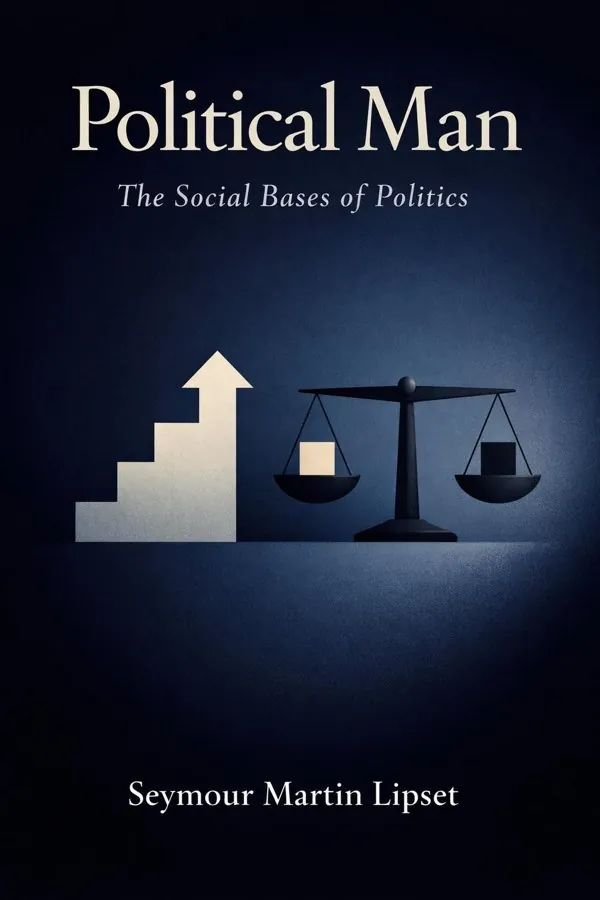
Political Man: The Social Bases of Politics: Summary & Key Insights
 10 min9 chaptersAudio available
Key Takeaways from Political Man: The Social Bases of Politics
Political conflict rarely starts in parliament; it starts in society.
Prosperity does not automatically create freedom, but Lipset argues that economic development strongly improves the chances that democracy will endure.
A democracy survives not only because it is legal, but because it is believed to be rightful.
Much of modern politics is the organized expression of social inequality.
Religious belief is personal, but religious politics is profoundly social.
What Is Political Man: The Social Bases of Politics About?
Political Man: The Social Bases of Politics by Seymour Martin Lipset is a sociology book spanning 11 pages. Political Man: The Social Bases of Politics is one of the defining works of modern political sociology because it asks a deceptively simple question: why do some societies sustain democracy while others fall into extremism, instability, or authoritarian rule? Seymour Martin Lipset answers by looking beneath constitutions, leaders, and party slogans to the social structure itself. He argues that political life is rooted in class divisions, religious traditions, education levels, patterns of social mobility, economic development, and the legitimacy citizens grant to institutions. In other words, politics is never just about ideas; it is also about the social conditions that make certain ideas attractive, credible, or dangerous. What makes the book so enduring is its comparative method and broad ambition. Lipset moves across countries, regimes, and historical moments to show recurring patterns in democratic stability and political conflict. As a leading sociologist and political scientist, Lipset brought together empirical evidence and big theory in a way few scholars have matched. The result is a foundational book for anyone who wants to understand not only how politics works, but why democracy succeeds in some places and struggles in others.
This FizzRead summary covers all 9 key chapters of Political Man: The Social Bases of Politics in approximately 10 minutes, distilling the most important ideas, arguments, and takeaways from Seymour Martin Lipset's work. Also available as an audio summary and Key Quotes Podcast.
Political Man: The Social Bases of Politics
Political Man: The Social Bases of Politics is one of the defining works of modern political sociology because it asks a deceptively simple question: why do some societies sustain democracy while others fall into extremism, instability, or authoritarian rule? Seymour Martin Lipset answers by looking beneath constitutions, leaders, and party slogans to the social structure itself. He argues that political life is rooted in class divisions, religious traditions, education levels, patterns of social mobility, economic development, and the legitimacy citizens grant to institutions. In other words, politics is never just about ideas; it is also about the social conditions that make certain ideas attractive, credible, or dangerous. What makes the book so enduring is its comparative method and broad ambition. Lipset moves across countries, regimes, and historical moments to show recurring patterns in democratic stability and political conflict. As a leading sociologist and political scientist, Lipset brought together empirical evidence and big theory in a way few scholars have matched. The result is a foundational book for anyone who wants to understand not only how politics works, but why democracy succeeds in some places and struggles in others.
Who Should Read Political Man: The Social Bases of Politics?
This book is perfect for anyone interested in sociology and looking to gain actionable insights in a short read. Whether you're a student, professional, or lifelong learner, the key ideas from Political Man: The Social Bases of Politics by Seymour Martin Lipset will help you think differently.
- ✓Readers who enjoy sociology and want practical takeaways
- ✓Professionals looking to apply new ideas to their work and life
- ✓Anyone who wants the core insights of Political Man: The Social Bases of Politics in just 10 minutes
Want the full summary?
Get instant access to this book summary and 100K+ more with Fizz Moment.
Get Free SummaryAvailable on App Store • Free to download
Key Chapters
Prosperity does not automatically create freedom, but Lipset argues that economic development strongly improves the chances that democracy will endure. His famous thesis links wealth, industrialization, urbanization, and education to democratic stability. As societies grow richer, they typically develop larger middle classes, broader literacy, more complex organizations, and less desperate forms of conflict. These changes make compromise more likely and revolutionary politics less attractive.
The mechanism is social as much as economic. Development expands communication, encourages specialization, and creates institutions between the individual and the state: unions, professional associations, civic organizations, universities, and media systems. It also tends to reduce zero-sum political struggles. In very poor societies, politics can feel existential because losing power may mean exclusion from resources, dignity, or survival itself. In more developed societies, conflict does not disappear, but it is more likely to be negotiated through institutions.
Lipset does not claim that all wealthy societies are democratic or that all poor societies are authoritarian. Rather, he shows a pattern: democracy is more likely to survive where economic development has created social complexity and legitimacy. Contemporary examples still support the broad insight. Countries with strong educational systems, functioning bureaucracies, and broad-based prosperity tend to have more resilient democratic institutions than countries marked by extreme poverty and weak state capacity.
For readers today, this idea is useful beyond cross-national comparison. It suggests that democratic stability depends not only on elections and constitutions but also on long-term investments in education, economic opportunity, and civic infrastructure. When large groups feel excluded from growth, trust in democracy can erode.
Actionable takeaway: If you care about democratic resilience, pay attention to economic inclusion, education, and institution-building, not just electoral rules or campaign rhetoric.
A democracy survives not only because it is legal, but because it is believed to be rightful. Lipset argues that stable political systems depend on two connected qualities: legitimacy and effectiveness. Effectiveness refers to a regime’s ability to solve problems, maintain order, and deliver acceptable outcomes. Legitimacy refers to the belief that the regime has a rightful claim to govern. A government may be efficient but unloved, or popular but incompetent; durable democracy needs enough of both.
This distinction explains why political systems can collapse even when formal institutions remain intact. If citizens no longer believe their institutions represent shared values, procedures lose authority. Elections become suspect, losses become intolerable, and opposition appears treasonous rather than normal. On the other hand, a highly legitimate system can still weaken if it repeatedly fails to govern effectively. Persistent corruption, inflation, administrative breakdown, or insecurity can drain faith from democratic norms.
Lipset’s insight is especially powerful in moments of crisis. Economic downturns, military defeat, scandal, or cultural upheaval test whether people support democratic rules only when they win, or whether they accept them as intrinsically legitimate. The stronger the legitimacy, the more likely a society is to endure conflict without abandoning democracy. The stronger the effectiveness, the more likely legitimacy is to be renewed.
This has practical relevance for institutions today. Courts need not only independence but public trust. Elections need not only procedures but widespread acceptance. Leaders need not only mandates but the capacity to govern competently. Democratic stability is social and psychological as much as constitutional.
Actionable takeaway: When evaluating a political system, ask two questions together: does it work, and do citizens believe it has the right to rule? Weakness in either area is a warning sign.
Much of modern politics is the organized expression of social inequality. Lipset treats class as one of the most important foundations of political behavior because differences in income, occupation, prestige, and life chances produce distinct political interests and worldviews. Workers, employers, professionals, and property owners often develop different attitudes toward welfare, taxation, labor rights, education, and authority not because they have abstractly chosen opposing philosophies, but because they inhabit different social realities.
Class conflict, however, does not produce the same political outcome everywhere. In some societies, class divisions are managed through reformist parties, trade unions, collective bargaining, and welfare institutions. In others, they become revolutionary, anti-systemic, or authoritarian. What matters is how deeply class antagonisms are embedded, how flexible institutions are, and whether cross-cutting identities soften conflict. A worker may vote with a class bloc in one country, with a religious community in another, or with a national movement in a third.
Lipset is particularly insightful in showing that class politics is not just about material self-interest. It also concerns dignity, status, and recognition. Social classes develop cultures, symbols, and moral vocabularies. Political parties become carriers of those identities. This helps explain why class voting can remain powerful even when policy details are unclear.
In contemporary democracies, class still matters, though often in more fragmented forms. Debates over housing, inflation, debt, wages, university access, and job security continue to reflect structural inequalities. Even so-called cultural conflicts often overlap with class location.
Actionable takeaway: To understand a party system or ideological divide, examine how class interests and status anxieties are organized, represented, and either moderated or intensified by institutions.
Religious belief is personal, but religious politics is profoundly social. Lipset shows that religion influences politics not merely through doctrine but through institutions, communities, moral authority, and collective identity. Churches, denominations, and religious networks create patterns of belonging that can shape voting behavior, attitudes toward the state, views on education, and ideas about social order.
In many societies, religion has served as a major political cleavage because it intersects with class, region, and historical conflict. A religious minority may support constitutional protections and pluralism because it fears domination. A dominant religious institution may align with conservative politics if it seeks to preserve cultural authority. Secular movements may arise not only from intellectual trends but from struggles over education, family law, and public morality. Lipset’s comparative approach makes clear that religion is not politically uniform; it can support democracy, resist it, or coexist ambiguously with it depending on context.
One reason religion matters politically is that it socializes citizens. It teaches discipline, civic participation, obligation, and trust within a community. Those habits can strengthen democratic engagement. But religion can also harden boundaries when political parties map too neatly onto confessional lines. In such cases, elections become contests between ways of life rather than contests over policy, making compromise harder.
Today, the political role of religion remains visible in debates about abortion, schooling, gender, nationalism, and minority rights. Even in secularizing societies, inherited religious divisions often survive culturally and politically.
Actionable takeaway: When analyzing political behavior, do not reduce religion to private belief. Look at its institutions, social networks, and historical conflicts to understand how it shapes political alliances and democratic stability.
Democracy depends on more than the right to vote; it depends on citizens who can navigate public life. Lipset emphasizes education as one of the strongest social supports for democratic participation and tolerance. More educated citizens are generally better able to follow political debates, evaluate competing claims, engage with abstract principles, and participate in associations that connect private life to public institutions. Education broadens horizons and often makes individuals less vulnerable to simplistic propaganda or authoritarian appeals.
This does not mean educated people always make wise choices or agree on policy. Lipset’s point is subtler: education tends to foster the social and cognitive capacities that democratic life requires. It encourages literacy, discussion, exposure to difference, and confidence in one’s ability to act politically. It also correlates with higher rates of voting, organizational membership, and civic engagement.
Education matters at the societal level too. A broadly educated population can support a more complex economy, a more professional civil service, and more informed media consumption. These conditions strengthen institutions beyond the individual voter. Conversely, societies with large educational inequalities may develop political systems in which some groups are consistently more informed, organized, and influential than others.
The relevance today is obvious. Digital media has lowered barriers to information while raising the risk of manipulation. Civic education, media literacy, and critical thinking are therefore even more important. A democratic society cannot assume that participation alone will produce good governance if citizens lack the tools to interpret public claims.
Actionable takeaway: Treat education as democratic infrastructure. Support not only access to schooling, but forms of learning that build civic competence, critical reasoning, and the capacity to engage constructively with disagreement.
Political extremism rarely appears from nowhere; it feeds on social strain, dislocation, and threatened status. Lipset explores why anti-democratic movements gain support by examining the groups most vulnerable to anxiety, resentment, and political alienation. Extremist politics often attracts those who feel displaced by modernization, humiliated by social change, or squeezed between classes and institutions. It can thrive among groups that perceive themselves as losing status, even if they are not the poorest in material terms.
This is one of the book’s most enduring contributions. Lipset shows that extremism is not simply a product of ignorance or hatred. It often reflects unstable social positions. Small proprietors threatened by large corporations, lower middle-class groups fearful of downward mobility, or communities unsettled by rapid cultural transformation may be especially receptive to movements that promise order, purity, and restored dignity. Such movements simplify complexity by identifying enemies and offering moral certainty.
Extremism also becomes more likely when democratic institutions lose legitimacy. If mainstream parties seem corrupt, unresponsive, or indistinguishable, anti-system actors can present themselves as authentic alternatives. Economic crisis intensifies the danger, but so can cultural conflict and weakened mediating institutions such as unions, parties, churches, and civic associations.
The contemporary application is clear in many countries where polarization, conspiracy thinking, and anti-establishment mobilization have spread. Lipset reminds us that defending democracy requires more than condemning extremists; it requires understanding the social conditions that make extremism attractive.
Actionable takeaway: Watch for combinations of status anxiety, weak institutions, and public distrust. Preventing extremism means rebuilding social integration and credible democratic channels before alienation hardens into anti-system politics.
The United States occupies a special place in Lipset’s analysis because it combines strong democratic continuity with unusual social and political patterns. He examines why the American case differs from many European societies, especially in relation to class politics, ideology, and party development. One of his major observations is that the United States historically lacked a mass socialist party of the kind found in much of Europe, despite industrial capitalism and social inequality. This raises a deeper question: what social conditions made American politics different?
Lipset points to several factors, including the country’s revolutionary liberal origins, religious diversity, federal structure, high levels of mobility, and widespread belief in individual opportunity. The American creed emphasized liberty, equality of opportunity, anti-aristocracy, and achievement, reducing the appeal of explicitly class-based politics. Ethnic, regional, racial, and religious divisions also cross-cut class identity, making a single working-class political movement harder to consolidate.
At the same time, American exceptionalism is not presented as simple democratic virtue. Lipset recognizes tensions in the system: racial exclusion, anti-radicalism, unequal participation, and recurrent populist backlash. The United States may be exceptional, but it is not exempt from the social bases of politics. Its conflicts are simply organized differently.
This chapter remains highly relevant for understanding why American political debates often center on culture, nationalism, religion, and individual freedom as much as on class redistribution. It also helps explain the durability of two-party competition and the persistence of anti-statist language even when government action is widely demanded.
Actionable takeaway: When comparing political systems, do not assume one model fits all. Study the specific historical myths, social cleavages, and institutional arrangements that shape each country’s political identity.
All Chapters in Political Man: The Social Bases of Politics
About the Author
Seymour Martin Lipset (1922–2006) was one of the most influential sociologists and political scientists of the twentieth century. Born in New York City, he built a distinguished academic career at Columbia University, the University of California, Berkeley, Harvard University, Stanford University, and George Mason University. Lipset’s scholarship focused on democracy, social stratification, public opinion, labor movements, political conflict, and American exceptionalism. He became especially well known for exploring the social conditions that support democratic stability, combining broad comparative theory with empirical analysis. Political Man remains his signature work and a foundational text in political sociology. Across decades of teaching and research, Lipset helped shape how scholars understand the links between economic development, legitimacy, class structure, and political behavior, leaving a lasting mark on both sociology and comparative politics.
Get This Summary in Your Preferred Format
Read or listen to the Political Man: The Social Bases of Politics summary by Seymour Martin Lipset anytime, anywhere. FizzRead offers multiple formats so you can learn on your terms — all free.
Available formats: App · Audio · PDF · EPUB — All included free with FizzRead
Download Political Man: The Social Bases of Politics PDF and EPUB Summary
Key Quotes from Political Man: The Social Bases of Politics
“Political conflict rarely starts in parliament; it starts in society.”
“Prosperity does not automatically create freedom, but Lipset argues that economic development strongly improves the chances that democracy will endure.”
“A democracy survives not only because it is legal, but because it is believed to be rightful.”
“Much of modern politics is the organized expression of social inequality.”
“Religious belief is personal, but religious politics is profoundly social.”
Frequently Asked Questions about Political Man: The Social Bases of Politics
Political Man: The Social Bases of Politics by Seymour Martin Lipset is a sociology book that explores key ideas across 9 chapters. Political Man: The Social Bases of Politics is one of the defining works of modern political sociology because it asks a deceptively simple question: why do some societies sustain democracy while others fall into extremism, instability, or authoritarian rule? Seymour Martin Lipset answers by looking beneath constitutions, leaders, and party slogans to the social structure itself. He argues that political life is rooted in class divisions, religious traditions, education levels, patterns of social mobility, economic development, and the legitimacy citizens grant to institutions. In other words, politics is never just about ideas; it is also about the social conditions that make certain ideas attractive, credible, or dangerous. What makes the book so enduring is its comparative method and broad ambition. Lipset moves across countries, regimes, and historical moments to show recurring patterns in democratic stability and political conflict. As a leading sociologist and political scientist, Lipset brought together empirical evidence and big theory in a way few scholars have matched. The result is a foundational book for anyone who wants to understand not only how politics works, but why democracy succeeds in some places and struggles in others.
You Might Also Like

Between the World and Me
Ta-Nehisi Coates
10 min
Half the Sky
Nicholas D. Kristof, Sheryl WuDunn
10 min
Men Explain Things To Me
Rebecca Solnit
10 min
Rational Ritual
Michael Suk-Young Chwe
10 min
The New Jim Crow
Michelle Alexander
10 min
Beyond Culture
Edward T. Hall
10 minBrowse by Category
Ready to read Political Man: The Social Bases of Politics?
Get the full summary and 100K+ more books with Fizz Moment.