
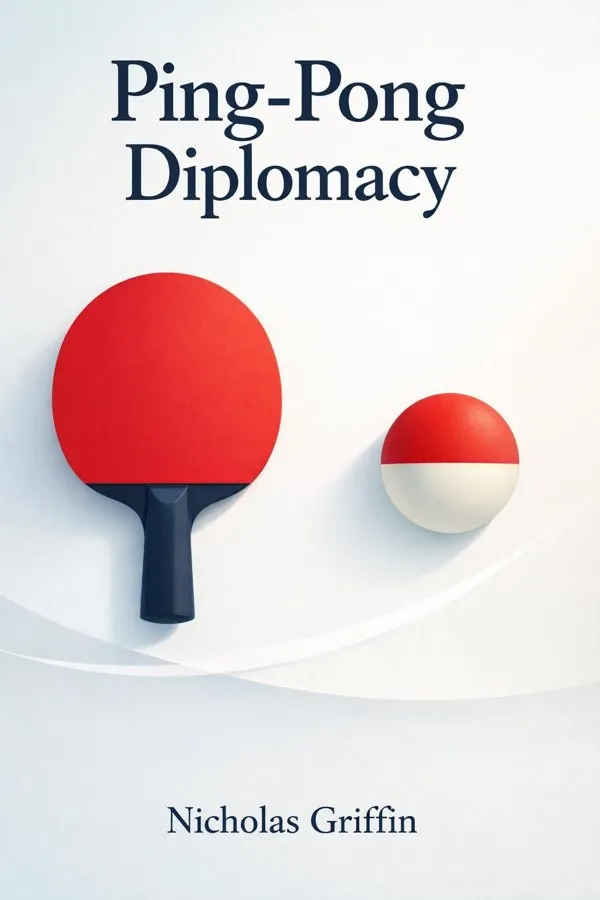
Ping-Pong Diplomacy: The Secret History Behind the Game That Changed the World: Summary & Key Insights
 10 min7 chaptersAudio available
What Is Ping-Pong Diplomacy: The Secret History Behind the Game That Changed the World About?
Ping-Pong Diplomacy: The Secret History Behind the Game That Changed the World by Nicholas Griffin is a world_history book spanning 7 pages. Ping-Pong Diplomacy: The Secret History Behind the Game That Changed the World is a historical narrative that explores how table tennis became an unlikely instrument of international diplomacy between the United States and China during the Cold War. The book traces the origins of the sport’s political significance, focusing on the events leading up to the 1971 exchange between American and Chinese players that helped thaw decades of hostility. Griffin combines sports history, political intrigue, and cultural analysis to reveal how a simple game became a turning point in global relations.
This FizzRead summary covers all 7 key chapters of Ping-Pong Diplomacy: The Secret History Behind the Game That Changed the World in approximately 10 minutes, distilling the most important ideas, arguments, and takeaways from Nicholas Griffin's work. Also available as an audio summary and Key Quotes Podcast.
Ping-Pong Diplomacy: The Secret History Behind the Game That Changed the World
Ping-Pong Diplomacy: The Secret History Behind the Game That Changed the World is a historical narrative that explores how table tennis became an unlikely instrument of international diplomacy between the United States and China during the Cold War. The book traces the origins of the sport’s political significance, focusing on the events leading up to the 1971 exchange between American and Chinese players that helped thaw decades of hostility. Griffin combines sports history, political intrigue, and cultural analysis to reveal how a simple game became a turning point in global relations.
Who Should Read Ping-Pong Diplomacy: The Secret History Behind the Game That Changed the World?
This book is perfect for anyone interested in world_history and looking to gain actionable insights in a short read. Whether you're a student, professional, or lifelong learner, the key ideas from Ping-Pong Diplomacy: The Secret History Behind the Game That Changed the World by Nicholas Griffin will help you think differently.
- ✓Readers who enjoy world_history and want practical takeaways
- ✓Professionals looking to apply new ideas to their work and life
- ✓Anyone who wants the core insights of Ping-Pong Diplomacy: The Secret History Behind the Game That Changed the World in just 10 minutes
Want the full summary?
Get instant access to this book summary and 100K+ more with Fizz Moment.
Get Free SummaryAvailable on App Store • Free to download
Key Chapters
To understand how Ping-Pong could become political, one must first step into the stark world of the Cold War. After 1949, when Mao Zedong’s revolution succeeded, the landscape of global order fractured. The United States recognized Taiwan as the legitimate Chinese government, while mainland China was rendered diplomatically invisible to the Western world. The iron curtain was not only between Washington and Moscow—it extended across the Pacific.
Through the 1950s and 1960s, mutual distrust deepened. Trade froze, communication ceased, propaganda hardened each side’s image of the other as an existential threat. Yet beneath the official posture lay a gradual awakening of pragmatists and dreamers on both sides who wondered whether such absolute division could last forever. In this world of isolation, small gestures acquired symbolic power. In my research, I found how cultural exchanges—films, art, sports—were tested as subtle tools of influence, soft weapons of diplomacy.
Still, China remained one of the most secretive nations, locked in revolutionary fervor, while America cycled through administrations cautious of any move that might appear as appeasement. The environment was so rigid that even a sport’s tournament became a realm of ideological confrontation. It was exactly this rigidity, however, that made the 1971 encounter so miraculous: tiny cracks formed where human curiosity slipped through. To grasp the meaning of Ping-Pong Diplomacy, you must first feel the silence that preceded it—a silence loud with decades of ideological fear. Only against such backdrop could a paddle strike sound political.
Table tennis began not as an arena for nations but as an eccentric recreation born in British parlors. The sport’s early players saw it as leisure, yet its structure—a game of speed, precision, and reflex—soon appealed to competitive minds worldwide. My research led me to the story of Ivor Montagu, a man whose ideals mirrored the currents of his century. Montagu was a British leftist and intellectual, steeped in socialist doctrine yet gifted with organizational genius. He founded the International Table Tennis Federation, envisioning sport as a vehicle for unity rather than division.
Montagu’s politics were vibrant and controversial. He sympathized with the Communist ideal and believed table tennis could transcend class barriers. Under his stewardship, the game spread across Europe and Asia, reaching into the Soviet bloc and soon into China. The sport grew precisely because it was universal—simple equipment, minimal space, pure skill. Governments realized its potential for soft propaganda: players could be molded into symbols of ideological triumph.
China’s adoption of the game in the 1950s was propelled by both admiration and strategy. Mao’s new government recognized that table tennis embodied socialist modesty—accessible to all, demanding discipline, and adaptable to the collective ethic. By the early 1960s, Chinese athletes began to dominate world tournaments, turning the sport into proof of national vigor. Montagu’s ideals had traveled farther than he perhaps dreamed: what he envisioned as unity through sport became, under competing systems, a tool for rivalry. Yet the seed he planted—the idea that games could unite humanity—remained at the story’s heart.
+ 5 more chapters — available in the FizzRead app
All Chapters in Ping-Pong Diplomacy: The Secret History Behind the Game That Changed the World
About the Author
Nicholas Griffin is a British author and journalist known for his works of narrative nonfiction and historical writing. His books often explore the intersection of politics, culture, and adventure, and he has contributed to major publications such as The Times and The Guardian.
Get This Summary in Your Preferred Format
Read or listen to the Ping-Pong Diplomacy: The Secret History Behind the Game That Changed the World summary by Nicholas Griffin anytime, anywhere. FizzRead offers multiple formats so you can learn on your terms — all free.
Available formats: App · Audio · PDF · EPUB — All included free with FizzRead
Download Ping-Pong Diplomacy: The Secret History Behind the Game That Changed the World PDF and EPUB Summary
Key Quotes from Ping-Pong Diplomacy: The Secret History Behind the Game That Changed the World
“To understand how Ping-Pong could become political, one must first step into the stark world of the Cold War.”
“Table tennis began not as an arena for nations but as an eccentric recreation born in British parlors.”
Frequently Asked Questions about Ping-Pong Diplomacy: The Secret History Behind the Game That Changed the World
Ping-Pong Diplomacy: The Secret History Behind the Game That Changed the World by Nicholas Griffin is a world_history book that explores key ideas across 7 chapters. Ping-Pong Diplomacy: The Secret History Behind the Game That Changed the World is a historical narrative that explores how table tennis became an unlikely instrument of international diplomacy between the United States and China during the Cold War. The book traces the origins of the sport’s political significance, focusing on the events leading up to the 1971 exchange between American and Chinese players that helped thaw decades of hostility. Griffin combines sports history, political intrigue, and cultural analysis to reveal how a simple game became a turning point in global relations.
You Might Also Like
The Age of Capital
Eric Hobsbawm
10 min
The Gulag Archipelago
Aleksandr Solzhenitsyn
10 min
Jerusalem: The Biography
Simon Sebag Montefiore
10 min
The Anglo-Saxons
James Campbell
10 min
The Boer War
Thomas Pakenham
10 min
The Industrial Revolutionaries: The Making of the Modern World 1776–1914
Gavin Weightman
10 minBrowse by Category
Ready to read Ping-Pong Diplomacy: The Secret History Behind the Game That Changed the World?
Get the full summary and 100K+ more books with Fizz Moment.