
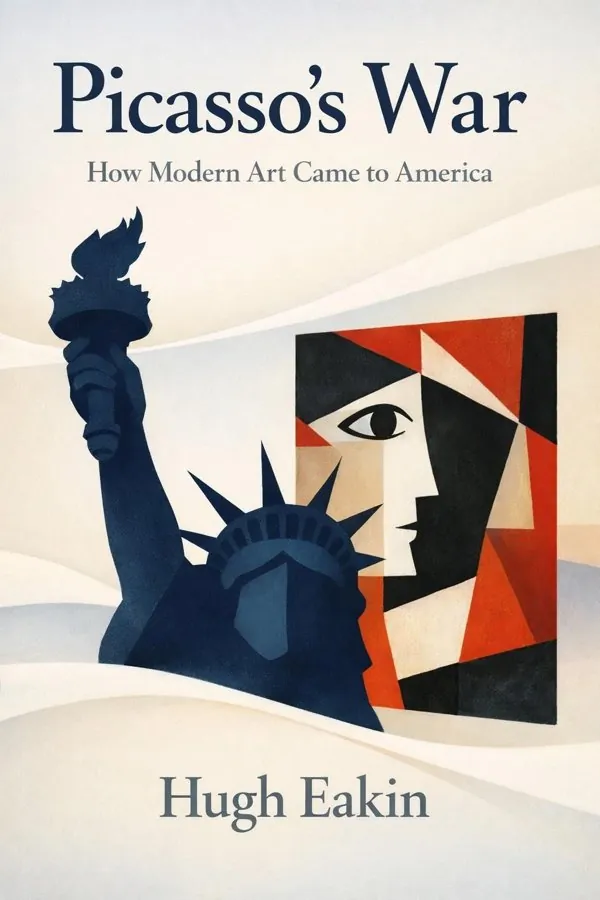
Picasso's War: How Modern Art Came to America: Summary & Key Insights
by Hugh Eakin
 10 min5 chaptersAudio available
What Is Picasso's War: How Modern Art Came to America About?
Picasso's War: How Modern Art Came to America by Hugh Eakin is a world_history book spanning 5 pages. A revelatory account of how a small group of American collectors, curators, and artists brought modern art to the United States during and after World War II, transforming the nation into the new center of the art world. Hugh Eakin traces the rivalry between figures like Alfred H. Barr Jr. of the Museum of Modern Art and Paul Rosenberg, Picasso’s dealer, showing how their efforts and the upheavals of war reshaped cultural power from Europe to America.
This FizzRead summary covers all 5 key chapters of Picasso's War: How Modern Art Came to America in approximately 10 minutes, distilling the most important ideas, arguments, and takeaways from Hugh Eakin's work. Also available as an audio summary and Key Quotes Podcast.
Picasso's War: How Modern Art Came to America
A revelatory account of how a small group of American collectors, curators, and artists brought modern art to the United States during and after World War II, transforming the nation into the new center of the art world. Hugh Eakin traces the rivalry between figures like Alfred H. Barr Jr. of the Museum of Modern Art and Paul Rosenberg, Picasso’s dealer, showing how their efforts and the upheavals of war reshaped cultural power from Europe to America.
Who Should Read Picasso's War: How Modern Art Came to America?
This book is perfect for anyone interested in world_history and looking to gain actionable insights in a short read. Whether you're a student, professional, or lifelong learner, the key ideas from Picasso's War: How Modern Art Came to America by Hugh Eakin will help you think differently.
- ✓Readers who enjoy world_history and want practical takeaways
- ✓Professionals looking to apply new ideas to their work and life
- ✓Anyone who wants the core insights of Picasso's War: How Modern Art Came to America in just 10 minutes
Want the full summary?
Get instant access to this book summary and 100K+ more with Fizz Moment.
Get Free SummaryAvailable on App Store • Free to download
Key Chapters
When Alfred H. Barr Jr. first encountered the radical art of Europe during his travels in the 1920s, it was as if he had glimpsed the future. Educated at Princeton and steeped in traditional art theory, Barr was intellectually restless. His time studying in Berlin, Paris, and Moscow opened his eyes to new possibilities for both art and museums. He was fascinated not simply by modernism’s visual language—the fractured planes of Cubism, the psychological intensity of Expressionism—but by its moral energy. These artists were redefining how humans saw themselves in an age of machines and global upheaval. When he returned to the United States, Barr brought back a conviction: modernism was not a passing European fad but the next chapter of human creativity, and America needed to claim its place in this story.
Founding the Museum of Modern Art in 1929, with the backing of influential patrons like Abby Aldrich Rockefeller, Barr imagined an institution unlike any that existed in America. It would be, in his words, a laboratory rather than a temple—a place to experiment with contemporary visual culture in all its forms, from painting and film to industrial design. Yet his vision was often misunderstood, even ridiculed. To many Americans, Picasso and Matisse were incomprehensible; modern art was dismissed as a European eccentricity. Barr knew he faced not merely curatorial challenges but cultural resistance. Still, his faith in education and presentation never wavered. Through carefully curated exhibitions such as “Cubism and Abstract Art” (1936), he sought to teach Americans how to see. Each wall label, each chronological diagram, was crafted not to dazzle a connoisseur but to awaken a nation.
By the end of the 1930s, Barr’s MoMA stood as a fragile bridge between the European avant-garde and an American public still defining its taste. His dream was larger than any institution: it was nothing less than transforming the United States into the next great capital of artistic modernity.
While Barr built institutions, Paul Rosenberg built reputations. A Frenchman of keen intellect and ferocious commitment, Rosenberg was the link between Europe’s modern masters and the emerging class of collectors who sustained them. His Paris gallery on Rue La Boétie was not only a commercial space but a cultural temple where Picasso, Braque, and Matisse passed in and out as equals, friends, and sometimes rivals. Rosenberg’s genius was his ability to combine aesthetic conviction with commercial strategy. He understood that for modern art to survive, it needed patrons as devoted as the artists themselves.
Rosenberg’s relationship with Picasso was not merely professional; it was deeply collaborative. He guided Picasso’s career through the interwar years, shaping how his art would be seen and valued. He framed exhibitions, arranged sales, and cultivated an elite clientele that included Americans eager to collect European art as a symbol of sophistication. By the late 1930s, Rosenberg had turned Picasso from a bohemian rebel into a global brand, while still preserving the artist’s integrity. His approach exemplified the fusion of modernism and the market—an uneasy but vital alliance.
Yet Rosenberg’s ideological commitment to art transcended money. He saw in Picasso’s vision a defense of civilization itself, particularly as Europe plunged deeper into political darkness. The outbreak of war would soon test that faith and dismantle the comfortable world that sustained modern art’s European preeminence.
+ 3 more chapters — available in the FizzRead app
All Chapters in Picasso's War: How Modern Art Came to America
About the Author
Hugh Eakin is an American journalist and senior editor at Foreign Affairs. He has written extensively on art, culture, and politics for publications such as The New York Review of Books and The New York Times. 'Picasso’s War' is his first book, reflecting his deep interest in the intersection of art and history.
Get This Summary in Your Preferred Format
Read or listen to the Picasso's War: How Modern Art Came to America summary by Hugh Eakin anytime, anywhere. FizzRead offers multiple formats so you can learn on your terms — all free.
Available formats: App · Audio · PDF · EPUB — All included free with FizzRead
Download Picasso's War: How Modern Art Came to America PDF and EPUB Summary
Key Quotes from Picasso's War: How Modern Art Came to America
“While Barr built institutions, Paul Rosenberg built reputations.”
Frequently Asked Questions about Picasso's War: How Modern Art Came to America
Picasso's War: How Modern Art Came to America by Hugh Eakin is a world_history book that explores key ideas across 5 chapters. A revelatory account of how a small group of American collectors, curators, and artists brought modern art to the United States during and after World War II, transforming the nation into the new center of the art world. Hugh Eakin traces the rivalry between figures like Alfred H. Barr Jr. of the Museum of Modern Art and Paul Rosenberg, Picasso’s dealer, showing how their efforts and the upheavals of war reshaped cultural power from Europe to America.
You Might Also Like
The Age of Capital
Eric Hobsbawm
10 min
The Gulag Archipelago
Aleksandr Solzhenitsyn
10 min
Jerusalem: The Biography
Simon Sebag Montefiore
10 min
The Anglo-Saxons
James Campbell
10 min
The Boer War
Thomas Pakenham
10 min
The Industrial Revolutionaries: The Making of the Modern World 1776–1914
Gavin Weightman
10 minBrowse by Category
Ready to read Picasso's War: How Modern Art Came to America?
Get the full summary and 100K+ more books with Fizz Moment.