
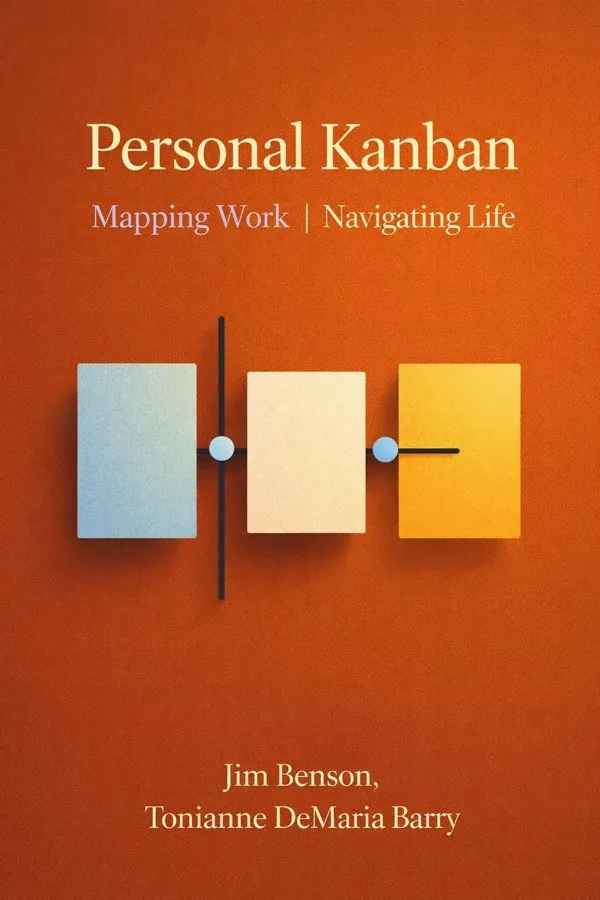
Personal Kanban: Mapping Work | Navigating Life: Summary & Key Insights
by Jim Benson, Tonianne DeMaria Barry
 10 min5 chaptersAudio available
What Is Personal Kanban: Mapping Work | Navigating Life About?
Personal Kanban: Mapping Work | Navigating Life by Jim Benson, Tonianne DeMaria Barry is a productivity book spanning 5 pages. Personal Kanban es un enfoque visual para gestionar el trabajo y la vida personal. Desarrollado por Jim Benson y Tonianne DeMaria Barry, adapta los principios del método Kanban de la manufactura y el desarrollo de software para el uso individual y de equipos pequeños. El libro enseña cómo visualizar tareas, limitar el trabajo en curso y mejorar el flujo de trabajo para aumentar la eficiencia y reducir el estrés.
This FizzRead summary covers all 5 key chapters of Personal Kanban: Mapping Work | Navigating Life in approximately 10 minutes, distilling the most important ideas, arguments, and takeaways from Jim Benson, Tonianne DeMaria Barry's work. Also available as an audio summary and Key Quotes Podcast.
Personal Kanban: Mapping Work | Navigating Life
Personal Kanban es un enfoque visual para gestionar el trabajo y la vida personal. Desarrollado por Jim Benson y Tonianne DeMaria Barry, adapta los principios del método Kanban de la manufactura y el desarrollo de software para el uso individual y de equipos pequeños. El libro enseña cómo visualizar tareas, limitar el trabajo en curso y mejorar el flujo de trabajo para aumentar la eficiencia y reducir el estrés.
Who Should Read Personal Kanban: Mapping Work | Navigating Life?
This book is perfect for anyone interested in productivity and looking to gain actionable insights in a short read. Whether you're a student, professional, or lifelong learner, the key ideas from Personal Kanban: Mapping Work | Navigating Life by Jim Benson, Tonianne DeMaria Barry will help you think differently.
- ✓Readers who enjoy productivity and want practical takeaways
- ✓Professionals looking to apply new ideas to their work and life
- ✓Anyone who wants the core insights of Personal Kanban: Mapping Work | Navigating Life in just 10 minutes
Want the full summary?
Get instant access to this book summary and 100K+ more with Fizz Moment.
Get Free SummaryAvailable on App Store • Free to download
Key Chapters
In the beginning, there is only the fog: tasks swimming amorphously around you, each demanding attention without form or structure. When work is invisible, stress follows because our minds are poor at juggling vague obligations. Visualization is our way of cutting through that fog. By mapping every piece of work—large and small—onto a board, you externalize what was once hidden in your head.
This habit draws deeply from Lean principles, where manufacturing systems used Kanban boards to make production lines transparent. In our personal lives, we rarely grant ourselves that same clarity. Instead, we internalize demands until they weigh us down. The moment we move them into the physical world, represented as cards or post-its organized into columns such as “To Do,” “Doing,” and “Done,” everything changes. Suddenly, you can see—not just imagine—what you are doing.
Visualization is not a management trick; it is an act of mindfulness. It compels you to pause, to see your own story unfold through the work you’ve chosen to do. The Kanban board is your mirror. Each card carries with it a conversation: What is this task? Why am I doing it? Does it still matter? This awareness alone begins to reduce overwhelm and bring intention to your daily choices.
Individuals often experience their first shock of relief when they place every pending task onto the board and realize how much they had been holding inside. Teams, too, find that transparency breeds trust. When everyone can see what others are working on, the need for constant status meetings diminishes, and collaboration becomes natural. Visualizing work is not merely an organizational technique—it’s a commitment to honesty with oneself and one’s team. You can’t ignore what’s plainly visible. You must respond to it.
Once you can see your work, the next discipline emerges: restraint. The human brain is not designed for sustained multitasking, yet modern culture encourages us to spread attention thinly across too many priorities. Work in Progress (WIP) limits are a promise you make to yourself—a conscious choice to perform fewer things at once, so that each receives the focus it deserves.
The essence of limiting WIP is that it forces a trade: if you want to start something new, something else must move forward to completion first. This constraint is liberating because it prevents work from stalling in the middle, where most projects die. Flow cannot exist when everything is half-done. By setting boundaries—say, only two or three items in the “Doing” column—you ensure that what’s begun will also be completed.
In practice, limiting WIP often feels uncomfortable at first. There’s a fear of letting something idle, of appearing unproductive because fewer tasks are being handled simultaneously. Yet, paradoxically, throughput increases over time. You finish faster, with less stress, and produce higher quality results. You also begin to appreciate work as an intentional sequence, not a simultaneous blur.
WIP limits cultivate focus, but they also teach humility. They remind you of your own human limits and encourage more realistic commitments. Across teams, WIP limits foster collective accountability: when a team hits its capacity, the question becomes not “How can we start more?” but “How can we help finish what’s already begun?” This cultural shift—toward completion rather than accumulation—is the secret heart of improved flow.
+ 3 more chapters — available in the FizzRead app
All Chapters in Personal Kanban: Mapping Work | Navigating Life
About the Authors
Jim Benson es fundador de Modus Cooperandi y creador del concepto de Personal Kanban. Tonianne DeMaria Barry es consultora de gestión y coautora del libro, especializada en productividad y colaboración en equipos.
Get This Summary in Your Preferred Format
Read or listen to the Personal Kanban: Mapping Work | Navigating Life summary by Jim Benson, Tonianne DeMaria Barry anytime, anywhere. FizzRead offers multiple formats so you can learn on your terms — all free.
Available formats: App · Audio · PDF · EPUB — All included free with FizzRead
Download Personal Kanban: Mapping Work | Navigating Life PDF and EPUB Summary
Key Quotes from Personal Kanban: Mapping Work | Navigating Life
“In the beginning, there is only the fog: tasks swimming amorphously around you, each demanding attention without form or structure.”
“Once you can see your work, the next discipline emerges: restraint.”
Frequently Asked Questions about Personal Kanban: Mapping Work | Navigating Life
Personal Kanban: Mapping Work | Navigating Life by Jim Benson, Tonianne DeMaria Barry is a productivity book that explores key ideas across 5 chapters. Personal Kanban es un enfoque visual para gestionar el trabajo y la vida personal. Desarrollado por Jim Benson y Tonianne DeMaria Barry, adapta los principios del método Kanban de la manufactura y el desarrollo de software para el uso individual y de equipos pequeños. El libro enseña cómo visualizar tareas, limitar el trabajo en curso y mejorar el flujo de trabajo para aumentar la eficiencia y reducir el estrés.
You Might Also Like



Browse by Category
Ready to read Personal Kanban: Mapping Work | Navigating Life?
Get the full summary and 100K+ more books with Fizz Moment.