
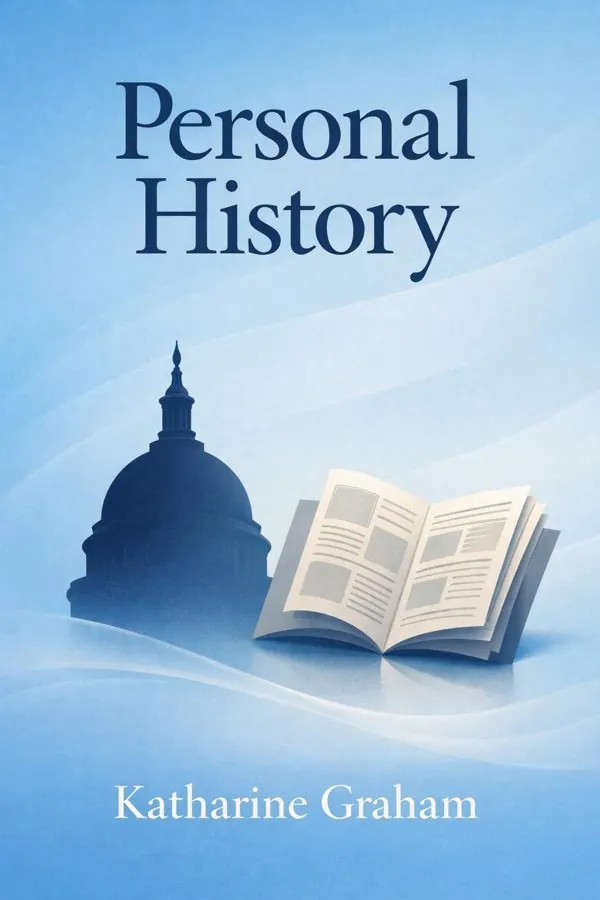
Personal History: Summary & Key Insights
 10 min6 chaptersAudio available
What Is Personal History About?
Personal History by Katharine Graham is a biographies book spanning 6 pages. Personal History is the Pulitzer Prize–winning autobiography of Katharine Graham, longtime publisher of The Washington Post. In this candid and deeply personal memoir, Graham recounts her privileged yet turbulent upbringing, her marriage to Philip Graham, her unexpected rise to leadership after his death, and her pivotal role in guiding the Post through the Pentagon Papers and Watergate eras. The book offers an intimate portrait of a woman who transformed herself from a shy socialite into one of the most influential figures in American journalism.
This FizzRead summary covers all 6 key chapters of Personal History in approximately 10 minutes, distilling the most important ideas, arguments, and takeaways from Katharine Graham's work. Also available as an audio summary and Key Quotes Podcast.
Personal History
Personal History is the Pulitzer Prize–winning autobiography of Katharine Graham, longtime publisher of The Washington Post. In this candid and deeply personal memoir, Graham recounts her privileged yet turbulent upbringing, her marriage to Philip Graham, her unexpected rise to leadership after his death, and her pivotal role in guiding the Post through the Pentagon Papers and Watergate eras. The book offers an intimate portrait of a woman who transformed herself from a shy socialite into one of the most influential figures in American journalism.
Who Should Read Personal History?
This book is perfect for anyone interested in biographies and looking to gain actionable insights in a short read. Whether you're a student, professional, or lifelong learner, the key ideas from Personal History by Katharine Graham will help you think differently.
- ✓Readers who enjoy biographies and want practical takeaways
- ✓Professionals looking to apply new ideas to their work and life
- ✓Anyone who wants the core insights of Personal History in just 10 minutes
Want the full summary?
Get instant access to this book summary and 100K+ more with Fizz Moment.
Get Free SummaryAvailable on App Store • Free to download
Key Chapters
I was born into privilege, though at the time I never understood the significance of that world’s protections. My father, Eugene Meyer, was an extraordinary man—a financier, philanthropist, and later the publisher of The Washington Post. He believed deeply in public service and intellectual rigor. My mother, Agnes Meyer, was equally formidable, but in different ways: outspoken, artistic, and deeply engaged in social causes. Together they created a household that buzzed with ideas, debate, and expectation. Yet, amid the comfort and sophistication, there was also emotional distance. Our family was not the sort that revealed affection easily. Success was encouraged; vulnerability was not.
My father’s acquisition of The Washington Post was one of the pivotal acts of his career. The paper was sinking toward bankruptcy, and he saw it as both a challenge and a civic duty—to restore an institution vital to democratic life. As a child, I watched without understanding that those decisions would define my future. The Post was simply another of my father’s enterprises, a backdrop to my youth. My own sense of purpose had not yet emerged. I grew up observing powerful people, from Franklin Roosevelt’s circle to the intellectual elites of Washington, all orbiting my parents’ dinner table. Yet knowledge of politics and influence did not translate into self-assurance.
I remember feeling perpetually shadowed by others’ accomplishments—my father’s commanding intellect, my mother’s activism, the brilliance of my siblings. I adored them and admired their confidence, but I internalized the belief that I was less extraordinary, lesser by temperament and worth. That early conditioning—being surrounded by greatness yet quietly feeling inadequate—would later define how I approached leadership. It taught me that privilege does not automatically confer self-confidence; in fact, it can obscure the search for one’s own voice.
Education was the first structure through which I began to test my independence, though even that journey was initially marked by uncertainty. I attended Vassar, then transferred to the University of Chicago—a world brimming with energy and ideas. Chicago in the late 1930s was teeming with young thinkers who debated capitalism, democracy, and the new frontiers of social science. It was a place where intellectual discovery was equated with social responsibility.
What struck me most during those formative years was the moral seriousness of those around me. People spoke of justice not as an abstraction but as a duty. That atmosphere ignited something dormant in me: a curiosity about public life and an empathy for those living outside privilege. Those years in Chicago exposed me to realities my upbringing had avoided—the working poor, the struggles of the Great Depression, the tension between individual comfort and collective conscience. It was in those conversations and classes that I began to see journalism not merely as a business, but as a moral enterprise.
Still, I did not imagine myself as the one who would one day shape a newspaper’s destiny. I once wrote for the San Francisco News and experienced firsthand the excitement of reporting, though I did not yet see it as a lifelong calling. My path at this stage was shaped more by observation than ambition. I was learning about the world, collecting impressions that would later form the moral backbone of my decisions as publisher. I was waking up, slowly, to the idea that knowledge—especially knowledge of human struggle—should compel one toward participation. It was an awakening of empathy, but not yet of identity.
+ 4 more chapters — available in the FizzRead app
All Chapters in Personal History
About the Author
Katharine Graham (1917–2001) was an American publisher and businesswoman best known for her leadership of The Washington Post Company. Under her direction, the Post became a major force in American journalism, notably for its coverage of the Pentagon Papers and the Watergate scandal. She received the Pulitzer Prize for Biography or Autobiography in 1998 for her memoir, Personal History.
Get This Summary in Your Preferred Format
Read or listen to the Personal History summary by Katharine Graham anytime, anywhere. FizzRead offers multiple formats so you can learn on your terms — all free.
Available formats: App · Audio · PDF · EPUB — All included free with FizzRead
Download Personal History PDF and EPUB Summary
Key Quotes from Personal History
“I was born into privilege, though at the time I never understood the significance of that world’s protections.”
“Education was the first structure through which I began to test my independence, though even that journey was initially marked by uncertainty.”
Frequently Asked Questions about Personal History
Personal History by Katharine Graham is a biographies book that explores key ideas across 6 chapters. Personal History is the Pulitzer Prize–winning autobiography of Katharine Graham, longtime publisher of The Washington Post. In this candid and deeply personal memoir, Graham recounts her privileged yet turbulent upbringing, her marriage to Philip Graham, her unexpected rise to leadership after his death, and her pivotal role in guiding the Post through the Pentagon Papers and Watergate eras. The book offers an intimate portrait of a woman who transformed herself from a shy socialite into one of the most influential figures in American journalism.
You Might Also Like

An American Marriage
Tayari Jones
10 min
Benjamin Franklin: An American Life
Walter Isaacson
10 min
I Know Why The Caged Bird Sings
Maya Angelou
10 min
Long Walk to Freedom
Nelson Mandela
10 min
Persepolis
Marjane Satrapi
10 min
Surely You're Joking, Mr. Feynman!
Richard P. Feynman
10 minBrowse by Category
Ready to read Personal History?
Get the full summary and 100K+ more books with Fizz Moment.