
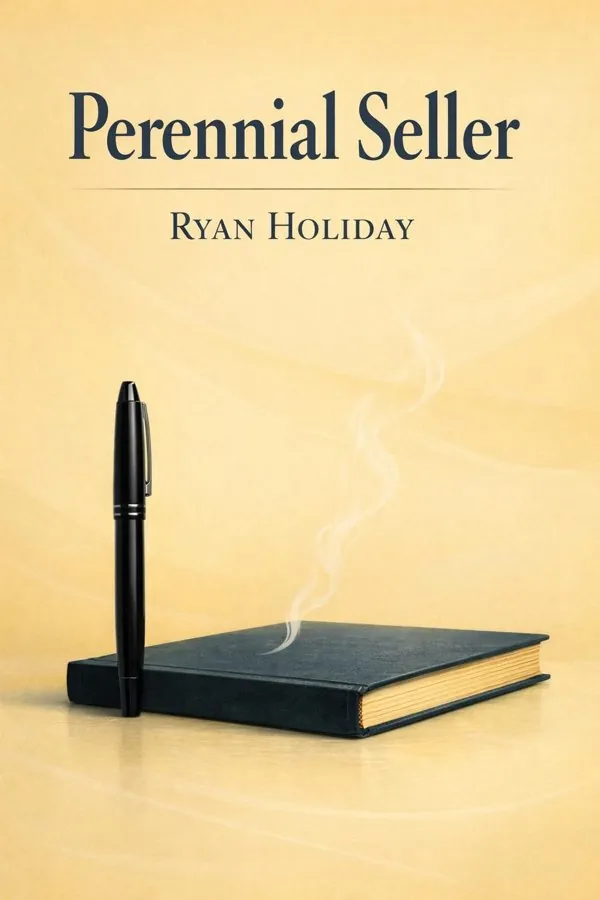
Perennial Seller: The Art of Making and Marketing Work That Lasts: Summary & Key Insights
by Ryan Holiday
 10 min10 chaptersAudio available
Key Takeaways from Perennial Seller: The Art of Making and Marketing Work That Lasts
The harshest truth in creative work is also the most liberating one: marketing cannot permanently save something mediocre.
A common creative fantasy is that great work should appeal to everyone.
Holiday argues that development is where durable work separates itself from disposable output.
Even excellent work can vanish if people do not understand what it is, who it is for, or why it matters.
People do judge books by their covers, products by their design, and ideas by their presentation.
What Is Perennial Seller: The Art of Making and Marketing Work That Lasts About?
Perennial Seller: The Art of Making and Marketing Work That Lasts by Ryan Holiday is a marketing book spanning 10 pages. Most creative work is built for the moment. Ryan Holiday’s Perennial Seller argues that the most meaningful work should be built for years, even decades. A perennial seller is not just a bestseller, viral hit, or trendy product. It is something that continues to find readers, customers, and relevance long after its release. Holiday explores what makes that possible by combining lessons from publishing, media, entrepreneurship, entertainment, and history. He shows that lasting success is rarely accidental. It comes from creating something truly excellent, understanding exactly who it serves, positioning it intelligently, and marketing it with patience and discipline. What makes this book especially useful is Holiday’s authority on both sides of the equation: creation and promotion. As a bestselling author and former marketing director for American Apparel, he has seen how ideas spread, how audiences behave, and why some works endure while others disappear. Perennial Seller is valuable for writers, founders, artists, marketers, and anyone building something they hope will outlive the launch cycle. Its central promise is simple but powerful: make better work, market it better, and keep showing up long enough for it to matter.
This FizzRead summary covers all 10 key chapters of Perennial Seller: The Art of Making and Marketing Work That Lasts in approximately 10 minutes, distilling the most important ideas, arguments, and takeaways from Ryan Holiday's work. Also available as an audio summary and Key Quotes Podcast.
Perennial Seller: The Art of Making and Marketing Work That Lasts
Most creative work is built for the moment. Ryan Holiday’s Perennial Seller argues that the most meaningful work should be built for years, even decades. A perennial seller is not just a bestseller, viral hit, or trendy product. It is something that continues to find readers, customers, and relevance long after its release. Holiday explores what makes that possible by combining lessons from publishing, media, entrepreneurship, entertainment, and history. He shows that lasting success is rarely accidental. It comes from creating something truly excellent, understanding exactly who it serves, positioning it intelligently, and marketing it with patience and discipline.
What makes this book especially useful is Holiday’s authority on both sides of the equation: creation and promotion. As a bestselling author and former marketing director for American Apparel, he has seen how ideas spread, how audiences behave, and why some works endure while others disappear. Perennial Seller is valuable for writers, founders, artists, marketers, and anyone building something they hope will outlive the launch cycle. Its central promise is simple but powerful: make better work, market it better, and keep showing up long enough for it to matter.
Who Should Read Perennial Seller: The Art of Making and Marketing Work That Lasts?
This book is perfect for anyone interested in marketing and looking to gain actionable insights in a short read. Whether you're a student, professional, or lifelong learner, the key ideas from Perennial Seller: The Art of Making and Marketing Work That Lasts by Ryan Holiday will help you think differently.
- ✓Readers who enjoy marketing and want practical takeaways
- ✓Professionals looking to apply new ideas to their work and life
- ✓Anyone who wants the core insights of Perennial Seller: The Art of Making and Marketing Work That Lasts in just 10 minutes
Want the full summary?
Get instant access to this book summary and 100K+ more with Fizz Moment.
Get Free SummaryAvailable on App Store • Free to download
Key Chapters
The harshest truth in creative work is also the most liberating one: marketing cannot permanently save something mediocre. Holiday insists that every perennial seller begins with quality so undeniable that people want to return to it, recommend it, and keep buying it long after the initial release. In a world obsessed with hacks, speed, and visibility, this is easy to forget. But enduring work is usually the result of standards, rigor, revision, and restraint.
Holiday argues that creators must stop asking, “How do I get attention?” before they ask, “Is this actually good enough?” Great work is not assembled from shortcuts. It is shaped through difficult decisions, deep research, emotional honesty, and the willingness to cut what is merely clever in favor of what is essential. This applies whether you are writing a book, building a software product, launching a podcast, or designing a course. If the underlying thing does not solve a real problem, move people emotionally, or deliver uncommon value, no promotional strategy will turn it into a durable success.
Consider the difference between a disposable article built around a news cycle and a timeless essay that helps people think clearly for years. Or compare a product stuffed with trendy features to one that reliably solves a core customer pain point. One may spike fast; the other compounds.
Holiday’s message is not perfectionism for its own sake. It is excellence in service of longevity. If you want work that lasts, build something people can grow with, come back to, and confidently share. Actionable takeaway: before focusing on promotion, ask what would make your work undeniably useful, memorable, and re-readable five years from now.
A common creative fantasy is that great work should appeal to everyone. Holiday challenges this directly: no one is owed an audience, and broad appeal usually starts with narrow relevance. Perennial sellers endure because they solve a specific problem, satisfy a real desire, or speak deeply to a distinct group of people. In other words, timelessness is not created by vagueness. It is created by precision.
Holiday emphasizes empathy as a strategic advantage. Creators must understand who their audience is, what they care about, what language they use, what alternatives they already have, and why they would choose this work instead. That means moving beyond demographic labels and into motivation. A business book, for example, is not written for “professionals”; it may be for first-time managers overwhelmed by responsibility. A fitness app is not for “everyone who wants health”; it might be for busy parents who need ten-minute routines and zero friction.
This audience clarity affects every decision. It shapes content, design, pricing, title, tone, channels, and timing. It also makes marketing more efficient, because you know where to find your people and what message will resonate. Rather than chasing mass attention, you create strong relevance for the audience most likely to care and share.
Holiday’s insight is that works often become broader only after they become indispensable to a core group. Many classic books, cult films, and enduring brands started by serving a niche unusually well. Their depth created momentum.
Actionable takeaway: define your ideal audience in one sentence, identify the precise problem or desire your work addresses, and test every creative and marketing choice against whether it truly serves that person.
What lasts is rarely rushed. Holiday argues that development is where durable work separates itself from disposable output. The market rewards speed in the short term, but longevity often comes from depth, refinement, and the willingness to keep improving long after the first draft, prototype, or concept feels good enough. If creation is inspiration, development is discipline.
This stage requires creators to be ruthless about revision. A book may need structural rewrites, not just line edits. A product may need repeated usability testing, not just feature expansion. A course may need better sequencing, examples, and outcomes, not just more content. Holiday’s point is that many projects fail because creators protect their ego instead of improving the work. They become attached to what they made rather than committed to what it could become.
Development also means exposing work to reality. Feedback from editors, early users, trusted peers, and skeptical customers reveals blind spots. While not every opinion should be followed, thoughtful criticism often uncovers what the creator cannot see alone. This process can be uncomfortable, but it makes the work stronger, clearer, and more durable.
A practical example is software that launches with one elegant core function instead of ten poorly executed features. Another is a nonfiction book that spends extra months clarifying its framework so readers can actually apply it years later. The temptation is always to ship fast and fix later. Holiday reminds us that the market remembers quality.
Actionable takeaway: build a development process that includes revision, outside feedback, and at least one major improvement cycle focused not on adding more, but on making the core experience sharper, clearer, and more useful.
Even excellent work can vanish if people do not understand what it is, who it is for, or why it matters. Holiday treats positioning as the bridge between creation and audience. Positioning is not spin. It is the disciplined art of making your work legible and compelling in a crowded market.
To position well, you must answer a few essential questions: what category does this belong to, what problem does it solve, what makes it different, and why should someone care now? A perennial seller often succeeds because it occupies a memorable place in the customer’s mind. It is not “another business book”; it becomes “the practical guide to timeless strategy under uncertainty.” It is not just “a skincare brand”; it is “simple, trusted care for sensitive skin.” Clear positioning reduces confusion, and confusion kills momentum.
Holiday also highlights the importance of context. Great positioning connects the work to existing desires, conversations, or categories without making it seem derivative. It gives audiences a handle. A creator might frame a complex idea through a familiar comparison, or package a niche product around a universal need. This helps the audience quickly understand why the work belongs in their life.
Positioning matters internally too. It guides titles, subtitles, taglines, cover design, metadata, sales pages, and pitches. If those elements point in different directions, the market receives a blurred message. If they align, the work gains coherence and traction.
Actionable takeaway: write a one-paragraph positioning statement covering audience, category, problem solved, and unique value, then use it to align your title, messaging, and promotion so people instantly understand why your work matters.
People do judge books by their covers, products by their design, and ideas by their presentation. Holiday argues that packaging is not superficial decoration; it is part of how value is perceived and understood. Strong packaging increases the odds that someone pays attention long enough to experience the actual substance. Weak packaging hides great work behind avoidable friction.
Packaging includes everything that shapes first impression: title, subtitle, cover, design, visual identity, pricing, format, website, trailer, description, and even the order in which information appears. These elements tell the audience what the work is and what kind of experience to expect. If the packaging is confusing, generic, or mismatched, the audience may never discover the quality underneath.
Holiday’s larger point is that creators often split into two unhealthy camps: those who obsess over presentation and neglect the product, and those who pride themselves on substance while dismissing presentation. Perennial sellers require both. A great title can dramatically improve discoverability. A clean landing page can raise conversion. Better onboarding can help users realize value sooner. Packaging can also support longevity by making the work feel timeless rather than trapped in a passing trend.
For example, classic book covers are often simple, distinctive, and durable. Enduring consumer brands use packaging that communicates trust and recognition over novelty alone. The goal is not flashiness. It is clarity, attractiveness, and fit.
Actionable takeaway: review every point of first contact with your audience and ask whether it communicates quality, relevance, and trust within seconds; if not, improve the presentation until it helps, rather than obscures, the work.
Many creators treat marketing as a necessary evil that begins after the work is finished. Holiday rejects this mindset. Marketing is not a last-minute campaign layered on top of creation; it is an ongoing process of connecting value with the people who need it. When done well, it is less about persuasion and more about discovery, access, and repetition.
Holiday emphasizes that perennial sellers are marketed for the long haul. Instead of one explosive launch followed by silence, enduring works benefit from continued exposure through interviews, partnerships, evergreen content, media outreach, word of mouth, and strategic distribution. The key is consistency. A product that helps people year after year deserves a marketing system that keeps introducing it to new audiences.
He also encourages creators to think in channels, not just moments. Where does your audience already gather? Which podcasts, newsletters, retailers, communities, search terms, influencers, or events naturally connect to your work? Effective marketing comes from meeting people in trusted environments with a message that reflects their interests. For example, an author might keep a book selling through articles, podcast appearances, speaking, and search-friendly content years after publication. A SaaS founder might build recurring demand through customer education, affiliate relationships, and case studies.
Crucially, Holiday sees ethical marketing as a service. If your work genuinely helps, promoting it is not vanity. It is responsibility. The market cannot benefit from what it never hears about.
Actionable takeaway: build a simple evergreen marketing plan with three repeatable channels, one core message, and a schedule for ongoing promotion long after launch week ends.
Launches are overrated and underrated at the same time. Holiday explains that a launch matters because it creates initial momentum, attention, and social proof, but it becomes dangerous when creators treat it as the only moment that counts. A perennial seller is not made in a weekend. It is made through a strong debut followed by many smaller relaunches over time.
A good launch does several things at once. It activates your existing network, gives early supporters a reason to spread the word, places the work in front of concentrated attention, and generates the first wave of reviews, testimonials, or user results. Holiday urges creators to prepare this phase carefully: line up media opportunities, coordinate partners, gather endorsements, seed advance copies, and make buying or sharing easy. The goal is not noise for its own sake. It is enough initial traction to signal relevance.
But once launch week ends, the real work begins. Holiday encourages creators to look for fresh angles, seasonal ties, cultural moments, updates, anniversaries, and adjacent audiences that can renew interest. A book can relaunch with a new foreword, a podcast appearance, or a tie-in to current events. A product can relaunch through a feature story, a new use case, or customer success data. These moments keep the work visible without pretending it is brand new.
The best launches create an asset, not just an event. They produce reviews, relationships, audience data, and credibility that support years of future growth.
Actionable takeaway: plan your launch as the first of several promotional waves, and schedule future relaunch opportunities tied to milestones, updates, partnerships, or new audience segments.
One of Holiday’s most practical lessons is that creators should not wait until release day to find an audience. A platform is the collection of channels, relationships, and trust that allows your message to travel. It can include an email list, social following, podcast, blog, media contacts, speaking opportunities, customer base, or professional network. Whatever the form, it reduces dependence on luck.
Holiday does not present platform building as empty personal branding. Its purpose is to create direct access to people who care about your work. This matters because algorithms change, press is unpredictable, and crowded marketplaces reward those who can generate attention on demand. If you already have an audience that values your perspective, every future project starts with momentum.
Building a platform usually begins with generosity. Share useful ideas consistently. Publish insights related to your field. Help communities before asking them to buy. Collaborate with peers. Collect email subscribers rather than relying only on rented attention from social platforms. Over time, this creates trust and familiarity. When your work is ready, you are not introducing yourself to strangers; you are inviting an existing audience deeper.
For example, a writer who publishes thoughtful essays can later launch a book to engaged readers. A founder who teaches publicly can create a market for a product before it arrives. A consultant who speaks and writes regularly can turn expertise into durable demand.
Actionable takeaway: choose one owned channel and one discovery channel, then commit to a regular cadence of valuable content so your audience grows before your next launch depends on it.
The real advantage of a perennial seller is not a big debut but a long life. Holiday argues that sustainable success comes from compounding: small, repeated actions that keep a work available, discoverable, and relevant over time. This requires creators to think like stewards, not sprinters.
After release, many people move on too quickly, assuming the market has already decided. Holiday warns against this. Some works take time to find their audience. Others become newly relevant because circumstances change. A neglected backlist title might suddenly connect with a new generation. A product may gain traction after better onboarding, testimonials, or channel partnerships. If the work is strong, patience can become a competitive advantage.
Sustaining success means tracking what actually drives discovery and sales, then reinforcing it. Which referrals convert best? Which communities respond most? Which reviews or testimonials clarify value? Which keywords keep bringing people in? The goal is to maintain and improve systems rather than constantly reinventing yourself. It also means keeping the work fresh through updates, support, better explanations, and renewed visibility.
Holiday’s philosophy opposes the culture of novelty addiction. Instead of abandoning one project for the next shiny thing, he suggests extracting the full value from meaningful work. A song, course, book, or product can keep producing impact if its creator continues to nurture it.
Actionable takeaway: set a quarterly review for your existing work, identify the top sources of ongoing traction, and invest in the small improvements and promotions that can help it keep growing rather than fade away.
One of Holiday’s strengths is showing that perennial success follows recognizable patterns across books, films, products, music, and businesses. While formats differ, the underlying dynamics are similar: strong fundamentals, emotional or practical value, clear positioning, and long-term distribution. Studying perennial sellers helps creators escape the myth that enduring success is mysterious or reserved for geniuses.
Holiday draws lessons from works that became classics not because they launched perfectly, but because they kept earning attention. Some started slowly and grew through word of mouth. Others benefited from reissues, cultural rediscovery, or improved positioning. Many outlasted competitors that were initially more fashionable. This teaches an important strategic lesson: immediate popularity and long-term relevance are not the same thing.
Case studies also reveal that creators often misread the market. They assume success depends on trend alignment, celebrity, or timing alone. But perennial sellers frequently win because they address permanent human needs: status, belonging, meaning, mastery, love, fear, curiosity, relief, or transformation. They remain useful because the underlying problem or desire persists.
For a business owner, this might mean building around a stable customer pain point rather than a fad. For a writer, it may mean focusing on evergreen questions rather than temporary outrage. For a teacher, it means making material clear and applicable enough to survive changing platforms.
Actionable takeaway: analyze three works in your field that have sold or mattered for years, identify the timeless need they serve and the systems that kept them visible, then adapt those patterns to your own project.
All Chapters in Perennial Seller: The Art of Making and Marketing Work That Lasts
About the Author
Ryan Holiday is an American author, marketer, and media strategist known for combining practical business insight with timeless philosophical ideas. He began his career in marketing and became Director of Marketing at American Apparel, where he gained firsthand experience in publicity, brand building, and the mechanics of attention. He later transitioned into writing and became the bestselling author of books such as The Obstacle Is the Way, Ego Is the Enemy, Stillness Is the Key, and Courage Is Calling. Much of his work is influenced by Stoic philosophy, but he also writes extensively about creativity, discipline, leadership, and media manipulation. Holiday’s background in both promotion and authorship makes him especially credible on the subject of how enduring work is created, positioned, and sustained in the marketplace.
Get This Summary in Your Preferred Format
Read or listen to the Perennial Seller: The Art of Making and Marketing Work That Lasts summary by Ryan Holiday anytime, anywhere. FizzRead offers multiple formats so you can learn on your terms — all free.
Available formats: App · Audio · PDF · EPUB — All included free with FizzRead
Download Perennial Seller: The Art of Making and Marketing Work That Lasts PDF and EPUB Summary
Key Quotes from Perennial Seller: The Art of Making and Marketing Work That Lasts
“The harshest truth in creative work is also the most liberating one: marketing cannot permanently save something mediocre.”
“A common creative fantasy is that great work should appeal to everyone.”
“Holiday argues that development is where durable work separates itself from disposable output.”
“Even excellent work can vanish if people do not understand what it is, who it is for, or why it matters.”
“People do judge books by their covers, products by their design, and ideas by their presentation.”
Frequently Asked Questions about Perennial Seller: The Art of Making and Marketing Work That Lasts
Perennial Seller: The Art of Making and Marketing Work That Lasts by Ryan Holiday is a marketing book that explores key ideas across 10 chapters. Most creative work is built for the moment. Ryan Holiday’s Perennial Seller argues that the most meaningful work should be built for years, even decades. A perennial seller is not just a bestseller, viral hit, or trendy product. It is something that continues to find readers, customers, and relevance long after its release. Holiday explores what makes that possible by combining lessons from publishing, media, entrepreneurship, entertainment, and history. He shows that lasting success is rarely accidental. It comes from creating something truly excellent, understanding exactly who it serves, positioning it intelligently, and marketing it with patience and discipline. What makes this book especially useful is Holiday’s authority on both sides of the equation: creation and promotion. As a bestselling author and former marketing director for American Apparel, he has seen how ideas spread, how audiences behave, and why some works endure while others disappear. Perennial Seller is valuable for writers, founders, artists, marketers, and anyone building something they hope will outlive the launch cycle. Its central promise is simple but powerful: make better work, market it better, and keep showing up long enough for it to matter.
More by Ryan Holiday
You Might Also Like
Captivology: The Science of Capturing People's Attention
Ben Parr
10 min
Marketing 5.0: Technology for Humanity
Philip Kotler, Hermawan Kartajaya, Iwan Setiawan
10 min
Marketing Strategy
Paul Fifield
10 min
UnMarketing: Stop Marketing. Start Engaging.
Scott Stratten
10 min
$100M Leads: How to Get Strangers to Want to Buy Your Stuff
Alex Hormozi
10 min
80/20 Sales and Marketing: The Definitive Guide to Working Less and Making More
Perry Marshall
10 minBrowse by Category
Ready to read Perennial Seller: The Art of Making and Marketing Work That Lasts?
Get the full summary and 100K+ more books with Fizz Moment.