
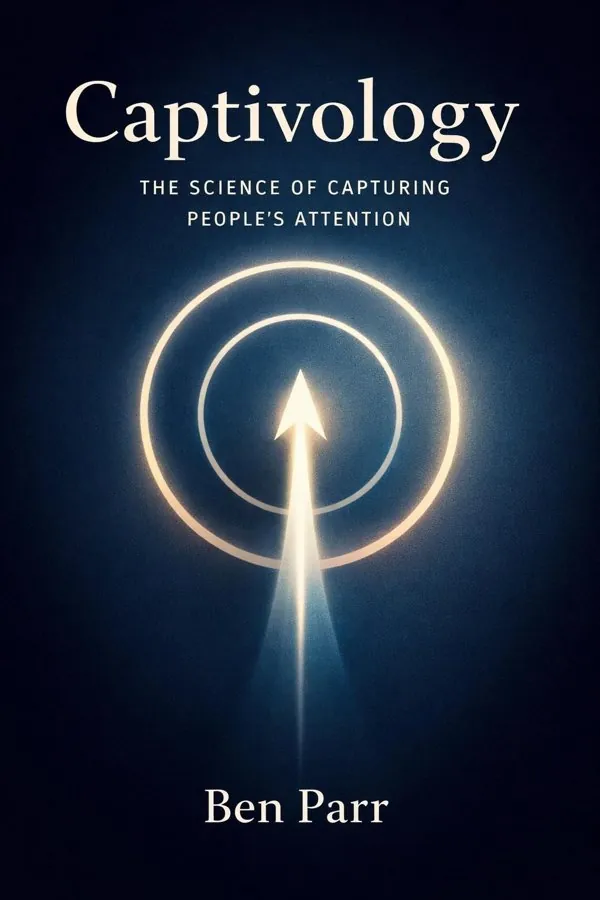
Captivology: The Science of Capturing People's Attention: Summary & Key Insights
by Ben Parr
 10 min9 chaptersAudio available
Key Takeaways from Captivology: The Science of Capturing People's Attention
Most people treat attention as if it were a matter of luck, but Ben Parr’s central insight is that attention follows patterns.
Novelty acts like a mental spotlight.
People rarely pay sustained attention to what feels emotionally neutral.
Attention does not begin the moment people hear your message.
Nothing captures attention like feeling seen.
What Is Captivology: The Science of Capturing People's Attention About?
Captivology: The Science of Capturing People's Attention by Ben Parr is a marketing book. Why do some ideas spread instantly while others disappear without a trace? Why do certain people, products, and stories command attention in a noisy world while equally worthy alternatives are ignored? In Captivology, entrepreneur, journalist, and investor Ben Parr explores the science behind one of the most valuable resources in modern life: human attention. Drawing from neuroscience, psychology, biology, behavioral economics, and hundreds of interviews with experts ranging from marketers to researchers, Parr breaks attention down into understandable patterns anyone can use. The book matters because attention is the gateway to everything else. Before people can trust you, buy from you, support your cause, or remember your message, they have to notice you first. Parr argues that attention is not random luck or mysterious charisma. It follows principles that can be studied, designed, and applied. He identifies the triggers that make people look up, lean in, and care. For marketers, creators, leaders, founders, and communicators, Captivology offers a practical framework for standing out without relying on gimmicks. It is both a smart investigation into human behavior and a useful guide for anyone trying to break through distraction and make an idea impossible to ignore.
This FizzRead summary covers all 9 key chapters of Captivology: The Science of Capturing People's Attention in approximately 10 minutes, distilling the most important ideas, arguments, and takeaways from Ben Parr's work. Also available as an audio summary and Key Quotes Podcast.
Captivology: The Science of Capturing People's Attention
Why do some ideas spread instantly while others disappear without a trace? Why do certain people, products, and stories command attention in a noisy world while equally worthy alternatives are ignored? In Captivology, entrepreneur, journalist, and investor Ben Parr explores the science behind one of the most valuable resources in modern life: human attention. Drawing from neuroscience, psychology, biology, behavioral economics, and hundreds of interviews with experts ranging from marketers to researchers, Parr breaks attention down into understandable patterns anyone can use.
The book matters because attention is the gateway to everything else. Before people can trust you, buy from you, support your cause, or remember your message, they have to notice you first. Parr argues that attention is not random luck or mysterious charisma. It follows principles that can be studied, designed, and applied. He identifies the triggers that make people look up, lean in, and care.
For marketers, creators, leaders, founders, and communicators, Captivology offers a practical framework for standing out without relying on gimmicks. It is both a smart investigation into human behavior and a useful guide for anyone trying to break through distraction and make an idea impossible to ignore.
Who Should Read Captivology: The Science of Capturing People's Attention?
This book is perfect for anyone interested in marketing and looking to gain actionable insights in a short read. Whether you're a student, professional, or lifelong learner, the key ideas from Captivology: The Science of Capturing People's Attention by Ben Parr will help you think differently.
- ✓Readers who enjoy marketing and want practical takeaways
- ✓Professionals looking to apply new ideas to their work and life
- ✓Anyone who wants the core insights of Captivology: The Science of Capturing People's Attention in just 10 minutes
Want the full summary?
Get instant access to this book summary and 100K+ more with Fizz Moment.
Get Free SummaryAvailable on App Store • Free to download
Key Chapters
Most people treat attention as if it were a matter of luck, but Ben Parr’s central insight is that attention follows patterns. What captures us is not random. Human beings are wired to notice specific signals because attention evolved as a survival tool. We focus on what seems relevant, threatening, novel, rewarding, or socially important. That means attention can be studied and, more importantly, intentionally earned.
Parr shows that businesses, leaders, and creators often fail not because their ideas are weak, but because they misunderstand the mechanics of perception. A great product that nobody notices has no impact. A valuable message presented in a forgettable way gets buried. Captivology reframes attention as the first and most important step in persuasion, sales, branding, and influence.
This idea is powerful because it removes the myth of "natural magnetism." You do not need to be the loudest person in the room. You need to present your message in a way that aligns with how the brain prioritizes information. A startup can gain traction by framing its offer around urgency and novelty. A teacher can hold student focus by shifting pace, introducing surprise, or making lessons emotionally relevant. A marketer can improve campaign performance by understanding when to use contrast, storytelling, and social proof.
The practical lesson is simple: stop asking only whether your content is good, and start asking whether it is noticeable. Before publishing a campaign, speech, article, or pitch, identify the exact mechanism that will earn attention in the first five seconds. If you cannot name it, your audience probably will not notice it either.
Novelty acts like a mental spotlight. When something breaks pattern, we instinctively notice it. Parr explains that the brain is constantly filtering information to protect us from overload, which means familiar and predictable inputs often fade into the background. Newness, by contrast, signals that something may matter. It might be an opportunity, a threat, or simply something worth investigating.
This is why unusual headlines, unexpected visuals, surprising statistics, and unconventional product launches often outperform ordinary ones. Novelty interrupts autopilot. But Parr is careful to distinguish meaningful novelty from empty shock value. Random weirdness may grab a glance, yet it rarely sustains engagement. Effective novelty connects surprise with relevance.
In practice, this principle appears everywhere. A brand might redesign packaging so it stands apart on a crowded shelf. A presenter might begin with an unexpected question instead of a standard introduction. A nonprofit might frame a familiar issue through one startling human story rather than broad abstract facts. Even in conversation, someone becomes more memorable when they introduce a distinctive perspective instead of repeating obvious talking points.
However, novelty has limits. If your audience cannot quickly understand why the unexpected element matters, confusion replaces curiosity. The best use of novelty is to open the door, not to become the whole house. Once people look, substance must keep them there.
The actionable takeaway is to audit your communication for predictability. Ask: what element in this message breaks expectation in a useful way? Add one surprising but relevant feature, phrase, image, angle, or question that makes people pause and think, "I did not expect that, but I want to know more."
People rarely pay sustained attention to what feels emotionally neutral. Parr argues that emotion is one of the strongest amplifiers of attention because feelings help the brain decide what matters. Joy, fear, awe, anger, hope, and curiosity all signal importance. When something stirs emotion, we are more likely to notice it, remember it, and talk about it.
This matters because many professionals communicate as if facts alone persuade. They overload presentations with data, load websites with technical language, or write marketing copy that is accurate but lifeless. Captivology reminds us that information without emotional energy struggles to compete. Emotion is not the opposite of reason; it is often the gateway to reason.
Parr’s insight is especially useful in storytelling. A founder pitching investors should not just list market size and product features. They should show the frustration, aspiration, or urgency behind the problem. A health campaign will reach more people with a vivid personal narrative than with abstract percentages. Teachers who connect material to students’ ambitions or anxieties often create deeper engagement than those who merely recite content.
Importantly, emotional attention must be handled ethically. Fear can motivate, but too much fear can paralyze. Anger can drive sharing, but it can also polarize. Hope and inspiration often create more constructive forms of engagement, especially for brands and leaders seeking long-term trust.
The practical takeaway is to identify the emotion at the heart of your message before you share it. Ask yourself: what should my audience feel, not just know? Then shape your opening, examples, and language around that feeling so attention becomes deeper, more memorable, and more meaningful.
Attention does not begin the moment people hear your message. Often, it begins earlier through your reputation. Parr explains that the human brain uses shortcuts to decide what deserves focus, and one of the most powerful shortcuts is perceived credibility. When a person, brand, or publication has status, expertise, or social trust, audiences are more likely to pay attention before evaluating the details.
This is why endorsements, press mentions, testimonials, credentials, and visible associations matter so much. They reduce uncertainty. People assume that if others respect you, you may be worth noticing. Reputation acts as a signal in crowded environments where audiences lack the time to examine everything deeply.
For companies, this means brand-building is not just about image; it is about earning future attention. A startup that consistently publishes useful insights and secures respected partners becomes easier to notice over time. A consultant who shares clear expertise online builds authority that helps every future pitch land better. Even individuals can use this principle in small ways, such as speaking at recognized events, contributing to trusted platforms, or collecting social proof from clients.
Parr’s point is not that reputation replaces quality. It simply gets you considered. Without substance, reputation eventually collapses. But with substance, it becomes an attention multiplier.
The actionable takeaway is to build credibility assets deliberately. Ask what external signals make your audience trust you faster: testimonials, case studies, certifications, media mentions, respected collaborators, or visible results. Add at least one credibility marker anywhere attention matters most, such as your homepage, sales page, pitch deck, or social profile.
Nothing captures attention like feeling seen. Parr highlights acknowledgment as a deeply human trigger: when people believe a message recognizes their identity, needs, struggles, or values, they instinctively lean closer. We are drawn to what reflects us back to ourselves. This is why generic communication often fails while personalized or empathetic communication succeeds.
Acknowledgment can be explicit, such as using a customer’s name in an email or referencing a community’s specific challenge. It can also be psychological, such as describing a frustration so accurately that the audience thinks, "That is exactly me." Great communicators do not just broadcast; they mirror. They show audiences that they understand the world from their point of view.
This principle explains why niche brands can build loyal followings faster than broad, impersonal competitors. A fitness coach who speaks directly to busy new parents may attract more engaged clients than one marketing to everyone. A manager who opens a meeting by recognizing employee stress will gain more focus than one who jumps straight into metrics. In social media, creators grow faster when followers feel personally understood rather than vaguely targeted.
Acknowledgment is also foundational to inclusion. Different groups pay attention differently based on experience, identity, and context. Messages become more powerful when they respect those differences instead of pretending everyone is the same.
The practical takeaway is to replace broad communication with specific recognition. Before writing or speaking, define exactly who you are addressing and what they are feeling, fearing, wanting, or trying to solve. Then use language that proves you understand them. People give attention to those who make them feel visible.
Attention is not only won in an instant; it must also be maintained. Parr shows that curiosity is one of the best ways to hold people beyond the opening moment. The brain dislikes incomplete patterns. When we sense a gap between what we know and what we want to know, we feel pulled to close it. That tension creates sustained attention.
This is why effective headlines, stories, and presentations often withhold just enough information to make people want the rest. A headline that reveals everything can feel flat. A headline that promises a useful answer but leaves one unresolved question becomes compelling. A speaker who hints at a surprising result early in a talk creates a reason to keep listening. Product launches often use teasers for the same reason.
However, Parr’s framework suggests that curiosity works best when the eventual payoff is worthwhile. If you create mystery and then deliver something obvious, audiences feel manipulated. Clickbait is the broken form of this principle: it generates curiosity without satisfying it. Real captivation builds tension and then rewards attention with clarity, surprise, or value.
This applies in everyday work. Teachers can frame lessons around puzzles rather than answers. Sales professionals can lead discovery calls with provocative insights. Writers can structure articles so each section naturally opens a new question. Leaders can use curiosity to guide teams through change by revealing a meaningful path rather than dumping every detail at once.
The actionable takeaway is to engineer an information gap into your communication. Do not reveal everything immediately. Open with a question, contradiction, mystery, or unusual result that your audience genuinely wants explained, then make sure your content delivers a satisfying resolution.
One of Parr’s most useful ideas is that attention must be understood in context. People are not evaluating your message in a quiet laboratory. They are scanning emails between meetings, scrolling while tired, browsing with dozens of tabs open, and filtering information nonstop. In other words, distraction is not an obstacle to communication; it is the normal condition of communication.
This changes the way effective messages should be designed. Complexity, friction, and delayed relevance are deadly when attention is scarce. If your point takes too long to emerge, most people will never reach it. If your design is cluttered, your audience will choose something easier. If your writing is vague, the brain will classify it as low priority.
Parr’s work encourages communicators to simplify without becoming simplistic. Clear structure, strong openings, visual contrast, concise language, and obvious relevance all help messages survive in noisy environments. Think of the difference between a homepage that instantly states its benefit versus one filled with generic slogans. Or a presentation that opens with a striking insight versus one that starts with housekeeping remarks. Small design choices determine whether attention continues or disappears.
This principle is especially important for digital marketing. Subject lines, thumbnails, landing page headers, and call-to-action buttons are all points where attention can be lost. Reducing friction can be as powerful as adding creativity.
The practical takeaway is to design for distracted people. Review your content and remove anything that delays clarity. In the first few seconds, answer three silent questions: What is this? Why should I care? What should I do next? If those answers are hard to find, attention will vanish.
Getting attention is only the beginning. Parr makes an important distinction between grabbing eyes and earning lasting impact. Spectacle can produce a moment. Value creates memory, trust, and action. If attention is captured through gimmicks alone, audiences may look briefly and then move on with less trust than before. Captivology is not a manual for manipulation; it is a guide to aligning worthy messages with human psychology.
This matters because many brands chase visibility without thinking about what happens after the click, view, or impression. A flashy ad may generate traffic, but if the product disappoints, attention becomes waste. A dramatic headline may win curiosity, but if the article is thin, the relationship weakens. Sustainable influence requires coherence between the promise that captured attention and the experience that follows.
Parr’s broader contribution is to connect attention with service. The most effective communicators are not merely attention seekers. They understand what their audience values and deliver something meaningful once they have earned focus. A teacher uses attention to deepen learning. A founder uses it to reveal a product that truly solves a problem. A leader uses it to align people around a mission that matters.
This idea is especially useful in marketing, where short-term metrics can distort judgment. High click-through rates do not always mean effective communication if retention, satisfaction, and trust decline. Better attention creates better relationships, not just better numbers.
The actionable takeaway is to test every attention tactic against a simple question: does this accurately prepare the audience for the value I will deliver? If the answer is no, revise the message. The best captivation is honest, relevant, and rewarding.
All Chapters in Captivology: The Science of Capturing People's Attention
About the Author
Ben Parr is an American entrepreneur, investor, journalist, and author focused on technology, media, and business growth. He became widely known through his work at Mashable, where he served as editor-at-large and wrote extensively about digital trends, startups, and the evolving internet economy. Over the years, he has advised and invested in numerous companies, giving him firsthand experience in how products, ideas, and brands compete for visibility. Parr is recognized for blending analytical thinking with practical business insight, especially on topics related to communication, innovation, and influence. In Captivology, he draws on research across multiple disciplines as well as interviews with experts and successful leaders. His work stands out for translating complex science into useful frameworks for marketers, founders, creators, and anyone trying to earn attention in a distracted world.
Get This Summary in Your Preferred Format
Read or listen to the Captivology: The Science of Capturing People's Attention summary by Ben Parr anytime, anywhere. FizzRead offers multiple formats so you can learn on your terms — all free.
Available formats: App · Audio · PDF · EPUB — All included free with FizzRead
Download Captivology: The Science of Capturing People's Attention PDF and EPUB Summary
Key Quotes from Captivology: The Science of Capturing People's Attention
“Most people treat attention as if it were a matter of luck, but Ben Parr’s central insight is that attention follows patterns.”
“When something breaks pattern, we instinctively notice it.”
“People rarely pay sustained attention to what feels emotionally neutral.”
“Attention does not begin the moment people hear your message.”
“Nothing captures attention like feeling seen.”
Frequently Asked Questions about Captivology: The Science of Capturing People's Attention
Captivology: The Science of Capturing People's Attention by Ben Parr is a marketing book that explores key ideas across 9 chapters. Why do some ideas spread instantly while others disappear without a trace? Why do certain people, products, and stories command attention in a noisy world while equally worthy alternatives are ignored? In Captivology, entrepreneur, journalist, and investor Ben Parr explores the science behind one of the most valuable resources in modern life: human attention. Drawing from neuroscience, psychology, biology, behavioral economics, and hundreds of interviews with experts ranging from marketers to researchers, Parr breaks attention down into understandable patterns anyone can use. The book matters because attention is the gateway to everything else. Before people can trust you, buy from you, support your cause, or remember your message, they have to notice you first. Parr argues that attention is not random luck or mysterious charisma. It follows principles that can be studied, designed, and applied. He identifies the triggers that make people look up, lean in, and care. For marketers, creators, leaders, founders, and communicators, Captivology offers a practical framework for standing out without relying on gimmicks. It is both a smart investigation into human behavior and a useful guide for anyone trying to break through distraction and make an idea impossible to ignore.
You Might Also Like

Marketing 5.0: Technology for Humanity
Philip Kotler, Hermawan Kartajaya, Iwan Setiawan
10 min
Marketing Strategy
Paul Fifield
10 min
UnMarketing: Stop Marketing. Start Engaging.
Scott Stratten
10 min
$100M Leads: How to Get Strangers to Want to Buy Your Stuff
Alex Hormozi
10 min
80/20 Sales and Marketing: The Definitive Guide to Working Less and Making More
Perry Marshall
10 min
AI Strategy for Sales and Marketing: Connecting Marketing, Sales and Customer Experience
Katie King
10 minBrowse by Category
Ready to read Captivology: The Science of Capturing People's Attention?
Get the full summary and 100K+ more books with Fizz Moment.