
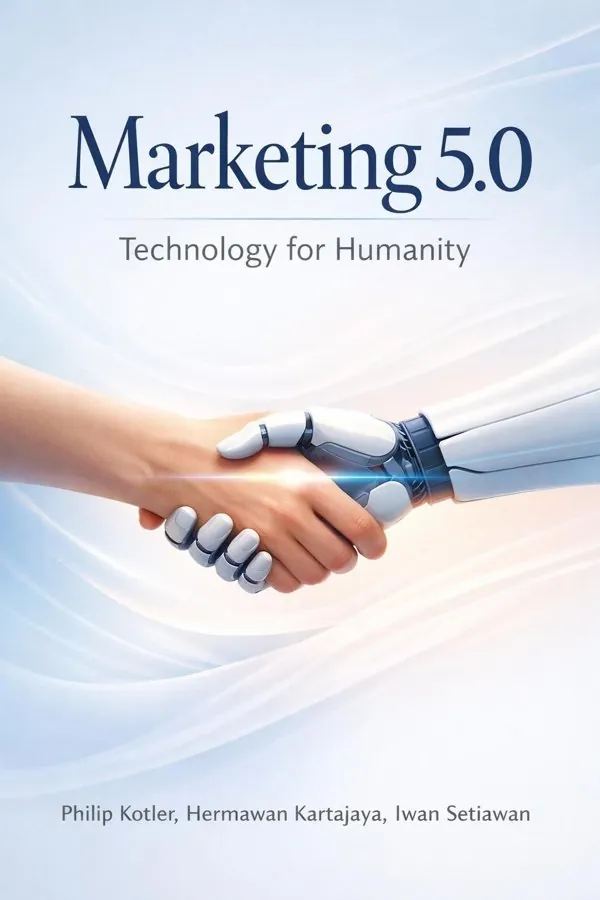
Marketing 5.0: Technology for Humanity: Summary & Key Insights
by Philip Kotler, Hermawan Kartajaya, Iwan Setiawan
 10 min9 chaptersAudio available
Key Takeaways from Marketing 5.0: Technology for Humanity
A company can deploy the newest tools in the world and still fail if customers feel ignored, manipulated, or misunderstood.
The marketplace is no longer defined by one dominant customer profile.
Data can reveal what customers do, but it does not automatically explain why they do it.
The most powerful marketing often happens before the customer explicitly asks for help.
Customers do not simply want brands to know their names.
What Is Marketing 5.0: Technology for Humanity About?
Marketing 5.0: Technology for Humanity by Philip Kotler, Hermawan Kartajaya, Iwan Setiawan is a marketing book. Marketing 5.0: Technology for Humanity explores one of the defining business challenges of our time: how companies can use advanced technology without losing sight of the people they serve. In this book, Philip Kotler, Hermawan Kartajaya, and Iwan Setiawan argue that the future of marketing is not simply digital, automated, or data-driven. It is deeply human. The real opportunity lies in applying technologies such as artificial intelligence, predictive analytics, automation, augmented reality, and smart interfaces to create more relevant, empathetic, and meaningful customer experiences. The book matters because marketing has entered an era shaped by rapid digital adoption, shifting customer expectations, and widening generational differences. Traditional approaches are no longer enough. Brands must understand connected consumers, fragmented markets, and the growing demand for personalization at scale. Few authors are better positioned to explain this shift. Kotler is widely regarded as the father of modern marketing, while Kartajaya and Setiawan are influential strategic thinkers known for translating big ideas into practical business frameworks. Together, they offer a clear guide for leaders who want to modernize marketing while keeping humanity, trust, and customer value at the center.
This FizzRead summary covers all 9 key chapters of Marketing 5.0: Technology for Humanity in approximately 10 minutes, distilling the most important ideas, arguments, and takeaways from Philip Kotler, Hermawan Kartajaya, Iwan Setiawan's work. Also available as an audio summary and Key Quotes Podcast.
Marketing 5.0: Technology for Humanity
Marketing 5.0: Technology for Humanity explores one of the defining business challenges of our time: how companies can use advanced technology without losing sight of the people they serve. In this book, Philip Kotler, Hermawan Kartajaya, and Iwan Setiawan argue that the future of marketing is not simply digital, automated, or data-driven. It is deeply human. The real opportunity lies in applying technologies such as artificial intelligence, predictive analytics, automation, augmented reality, and smart interfaces to create more relevant, empathetic, and meaningful customer experiences.
The book matters because marketing has entered an era shaped by rapid digital adoption, shifting customer expectations, and widening generational differences. Traditional approaches are no longer enough. Brands must understand connected consumers, fragmented markets, and the growing demand for personalization at scale. Few authors are better positioned to explain this shift. Kotler is widely regarded as the father of modern marketing, while Kartajaya and Setiawan are influential strategic thinkers known for translating big ideas into practical business frameworks. Together, they offer a clear guide for leaders who want to modernize marketing while keeping humanity, trust, and customer value at the center.
Who Should Read Marketing 5.0: Technology for Humanity?
This book is perfect for anyone interested in marketing and looking to gain actionable insights in a short read. Whether you're a student, professional, or lifelong learner, the key ideas from Marketing 5.0: Technology for Humanity by Philip Kotler, Hermawan Kartajaya, Iwan Setiawan will help you think differently.
- ✓Readers who enjoy marketing and want practical takeaways
- ✓Professionals looking to apply new ideas to their work and life
- ✓Anyone who wants the core insights of Marketing 5.0: Technology for Humanity in just 10 minutes
Want the full summary?
Get instant access to this book summary and 100K+ more with Fizz Moment.
Get Free SummaryAvailable on App Store • Free to download
Key Chapters
A company can deploy the newest tools in the world and still fail if customers feel ignored, manipulated, or misunderstood. That is the central tension at the heart of Marketing 5.0. The book argues that technology is not the goal of modern marketing; it is the enabler. The true objective remains the same as it has always been: understanding people and creating value for them in ways that feel relevant, useful, and respectful.
The authors build on earlier marketing eras. Marketing 1.0 focused on products, 2.0 on customers, 3.0 on values, and 4.0 on digital transformation. Marketing 5.0 moves one step further by combining advanced technology with a human-centered mindset. This means using data, algorithms, automation, and digital platforms not to replace human judgment, but to augment it. A chatbot, for example, should not simply reduce service costs. It should help customers get answers faster and with less frustration. A recommendation engine should not just push more products. It should help people discover solutions that genuinely fit their needs.
This shift is especially important because many businesses mistake efficiency for effectiveness. Automating every touchpoint may save money, but if the experience feels cold or invasive, trust erodes. On the other hand, when technology removes friction, anticipates needs, and supports more personalized engagement, it strengthens relationships.
A practical application is to audit every marketing technology investment with one question: how does this improve the customer experience? If the answer is vague, the tool may be solving an internal problem rather than a customer one.
Actionable takeaway: Treat every technology decision as a human experience decision, and measure success not only by cost savings or conversion rates, but by relevance, trust, and customer satisfaction.
The marketplace is no longer defined by one dominant customer profile. It is a multigenerational arena where each group brings different expectations, digital habits, trust patterns, and buying behaviors. One of the book’s most useful contributions is its emphasis on understanding how demographic change affects marketing strategy.
The authors highlight that businesses now serve Baby Boomers, Generation X, Millennials, Generation Z, and emerging younger audiences at the same time. These generations may interact with the same brand through very different channels. Older consumers may still value in-person guidance, phone support, or clear step-by-step communication, while younger consumers expect mobile-first design, instant responses, and seamless digital experiences. The challenge is not choosing one audience over another, but designing marketing systems flexible enough to meet all of them where they are.
This matters because many brands either over-digitize or under-digitize. A financial services company that pushes every customer toward an app may alienate older users who want reassurance and human contact. At the same time, a retailer relying too heavily on traditional communication may lose younger buyers who expect social commerce, personalized recommendations, and frictionless checkout.
The practical implication is segmentation beyond age alone. Marketers should study digital maturity, preferred decision-making styles, media behavior, and emotional triggers across customer groups. For example, the same product can be marketed through detailed explanatory content for one segment and short-form social proof for another.
Marketing 5.0 encourages inclusive strategy: use technology to personalize interaction without stereotyping people. Smart CRM systems, behavioral analytics, and channel optimization can help brands adapt communication while maintaining a consistent brand promise.
Actionable takeaway: Build campaigns around customer behaviors and preferences, not just demographic labels, and create flexible journeys that accommodate both high-tech convenience and human support.
Data can reveal what customers do, but it does not automatically explain why they do it. One of the book’s key insights is that effective marketing in the age of technology requires both analytical power and human interpretation. Numbers matter, but meaning matters more.
Marketing 5.0 emphasizes the increasing importance of data ecosystems: customer databases, transaction histories, social listening, behavioral analytics, location signals, and predictive models. These tools help marketers identify patterns, forecast demand, personalize offers, and allocate resources more intelligently. Yet the authors warn against blind faith in dashboards. Data may tell you that customers abandon a checkout page, stop opening emails, or engage with certain messages, but only thoughtful interpretation reveals the emotional and contextual reasons behind those patterns.
For example, a drop in app usage might not indicate product failure. It could reflect seasonal behavior, poor onboarding, confusing navigation, or a lack of trust around permissions. Similarly, a high click-through rate does not always mean a campaign succeeded if the traffic never converts or if it attracts the wrong audience.
This is where human judgment, customer interviews, and cross-functional collaboration remain essential. Data should guide questions, not end them. Marketing teams must combine quantitative insights with qualitative understanding from service teams, sales staff, online reviews, and direct customer feedback.
A practical application is to create regular insight sessions where teams review performance data alongside customer stories and frontline observations. This prevents marketing from becoming overly mechanical and helps businesses design actions that solve real problems.
Actionable takeaway: Use data as a decision support system, not a substitute for empathy, and always pair analytics with direct customer understanding before making major marketing moves.
The most powerful marketing often happens before the customer explicitly asks for help. Marketing 5.0 introduces predictive marketing as a major capability in the technology-for-humanity era. Instead of reacting to customer behavior after the fact, companies can use data and machine learning to anticipate likely needs, timing, and next actions.
Predictive marketing relies on historical patterns, current signals, and contextual data to estimate future behavior. It can help businesses forecast which prospects are most likely to convert, which customers are at risk of leaving, what products may be needed next, and when outreach will be most effective. When done well, this makes marketing more relevant and less wasteful. Rather than blasting generic promotions to everyone, brands can engage people with messages that fit their likely situation.
Consider a health and wellness platform. If usage patterns suggest that a member tends to lose motivation after two weeks, the platform can proactively send encouragement, coach recommendations, or personalized routines before disengagement happens. An e-commerce brand can recognize replenishment cycles and remind customers to reorder essentials at the right time. A bank can identify customers nearing important life stages and provide educational offers aligned with their needs.
However, the authors imply that predictive power must be balanced with ethics and restraint. Anticipation should feel helpful, not invasive. If customers feel watched too closely or manipulated based on hidden data, trust declines. Transparency and clear value exchange matter.
To apply this idea, marketers should start with a few high-impact use cases such as churn prevention, next-best-offer recommendations, or demand forecasting. The goal is not perfect prediction but better timing and more useful interaction.
Actionable takeaway: Begin using predictive analytics in one customer journey where earlier intervention can clearly improve customer outcomes, and design the experience to feel supportive rather than intrusive.
Customers do not simply want brands to know their names. They want brands to understand their context. One of the most practical ideas in Marketing 5.0 is that personalization becomes meaningful only when it reflects timing, intent, channel, mood, and situational relevance.
Many companies confuse personalization with surface-level customization. Adding a first name to an email or recommending popular items based on past purchases is a start, but it is not enough in a crowded, fast-moving digital environment. The authors point toward a richer model in which technology helps businesses recognize where a customer is in the journey and what would be most useful in that specific moment.
For example, a travel brand should not send the same promotional message to someone browsing dream vacations, someone comparing prices, and someone dealing with a delayed flight. Each customer has different emotional needs. The browser may need inspiration, the price comparer may need reassurance on value, and the delayed traveler may need fast service and empathy. Context transforms communication from noise into assistance.
This requires integrating data across touchpoints: website activity, service interactions, purchase history, app behavior, device type, and even location in some cases. It also requires careful orchestration so the brand feels coherent across channels. A customer should not receive an aggressive sales message immediately after filing a complaint.
The strongest practical use of contextual personalization is journey design. Instead of asking, “How can we target this segment?” teams ask, “What is this person trying to accomplish right now, and how can we help?” That shift improves both conversion and loyalty.
Actionable takeaway: Map your core customer journeys and identify the top three moments where context-aware personalization would reduce friction, increase relevance, or improve emotional experience.
In a volatile environment, the biggest marketing advantage is often not budget or brand awareness, but speed of learning. Marketing 5.0 stresses that technological change, competitive pressure, and shifting customer behavior demand a more agile approach to marketing management.
Traditional annual planning cycles assume stability. Teams define campaigns months in advance, allocate fixed budgets, and execute against rigid assumptions. But today, customer sentiment can shift in days, platform algorithms can change overnight, and external events can alter market priorities almost instantly. In such conditions, slow organizations lose relevance.
The authors advocate a more adaptive model in which marketers test, learn, refine, and scale quickly. Agile marketing borrows principles from software development: smaller experiments, shorter cycles, close collaboration, and continuous feedback. Rather than betting everything on one large campaign, teams can launch variations, analyze results, and improve in real time.
A practical example is a consumer brand introducing a new product. Instead of rolling out one national message, it can test multiple audience segments, value propositions, creatives, and channels in selected markets. Data from these experiments then informs broader expansion. This reduces waste and increases confidence.
Agility also depends on organizational design. Marketing, sales, service, analytics, and IT must work more closely together. Technology alone cannot create adaptability if teams remain siloed. Leaders must encourage fast decision-making, transparency, and a culture where iteration is seen as intelligence rather than indecision.
Importantly, agility should not create chaos. It works best when guided by a clear strategic direction and customer-centric metrics. Fast experiments are useful only if they move the organization toward meaningful goals.
Actionable takeaway: Replace at least one large, fixed campaign plan with a structured test-and-learn process that uses short cycles, shared data, and clear customer outcome metrics.
Technology does more than optimize existing marketing activities; it can redefine the experience itself. One of the exciting dimensions of Marketing 5.0 is its discussion of technologies such as artificial intelligence, natural language processing, sensors, augmented reality, virtual reality, and internet-connected devices. These tools are not just back-end systems. They can become part of the value customers directly experience.
The authors encourage marketers to think beyond promotion and see technology as a way to make interactions more immersive, convenient, and informative. Augmented reality, for instance, allows shoppers to visualize furniture in their homes, test cosmetics virtually, or preview products before purchase. AI assistants can guide customers through complex decisions, answer questions instantly, and reduce confusion. Smart devices can enable proactive service by detecting issues before they become serious.
What makes this idea important is that customer experience is increasingly the product. In many categories, features and prices are easy to copy. The differentiator becomes how easy, engaging, and reassuring the buying and usage process feels. A healthcare provider using remote monitoring and intelligent alerts, for example, can create a sense of continuous care. A B2B software company using guided onboarding and predictive support can shorten time to value.
Still, the book’s broader philosophy applies here too: novelty is not enough. A flashy virtual tool that adds complexity rather than clarity will not help. The best experience technologies remove uncertainty, improve confidence, and deliver practical value.
Actionable takeaway: Identify one point in your customer journey where people hesitate, feel overwhelmed, or lack confidence, and explore whether an experience technology such as AI guidance or visualization can make the decision easier.
The more technology marketers use, the more trust becomes a competitive asset. Marketing 5.0 makes it clear that advanced capabilities such as AI, automation, and deep data analysis create enormous opportunity, but also raise serious ethical questions. How much should brands know? How should they use that information? When does personalization become surveillance? These are not side issues; they are central to sustainable marketing success.
Customers are increasingly aware that their behavior is tracked, stored, and analyzed. Many are willing to share data when they receive clear value in return, such as convenience, better recommendations, or faster service. But that willingness is fragile. If people feel deceived, manipulated, or exposed, they disengage. Trust once lost is difficult to rebuild.
The authors’ human-centered philosophy implies several ethical principles. First, transparency: brands should be clear about what data they collect and why. Second, fairness: algorithms should not create harmful bias or exclude certain groups. Third, respect: automation should not exploit vulnerability or pressure customers into decisions that do not serve them. Fourth, security: data stewardship is part of the brand promise.
A practical example is in dynamic pricing or personalized offers. While technology can optimize revenue, businesses must ensure that customers do not feel unfairly treated or punished for their behavior. Likewise, recommendation systems should guide rather than manipulate.
For marketers, ethical discipline is not a constraint on growth. It is a foundation for long-term loyalty, advocacy, and brand resilience. Trust compounds over time in the same way distrust does.
Actionable takeaway: Establish clear ethical guidelines for data use, personalization, and AI deployment, and review marketing practices regularly through the lens of customer trust, fairness, and transparency.
The future of marketing will not be built by machines alone. It will be built by people who know how to work with machines intelligently. A final major message in Marketing 5.0 is that organizations need new capabilities, mindsets, and roles to make technology truly valuable.
As marketing becomes more data-rich and platform-driven, the required skill set expands. Marketers must understand analytics, experimentation, automation tools, content strategy, customer psychology, and digital experience design. Yet the answer is not to turn every marketer into an engineer. The deeper need is hybrid capability: teams that combine technical literacy with creativity, empathy, strategic thinking, and ethical judgment.
This means companies should rethink talent development. A strong marketing team today may include data analysts, customer experience designers, marketing technologists, content creators, and performance specialists working alongside brand strategists and researchers. Collaboration becomes crucial because customer journeys cut across functions and systems.
The book also implies a shift in leadership. Executives must champion learning cultures where experimentation is encouraged and upskilling is ongoing. Employees should be trained not only to use tools, but to question outputs, interpret signals, and connect insights to real human needs. An organization that buys expensive technology without developing people will underperform.
For example, a company may invest in a sophisticated CRM and automation suite, but if teams do not know how to design journeys, create relevant content, or analyze results, the platform becomes an expensive database rather than a growth engine.
Actionable takeaway: Conduct a marketing capability audit to identify the technical, analytical, creative, and customer-experience skills your team needs next, then build a training and hiring plan that develops those capabilities together.
All Chapters in Marketing 5.0: Technology for Humanity
About the Authors
Philip Kotler is widely recognized as the father of modern marketing and is one of the most influential business thinkers of the last century. A professor, author, and global consultant, he helped define core marketing principles used in business schools and companies worldwide. Hermawan Kartajaya is a leading Indonesian marketing strategist, entrepreneur, and founder of MarkPlus, known for his work on customer-centric strategy and market development. Iwan Setiawan is a marketing expert and writer who has collaborated extensively on translating emerging business trends into practical frameworks. Together, the three authors have co-written several important books on the evolution of marketing, blending academic rigor, strategic insight, and real-world relevance for leaders navigating rapid change.
Get This Summary in Your Preferred Format
Read or listen to the Marketing 5.0: Technology for Humanity summary by Philip Kotler, Hermawan Kartajaya, Iwan Setiawan anytime, anywhere. FizzRead offers multiple formats so you can learn on your terms — all free.
Available formats: App · Audio · PDF · EPUB — All included free with FizzRead
Download Marketing 5.0: Technology for Humanity PDF and EPUB Summary
Key Quotes from Marketing 5.0: Technology for Humanity
“A company can deploy the newest tools in the world and still fail if customers feel ignored, manipulated, or misunderstood.”
“The marketplace is no longer defined by one dominant customer profile.”
“Data can reveal what customers do, but it does not automatically explain why they do it.”
“The most powerful marketing often happens before the customer explicitly asks for help.”
“Customers do not simply want brands to know their names.”
Frequently Asked Questions about Marketing 5.0: Technology for Humanity
Marketing 5.0: Technology for Humanity by Philip Kotler, Hermawan Kartajaya, Iwan Setiawan is a marketing book that explores key ideas across 9 chapters. Marketing 5.0: Technology for Humanity explores one of the defining business challenges of our time: how companies can use advanced technology without losing sight of the people they serve. In this book, Philip Kotler, Hermawan Kartajaya, and Iwan Setiawan argue that the future of marketing is not simply digital, automated, or data-driven. It is deeply human. The real opportunity lies in applying technologies such as artificial intelligence, predictive analytics, automation, augmented reality, and smart interfaces to create more relevant, empathetic, and meaningful customer experiences. The book matters because marketing has entered an era shaped by rapid digital adoption, shifting customer expectations, and widening generational differences. Traditional approaches are no longer enough. Brands must understand connected consumers, fragmented markets, and the growing demand for personalization at scale. Few authors are better positioned to explain this shift. Kotler is widely regarded as the father of modern marketing, while Kartajaya and Setiawan are influential strategic thinkers known for translating big ideas into practical business frameworks. Together, they offer a clear guide for leaders who want to modernize marketing while keeping humanity, trust, and customer value at the center.
More by Philip Kotler, Hermawan Kartajaya, Iwan Setiawan
You Might Also Like
Captivology: The Science of Capturing People's Attention
Ben Parr
10 min
Marketing Strategy
Paul Fifield
10 min
UnMarketing: Stop Marketing. Start Engaging.
Scott Stratten
10 min
$100M Leads: How to Get Strangers to Want to Buy Your Stuff
Alex Hormozi
10 min
80/20 Sales and Marketing: The Definitive Guide to Working Less and Making More
Perry Marshall
10 min
AI Strategy for Sales and Marketing: Connecting Marketing, Sales and Customer Experience
Katie King
10 minBrowse by Category
Ready to read Marketing 5.0: Technology for Humanity?
Get the full summary and 100K+ more books with Fizz Moment.