
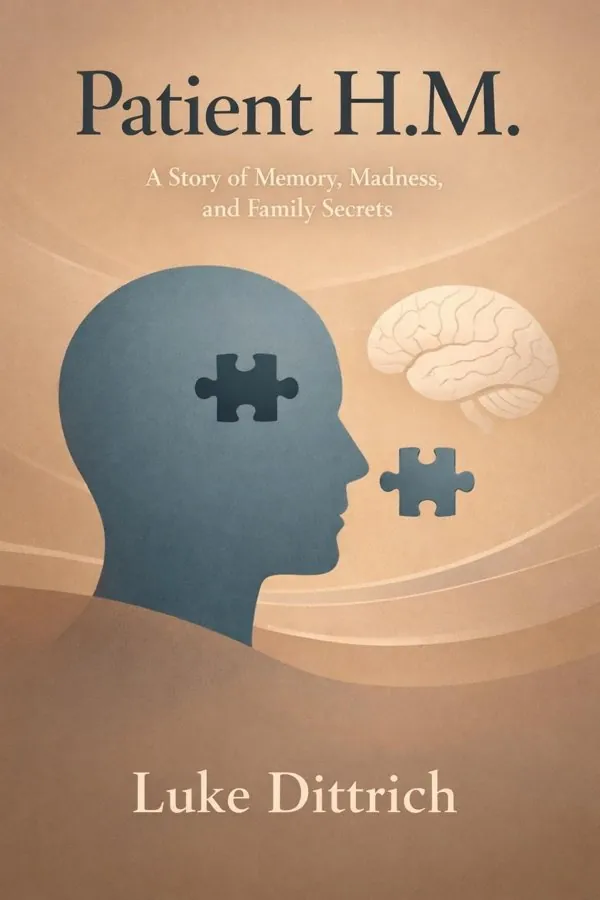
Patient H.M.: A Story of Memory, Madness, and Family Secrets: Summary & Key Insights
 10 min5 chaptersAudio available
What Is Patient H.M.: A Story of Memory, Madness, and Family Secrets About?
Patient H.M.: A Story of Memory, Madness, and Family Secrets by Luke Dittrich is a biographies book spanning 5 pages. Patient H.M. tells the true story of Henry Molaison, a man who became one of the most studied patients in the history of neuroscience after a brain operation left him unable to form new memories. Journalist Luke Dittrich, the grandson of the neurosurgeon who performed the operation, explores the scientific, ethical, and personal dimensions of this case, revealing how it shaped modern understanding of memory and consciousness.
This FizzRead summary covers all 5 key chapters of Patient H.M.: A Story of Memory, Madness, and Family Secrets in approximately 10 minutes, distilling the most important ideas, arguments, and takeaways from Luke Dittrich's work. Also available as an audio summary and Key Quotes Podcast.
Patient H.M.: A Story of Memory, Madness, and Family Secrets
Patient H.M. tells the true story of Henry Molaison, a man who became one of the most studied patients in the history of neuroscience after a brain operation left him unable to form new memories. Journalist Luke Dittrich, the grandson of the neurosurgeon who performed the operation, explores the scientific, ethical, and personal dimensions of this case, revealing how it shaped modern understanding of memory and consciousness.
Who Should Read Patient H.M.: A Story of Memory, Madness, and Family Secrets?
This book is perfect for anyone interested in biographies and looking to gain actionable insights in a short read. Whether you're a student, professional, or lifelong learner, the key ideas from Patient H.M.: A Story of Memory, Madness, and Family Secrets by Luke Dittrich will help you think differently.
- ✓Readers who enjoy biographies and want practical takeaways
- ✓Professionals looking to apply new ideas to their work and life
- ✓Anyone who wants the core insights of Patient H.M.: A Story of Memory, Madness, and Family Secrets in just 10 minutes
Want the full summary?
Get instant access to this book summary and 100K+ more with Fizz Moment.
Get Free SummaryAvailable on App Store • Free to download
Key Chapters
Henry Molaison’s life began like that of countless Americans born in the early twentieth century, a boy in Connecticut whose future seemed ordinary until epilepsy began to shadow his adolescence. His seizures grew uncontrollable; medications failed. When he met Dr. William Scoville—my grandfather—Henry placed his trust in a man renowned for daring surgical interventions. In 1953, Scoville decided that the key lay deep in Henry’s brain, within the folds of his medial temporal lobes. That August, he removed portions of them, including the hippocampus—structures that, at the time, were poorly understood.
The operation achieved its narrow medical aim: Henry’s seizures abated. But clinically and humanly, it produced an unprecedented result. When Henry awoke, he could recall with clarity events from before the surgery, but he could no longer create new memories. His experience of life froze—the days that followed were perpetually the same, repeating in an eternal present. His personality, his intelligence, his humor endured, yet his identity fractured with every passing minute he could not retain.
Researchers soon recognized the immeasurable value of this tragic condition. Over decades, psychologists and neuroscientists—Brenda Milner among them—worked with Henry in meticulous experiments. They discovered that the hippocampus was essential for converting short-term experience into long-term memory, and they mapped the boundaries between semantic and procedural learning. Through him, science glimpsed how memory defines consciousness itself.
For Henry, the result was paradoxical: his inability to remember made him immortal in scientific history, yet it removed him from the flow of life. He became a man studied more than any other, existing simultaneously as subject, symbol, and ghost.
To understand how such a drastic operation came to pass, we must look backward—to the mid-twentieth century’s climate of experimentation. Psychosurgery promised order in a world beset by mental illness; lobotomies were heralded as miracles, performed with confidence but little comprehension. My grandfather, William Scoville, inhabited that frontier as a charismatic surgeon fascinated by the mind’s physical roots. He resected brain tissue to treat psychosis, obsessive disorders, and epilepsy, driven by faith in exploration more than established science.
At that time, neurosurgery occupied a strange intersection of heroism and hubris. The tools were crude, the ethics unformed. Institutionalized patients often served as test subjects without informed consent. Progress was measured not only by cure but by boldness. In that environment, Henry’s operation seemed a reasonable experiment, not an unimaginable risk.
But as the decades passed, that optimism dimmed; the scientific community reassessed its foundations. Henry’s case became emblematic—both of innovation and oversight. His operation gave birth to the era of modern cognitive neuroscience, transforming how the scientific world saw the connection between anatomy and memory. Yet it also exposed the moral vacuum within which early psychosurgery thrived. The knife that opened the door to understanding human memory also cut deeply into the question of what science owes its subjects.
+ 3 more chapters — available in the FizzRead app
All Chapters in Patient H.M.: A Story of Memory, Madness, and Family Secrets
About the Author
Luke Dittrich is an American journalist and author whose work has appeared in Esquire and other major publications. He is known for his investigative reporting and narrative nonfiction, particularly in the fields of science and medicine.
Get This Summary in Your Preferred Format
Read or listen to the Patient H.M.: A Story of Memory, Madness, and Family Secrets summary by Luke Dittrich anytime, anywhere. FizzRead offers multiple formats so you can learn on your terms — all free.
Available formats: App · Audio · PDF · EPUB — All included free with FizzRead
Download Patient H.M.: A Story of Memory, Madness, and Family Secrets PDF and EPUB Summary
Key Quotes from Patient H.M.: A Story of Memory, Madness, and Family Secrets
“Henry Molaison’s life began like that of countless Americans born in the early twentieth century, a boy in Connecticut whose future seemed ordinary until epilepsy began to shadow his adolescence.”
“To understand how such a drastic operation came to pass, we must look backward—to the mid-twentieth century’s climate of experimentation.”
Frequently Asked Questions about Patient H.M.: A Story of Memory, Madness, and Family Secrets
Patient H.M.: A Story of Memory, Madness, and Family Secrets by Luke Dittrich is a biographies book that explores key ideas across 5 chapters. Patient H.M. tells the true story of Henry Molaison, a man who became one of the most studied patients in the history of neuroscience after a brain operation left him unable to form new memories. Journalist Luke Dittrich, the grandson of the neurosurgeon who performed the operation, explores the scientific, ethical, and personal dimensions of this case, revealing how it shaped modern understanding of memory and consciousness.
You Might Also Like

An American Marriage
Tayari Jones
10 min
Benjamin Franklin: An American Life
Walter Isaacson
10 min
I Know Why The Caged Bird Sings
Maya Angelou
10 min
Long Walk to Freedom
Nelson Mandela
10 min
Persepolis
Marjane Satrapi
10 min
Surely You're Joking, Mr. Feynman!
Richard P. Feynman
10 minBrowse by Category
Ready to read Patient H.M.: A Story of Memory, Madness, and Family Secrets?
Get the full summary and 100K+ more books with Fizz Moment.