
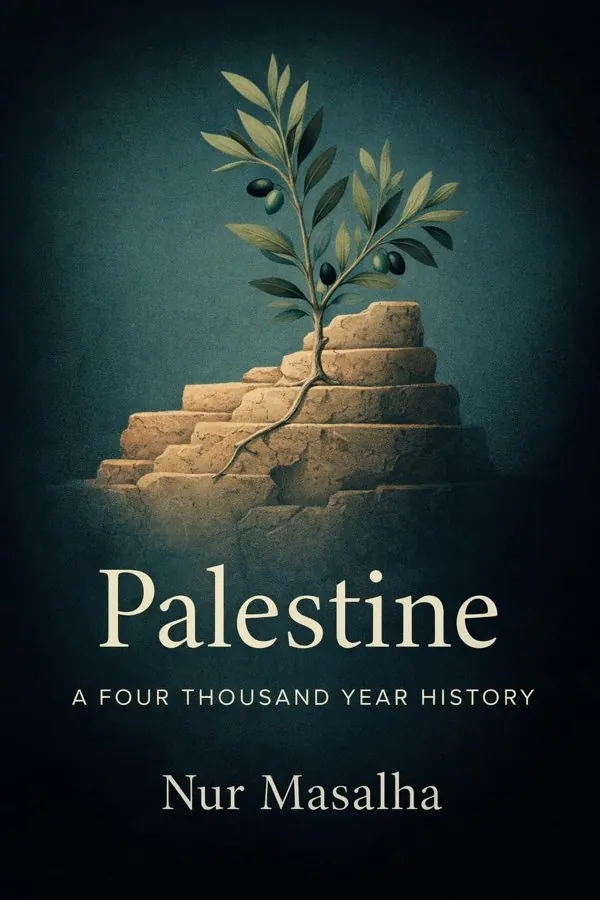
Palestine: A Four Thousand Year History: Summary & Key Insights
by Nur Masalha
 10 min10 chaptersAudio available
Key Takeaways from Palestine: A Four Thousand Year History
A homeland often survives first in language, long before it is defended on a map.
Geography becomes political the moment someone claims a land has no real history.
Civilizations rise and fall, but local life often continues through them with surprising resilience.
A land becomes invisible when history is told only through conquerors.
Long imperial rule does not necessarily dissolve local identity; sometimes it records it.
What Is Palestine: A Four Thousand Year History About?
Palestine: A Four Thousand Year History by Nur Masalha is a world_history book spanning 10 pages. History is never just about the past; it is also a struggle over who gets to belong in the present. In Palestine: A Four Thousand Year History, Nur Masalha offers a sweeping account of Palestine from the Bronze Age to today, arguing that the land and its people cannot be reduced to a modern political dispute or erased by colonial narratives. Drawing on archaeology, ancient inscriptions, classical texts, Islamic records, Ottoman archives, maps, place names, and modern political history, Masalha reconstructs Palestine as a deeply rooted historical reality rather than a recent invention. What makes this book especially important is its challenge to claims that Palestine lacked historical continuity or that Palestinians are merely a modern population without deep ties to the land. Masalha shows instead how names, memory, settlement patterns, culture, and local institutions preserved a durable Palestinian presence across empires and eras. As a Palestinian historian and leading scholar of memory, identity, and colonialism, he writes with both academic rigor and moral urgency. The result is a powerful, corrective history for anyone seeking a fuller understanding of Palestine beyond slogans, propaganda, and historical amnesia.
This FizzRead summary covers all 10 key chapters of Palestine: A Four Thousand Year History in approximately 10 minutes, distilling the most important ideas, arguments, and takeaways from Nur Masalha's work. Also available as an audio summary and Key Quotes Podcast.
Palestine: A Four Thousand Year History
History is never just about the past; it is also a struggle over who gets to belong in the present. In Palestine: A Four Thousand Year History, Nur Masalha offers a sweeping account of Palestine from the Bronze Age to today, arguing that the land and its people cannot be reduced to a modern political dispute or erased by colonial narratives. Drawing on archaeology, ancient inscriptions, classical texts, Islamic records, Ottoman archives, maps, place names, and modern political history, Masalha reconstructs Palestine as a deeply rooted historical reality rather than a recent invention.
What makes this book especially important is its challenge to claims that Palestine lacked historical continuity or that Palestinians are merely a modern population without deep ties to the land. Masalha shows instead how names, memory, settlement patterns, culture, and local institutions preserved a durable Palestinian presence across empires and eras. As a Palestinian historian and leading scholar of memory, identity, and colonialism, he writes with both academic rigor and moral urgency. The result is a powerful, corrective history for anyone seeking a fuller understanding of Palestine beyond slogans, propaganda, and historical amnesia.
Who Should Read Palestine: A Four Thousand Year History?
This book is perfect for anyone interested in world_history and looking to gain actionable insights in a short read. Whether you're a student, professional, or lifelong learner, the key ideas from Palestine: A Four Thousand Year History by Nur Masalha will help you think differently.
- ✓Readers who enjoy world_history and want practical takeaways
- ✓Professionals looking to apply new ideas to their work and life
- ✓Anyone who wants the core insights of Palestine: A Four Thousand Year History in just 10 minutes
Want the full summary?
Get instant access to this book summary and 100K+ more with Fizz Moment.
Get Free SummaryAvailable on App Store • Free to download
Key Chapters
A homeland often survives first in language, long before it is defended on a map. Masalha begins by showing that the history of Palestine cannot be understood without paying close attention to the names attached to the land across millennia. Before modern political battles over the word “Palestine,” the region was identified through ancient terms such as Canaan in Egyptian and Near Eastern records. Over time, these names evolved, overlapped, and were reinterpreted, but they consistently reflected a recognized land inhabited by local populations with enduring attachments to place.
Masalha’s key intervention is to reject the idea that Palestine is a recent label invented for convenience. By tracing references in inscriptions, administrative records, and literary traditions, he demonstrates that the naming of the land has deep historical roots. The term later associated with Palestine did not emerge from nowhere; it formed part of a long geographic and cultural vocabulary used by surrounding empires, travelers, historians, and inhabitants themselves. Names also matter because they carry memory. Place names preserve settlement patterns, ecological knowledge, religious significance, and social continuity even when imperial rulers change.
A practical way to understand this is to think about how modern disputes over renaming villages, streets, or regions are never merely bureaucratic. They are efforts to shape public memory and political legitimacy. When a place name disappears, part of its historical archive can disappear with it. Masalha treats toponymy, the study of place names, as evidence that ordinary people often carry history more faithfully than official power does.
The broader lesson is clear: whenever a people’s history is questioned, look first at the names they have used and the names others have long used for them. Actionable takeaway: examine maps, local place names, and historical references together; they often reveal continuities that ideological narratives try to hide.
Geography becomes political the moment someone claims a land has no real history. Masalha shows that during the Hellenistic and Roman eras, Palestine was already widely recognized as a distinct geographical and administrative space. Classical authors, including Herodotus, referred to “Palaistine Syria,” indicating that the name had entered broader Mediterranean understanding centuries before modern nationalism. This matters because it undermines claims that Palestine is only a recent or artificial construct.
Masalha does not argue that ancient usage maps neatly onto modern nationhood. Instead, he makes a more careful and historically grounded point: long before current conflicts, the land was known, described, and situated within regional systems of trade, empire, pilgrimage, and administration. Under Greek and then Roman influence, the area became more deeply integrated into imperial networks, yet this did not erase local populations or sever the land’s distinct identity. Administrative shifts altered borders and governance, but the accumulated recognition of Palestine as a place endured.
This period also reveals one of the book’s larger themes: empires rename and reorganize territories, but they rarely create them from nothing. Palestine was shaped by imperial rule while remaining legible to outsiders and locals alike as a recognizable land. That historical legibility matters today because denial often begins by asserting vagueness where historical evidence shows continuity.
A practical example is the way textbooks or media accounts sometimes leap from biblical history directly to modern geopolitics, skipping centuries of classical and late antique references to Palestine. Such omissions make the land seem historically empty. Masalha restores the missing middle. Actionable takeaway: when evaluating contested histories, ask not only who ruled a place, but also how consistently that place was recognized in geography, administration, and public memory.
Civilizations rise and fall, but local life often continues through them with surprising resilience. In his treatment of the Byzantine and early Islamic periods, Masalha emphasizes continuity rather than rupture. Too many historical narratives portray the arrival of Islam as a civilizational break that replaced what came before. Masalha instead shows how Palestine remained a lived landscape shaped by continuity in settlement, agriculture, trade routes, sacred sites, and local social structures.
During the Byzantine era, Palestine held major religious significance within Christianity, attracting pilgrims and generating administrative and architectural development. With the Muslim conquests of the seventh century, the region became integrated into new political frameworks, but not emptied or reinvented from scratch. Arabic gradually became more prominent, Islamic institutions expanded, and Jerusalem gained renewed centrality, yet existing communities, landscapes, and traditions were absorbed into evolving forms of life rather than simply erased.
This continuity is important for understanding Palestinian identity. Masalha argues that Palestinian belonging is not tied to a single religious era or imperial order. It emerges through layered inheritances: Canaanite, classical, Christian, Islamic, Arab, and local. Such layering resists simplistic narratives that seek to assign exclusive ownership of the land to one civilization alone. It also helps explain why Palestine remained meaningful across changing rulers: people adapted while preserving their relationship to the land.
In practical terms, this reminds readers to treat historical change as cumulative rather than absolute. A city can acquire new rulers and religious institutions while still carrying forward earlier social worlds. Jerusalem is a prime example, where sacred geographies accumulated rather than followed a single linear succession. Actionable takeaway: read periods of conquest with attention to what persisted on the ground, not just what changed at the top; continuity often tells the deeper story.
A land becomes invisible when history is told only through conquerors. Masalha’s discussion of medieval Palestine counters this by shifting attention from crusaders, sultans, and dynasties to the social reality of the land itself. Medieval Palestine was not merely a battlefield between East and West; it was a functioning society of villages, towns, markets, shrines, farms, scholars, artisans, and religious communities. By recovering these layers, Masalha restores Palestinians and their predecessors as historical actors rather than scenery in someone else’s drama.
The Crusades are often narrated from a European perspective, emphasizing military campaigns and sacred ambitions. Masalha places these events within a broader Palestinian context. Despite invasions, warfare, and changing regimes, everyday life continued. Agricultural production, trade routes, local administration, and communal memory linked generations to the same landscapes. This is a crucial corrective because histories centered only on foreign intervention can make local continuity disappear.
Masalha also shows that medieval Palestine was culturally plural. Muslims, Christians, Jews, and others inhabited shared spaces, even amid hierarchy and conflict. The point is not to romanticize the period, but to recognize that Palestine had a deeply rooted social fabric long before modern nationalism. That fabric matters because it demonstrates indigenous continuity despite centuries of external rule.
A modern application is clear: whenever a region is discussed solely through war, outsiders begin to imagine that violence is its natural condition. Recovering social history changes that picture. It reveals agriculture, law, ritual, family life, and urban development as central historical forces. Actionable takeaway: when studying conflict zones, deliberately seek sources on ordinary life; they often provide the strongest evidence against narratives of emptiness or civilizational interruption.
Long imperial rule does not necessarily dissolve local identity; sometimes it records it. In Masalha’s account, the Ottoman era is essential because it offers abundant administrative and social evidence for the continued existence of Palestine as a lived region. From the sixteenth century to the early twentieth, Ottoman governance organized the land through districts, tax registers, landholding systems, religious institutions, and municipal structures. These records reveal villages, towns, families, agricultural production, and local networks that demonstrate rooted continuity rather than demographic or historical emptiness.
Masalha uses this period to challenge the myth that Palestine lacked a people before the twentieth century. Ottoman documentation shows precisely the opposite: settled communities farmed the land, paid taxes, maintained shrines, traded regionally, and formed local elites. Cities such as Jerusalem, Nablus, Gaza, Jaffa, and Acre were not isolated points but part of a connected social world. Even when administrative boundaries shifted, the land remained recognizable through local patterns of life and regional consciousness.
This era also helps explain how modern Palestinian identity emerged. Masalha does not argue that a fully modern nationalism existed unchanged for centuries. Rather, he shows that local and regional identities deepened over time and later interacted with anti-colonial politics, Arab reform currents, and modern state pressures. In that sense, Ottoman Palestine was both old and becoming new.
A practical example is the use of archival records in public debate. Assertions that Palestine was “a land without a people” collapse when confronted with tax registers, travel accounts, village lists, court records, and demographic studies. Archives can humanize what ideology abstracts. Actionable takeaway: when grand political claims are made about a land’s supposed emptiness, look for census data, land records, and local archives; bureaucratic detail often defeats myth.
Political power rarely relies on force alone; it also rewrites the past. One of Masalha’s central arguments is that European colonialism and political Zionism did not simply enter Palestine as neutral historical developments. They brought with them a new narrative framework that cast the land as underused, underdeveloped, or awaiting redemption by outsiders. This was not just a political project but a historiographical one, aimed at recoding Palestine in European and settler-colonial terms.
Masalha situates Zionism within a broader age of European empire, when colonization was often justified through claims of civilizational superiority and indigenous absence. In this framework, Palestinians were minimized, folklorized, or denied altogether. Biblical imagery and selective historical memory were mobilized to privilege one form of attachment to the land while dismissing another. The result was not merely conflict over territory, but conflict over who counted as historical.
The power of this chapter lies in showing how ideas become institutions. Colonial surveys, maps, schools, travel writing, archaeology, and diplomatic language all helped produce a version of Palestine more legible to Europe than to its own people. Once embedded in public discourse, these narratives shaped international policy and normalized dispossession.
This analysis has wider relevance beyond Palestine. Colonial systems often justify themselves by portraying indigenous populations as late, primitive, or politically insignificant. Similar patterns can be seen in the Americas, Australia, and parts of Africa. Understanding Palestine in that comparative frame clarifies how historical erasure works.
Actionable takeaway: whenever a political movement presents itself as merely returning, modernizing, or making the desert bloom, examine whose prior presence is being ignored, renamed, or rendered invisible in the process.
Some of the most decisive acts in history happen through paperwork, commissions, and legal language rather than open warfare. Masalha treats the British Mandate period as a turning point because it translated colonial and Zionist ambitions into administrative reality. British rule after World War I did not govern Palestine impartially. Through legal structures, immigration policy, land administration, and diplomatic commitments such as the Balfour Declaration, the Mandate created the conditions for deepening Palestinian dispossession.
Masalha shows how Palestinians became marginalized in their own homeland through institutions that claimed to be modern and neutral. British authorities recognized and facilitated Zionist national development while refusing equivalent political recognition to the Arab majority. This asymmetry transformed the Mandate into a colonial laboratory where demographic engineering, land transfer, and unequal political representation laid the groundwork for later catastrophe.
What makes this argument especially important is its emphasis on bureaucracy as a weapon. It was not only militias and settlers that changed Palestine, but also surveys, ordinances, commissions, and emergency regulations. These tools shaped land ownership, controlled dissent, and reframed Palestinians as obstacles to a project they had never consented to. The suppression of the Arab Revolt in the 1930s further weakened Palestinian political capacity at a crucial historical moment.
A practical lesson emerges for readers of modern politics: legal systems do not automatically produce justice. Under colonial conditions, law can formalize inequality while appearing procedural and civilized. This is why historical literacy requires attention to institutions as much as ideology. Actionable takeaway: when analyzing colonial rule, study the laws, land codes, and administrative practices; institutional asymmetry often reveals intentions more clearly than official rhetoric.
To understand 1948 only as a war is to miss its deepest human meaning. Masalha presents the Nakba not merely as a moment of military defeat, but as the destruction of Palestinian society through mass displacement, village depopulation, expropriation, and memory erasure. More than 700,000 Palestinians were expelled or fled, and hundreds of villages were destroyed, repopulated, renamed, or wiped from official maps. The result was not incidental wartime suffering but a foundational rupture in Palestinian history.
Masalha insists that the Nakba should be understood structurally. It involved the removal of a people from their land and the replacement of their historical presence with a new national narrative. Homes, fields, mosques, churches, cemeteries, schools, and archives were not simply abandoned; they became targets in a broader project of transforming the land’s identity. This helps explain why the Nakba remains central to Palestinian consciousness: it was both material dispossession and an assault on historical existence.
The practical importance of this concept is immense. Refugeehood in the Palestinian case is not only about humanitarian need, but about rights, return, recognition, and historical accountability. Oral history, family documents, village books, and commemorative practices all serve as forms of resistance against disappearance. They preserve the names and realities that official state narratives tried to bury.
Readers can apply this insight by distinguishing between generic displacement and settler-colonial replacement. Not every refugee crisis has the same structure. In Palestine, depopulation was tied to a long-term remapping of land and memory. Actionable takeaway: whenever a historical trauma is discussed, ask what happened not only to people, but also to their homes, archives, place names, and right to narrate the past.
A nation can be dispersed without ceasing to exist. Masalha’s account of the post-1948 period explores how Palestinians continued to sustain identity despite fragmentation across Israel, the West Bank, Gaza, refugee camps, and global exile. The destruction of a territorial social order did not erase the people. Instead, Palestinian identity was reconstituted through memory, political organization, literature, education, family networks, and resistance movements.
This period is crucial because it complicates simplistic assumptions about national continuity. Palestinians after 1948 did not experience history in one unified space. Some became citizens under Israeli rule, often subjected to military administration and discrimination. Others lived under Jordanian or Egyptian control, and later Israeli occupation after 1967. Millions remained refugees in Lebanon, Syria, Jordan, and beyond. Yet across these fractured conditions, a shared historical consciousness endured, anchored above all in the memory of villages, dispossession, and the right to return.
Masalha shows that identity can survive without sovereignty when it is sustained by institutions of memory. Poetry, schoolbooks, commemorations, maps, refugee testimonies, political movements, and local associations became vehicles for preserving Palestine as a lived idea tied to real places. This is one reason why attempts to treat Palestinians as merely a humanitarian population rather than a people with history have failed.
A practical application of this insight is relevant to many displaced communities. Statelessness does not equal historical disappearance. Communities often reproduce collective identity through cultural production and intergenerational storytelling. Actionable takeaway: when evaluating whether a people still exists politically, do not look only for state institutions; look for memory networks, social continuity, and the persistence of claims tied to land and justice.
When a people’s archive is attacked, memory becomes a form of political survival. The final thread running through Masalha’s book is that the struggle over Palestine is also a struggle over historical narration in the present. Contemporary erasures occur through demolished villages, altered landscapes, missing maps, selective archaeology, sanitized tourism, and public discourse that treats Palestinians as recent, secondary, or invisible. Against this, Masalha argues for memory as both evidence and resistance.
He pays particular attention to the preservation of village histories, oral testimony, family records, and indigenous place names. These are not nostalgic fragments; they are counter-archives that challenge official stories. Memory in this sense is not opposed to scholarship. On the contrary, it complements documentary and archaeological evidence by preserving lived textures of history that bureaucracies often ignore or suppress. The grandmother who remembers a spring, the refugee who can name each family in a destroyed village, and the map that preserves an old Arabic place name all become part of the historical record.
This insight also has ethical importance. Denial thrives when audiences accept only the archives of power as legitimate. Masalha encourages readers to think critically about whose records survive and why. Modern states are highly effective at producing documents, but not always at telling the truth about those they displaced.
In everyday terms, memory work can take many forms: recording elders, preserving documents, supporting local history projects, studying old maps, and refusing dehumanizing simplifications. Actionable takeaway: treat oral history and local memory as serious historical sources, especially in contexts where official institutions have benefited from forgetting.
All Chapters in Palestine: A Four Thousand Year History
About the Author
Nur Masalha is a Palestinian historian and leading scholar of modern Middle Eastern history, Palestinian identity, and the politics of memory. He has taught and conducted research at major academic institutions, including SOAS, University of London, and is widely recognized for his work on Zionism, expulsion, colonialism, and historical narration in Palestine. Across his books and public scholarship, Masalha has explored how archives, place names, oral histories, and state power shape competing understandings of the past. His writing combines rigorous historical research with a clear commitment to recovering marginalized voices and challenging narratives of indigenous absence. He is regarded as an important figure in Palestinian historiography and a key interpreter of how history, memory, and identity intersect in the Palestinian experience.
Get This Summary in Your Preferred Format
Read or listen to the Palestine: A Four Thousand Year History summary by Nur Masalha anytime, anywhere. FizzRead offers multiple formats so you can learn on your terms — all free.
Available formats: App · Audio · PDF · EPUB — All included free with FizzRead
Download Palestine: A Four Thousand Year History PDF and EPUB Summary
Key Quotes from Palestine: A Four Thousand Year History
“A homeland often survives first in language, long before it is defended on a map.”
“Geography becomes political the moment someone claims a land has no real history.”
“Civilizations rise and fall, but local life often continues through them with surprising resilience.”
“A land becomes invisible when history is told only through conquerors.”
“Long imperial rule does not necessarily dissolve local identity; sometimes it records it.”
Frequently Asked Questions about Palestine: A Four Thousand Year History
Palestine: A Four Thousand Year History by Nur Masalha is a world_history book that explores key ideas across 10 chapters. History is never just about the past; it is also a struggle over who gets to belong in the present. In Palestine: A Four Thousand Year History, Nur Masalha offers a sweeping account of Palestine from the Bronze Age to today, arguing that the land and its people cannot be reduced to a modern political dispute or erased by colonial narratives. Drawing on archaeology, ancient inscriptions, classical texts, Islamic records, Ottoman archives, maps, place names, and modern political history, Masalha reconstructs Palestine as a deeply rooted historical reality rather than a recent invention. What makes this book especially important is its challenge to claims that Palestine lacked historical continuity or that Palestinians are merely a modern population without deep ties to the land. Masalha shows instead how names, memory, settlement patterns, culture, and local institutions preserved a durable Palestinian presence across empires and eras. As a Palestinian historian and leading scholar of memory, identity, and colonialism, he writes with both academic rigor and moral urgency. The result is a powerful, corrective history for anyone seeking a fuller understanding of Palestine beyond slogans, propaganda, and historical amnesia.
You Might Also Like
The Age of Capital
Eric Hobsbawm
10 min
The Gulag Archipelago
Aleksandr Solzhenitsyn
10 min
Jerusalem: The Biography
Simon Sebag Montefiore
10 min
The Anglo-Saxons
James Campbell
10 min
The Boer War
Thomas Pakenham
10 min
The Industrial Revolutionaries: The Making of the Modern World 1776–1914
Gavin Weightman
10 minBrowse by Category
Ready to read Palestine: A Four Thousand Year History?
Get the full summary and 100K+ more books with Fizz Moment.