
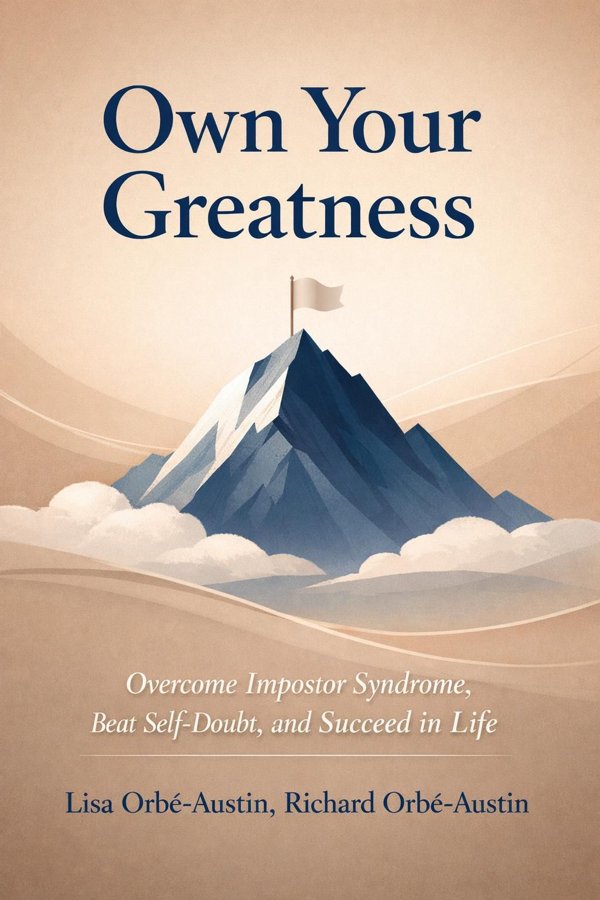
Own Your Greatness: Overcome Impostor Syndrome, Beat Self-Doubt, and Succeed in Life: Summary & Key Insights
by Lisa Orbé-Austin, Richard Orbé-Austin
 10 min9 chaptersAudio available
What Is Own Your Greatness: Overcome Impostor Syndrome, Beat Self-Doubt, and Succeed in Life About?
Own Your Greatness: Overcome Impostor Syndrome, Beat Self-Doubt, and Succeed in Life by Lisa Orbé-Austin, Richard Orbé-Austin is a mental_health book spanning 9 pages. This empowering guide helps readers recognize and overcome impostor syndrome, a psychological pattern where individuals doubt their accomplishments and fear being exposed as a fraud. Through practical exercises and cognitive-behavioral strategies, the authors—both psychologists—offer tools to build confidence, embrace achievements, and develop a healthier self-concept.
This FizzRead summary covers all 9 key chapters of Own Your Greatness: Overcome Impostor Syndrome, Beat Self-Doubt, and Succeed in Life in approximately 10 minutes, distilling the most important ideas, arguments, and takeaways from Lisa Orbé-Austin, Richard Orbé-Austin's work. Also available as an audio summary and Key Quotes Podcast.
Own Your Greatness: Overcome Impostor Syndrome, Beat Self-Doubt, and Succeed in Life
This empowering guide helps readers recognize and overcome impostor syndrome, a psychological pattern where individuals doubt their accomplishments and fear being exposed as a fraud. Through practical exercises and cognitive-behavioral strategies, the authors—both psychologists—offer tools to build confidence, embrace achievements, and develop a healthier self-concept.
Who Should Read Own Your Greatness: Overcome Impostor Syndrome, Beat Self-Doubt, and Succeed in Life?
This book is perfect for anyone interested in mental_health and looking to gain actionable insights in a short read. Whether you're a student, professional, or lifelong learner, the key ideas from Own Your Greatness: Overcome Impostor Syndrome, Beat Self-Doubt, and Succeed in Life by Lisa Orbé-Austin, Richard Orbé-Austin will help you think differently.
- ✓Readers who enjoy mental_health and want practical takeaways
- ✓Professionals looking to apply new ideas to their work and life
- ✓Anyone who wants the core insights of Own Your Greatness: Overcome Impostor Syndrome, Beat Self-Doubt, and Succeed in Life in just 10 minutes
Want the full summary?
Get instant access to this book summary and 100K+ more with Fizz Moment.
Get Free SummaryAvailable on App Store • Free to download
Key Chapters
Early in my work, I realized impostor syndrome wears many disguises. You might see it as the relentless perfectionist, the ever-prepared expert, the isolated soloist, the effortless natural genius, or the indefatigable superhuman. Each of these types operates on a distorted belief: that worth must be proven endlessly, never accepted.
The perfectionist obsessively strives for flawless outcomes, viewing any mistake as evidence of fraud. The expert collects credentials and information, fearing exposure if they fall short of omniscience. The soloist refuses help because accepting support feels like cheating. The natural genius believes skill must come effortlessly; any struggle triggers shame. The superhuman, finally, stretches themselves thin, convinced that only overachievement can shield them from judgment.
These categories are not labels but mirrors. When you recognize your type, you learn where the pressure originates. I encourage you to explore your dominant pattern — not as an accusation, but as an act of understanding. In this awareness lies power. Perfectionists can learn to value progress; experts can appreciate curiosity over certainty; soloists can discover connection in collaboration; natural geniuses can embrace growth; superhumans can find rest without guilt. Every impostor type carries both strength and vulnerability. Our task is not to eradicate these tendencies but to realign them toward health and authenticity.
Impostor feelings don’t appear out of nowhere. They are seeds sown by early experiences, family expectations, societal standards, and the invisible messages that shape how we see ourselves. In our work, Richard and I have found that many high achievers grew up being praised for accomplishments rather than effort. Others were taught to hide success to avoid envy or rejection. Some internalized racial, gender, or cultural narratives that suggested their success was conditional or surprising.
When you trace impostor syndrome back, you often find a child who linked self-worth to performance. That child may have absorbed unspoken lessons: you must be perfect to be accepted; mistakes mean failure; confidence is arrogance. Over time, those lessons evolved into chronic self-surveillance.
By understanding these roots, you begin the gentle work of disentangling inherited beliefs from actual reality. Reflect on the stories you were told — about success, humility, gender roles, ambition — and ask whether they align with who you truly are. The goal is not to absolve the past but to liberate the present. When you see how these narratives operate, you can rewrite them consciously. It’s a revelation that you were never broken; you were simply taught patterns that no longer serve your growth.
+ 7 more chapters — available in the FizzRead app
All Chapters in Own Your Greatness: Overcome Impostor Syndrome, Beat Self-Doubt, and Succeed in Life
About the Authors
Dr. Lisa Orbé-Austin and Dr. Richard Orbé-Austin are licensed psychologists and executive coaches specializing in career advancement, leadership development, and diversity issues. They are co-founders of Dynamic Transitions Psychological Consulting, a firm dedicated to helping professionals achieve personal and professional growth.
Get This Summary in Your Preferred Format
Read or listen to the Own Your Greatness: Overcome Impostor Syndrome, Beat Self-Doubt, and Succeed in Life summary by Lisa Orbé-Austin, Richard Orbé-Austin anytime, anywhere. FizzRead offers multiple formats so you can learn on your terms — all free.
Available formats: App · Audio · PDF · EPUB — All included free with FizzRead
Download Own Your Greatness: Overcome Impostor Syndrome, Beat Self-Doubt, and Succeed in Life PDF and EPUB Summary
Key Quotes from Own Your Greatness: Overcome Impostor Syndrome, Beat Self-Doubt, and Succeed in Life
“Early in my work, I realized impostor syndrome wears many disguises.”
“Impostor feelings don’t appear out of nowhere.”
Frequently Asked Questions about Own Your Greatness: Overcome Impostor Syndrome, Beat Self-Doubt, and Succeed in Life
Own Your Greatness: Overcome Impostor Syndrome, Beat Self-Doubt, and Succeed in Life by Lisa Orbé-Austin, Richard Orbé-Austin is a mental_health book that explores key ideas across 9 chapters. This empowering guide helps readers recognize and overcome impostor syndrome, a psychological pattern where individuals doubt their accomplishments and fear being exposed as a fraud. Through practical exercises and cognitive-behavioral strategies, the authors—both psychologists—offer tools to build confidence, embrace achievements, and develop a healthier self-concept.
You Might Also Like

Big Feelings: How to Be Okay When Things Are Not Okay
Liz Fosslien, Mollie West Duffy
10 min
Creative Arts Therapies Handbook: Art, Music and Dance Therapy Practices for Wellbeing
Susan I. Buchalter
10 min
Emotional First Aid: Healing Rejection, Guilt, Failure, and Other Everyday Hurts
Guy Winch
10 min
Lost Connections: Why You're Depressed and How to Find Hope
Johann Hari
10 min
No Time to Panic: How to Stop Worrying and Embrace Life
Matt Gutman
10 min
Overcoming Mobbing: A Recovery Guide for Workplace Aggression and Bullying
Maureen Duffy, Len Sperry
10 minBrowse by Category
Ready to read Own Your Greatness: Overcome Impostor Syndrome, Beat Self-Doubt, and Succeed in Life?
Get the full summary and 100K+ more books with Fizz Moment.