
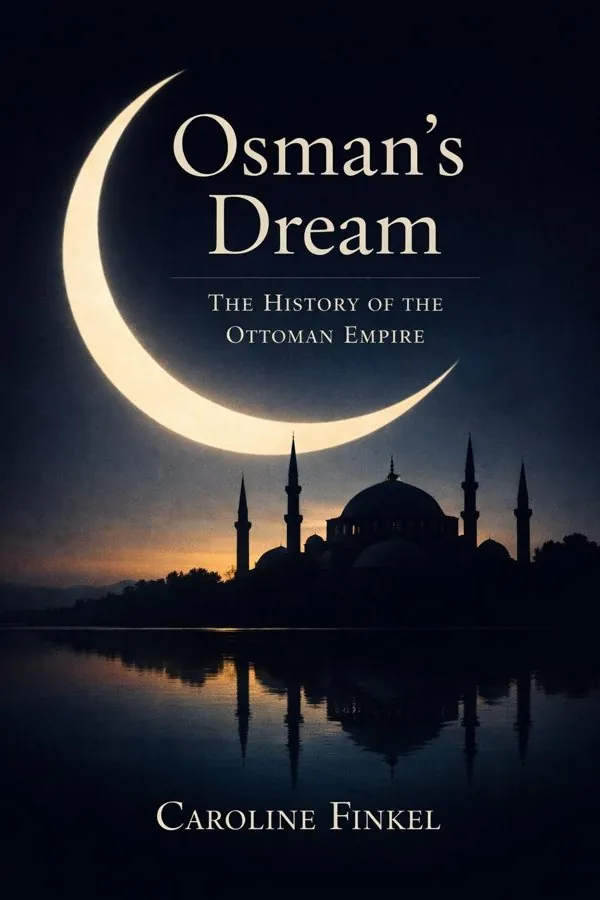
Osman's Dream: The History of the Ottoman Empire: Summary & Key Insights
 10 min6 chaptersAudio available
What Is Osman's Dream: The History of the Ottoman Empire About?
Osman's Dream: The History of the Ottoman Empire by Caroline Finkel is a world_history book spanning 6 pages. A comprehensive history of the Ottoman Empire from its foundation in the late thirteenth century to its dissolution in the early twentieth century. Caroline Finkel traces the empire’s evolution, exploring its political, cultural, and social dynamics, and how it shaped the modern Middle East and Europe. The book provides a detailed narrative of the sultans, wars, reforms, and the empire’s eventual decline.
This FizzRead summary covers all 6 key chapters of Osman's Dream: The History of the Ottoman Empire in approximately 10 minutes, distilling the most important ideas, arguments, and takeaways from Caroline Finkel's work. Also available as an audio summary and Key Quotes Podcast.
Osman's Dream: The History of the Ottoman Empire
A comprehensive history of the Ottoman Empire from its foundation in the late thirteenth century to its dissolution in the early twentieth century. Caroline Finkel traces the empire’s evolution, exploring its political, cultural, and social dynamics, and how it shaped the modern Middle East and Europe. The book provides a detailed narrative of the sultans, wars, reforms, and the empire’s eventual decline.
Who Should Read Osman's Dream: The History of the Ottoman Empire?
This book is perfect for anyone interested in world_history and looking to gain actionable insights in a short read. Whether you're a student, professional, or lifelong learner, the key ideas from Osman's Dream: The History of the Ottoman Empire by Caroline Finkel will help you think differently.
- ✓Readers who enjoy world_history and want practical takeaways
- ✓Professionals looking to apply new ideas to their work and life
- ✓Anyone who wants the core insights of Osman's Dream: The History of the Ottoman Empire in just 10 minutes
Want the full summary?
Get instant access to this book summary and 100K+ more with Fizz Moment.
Get Free SummaryAvailable on App Store • Free to download
Key Chapters
The Osmanlı story begins in the late thirteenth century, in a landscape of decay and opportunity. As Byzantine power receded in northwestern Anatolia, a mosaic of Turkic warrior bands, or ghazis, carved out principalities in the frontier zone. Osman, son of Ertuğrul, was one among many, but he proved exceptional not for wealth or lineage but for the capacity to blend religious zeal with political ambition. Here lies the birth of a dynasty—not through imperial inheritance but through charisma and faith in a destiny inspired by that fateful dream.
In reconstructing his rise, I relied on both Ottoman chronicles and Byzantine testimonies, which, despite their contradictions, reveal a man who mastered the art of alliance and absorption. Osman’s principality grew by incorporating Christian subjects and neighboring beyliks, establishing an embryonic system of governance that balanced tribal loyalty with the flexibility of islamic law. His capture of strategic forts like Karacahisar and the gradual expansion into Bithynia laid the foundations for something new: a polity defined not just by conquest, but by the ability to legitimize and stabilize rule over diverse peoples.
Osman’s legacy was a template rather than a blueprint. His was a world of uncertainty, where power was personal, yet the seeds of a lasting empire had been planted—the use of ghazi ideology to justify territorial consolidation, the creation of a ruling house with both martial prestige and divine sanction, and the assertion of a mission that transcended tribal bounds. Osman’s dream thus became both prophecy and program—a vision enacted by his descendants across centuries.
Osman’s son, Orhan, transformed the frontier principality into an organized state. He took Bursa in 1326, making it the dynasty’s first capital and the symbolic heart of Ottoman rulership. The city’s mosques, markets, and charitable foundations testify to a new urban order grounded in continuity with pre-Islamic institutions yet infused with Islamic purpose. Under Orhan, the Ottomans introduced administrative innovations—the minting of coins, standardized taxation, and appointment of viziers drawn from skilled bureaucrats—that signaled statehood rather than tribal dominion.
Murad I expanded on this base, crossing into Europe and conquering Adrianople (Edirne), which became the empire’s second capital. His establishment of the Janissary corps and the devshirme system marked a profound departure from traditional rule. Christian youths, recruited and converted, were trained to serve as soldiers and administrators—an audacious experiment blending meritocracy with loyal servitude. By separating military service from hereditary nobility, the Ottomans ensured a disciplined army and an impartial bureaucracy bound personally to the sultan.
These early centuries were characterized not only by territorial expansion but also by institutional innovation. The Ottomans forged a model of plurality and centralized control, using Islamic legitimacy while accommodating religious diversity. This capacity to govern difference would underpin the empire’s endurance long after the conquest fires dimmed.
+ 4 more chapters — available in the FizzRead app
All Chapters in Osman's Dream: The History of the Ottoman Empire
About the Author
Caroline Finkel is a British historian specializing in Ottoman history. She earned her PhD from the University of London and has written extensively on Ottoman military and political history. Her works are recognized for their scholarly depth and accessible narrative style.
Get This Summary in Your Preferred Format
Read or listen to the Osman's Dream: The History of the Ottoman Empire summary by Caroline Finkel anytime, anywhere. FizzRead offers multiple formats so you can learn on your terms — all free.
Available formats: App · Audio · PDF · EPUB — All included free with FizzRead
Download Osman's Dream: The History of the Ottoman Empire PDF and EPUB Summary
Key Quotes from Osman's Dream: The History of the Ottoman Empire
“The Osmanlı story begins in the late thirteenth century, in a landscape of decay and opportunity.”
“Osman’s son, Orhan, transformed the frontier principality into an organized state.”
Frequently Asked Questions about Osman's Dream: The History of the Ottoman Empire
Osman's Dream: The History of the Ottoman Empire by Caroline Finkel is a world_history book that explores key ideas across 6 chapters. A comprehensive history of the Ottoman Empire from its foundation in the late thirteenth century to its dissolution in the early twentieth century. Caroline Finkel traces the empire’s evolution, exploring its political, cultural, and social dynamics, and how it shaped the modern Middle East and Europe. The book provides a detailed narrative of the sultans, wars, reforms, and the empire’s eventual decline.
You Might Also Like
The Age of Capital
Eric Hobsbawm
10 min
The Gulag Archipelago
Aleksandr Solzhenitsyn
10 min
Jerusalem: The Biography
Simon Sebag Montefiore
10 min
The Anglo-Saxons
James Campbell
10 min
The Boer War
Thomas Pakenham
10 min
The Industrial Revolutionaries: The Making of the Modern World 1776–1914
Gavin Weightman
10 minBrowse by Category
Ready to read Osman's Dream: The History of the Ottoman Empire?
Get the full summary and 100K+ more books with Fizz Moment.