
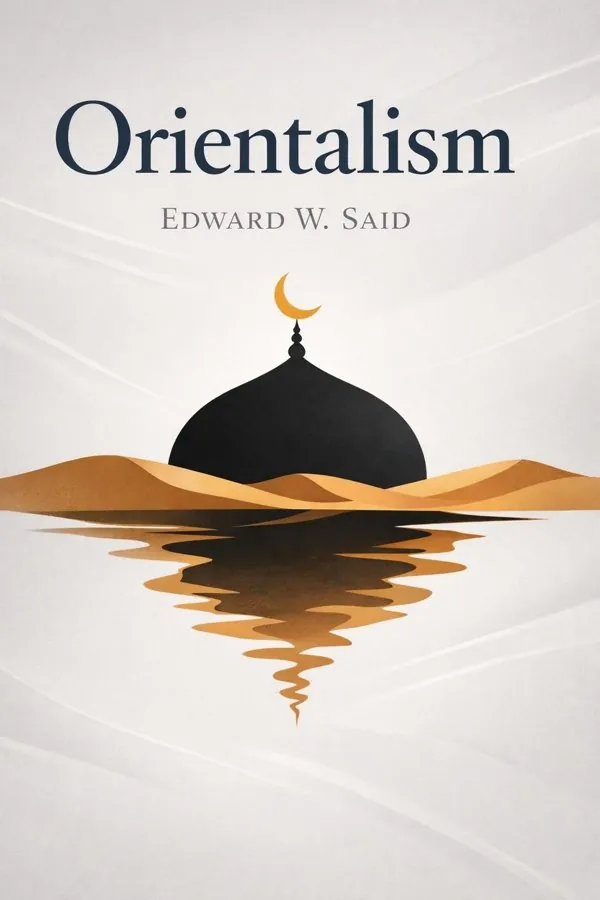
Orientalism: Summary & Key Insights
 10 min10 chaptersAudio available
What Is Orientalism About?
Orientalism by Edward W. Said is a civilization book spanning 10 pages. Orientalism es una obra fundamental de Edward W. Said publicada originalmente en 1978. El libro examina cómo Occidente ha construido una visión estereotipada y distorsionada del Oriente, especialmente del mundo árabe e islámico, a través de la literatura, el arte y la academia. Said argumenta que esta representación no es neutral, sino que sirve para justificar el dominio colonial y cultural de Occidente sobre Oriente. La obra inauguró el campo de los estudios poscoloniales y sigue siendo una referencia esencial en la crítica cultural y política.
This FizzRead summary covers all 10 key chapters of Orientalism in approximately 10 minutes, distilling the most important ideas, arguments, and takeaways from Edward W. Said's work. Also available as an audio summary and Key Quotes Podcast.
Orientalism
Orientalism es una obra fundamental de Edward W. Said publicada originalmente en 1978. El libro examina cómo Occidente ha construido una visión estereotipada y distorsionada del Oriente, especialmente del mundo árabe e islámico, a través de la literatura, el arte y la academia. Said argumenta que esta representación no es neutral, sino que sirve para justificar el dominio colonial y cultural de Occidente sobre Oriente. La obra inauguró el campo de los estudios poscoloniales y sigue siendo una referencia esencial en la crítica cultural y política.
Who Should Read Orientalism?
This book is perfect for anyone interested in civilization and looking to gain actionable insights in a short read. Whether you're a student, professional, or lifelong learner, the key ideas from Orientalism by Edward W. Said will help you think differently.
- ✓Readers who enjoy civilization and want practical takeaways
- ✓Professionals looking to apply new ideas to their work and life
- ✓Anyone who wants the core insights of Orientalism in just 10 minutes
Want the full summary?
Get instant access to this book summary and 100K+ more with Fizz Moment.
Get Free SummaryAvailable on App Store • Free to download
Key Chapters
To understand Orientalism, one must begin with the historical moment in which Europe expanded outward. The eighteenth and nineteenth centuries saw European nations—Britain, France, later others—extend their political reach into territories that they came to call the Orient. But colonial violence was accompanied by another kind of conquest: a conquest of knowledge. Explorers wrote travelogues, philologists cataloged languages, artists painted landscapes and faces that increasingly became symbols of otherness. What emerged was an intricate web of cultural production that defined the East as timeless, decadent, and fundamentally different from the rational, progressive West.
These depictions were not incidental; they were ideological. Napoleon’s mission to Egypt in 1798, for instance, was not only military—he brought with him scholars and scientists whose task was to study and classify the country. The subsequent publication, *Description de l’Égypte*, turned Egypt into an object of European knowledge, a vast archive cataloged for Western eyes. This effort reflected what I call a style of thought—Orientalism—a tradition that speaks of the East from a position of power. Those early colonial representations became the foundation for generations of scholarship and art. Europe thus inherited a coherent image of its opposite, an Orient that existed simultaneously as fascination and justification for domination.
To grasp the deeper mechanism behind Orientalism, I drew upon Michel Foucault’s concept of discourse—the idea that power and knowledge are intertwined. Orientalism is not merely a collection of lies or myths about the East; it is a discourse, a system of thought that produces the Orient through what it says and depicts. Every book written, every painting created, every scholarly theory postulates an Orient that is knowable only through Western categories. The discourse sets limits on what can be thought or said about the East. In other words, Orientalism is not so much about prejudice as about authority: the right to speak, to define, and to represent.
Within this framework, power no longer resides solely in armies or governments; it runs through universities, literary works, and museums. The West’s control over representation becomes a subtle form of rule. Even benevolent scholars and romantic poets operate within this field. They may love the Orient as an idea, but that love often masks possession. When a system of thought becomes stable enough, it produces truth. Thus, Orientalist discourse made certain ideas appear self-evident—such as the belief that the East is inherently despotic or sensual. To challenge Orientalism is therefore to challenge the way truth itself has been fabricated.
+ 8 more chapters — available in the FizzRead app
All Chapters in Orientalism
About the Author
Edward Wadie Said (1935–2003) fue un académico, crítico literario y pensador palestino-estadounidense. Profesor en la Universidad de Columbia, Said es reconocido por su influencia en los estudios literarios y culturales, especialmente por su análisis del imperialismo y la representación del Oriente en la cultura occidental. Su obra más conocida, Orientalism, transformó la comprensión de las relaciones entre cultura y poder.
Get This Summary in Your Preferred Format
Read or listen to the Orientalism summary by Edward W. Said anytime, anywhere. FizzRead offers multiple formats so you can learn on your terms — all free.
Available formats: App · Audio · PDF · EPUB — All included free with FizzRead
Download Orientalism PDF and EPUB Summary
Key Quotes from Orientalism
“To understand Orientalism, one must begin with the historical moment in which Europe expanded outward.”
“To grasp the deeper mechanism behind Orientalism, I drew upon Michel Foucault’s concept of discourse—the idea that power and knowledge are intertwined.”
Frequently Asked Questions about Orientalism
Orientalism by Edward W. Said is a civilization book that explores key ideas across 10 chapters. Orientalism es una obra fundamental de Edward W. Said publicada originalmente en 1978. El libro examina cómo Occidente ha construido una visión estereotipada y distorsionada del Oriente, especialmente del mundo árabe e islámico, a través de la literatura, el arte y la academia. Said argumenta que esta representación no es neutral, sino que sirve para justificar el dominio colonial y cultural de Occidente sobre Oriente. La obra inauguró el campo de los estudios poscoloniales y sigue siendo una referencia esencial en la crítica cultural y política.
You Might Also Like
The Structure of Scientific Revolutions
Thomas S. Kuhn
10 min
Genius
Harold Bloom
10 min
A Cultural History of the Medieval Age
Various Editors
10 min
A History of God: The 4,000-Year Quest of Judaism, Christianity and Islam
Karen Armstrong
10 min
A History of the World in 10½ Chapters
Julian Barnes
10 min
A Short History of Progress
Ronald Wright
10 minBrowse by Category
Ready to read Orientalism?
Get the full summary and 100K+ more books with Fizz Moment.