
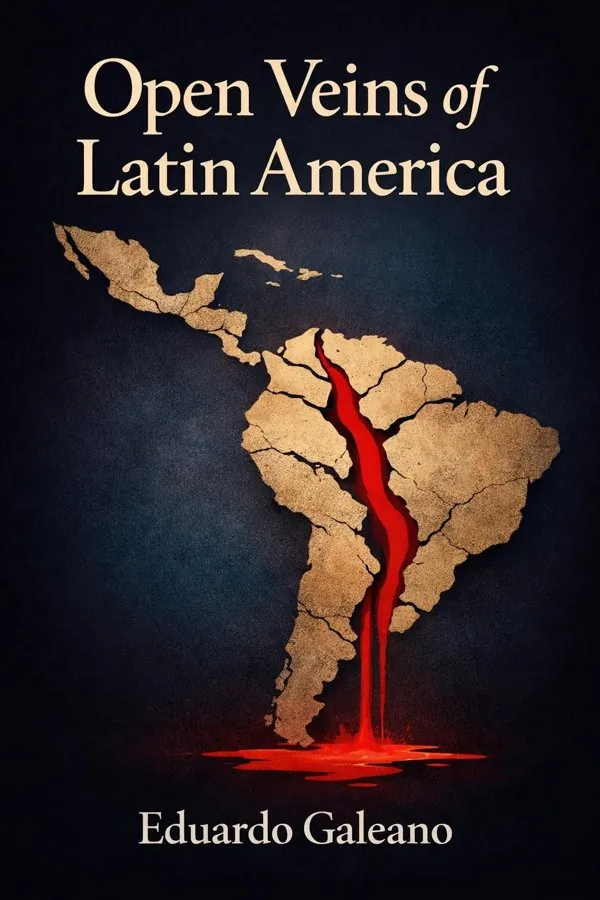
Open Veins of Latin America: Summary & Key Insights
 10 min11 chaptersAudio available
What Is Open Veins of Latin America About?
Open Veins of Latin America by Eduardo Galeano is a world_history book spanning 11 pages. Open Veins of Latin America: Five Centuries of the Pillage of a Continent is a landmark work of political and historical analysis by Uruguayan writer Eduardo Galeano. First published in 1971, the book explores five centuries of economic, political, and social exploitation in Latin America, from European colonization to the twentieth century. Galeano combines historical research, economic critique, and literary narrative to expose the structures of dependency and inequality imposed by foreign powers and local elites. The book has become a classic of Latin American thought and remains influential in discussions of colonialism and global economics.
This FizzRead summary covers all 11 key chapters of Open Veins of Latin America in approximately 10 minutes, distilling the most important ideas, arguments, and takeaways from Eduardo Galeano's work. Also available as an audio summary and Key Quotes Podcast.
Open Veins of Latin America
Open Veins of Latin America: Five Centuries of the Pillage of a Continent is a landmark work of political and historical analysis by Uruguayan writer Eduardo Galeano. First published in 1971, the book explores five centuries of economic, political, and social exploitation in Latin America, from European colonization to the twentieth century. Galeano combines historical research, economic critique, and literary narrative to expose the structures of dependency and inequality imposed by foreign powers and local elites. The book has become a classic of Latin American thought and remains influential in discussions of colonialism and global economics.
Who Should Read Open Veins of Latin America?
This book is perfect for anyone interested in world_history and looking to gain actionable insights in a short read. Whether you're a student, professional, or lifelong learner, the key ideas from Open Veins of Latin America by Eduardo Galeano will help you think differently.
- ✓Readers who enjoy world_history and want practical takeaways
- ✓Professionals looking to apply new ideas to their work and life
- ✓Anyone who wants the core insights of Open Veins of Latin America in just 10 minutes
Want the full summary?
Get instant access to this book summary and 100K+ more with Fizz Moment.
Get Free SummaryAvailable on App Store • Free to download
Key Chapters
The tale begins late in the fifteenth century, when European navigators stumbled upon what they called the New World. Yet for those who had lived here for millennia, it was not new but sacred, ordered, and full of life. The conquest that ensued was not the meeting of civilizations—it was the extermination of one by another. I recount how the Spanish Empire, backed by the hunger for precious metals, descended upon these lands with swords blessed by priests and treaties signed by kings. Gold was the god, and the indigenous peoples were its victims.
In Potosí, in the high heart of Bolivia, silver flowed like rivers from the mountain into the coffers of Europe. The riches extracted from this mountain financed palaces and wars, while the miners died unnamed, buried beneath the tunnels they dug. The legend said the mountain could build a bridge of silver all the way to Madrid, yet its townspeople could not afford bread. That paradox—wealth creating poverty—is the theme that the conquest introduced and history kept repeating.
This was not merely physical devastation but spiritual—cultures, languages, and beliefs were destroyed. The conquistadors wrote their chronicles of triumph, but underneath those pages lies another text, written in human suffering. The initial extraction of gold and silver became the symbol of how Europe’s rise required our depletion. I wish to show that the conquest was not a moment in time but the beginning of a pattern: a structure that established who would produce and who would profit.
After the clash of swords came the stability of systems—colonial institutions designed to maintain the flow of resources outward. The colonies became machines for extraction. Sugar, cotton, cacao, silver, and gold left our ports; in return came clothes, weapons, and luxuries. The economies were tailored to serve foreign demand, not local need. The colonizer viewed land purely as resource and man purely as labor. The social classes that developed reinforced that order: at the top, Europeans and creoles; below, the indigenous and African laborers.
This chapter exposes how dependency was engineered into our economies. The wealth did not circulate internally; it drained away. Ports were strategically built for export, not for interregional trade among Latin Americans. Even when production expanded, it did so for the benefit of Europe. I describe how colonial monopolies—such as the Royal Companions and trading houses—guarded this flow, ensuring that colonies remained consumers of European goods. This arrangement shaped not just commerce but consciousness, teaching our people that what was foreign was superior, what was ours was disposable.
Through this lens, I show that colonization was not only a political act of domination but also an economic program with centuries of endurance. The sickness of dependency still afflicts us because its roots lie deep in soil turned to profit under colonial rule.
+ 9 more chapters — available in the FizzRead app
All Chapters in Open Veins of Latin America
About the Author
Eduardo Galeano (1940–2015) was a Uruguayan journalist and writer known for his poetic and politically charged prose. His works blend history, politics, and literature to explore themes of identity, memory, and social justice in Latin America. Among his most notable books are 'Memory of Fire' and 'The Book of Embraces'. Galeano is regarded as one of the most important voices in contemporary Latin American literature.
Get This Summary in Your Preferred Format
Read or listen to the Open Veins of Latin America summary by Eduardo Galeano anytime, anywhere. FizzRead offers multiple formats so you can learn on your terms — all free.
Available formats: App · Audio · PDF · EPUB — All included free with FizzRead
Download Open Veins of Latin America PDF and EPUB Summary
Key Quotes from Open Veins of Latin America
“The tale begins late in the fifteenth century, when European navigators stumbled upon what they called the New World.”
“After the clash of swords came the stability of systems—colonial institutions designed to maintain the flow of resources outward.”
Frequently Asked Questions about Open Veins of Latin America
Open Veins of Latin America by Eduardo Galeano is a world_history book that explores key ideas across 11 chapters. Open Veins of Latin America: Five Centuries of the Pillage of a Continent is a landmark work of political and historical analysis by Uruguayan writer Eduardo Galeano. First published in 1971, the book explores five centuries of economic, political, and social exploitation in Latin America, from European colonization to the twentieth century. Galeano combines historical research, economic critique, and literary narrative to expose the structures of dependency and inequality imposed by foreign powers and local elites. The book has become a classic of Latin American thought and remains influential in discussions of colonialism and global economics.
You Might Also Like
The Age of Capital
Eric Hobsbawm
10 min
The Gulag Archipelago
Aleksandr Solzhenitsyn
10 min
Jerusalem: The Biography
Simon Sebag Montefiore
10 min
The Anglo-Saxons
James Campbell
10 min
The Boer War
Thomas Pakenham
10 min
The Industrial Revolutionaries: The Making of the Modern World 1776–1914
Gavin Weightman
10 minBrowse by Category
Ready to read Open Veins of Latin America?
Get the full summary and 100K+ more books with Fizz Moment.