
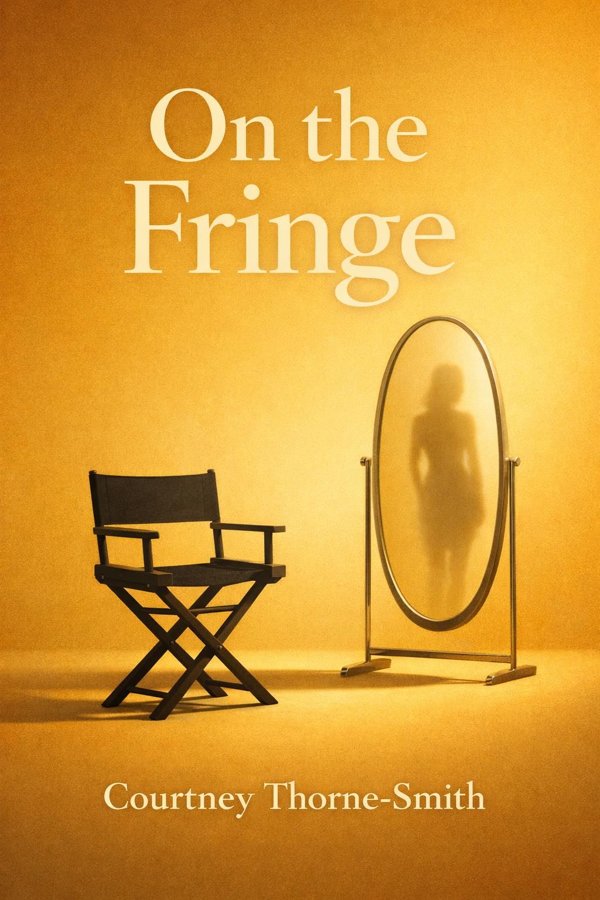
On the Fringe: Summary & Key Insights
 10 min10 chaptersAudio available
Key Takeaways from On the Fringe
Before a career becomes visible, it usually begins as a private longing.
Most careers do not begin with a breakthrough; they begin with ambiguity.
Visibility does not heal insecurity; it often enlarges it.
Popular culture often turns people into symbols before they have time to stay human.
When a culture treats the body as a résumé, self-harm can start looking like discipline.
What Is On the Fringe About?
On the Fringe by Courtney Thorne-Smith is a biographies book spanning 9 pages. On the Fringe is Courtney Thorne-Smith’s sharp, funny, and deeply personal memoir about living inside Hollywood without ever fully belonging to its illusions. Best known for popular television roles on Melrose Place, Ally McBeal, and According to Jim, Thorne-Smith writes not as a distant celebrity but as a working actress who spent years navigating auditions, fame, body scrutiny, public expectations, and private insecurity. What makes this book stand out is its emotional honesty: she does not simply recount career highlights, but examines the psychological cost of trying to look successful while feeling uncertain, hungry for approval, and disconnected from herself. Her story matters because it exposes how glamorous industries often reward performance over well-being, especially for women. Yet the memoir is never heavy-handed. Thorne-Smith brings wit, self-awareness, and humility to experiences that could easily have become bitter or self-congratulatory. The result is an insider’s portrait of entertainment culture and a broader reflection on perfectionism, self-image, and authenticity. This is not just a Hollywood memoir. It is a story about learning how to stop living for the camera and start living truthfully.
This FizzRead summary covers all 10 key chapters of On the Fringe in approximately 10 minutes, distilling the most important ideas, arguments, and takeaways from Courtney Thorne-Smith's work. Also available as an audio summary and Key Quotes Podcast.
On the Fringe
On the Fringe is Courtney Thorne-Smith’s sharp, funny, and deeply personal memoir about living inside Hollywood without ever fully belonging to its illusions. Best known for popular television roles on Melrose Place, Ally McBeal, and According to Jim, Thorne-Smith writes not as a distant celebrity but as a working actress who spent years navigating auditions, fame, body scrutiny, public expectations, and private insecurity. What makes this book stand out is its emotional honesty: she does not simply recount career highlights, but examines the psychological cost of trying to look successful while feeling uncertain, hungry for approval, and disconnected from herself. Her story matters because it exposes how glamorous industries often reward performance over well-being, especially for women. Yet the memoir is never heavy-handed. Thorne-Smith brings wit, self-awareness, and humility to experiences that could easily have become bitter or self-congratulatory. The result is an insider’s portrait of entertainment culture and a broader reflection on perfectionism, self-image, and authenticity. This is not just a Hollywood memoir. It is a story about learning how to stop living for the camera and start living truthfully.
Who Should Read On the Fringe?
This book is perfect for anyone interested in biographies and looking to gain actionable insights in a short read. Whether you're a student, professional, or lifelong learner, the key ideas from On the Fringe by Courtney Thorne-Smith will help you think differently.
- ✓Readers who enjoy biographies and want practical takeaways
- ✓Professionals looking to apply new ideas to their work and life
- ✓Anyone who wants the core insights of On the Fringe in just 10 minutes
Want the full summary?
Get instant access to this book summary and 100K+ more with Fizz Moment.
Get Free SummaryAvailable on App Store • Free to download
Key Chapters
Before a career becomes visible, it usually begins as a private longing. In On the Fringe, Courtney Thorne-Smith presents her early life not as a neat origin story but as the beginning of a personality shaped by imagination, sensitivity, and a desire to connect. Growing up in California, she was drawn to storytelling and performance long before she understood the machinery of Hollywood. Acting appealed to her not simply because it promised recognition, but because it offered a way to inhabit emotion, communicate, and belong. That distinction matters. Many people pursue ambitious careers because they want applause; others pursue them because they are searching for meaning, structure, or self-expression.
Thorne-Smith’s early experiences reveal how childhood traits often become the emotional engines behind adult choices. A person who is observant may become a performer, writer, or therapist. A child who feels out of place may be drawn to roles that allow reinvention. Her story shows that ambition is rarely only about achievement; it is often tied to identity and emotional need. That is why success alone does not always satisfy it.
This idea applies beyond acting. Someone entering business, law, teaching, or design can benefit from asking: What part of me is really being expressed here? Am I chasing prestige, or am I following a genuine form of connection? When people lose sight of that original impulse, their work can start feeling hollow even when it looks impressive from the outside.
Actionable takeaway: Reflect on the earliest reasons you were drawn to your field, and use those reasons as a compass when making future choices.
Most careers do not begin with a breakthrough; they begin with ambiguity. Thorne-Smith describes entering Hollywood as a process of endless auditions, small roles, near misses, and constant waiting. The fantasy of discovery hides the more common reality: progress is slow, irregular, and emotionally exhausting. One day offers hope, the next offers silence. In that kind of environment, resilience becomes more important than talent alone.
Her experiences show how difficult it is to build confidence when outcomes are mostly outside your control. An audition may go well and still lead nowhere. A job may arrive unexpectedly after months of rejection. This unpredictability can distort self-worth because people begin to treat external feedback as proof of inner value. In Hollywood, where appearance, timing, and trendiness heavily influence opportunities, that pressure becomes intense. But the lesson is universal. Early-stage professionals in any field often face internships, temporary roles, invisible labor, and long stretches without validation.
Thorne-Smith’s story reminds readers that uncertainty does not mean you are failing; it often means you are in the middle of building something real. The challenge is learning to separate process from identity. A bad week is not a bad self. A missed opportunity is not a final judgment. Practical resilience might look like maintaining routines, developing skills between opportunities, seeking grounded friends, and refusing to make every outcome mean something personal.
Actionable takeaway: Measure your progress by consistency and growth rather than by immediate recognition, especially during uncertain early phases.
Visibility does not heal insecurity; it often enlarges it. One of the most compelling insights in On the Fringe is that public success did not erase Thorne-Smith’s private doubts. As her career gained traction and her profile rose, especially during the years leading into greater television fame, the external rewards of Hollywood did not produce inner stability. Instead, being seen by millions intensified the fear of being judged, compared, and found lacking.
This is a powerful corrective to the common belief that achievement automatically creates confidence. If self-worth is fragile before success, fame can turn that fragility into a daily performance. Every compliment becomes temporary, every criticism feels amplified, and every image can become evidence in the ongoing case against yourself. Thorne-Smith’s account suggests that insecurity thrives when a person’s value becomes entangled with how others respond to them.
This pattern appears far beyond celebrity culture. A promotion, social media attention, a prestigious degree, or a public-facing role can create the same paradox: the more visible you become, the more pressure you feel to maintain the image that got you there. Without internal grounding, accomplishments become obligations. Instead of feeling freer, people become more guarded and self-monitoring.
Thorne-Smith’s honesty makes the lesson practical. Confidence is not built by collecting admiration. It is built by creating a stable identity that can survive both praise and criticism. That might involve setting boundaries with comparison, investing in relationships that are not transactional, and noticing when achievement becomes a substitute for self-acceptance.
Actionable takeaway: Build self-worth on values and relationships, not on attention, because visibility can magnify whatever remains unresolved inside.
Popular culture often turns people into symbols before they have time to stay human. Thorne-Smith’s Melrose Place years capture what happens when a television show becomes a phenomenon and the actors inside it are absorbed into the machinery of image, expectation, and constant interpretation. Success on a hit series brought exposure, career momentum, and public fascination, but it also created a world where glamour was less a natural state than a carefully maintained product.
Her experience highlights the strange split between the public narrative and private reality. Viewers see confidence, beauty, and drama; the actor may feel exhausted, insecure, overworked, or isolated. The industry rewards the illusion of effortless allure, while the people producing that illusion often live under immense strain. Thorne-Smith shows how easy it is to become trapped in a role not only on screen, but socially. Once the public recognizes you as a type, you may feel pressure to keep performing that version of yourself.
The broader lesson is about branding. In many careers today, people are encouraged to package themselves into a recognizable identity: the polished executive, the visionary founder, the perfect parent, the effortlessly balanced professional. Yet any identity maintained only for appearances can become restrictive. It may generate opportunity while quietly draining authenticity.
Thorne-Smith’s reflections suggest that glamour has costs when it becomes compulsory. A healthy life requires spaces where no one is curating, selling, or performing. That might mean protecting private rituals, speaking honestly with trusted people, or resisting the urge to let your public image define your entire self.
Actionable takeaway: Notice where your life has become overly performative, and create at least one area where you can show up without managing appearances.
When a culture treats the body as a résumé, self-harm can start looking like discipline. One of the memoir’s most affecting themes is Thorne-Smith’s struggle with body image and eating. In Hollywood, thinness was not presented as one possible beauty ideal; it functioned as currency, expectation, and professional insurance. Under those conditions, monitoring food and appearance can gradually shift from a practical concern into an obsession that governs mood, behavior, and self-worth.
Thorne-Smith does not frame these struggles as vanity. That is essential. Disordered eating often grows from fear, pressure, perfectionism, and the desperate hope that control over the body will create safety in an uncontrollable world. Her account reveals how external scrutiny becomes internalized until the harshest voice is no longer the industry’s, but your own. The tragedy is that what appears to be self-improvement can actually reduce joy, spontaneity, health, and presence.
This dynamic reaches far beyond entertainment. Fitness culture, workplace expectations, dating apps, and social media can all turn appearance into a constant evaluation. People may postpone happiness until they fix themselves physically, only to find that the target keeps moving. Thorne-Smith’s honesty helps expose the lie at the center of this cycle: perfection does not produce peace.
Recovery begins with reclaiming the body as lived experience rather than public object. That might mean eating more intuitively, seeking therapeutic support, challenging comparison habits, and paying attention to whether health practices are increasing freedom or increasing fear.
Actionable takeaway: Ask whether your habits around food and appearance are serving your well-being or serving your anxiety, and make one change in favor of health over control.
A dream job can still reveal painful truths. Thorne-Smith’s time on Ally McBeal represents another major career milestone, yet it also deepened her confrontation with the contradictions of success. On paper, joining a high-profile, culturally influential series should have felt like arrival. In practice, it intensified the familiar pressures around image, competition, and belonging. Professional accomplishment did not simplify life; it made the stakes feel higher.
This chapter of her story underscores a difficult but necessary insight: the things we work hardest to obtain often expose what external success cannot fix. A coveted role can bring money, validation, and visibility, but if someone is already physically depleted or emotionally fragile, the new opportunity may magnify those conditions. The problem is not the success itself; it is the expectation that success should rescue us from our underlying struggles.
Thorne-Smith’s experiences also show how work environments shape mental health. Even exciting, prestigious workplaces can become unhealthy if they revolve around comparison, relentless standards, or unspoken fear. Readers can apply this lesson in any profession. A famous company, elite institution, or admired organization is not automatically a healthy place to build a life. Career decisions should include emotional sustainability, not just status.
Her reflections invite a more mature definition of achievement. Rather than asking only, “How do I get there?” we also need to ask, “What will it cost me to stay there?” and “Who am I becoming in the process?” Those questions can prevent people from sacrificing too much in the name of ambition.
Actionable takeaway: Evaluate opportunities not only by prestige, but by whether they support your long-term health, values, and ability to remain yourself.
Pressure becomes dangerous when it feels normal. Throughout On the Fringe, Thorne-Smith illustrates how the entertainment industry can blur boundaries between professional demands and personal well-being. Long hours, public scrutiny, beauty standards, and the expectation to remain agreeable all create an environment where saying no can feel risky. Over time, that atmosphere can train people to override discomfort, dismiss fatigue, and confuse compliance with professionalism.
This is a crucial lesson because boundary erosion rarely happens all at once. It happens through tiny accommodations: skipping meals, accepting criticism you should challenge, pretending to be fine, agreeing to things that leave you depleted. In industries built on scarcity and competition, people often believe they must prove gratitude at all times. That mindset makes self-protection feel selfish.
Thorne-Smith’s story shows that personal growth often begins when a person stops adapting automatically and starts paying attention to internal signals. Anxiety, resentment, physical exhaustion, and emotional numbness are not inconveniences to ignore; they are information. The same holds true in ordinary workplaces, family systems, and social circles. If success requires chronic self-abandonment, the arrangement is unsustainable.
Healthy boundaries are not dramatic ultimatums. They can look like declining unnecessary appearances, protecting downtime, limiting exposure to toxic voices, or being honest about what you can no longer tolerate. They also require tolerating disappointment from others. That is often the hardest part. But without boundaries, identity gets outsourced to expectations.
Actionable takeaway: Identify one recurring situation where you regularly override your needs, and practice setting a clear limit before resentment and burnout deepen.
Fame can surround a person with attention while leaving them starved for real intimacy. Thorne-Smith’s reflections on relationships and personal life reveal how essential grounded connection becomes when work is unstable, image-driven, and emotionally demanding. In an environment where many interactions are transactional or appearance-based, genuine friendship, romance, and family ties offer a different kind of mirror. They reflect who you are when the performance ends.
Her memoir suggests that personal relationships can either reinforce unhealthy patterns or help interrupt them. If someone chooses partners or friends who reward perfection, they may deepen their own self-erasure. But if they build bonds with people who value honesty, humor, and ordinary humanity, those relationships can become protective. The point is not that love fixes everything, but that meaningful connection makes it harder to disappear into a role.
This insight matters for anyone whose work identity is strong. High achievers often neglect relationships while chasing momentum, only to discover that career success is a poor substitute for emotional belonging. Thorne-Smith’s story reminds readers that the people who know you offstage are often the ones who help you remain sane. They can challenge distorted thinking, remind you of your worth, and offer comfort that is not contingent on performance.
Practically, nurturing these relationships requires intentionality. It may mean prioritizing private time over public visibility, choosing honesty over image management, and investing in people who make you feel more real rather than more impressive. The healthiest relationships reduce the need to prove yourself.
Actionable takeaway: Strengthen one relationship in your life where you can be fully unpolished, and treat that connection as essential rather than optional.
Healing often starts when we stop treating ourselves like projects. As Thorne-Smith moves toward greater balance and wellness, her memoir shifts from survival to integration. She does not present recovery as a dramatic transformation or perfect resolution. Instead, it appears as an ongoing practice of listening to her body, questioning old assumptions, and valuing peace over image. That honesty is refreshing because it rejects the fantasy of a final arrival point.
Her journey suggests that wellness is not mainly about optimization; it is about reconnection. In high-pressure environments, people can become so focused on managing outcomes that they lose access to appetite, fatigue, pleasure, intuition, and rest. Wellness means recovering those internal signals. It means asking not, “How do I look?” but “How do I feel?” and not, “What will people think?” but “What helps me live with more steadiness and joy?”
This idea is especially relevant today, when self-care is often marketed as another form of performance. Expensive routines, perfect habits, and visible discipline can become new ways of chasing approval. Thorne-Smith’s perspective points somewhere simpler and more humane: wellness as honesty, sufficiency, and sustainable care. That could include therapy, nourishing food, supportive routines, movement that feels good, and a willingness to rest without earning it.
The larger contribution of the book is its insistence that health is not a reward for becoming flawless. It is a practice of treating yourself as someone worth caring for now, not later. That shift can change everything from daily routines to major life decisions.
Actionable takeaway: Replace one appearance-driven habit with a genuinely restorative one, and judge it by how it supports your peace rather than your image.
At some point, every public life confronts a private question: who am I when no one is watching? In the end, On the Fringe is less about celebrity than about authenticity. Thorne-Smith reflects on fame with clarity and ambivalence. Recognition brought opportunity, comfort, and exciting experiences, but it also threatened to pull her away from her own center. The memoir’s deepest insight is that a person can be admired and still feel estranged from themselves.
Authenticity in her telling is not blunt self-expression or refusal to adapt. It is the quieter work of aligning outer life with inner truth. That means recognizing when an image has become a mask, when achievement has become compensation, and when the desire to be liked is steering decisions that should be guided by values. Thorne-Smith does not pretend this alignment is easy, particularly in a culture that rewards pleasing appearances. But she suggests it is the only form of success that does not eventually collapse into emptiness.
This message resonates widely because modern life encourages everyone to perform. Social media profiles, professional identities, and even wellness narratives can become curated versions of selfhood. The temptation is to ask, “How can I be perceived well?” rather than, “How can I live well?” Her memoir gently redirects that question.
The most durable form of freedom is not escaping judgment altogether; it is becoming less governed by it. When people live more authentically, they may disappoint some expectations, but they regain coherence. They stop living on the fringe of their own lives.
Actionable takeaway: Make one decision this week based on what feels most true to you, not on what is most likely to earn approval.
All Chapters in On the Fringe
About the Author
Courtney Thorne-Smith is an American actress and author known for her work in popular television series that defined different eras of network TV. She gained wide attention for her performances in Melrose Place, Ally McBeal, and According to Jim, earning recognition for both dramatic and comedic roles. Over the years, she became a familiar face in Hollywood while navigating the pressures that often accompany visibility in the entertainment industry. In addition to acting, Thorne-Smith wrote On the Fringe, a memoir that draws on her personal experiences with fame, body image, professional ambition, and the search for a more authentic life. Her writing stands out for its humor, candor, and emotional intelligence, offering readers both an insider’s view of Hollywood and a relatable reflection on self-worth and identity.
Get This Summary in Your Preferred Format
Read or listen to the On the Fringe summary by Courtney Thorne-Smith anytime, anywhere. FizzRead offers multiple formats so you can learn on your terms — all free.
Available formats: App · Audio · PDF · EPUB — All included free with FizzRead
Download On the Fringe PDF and EPUB Summary
Key Quotes from On the Fringe
“Before a career becomes visible, it usually begins as a private longing.”
“Most careers do not begin with a breakthrough; they begin with ambiguity.”
“Visibility does not heal insecurity; it often enlarges it.”
“Popular culture often turns people into symbols before they have time to stay human.”
“When a culture treats the body as a résumé, self-harm can start looking like discipline.”
Frequently Asked Questions about On the Fringe
On the Fringe by Courtney Thorne-Smith is a biographies book that explores key ideas across 10 chapters. On the Fringe is Courtney Thorne-Smith’s sharp, funny, and deeply personal memoir about living inside Hollywood without ever fully belonging to its illusions. Best known for popular television roles on Melrose Place, Ally McBeal, and According to Jim, Thorne-Smith writes not as a distant celebrity but as a working actress who spent years navigating auditions, fame, body scrutiny, public expectations, and private insecurity. What makes this book stand out is its emotional honesty: she does not simply recount career highlights, but examines the psychological cost of trying to look successful while feeling uncertain, hungry for approval, and disconnected from herself. Her story matters because it exposes how glamorous industries often reward performance over well-being, especially for women. Yet the memoir is never heavy-handed. Thorne-Smith brings wit, self-awareness, and humility to experiences that could easily have become bitter or self-congratulatory. The result is an insider’s portrait of entertainment culture and a broader reflection on perfectionism, self-image, and authenticity. This is not just a Hollywood memoir. It is a story about learning how to stop living for the camera and start living truthfully.
You Might Also Like

An American Marriage
Tayari Jones
10 min
Benjamin Franklin: An American Life
Walter Isaacson
10 min
I Know Why The Caged Bird Sings
Maya Angelou
10 min
Long Walk to Freedom
Nelson Mandela
10 min
Persepolis
Marjane Satrapi
10 min
Surely You're Joking, Mr. Feynman!
Richard P. Feynman
10 minBrowse by Category
Ready to read On the Fringe?
Get the full summary and 100K+ more books with Fizz Moment.