
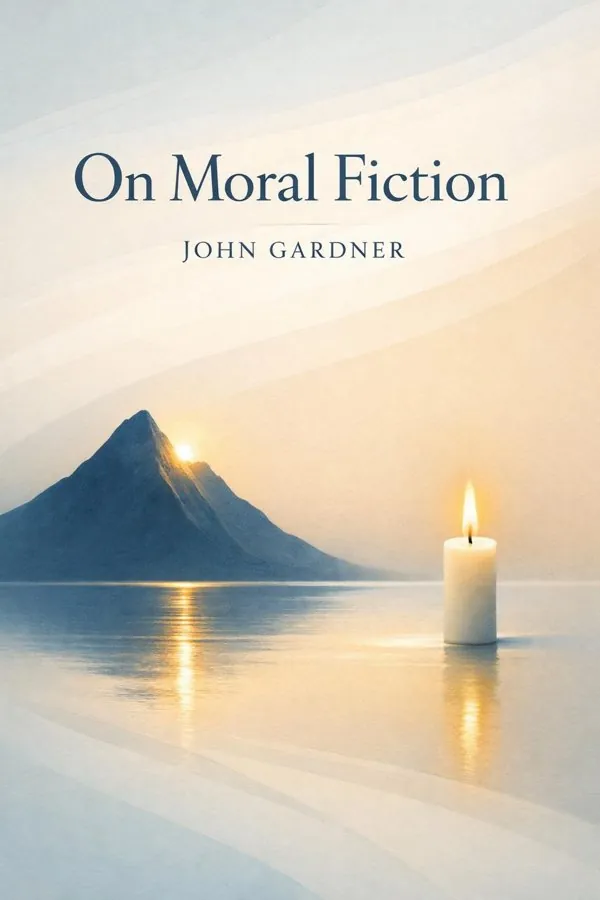
On Moral Fiction: Summary & Key Insights
by John Gardner
 10 min4 chaptersAudio available
What Is On Moral Fiction About?
On Moral Fiction by John Gardner is a western_phil book spanning 4 pages. On Moral Fiction is a collection of essays by American novelist John Gardner, first published in 1978. In this work, Gardner argues that true art must be moral, meaning it should affirm life and promote human values. He critiques contemporary writers and artists for producing works that, in his view, lack moral purpose and fail to engage with the ethical dimensions of human experience.
This FizzRead summary covers all 4 key chapters of On Moral Fiction in approximately 10 minutes, distilling the most important ideas, arguments, and takeaways from John Gardner's work. Also available as an audio summary and Key Quotes Podcast.
On Moral Fiction
On Moral Fiction is a collection of essays by American novelist John Gardner, first published in 1978. In this work, Gardner argues that true art must be moral, meaning it should affirm life and promote human values. He critiques contemporary writers and artists for producing works that, in his view, lack moral purpose and fail to engage with the ethical dimensions of human experience.
Who Should Read On Moral Fiction?
This book is perfect for anyone interested in western_phil and looking to gain actionable insights in a short read. Whether you're a student, professional, or lifelong learner, the key ideas from On Moral Fiction by John Gardner will help you think differently.
- ✓Readers who enjoy western_phil and want practical takeaways
- ✓Professionals looking to apply new ideas to their work and life
- ✓Anyone who wants the core insights of On Moral Fiction in just 10 minutes
Want the full summary?
Get instant access to this book summary and 100K+ more with Fizz Moment.
Get Free SummaryAvailable on App Store • Free to download
Key Chapters
At the heart of *On Moral Fiction* lies my conviction that art has an ethical purpose. When I call fiction 'moral,' I mean that it must be engaged with the eternal questions of how we should live, what we should value, and how meaning can be found amid suffering. Moral fiction holds that reality, though complex and painful, can be known—at least partially—and that human striving toward truth and goodness is worthwhile. This contrasts with the prevailing mood of much contemporary art, which hides behind irony or claims that nothing can be known or affirmed.
Art that truly affirms life does not deny pain or evil; instead, it confronts them honestly. Life-affirming art recognizes that meaning is possible, that compassion and coherence can emerge from chaos. When Tolstoy portrays human folly, or when Dostoevsky wrestles with despair, their vision remains redemptive because they understand that to see truth clearly is itself a kind of moral act. Such art enlarges our capacity for sympathy—it brings us closer to what I call 'the good,' which is not moralism but moral awareness.
In contrast, what I call amoral or immoral fiction—often the product of fashionable nihilism—refuses to commit to the possibility of value. It portrays existence as meaningless or mocks the very idea of striving for truth. This is easy art, because it asks nothing of the artist except cynicism. The moral artist, by contrast, must risk sincerity. The responsibility is immense, for to create moral fiction is to affirm the human condition with all its contradictions and to trust that, despite our blindness, truth has a shape we can glimpse through art.
Throughout the history of civilization, art has served as a moral guide. The ancient epics gave moral shape to chaos, showing human beings heroic and flawed, capable of grace and downfall. Greek tragedy revealed the moral dimension of fate. Medieval literature, steeped in religious and ethical traditions, sought to reconcile human suffering with divine justice. Even the great moderns, from Flaubert to Joyce, engaged deeply with moral consequence, though they redefined its language.
Yet in the twentieth century, especially within the postmodern era, I saw this tradition falter. Too often, writers retreated into aestheticism or nihilistic play. The notion that art should 'mean something' became suspect, equated with sentimentality or conservatism. But art without moral seriousness is like language divorced from truth—it becomes self-absorbed and sterile. When art refuses to affirm life, it betrays both artist and audience. Even the most innovative technique cannot redeem a work that denies human value.
I was not calling for a return to pious content or censorship, but to a renewal of seriousness—the moral seriousness that sees art as a powerful search for the good. The great works that survive time do so precisely because they speak to humanity’s moral imagination. They help us see that ethical and aesthetic truth are bound together; neither can exist in isolation. In abandoning that unity, modern art risks dissolving into either moral darkness or shallow irony. I ask writers to look again at their purpose: to remember that art’s oldest task is not to shock, but to reveal what it means to live well, courageously, and honestly.
+ 2 more chapters — available in the FizzRead app
All Chapters in On Moral Fiction
About the Author
John Gardner (1933–1982) was an American novelist, essayist, and literary critic known for his philosophical and moral approach to fiction. His notable works include 'Grendel', 'The Sunlight Dialogues', and 'On Becoming a Novelist'. Gardner was a professor of English and a major voice in American literary criticism during the 1970s.
Get This Summary in Your Preferred Format
Read or listen to the On Moral Fiction summary by John Gardner anytime, anywhere. FizzRead offers multiple formats so you can learn on your terms — all free.
Available formats: App · Audio · PDF · EPUB — All included free with FizzRead
Download On Moral Fiction PDF and EPUB Summary
Key Quotes from On Moral Fiction
“At the heart of *On Moral Fiction* lies my conviction that art has an ethical purpose.”
“Throughout the history of civilization, art has served as a moral guide.”
Frequently Asked Questions about On Moral Fiction
On Moral Fiction by John Gardner is a western_phil book that explores key ideas across 4 chapters. On Moral Fiction is a collection of essays by American novelist John Gardner, first published in 1978. In this work, Gardner argues that true art must be moral, meaning it should affirm life and promote human values. He critiques contemporary writers and artists for producing works that, in his view, lack moral purpose and fail to engage with the ethical dimensions of human experience.
More by John Gardner
You Might Also Like
A Little History of Philosophy
Nigel Warburton
10 min
Areopagitica
John Milton
10 min
How To Think Like A Philosopher: Essential Principles For Clear Thinking
Peter Cave
10 min
Language, Truth and Logic
A. J. Ayer
10 min
The Age of Reason
Thomas Paine
10 min
The Essays
Michel De Montaigne
10 minBrowse by Category
Ready to read On Moral Fiction?
Get the full summary and 100K+ more books with Fizz Moment.