
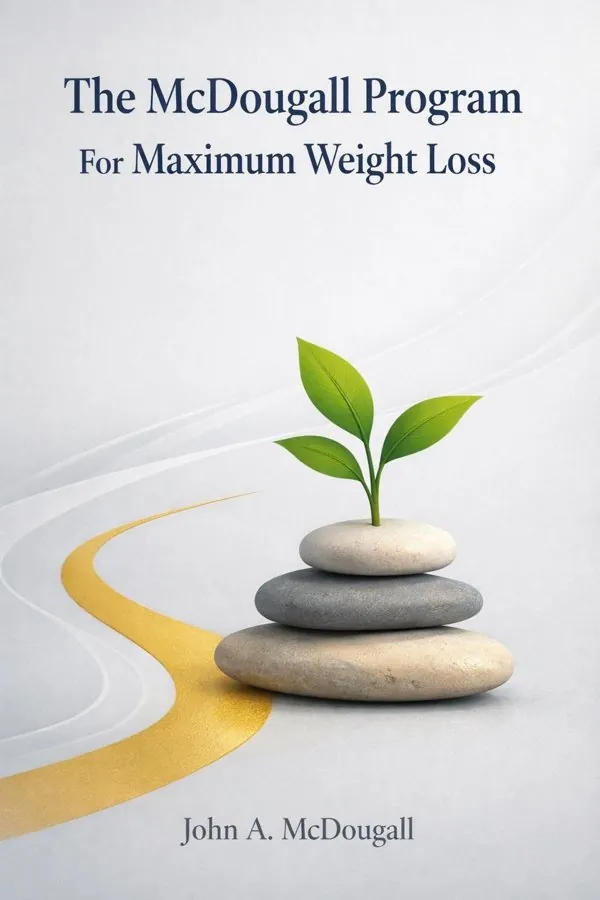
The McDougall Program For Maximum Weight Loss: Summary & Key Insights
 10 min8 chaptersAudio available
Key Takeaways from The McDougall Program For Maximum Weight Loss
Most people assume weight gain happens because they eat too much, but McDougall asks a more important question: too much of what?
In a culture that often fears carbohydrates, McDougall makes a provocative claim: starch is not the enemy, but the solution.
One of McDougall’s sharpest observations is that high-fat foods undermine natural appetite control.
A striking strength of McDougall’s program is its refusal to romanticize deprivation.
McDougall repeatedly points to a problem modern eaters often underestimate: food has become too stimulating.
What Is The McDougall Program For Maximum Weight Loss About?
The McDougall Program For Maximum Weight Loss by John A. McDougall is a health_med book. The McDougall Program For Maximum Weight Loss is John A. McDougall’s direct challenge to the modern diet industry and its endless cycle of calorie counting, appetite suppression, and short-term fixes. Instead of treating excess weight as a problem of weak willpower, McDougall argues that the real issue is food design: people gain weight when they build their diets around calorie-dense animal products, oils, and processed foods rather than the starch-based staples humans have historically relied on. The book lays out a simple but radical solution: eat satisfying, low-fat plant foods such as potatoes, rice, beans, corn, oats, and vegetables until full, and let your body naturally move toward a healthier weight. McDougall writes with the authority of a physician who has spent decades helping patients improve obesity-related conditions through nutrition. His program is not just about weight loss, but about making lasting change without hunger, expensive products, or extreme rules. For readers tired of diet confusion, this book offers a bold, structured, and highly practical path.
This FizzRead summary covers all 8 key chapters of The McDougall Program For Maximum Weight Loss in approximately 10 minutes, distilling the most important ideas, arguments, and takeaways from John A. McDougall's work. Also available as an audio summary and Key Quotes Podcast.
The McDougall Program For Maximum Weight Loss
The McDougall Program For Maximum Weight Loss is John A. McDougall’s direct challenge to the modern diet industry and its endless cycle of calorie counting, appetite suppression, and short-term fixes. Instead of treating excess weight as a problem of weak willpower, McDougall argues that the real issue is food design: people gain weight when they build their diets around calorie-dense animal products, oils, and processed foods rather than the starch-based staples humans have historically relied on. The book lays out a simple but radical solution: eat satisfying, low-fat plant foods such as potatoes, rice, beans, corn, oats, and vegetables until full, and let your body naturally move toward a healthier weight. McDougall writes with the authority of a physician who has spent decades helping patients improve obesity-related conditions through nutrition. His program is not just about weight loss, but about making lasting change without hunger, expensive products, or extreme rules. For readers tired of diet confusion, this book offers a bold, structured, and highly practical path.
Who Should Read The McDougall Program For Maximum Weight Loss?
This book is perfect for anyone interested in health_med and looking to gain actionable insights in a short read. Whether you're a student, professional, or lifelong learner, the key ideas from The McDougall Program For Maximum Weight Loss by John A. McDougall will help you think differently.
- ✓Readers who enjoy health_med and want practical takeaways
- ✓Professionals looking to apply new ideas to their work and life
- ✓Anyone who wants the core insights of The McDougall Program For Maximum Weight Loss in just 10 minutes
Want the full summary?
Get instant access to this book summary and 100K+ more with Fizz Moment.
Get Free SummaryAvailable on App Store • Free to download
Key Chapters
Most people assume weight gain happens because they eat too much, but McDougall asks a more important question: too much of what? His central argument is that body weight is strongly shaped by calorie density, the number of calories packed into each pound of food. Vegetables, fruits, potatoes, beans, and grains contain a great deal of water and fiber, so they fill the stomach with relatively few calories. Oils, cheese, meat, fried foods, and processed snacks do the opposite, delivering large amounts of calories in small portions that fail to create lasting fullness.
This idea changes the entire weight-loss conversation. Instead of encouraging people to eat tiny portions and battle constant cravings, McDougall recommends choosing foods that allow generous volume with fewer calories. A large bowl of vegetable soup, baked potatoes, rice with steamed vegetables, or bean chili can feel abundant and satisfying while still supporting fat loss. By contrast, a small serving of oily pasta, chicken, or cheese can contain more calories without providing the same physical sense of fullness.
The practical power of this concept is that it removes moral judgment from eating. People do not necessarily fail because they are lazy or undisciplined; they often fail because they are eating foods engineered by nature or industry to be calorie concentrated. If the food environment changes, appetite becomes easier to manage. McDougall’s approach therefore focuses less on restraint and more on smart food selection.
Actionable takeaway: Build each meal around low-calorie-density staples such as potatoes, rice, beans, oats, and nonstarchy vegetables, and minimize oils, cheeses, meats, and processed snack foods.
In a culture that often fears carbohydrates, McDougall makes a provocative claim: starch is not the enemy, but the solution. He argues that traditional societies around the world have long built their diets around starches such as rice, corn, potatoes, sweet potatoes, barley, and beans, and that these populations historically maintained lower rates of obesity when eating minimally processed foods. According to McDougall, starches are satisfying, affordable, culturally familiar, and naturally suited to human energy needs.
The book treats starch as the anchor that makes healthy eating sustainable. Many diets fail because they ask people to survive on salads, protein shakes, or tiny portions that leave them feeling deprived. McDougall instead encourages large, comforting meals centered on filling carbohydrates. A breakfast of oatmeal with fruit, a lunch of rice and vegetables, or a dinner of potatoes with bean stew provides bulk and satiety. These foods calm hunger rather than inflaming it.
Importantly, he distinguishes whole or minimally processed starches from refined, high-fat combinations sold as convenience food. French fries are not the same as baked potatoes, and buttery pastries are not the same as oats. The issue is not carbohydrates themselves, but what is added to them. Once oil, butter, cheese, and sugar dominate the plate, calorie density rises and the protective effects of starch-based eating disappear.
For readers, this idea can be liberating. It replaces fear with structure: if you are hungry, eat more starches in simple forms, not less food overall. Consistency becomes easier when meals feel hearty and normal.
Actionable takeaway: Make a plain starch the centerpiece of every meal, then add vegetables, legumes, and seasonings instead of building meals around meat, dairy, or oils.
One of McDougall’s sharpest observations is that high-fat foods undermine natural appetite control. Fat contains more than twice as many calories per gram as carbohydrate or protein, which means even modest-looking portions can deliver a heavy calorie load. Because many fatty foods are also highly palatable, people tend to eat them quickly and in excess before the body’s fullness signals have time to catch up. This is why rich foods feel easy to overconsume while simpler foods become self-limiting.
McDougall pays particular attention to added oils, dairy products, fatty meats, nuts in excess, and processed foods that combine fat with refined carbohydrates. Think of pizza, chips, pastries, burgers, creamy sauces, and fried foods. These items are dense, rewarding, and poor at satisfying hunger in proportion to their calories. In his framework, even foods marketed as healthy can become obstacles if they are calorie concentrated. A salad drenched in oil may contain more calories than a large bowl of bean soup.
The book does not frame fat as evil in a sensational way; rather, it presents excess dietary fat as a practical problem for weight control. When people rely on fatty foods, they often need deliberate restraint to avoid overeating. When they eat simple starches and vegetables, appetite regulation becomes more automatic. This distinction matters because long-term success depends less on motivation and more on whether the eating pattern is naturally livable.
A useful application is to rethink cooking methods. Roasting vegetables without oil, using broth-based sauces, choosing tomato-based dishes over creamy ones, and replacing cheese-heavy meals with bean-based options can dramatically reduce calories without shrinking plate size.
Actionable takeaway: Identify your major hidden fat sources, especially oils, cheese, fried foods, and creamy sauces, and replace them with lower-fat plant-based alternatives this week.
A striking strength of McDougall’s program is its refusal to romanticize deprivation. He understands that hunger defeats diets more reliably than lack of knowledge. Most people already know vegetables are healthier than fast food, but knowing that is not enough if they spend every day feeling deprived. McDougall therefore builds his plan around satiety, arguing that successful weight loss must allow people to eat until comfortably full.
This runs counter to the common advice to use portion control as the main strategy. McDougall believes portion control often fails because it asks people to fight biology with willpower. If meals are too small or too calorie dense, the body remains unsatisfied, making snacking and overeating almost inevitable. By contrast, large servings of potatoes, rice, lentils, vegetable soups, pasta with fat-free sauces, or fruit can physically fill the stomach and create psychological relief.
The deeper insight is that fullness is not a luxury; it is a requirement for adherence. A plan people can follow only when highly motivated is not a durable plan. McDougall’s approach aims to make healthy eating feel abundant enough that cravings lose some of their force. This is especially helpful for people who have bounced between strict dieting and bingeing.
In daily life, this means preparing enough food. Someone switching to a lower-fat plant-based diet may initially under-eat by choosing tiny salads or skimpy vegetable plates. McDougall would say the answer is not to quit the program, but to eat larger portions of satisfying starches. A giant baked potato is often more helpful than another lecture about discipline.
Actionable takeaway: Stop trying to white-knuckle through hunger; increase the volume of low-fat starches and vegetables so your meals are genuinely satisfying.
McDougall repeatedly points to a problem modern eaters often underestimate: food has become too stimulating. Highly processed meals are designed to overwhelm normal appetite regulation by combining fat, salt, sugar, and concentrated texture in ways that encourage repeated eating. In this environment, restraint becomes difficult not because people lack character, but because they are surrounded by foods that are easy to overconsume.
His solution is not culinary punishment but simplification. The more your meals resemble straightforward combinations of starches, vegetables, legumes, and fruit, the easier it becomes to recognize true hunger and fullness. A bowl of rice and vegetables, lentil soup, plain oatmeal, or baked sweet potatoes will usually satisfy hunger without provoking the same compulsive pull as chips, cookies, fast food, or rich restaurant dishes.
This principle also explains why home cooking is so important in the McDougall program. Restaurants and packaged-food companies often rely on oils, hidden sugars, and flavor boosters to keep dishes exciting. When you cook at home using basic ingredients, you control those appetite-distorting additions. The food may seem less thrilling at first, but many readers find their taste preferences reset over time. Natural flavors become more noticeable, and intense processed foods lose some of their hold.
In practical terms, simplification can reduce decision fatigue. Instead of constantly negotiating whether a treat fits into the day’s calorie budget, you create a clear default style of eating. Breakfast might be oats, lunch a bean-and-rice bowl, dinner potatoes with vegetables. That repetition can be a strength when the goal is consistency.
Actionable takeaway: Create a short list of simple, low-fat staple meals you can repeat during busy weeks, and reserve highly processed foods for rare exceptions rather than daily habits.
McDougall does not present weight loss as a cosmetic project detached from health. He argues that the same foods that promote excess weight also contribute to chronic disease, especially when diets are rich in animal products, saturated fat, cholesterol, and processed ingredients. His program is designed to improve multiple outcomes at once: body weight, blood pressure, cholesterol, energy, digestion, and risk factors for long-term illness.
This is one reason the book stands apart from many trend diets. Some plans produce weight loss by emphasizing extreme restriction, high animal-protein intake, or expensive supplements, yet may raise other concerns. McDougall’s approach tries to align weight reduction with broader physiological benefits by relying on whole plant foods. A person who shifts from bacon-and-eggs breakfasts, fast-food lunches, and creamy dinners to oatmeal, bean soups, rice dishes, and fruit is not merely reducing calories. They are often increasing fiber, reducing saturated fat, and improving nutrient quality across the board.
The psychological effect of this broader frame is important. If readers think only in terms of pounds lost, motivation can fade when progress slows. But if they also notice better digestion, steadier energy, easier movement, or improved lab results, the program gains deeper meaning. Health becomes an immediate reward, not just a future hope.
At the same time, McDougall warns against letting “health foods” become loopholes. Foods can be vegan, organic, or natural and still be too rich for effective weight control if they are loaded with oil, avocado, coconut, or refined sweeteners. The healthiest pattern, in his view, remains simple, starch-based, and low in added fat.
Actionable takeaway: Measure progress with more than the scale by tracking energy, digestion, blood markers, and everyday function while following a lower-fat plant-based diet.
One of the most practical lessons in McDougall’s philosophy is that lasting change comes from a repeatable system, not bursts of dietary heroism. Many people approach weight loss with all-or-nothing intensity: they start with strict rules, break them under pressure, and then abandon the plan entirely. McDougall encourages readers to adopt a clear, structured way of eating that can be used day after day, especially when life becomes stressful.
His program works best when it is made routine. That means keeping staple foods on hand, planning meals before hunger escalates, and reducing exposure to trigger foods that invite overeating. It may include batch-cooking rice, beans, potatoes, soups, or stews; bringing lunch to work; and deciding in advance how to handle restaurants, travel, or family gatherings. These ordinary systems are more predictive of success than motivation speeches.
McDougall also recognizes that slips happen. A high-calorie meal does not erase the effectiveness of the program, but repeated drift toward rich foods does. The goal is to return quickly to the basic pattern rather than turn one exception into a weeklong relapse. This mindset protects against the common belief that one imperfect choice means the diet has failed.
For many readers, consistency is easier when meals are familiar and satisfying rather than endlessly varied. Repetition reduces friction. You do not need a new recipe every night to lose weight; you need meals you will actually prepare and enjoy. In this sense, simplicity supports discipline better than novelty does.
Actionable takeaway: Set up a weekly food routine with a few reliable breakfasts, lunches, dinners, and emergency snacks so healthy choices become automatic instead of negotiable.
A powerful implication of McDougall’s program is that body weight is shaped not just by knowledge, but by surroundings. People tend to eat what is available, convenient, affordable, and socially normal. If the kitchen is stocked with chips, cheese, oils, desserts, and frozen convenience meals, good intentions are forced to fight a daily uphill battle. If the kitchen contains potatoes, fruit, oats, rice, beans, and ready-to-eat vegetables, healthier decisions become far easier.
McDougall’s emphasis on environment is deeply practical because it shifts attention from internal struggle to external design. Rather than relying on constant self-control at the end of a long day, he recommends arranging life so the default option is aligned with the program. This might mean prewashing produce, keeping cooked starches in the refrigerator, preparing fat-free sauces in advance, or removing trigger foods from the home entirely.
The same logic applies outside the home. Workplaces, social events, and restaurants often normalize high-fat eating. A reader following McDougall’s plan may need strategies such as reviewing menus beforehand, eating a filling starch-based meal before parties, or offering to bring a compliant dish to gatherings. These steps are not signs of weakness; they are signs of understanding how habits work.
The broader lesson is that sustainable weight loss rarely comes from inspiration alone. It comes from reducing the number of moments when temptation and exhaustion collide. The less often you have to negotiate with yourself, the better your odds of success.
Actionable takeaway: Redesign your food environment today by removing your top trigger items and stocking at least five ready-to-eat McDougall-friendly staples.
All Chapters in The McDougall Program For Maximum Weight Loss
About the Author
John A. McDougall was an American physician, author, and prominent advocate of low-fat, plant-based nutrition. Trained in medicine and known for decades of clinical work, he built his reputation by helping patients address obesity and chronic health problems through dietary change rather than medication alone. McDougall became especially well known for championing starch-based eating, arguing that foods such as potatoes, rice, beans, and grains should form the foundation of a healthy human diet. Over his career, he wrote numerous books, led educational programs, and influenced generations of readers interested in nutrition, preventive health, and lifestyle medicine. His work often challenged conventional diet wisdom and helped popularize the idea that simple whole plant foods can support both lasting weight loss and broader long-term wellness.
Get This Summary in Your Preferred Format
Read or listen to the The McDougall Program For Maximum Weight Loss summary by John A. McDougall anytime, anywhere. FizzRead offers multiple formats so you can learn on your terms — all free.
Available formats: App · Audio · PDF · EPUB — All included free with FizzRead
Download The McDougall Program For Maximum Weight Loss PDF and EPUB Summary
Key Quotes from The McDougall Program For Maximum Weight Loss
“Most people assume weight gain happens because they eat too much, but McDougall asks a more important question: too much of what?”
“In a culture that often fears carbohydrates, McDougall makes a provocative claim: starch is not the enemy, but the solution.”
“One of McDougall’s sharpest observations is that high-fat foods undermine natural appetite control.”
“A striking strength of McDougall’s program is its refusal to romanticize deprivation.”
“McDougall repeatedly points to a problem modern eaters often underestimate: food has become too stimulating.”
Frequently Asked Questions about The McDougall Program For Maximum Weight Loss
The McDougall Program For Maximum Weight Loss by John A. McDougall is a health_med book that explores key ideas across 8 chapters. The McDougall Program For Maximum Weight Loss is John A. McDougall’s direct challenge to the modern diet industry and its endless cycle of calorie counting, appetite suppression, and short-term fixes. Instead of treating excess weight as a problem of weak willpower, McDougall argues that the real issue is food design: people gain weight when they build their diets around calorie-dense animal products, oils, and processed foods rather than the starch-based staples humans have historically relied on. The book lays out a simple but radical solution: eat satisfying, low-fat plant foods such as potatoes, rice, beans, corn, oats, and vegetables until full, and let your body naturally move toward a healthier weight. McDougall writes with the authority of a physician who has spent decades helping patients improve obesity-related conditions through nutrition. His program is not just about weight loss, but about making lasting change without hunger, expensive products, or extreme rules. For readers tired of diet confusion, this book offers a bold, structured, and highly practical path.
You Might Also Like

On Immunity
Eula Biss
10 min
The Three-Body Problem
Liu Cixin
10 min
Community Health Volunteer Toolkit: Training and Practical Activities
World Health Organization
10 min
Healing Back Pain: The Mind-Body Connection
John E. Sarno
10 min
Health Literacy for All: Practical Guides to Communicate Health Information (Compilations)
World Health Organization
10 min
The Complete Guide to Sports Supplements: An Evidence-Based Review
Anita Bean
10 minBrowse by Category
Ready to read The McDougall Program For Maximum Weight Loss?
Get the full summary and 100K+ more books with Fizz Moment.