
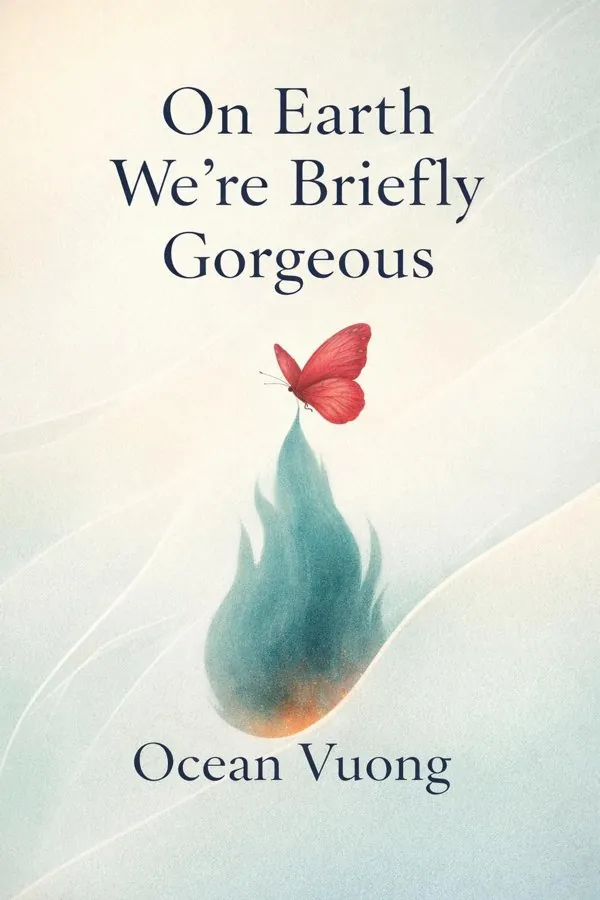
On Earth We're Briefly Gorgeous: Summary & Key Insights
by Ocean Vuong
 10 min9 chaptersAudio available
Key Takeaways from On Earth We're Briefly Gorgeous
Some of the deepest conversations in life happen where true communication is impossible.
Violence does not end when the fighting stops; it relocates into memory, habit, and the nervous system.
Identity often arrives before language does.
One of the hardest truths in the novel is that love does not automatically make people safe.
We often treat language as a tool for clarity, but Vuong shows that words are just as often signs of what cannot be fully said.
What Is On Earth We're Briefly Gorgeous About?
On Earth We're Briefly Gorgeous by Ocean Vuong is a bestsellers book spanning 3 pages. Ocean Vuong’s On Earth We’re Briefly Gorgeous is a novel written in the form of a letter from a son, known as Little Dog, to his mother, Rose, who cannot read. That impossible act of communication gives the book its emotional force. It is at once a family history, a coming-of-age story, a meditation on language, and an inquiry into how violence travels across generations. Moving between Vietnam and the United States, between childhood and adulthood, Vuong traces how war, migration, poverty, addiction, queerness, and desire shape one life while revealing the larger systems behind private pain. What makes the novel so powerful is not only what it says, but how it says it. Vuong brings the precision and music of an award-winning poet to prose, creating a style that is lyrical without losing emotional clarity. He writes with unusual honesty about masculinity, labor, sex, race, and the limits of speech itself. This book matters because it refuses easy categories: it is both intimate and political, brutal and tender. In telling one son’s story, Vuong illuminates how storytelling can become an act of survival, witness, and love.
This FizzRead summary covers all 9 key chapters of On Earth We're Briefly Gorgeous in approximately 10 minutes, distilling the most important ideas, arguments, and takeaways from Ocean Vuong's work. Also available as an audio summary and Key Quotes Podcast.
On Earth We're Briefly Gorgeous
Ocean Vuong’s On Earth We’re Briefly Gorgeous is a novel written in the form of a letter from a son, known as Little Dog, to his mother, Rose, who cannot read. That impossible act of communication gives the book its emotional force. It is at once a family history, a coming-of-age story, a meditation on language, and an inquiry into how violence travels across generations. Moving between Vietnam and the United States, between childhood and adulthood, Vuong traces how war, migration, poverty, addiction, queerness, and desire shape one life while revealing the larger systems behind private pain.
What makes the novel so powerful is not only what it says, but how it says it. Vuong brings the precision and music of an award-winning poet to prose, creating a style that is lyrical without losing emotional clarity. He writes with unusual honesty about masculinity, labor, sex, race, and the limits of speech itself. This book matters because it refuses easy categories: it is both intimate and political, brutal and tender. In telling one son’s story, Vuong illuminates how storytelling can become an act of survival, witness, and love.
Who Should Read On Earth We're Briefly Gorgeous?
This book is perfect for anyone interested in bestsellers and looking to gain actionable insights in a short read. Whether you're a student, professional, or lifelong learner, the key ideas from On Earth We're Briefly Gorgeous by Ocean Vuong will help you think differently.
- ✓Readers who enjoy bestsellers and want practical takeaways
- ✓Professionals looking to apply new ideas to their work and life
- ✓Anyone who wants the core insights of On Earth We're Briefly Gorgeous in just 10 minutes
Want the full summary?
Get instant access to this book summary and 100K+ more with Fizz Moment.
Get Free SummaryAvailable on App Store • Free to download
Key Chapters
Some of the deepest conversations in life happen where true communication is impossible. On Earth We’re Briefly Gorgeous begins with a son writing to his mother, Rose, even though she cannot read the letter. That contradiction is not a gimmick; it is the heart of the novel. Little Dog writes into a silence shaped by illiteracy, trauma, migration, and the emotional distance that often exists inside families who love one another but do not know how to speak about pain.
The letter form allows Vuong to show that families do not simply pass down stories; they also pass down absences. Rose’s life has been shaped by the aftershocks of war, domestic instability, and the struggle to survive in America. Her violence, tenderness, fear, and love all emerge from histories she cannot fully explain. Little Dog, in writing to her, tries to translate what was never spoken: why she hurts him, why she protects him, and why both things can be true at once. The family becomes a place where history is carried in the body long before it is put into words.
This idea matters far beyond the novel. Many people inherit patterns they do not choose: silence around money, addiction, grief, race, or mental health. In practical terms, Vuong suggests that understanding your family may require listening not just to what was said, but to what could never be said. Journaling, recording family memories, or asking elders concrete questions about their past can reveal how personal struggles are linked to larger forces.
Actionable takeaway: identify one silence in your family history and write about it honestly, even if the person you address may never read your words.
Violence does not end when the fighting stops; it relocates into memory, habit, and the nervous system. One of the novel’s central insights is that the Vietnam War is not presented as distant history but as a living presence shaping daily life in America. The war reaches Little Dog through his grandmother Lan, through Rose, and through the emotional climate of the household. Trauma is shown not as a dramatic event alone, but as a pattern of fear, rage, vigilance, and fragmentation.
Vuong demonstrates how historical catastrophe becomes intimate. Rose’s abuse cannot be separated from what she survived, just as the family’s instability cannot be separated from displacement and poverty. The book refuses to excuse cruelty, but it insists on context. This is one of its bravest achievements: it asks readers to hold accountability and compassion at the same time. The people in this novel are not symbols of victimhood; they are complex individuals trying, and often failing, to live after the unimaginable.
In everyday life, many people encounter the aftereffects of events they never directly experienced. Children of refugees, veterans, survivors, and marginalized communities often inherit anxiety, distrust, or emotional volatility without fully understanding the source. A practical application of Vuong’s insight is to widen the frame when thinking about behavior. Instead of asking only, “What is wrong with this person?” we can also ask, “What happened before this moment?” That shift can open room for more truthful conversations, trauma-informed care, and less judgment.
Actionable takeaway: when confronting painful family behavior, try mapping it against larger historical pressures to understand the pattern without denying its harm.
Identity often arrives before language does. As Little Dog grows into adolescence, he begins to understand his queerness not first as a public identity category, but as a bodily truth that resists explanation. The novel captures the disorientation of becoming in a world that offers few safe scripts for tenderness, especially for a poor, Vietnamese American boy navigating masculinity, racism, and family pressure.
Vuong portrays queerness with unusual nuance. It is not reduced to empowerment slogans or to tragedy. Instead, it appears as vulnerability, hunger, shame, wonder, and risk. Little Dog’s sexuality complicates his relationships to his mother, to American culture, and to himself. He must learn how to desire and how to survive at the same time. This is especially vivid in his relationship with Trevor, where love is real but constrained by addiction, social expectations, and the violence embedded in American masculinity. Queerness in the novel is not isolated from class or history; it is lived through them.
For readers, this section of the book offers a practical lesson about identity formation: people rarely become themselves in clean, linear ways. Whether the issue is sexuality, race, gender, or vocation, self-recognition usually happens amid contradiction. Supporting someone in that process means making room for uncertainty rather than demanding immediate clarity. In classrooms, workplaces, and families, that can look like allowing people to name themselves at their own pace, avoiding assumptions, and creating environments where complexity is not punished.
Actionable takeaway: practice giving yourself and others the freedom to be in process, recognizing that becoming fully visible often begins before there are words for it.
One of the hardest truths in the novel is that love does not automatically make people safe. Little Dog loves his mother and grandmother deeply, yet his home is also a place of volatility and fear. Vuong refuses simplistic moral categories. He shows how people shaped by poverty, trauma, and dislocation can love fiercely while still causing harm. This complexity is central to the emotional honesty of the book.
Rose’s affection is real, but so is her violence. Lan offers warmth and story, but she too carries distortions born from survival. Trevor gives Little Dog intimacy and recognition, yet their relationship unfolds within addiction, concealment, and social fragility. Again and again, Vuong asks readers to abandon the fantasy that love is pure. In this world, love is mixed with history, dependency, fear, and unmet need. That does not make love meaningless; it makes it human.
This idea has broad practical value. Many people struggle because they believe harm must mean there was no love, or that love must excuse harm. Vuong suggests a more mature framework: both can coexist, and wisdom lies in naming both. In real life, this can help people set boundaries without erasing affection, or grieve relationships honestly instead of idealizing them. For example, someone may appreciate a parent’s sacrifices while also acknowledging emotional damage. That dual awareness can be the beginning of healing.
Actionable takeaway: when reflecting on an important relationship, write down two truths side by side—how love was expressed and how harm was done—without forcing either truth to cancel the other.
We often treat language as a tool for clarity, but Vuong shows that words are just as often signs of what cannot be fully said. Little Dog grows up between Vietnamese and English, between spoken experience and written expression, between his mother’s illiteracy and his own literary voice. This tension makes language in the novel both a refuge and a wound. Words can separate people, expose them, or fail them entirely. Yet they are also the means by which Little Dog survives.
The novel repeatedly explores translation in the broadest sense. It is not only about converting one language into another; it is about translating trauma into story, desire into speech, and memory into something bearable. Little Dog uses language to make meaning out of experiences that would otherwise remain scattered and suffocating. Writing becomes a way to see his life rather than merely endure it. Even if the letter will never be read by its intended recipient, the act of composing it creates a self that can witness what happened.
This has practical resonance for anyone who has struggled to explain themselves. Not every important truth can be spoken directly in conversation. Sometimes a letter, poem, journal entry, or voice memo is more honest than face-to-face speech. For multilingual families, language differences can create painful misunderstandings, but they can also inspire creative forms of connection. The goal is not perfect communication; it is meaningful approximation.
Actionable takeaway: use writing as a private act of translation—put into words one feeling or memory you have never been able to say aloud, and notice how naming it changes your relationship to it.
A nation often reveals its values through the bodies it wears down. On Earth We’re Briefly Gorgeous is not only a family and identity novel; it is also a sharp portrait of class. Vuong pays close attention to labor: nail salons, tobacco fields, manual work, repetitive strain, economic precarity, and the bodily cost of survival. The American dream appears here not as freedom, but as exhaustion distributed unequally across race, class, and immigrant status.
Rose’s work in a nail salon is especially important. The salon is a site of femininity and service, but also of chemical exposure, invisibility, and exploitation. Trevor’s labor on the tobacco farm ties masculinity to physical endurance and economic fragility. Little Dog moves through these worlds with acute awareness of how poor people are expected to sacrifice their bodies for wages while remaining socially unseen. Vuong makes class impossible to ignore by grounding it in flesh: aching hands, damaged lungs, addiction, fatigue, hunger.
For readers, this insight broadens how we think about inequality. Economic hardship is not merely a matter of income or status; it affects posture, health, education, time, and emotional possibility. In practical terms, this can deepen empathy for workers whose lives are constrained by systems many more privileged people barely notice. It can also reshape personal choices: paying fairly, respecting service workers, supporting labor protections, or simply recognizing the hidden bodily costs behind convenience.
Actionable takeaway: pay attention this week to the labor behind ordinary comforts in your life and ask how greater awareness might change the way you treat workers, spend money, or talk about success.
Much of what passes for strength is actually fear in costume. Vuong examines masculinity not as a stable identity but as a performance enforced through shame, violence, silence, and physical endurance. This is particularly visible in Trevor, whose tenderness with Little Dog exists alongside his need to conform to a heterosexual, working-class ideal. The novel suggests that masculinity in America is often built by narrowing what men are allowed to feel and say.
Trevor is not portrayed as a villain or a symbol; he is a tragic example of how young men are shaped by contradictory demands. He wants intimacy but is trained to hide vulnerability. He seeks pleasure but cannot imagine a future outside inherited norms. His body becomes the site where social expectations, addiction, labor, and desire collide. In this way, Vuong links personal heartbreak to a larger cultural script: boys are taught to endure pain, suppress softness, and perform invulnerability until that performance becomes destructive.
This idea matters because rigid masculinity harms everyone, including the men who embody it. In practical settings, whether in families, schools, or workplaces, healthier masculinity means expanding the emotional vocabulary available to boys and men. That can look like normalizing care, asking direct questions about mental health, and refusing to equate dominance with maturity. For individual readers, it may mean noticing where toughness has become a mask for grief or fear.
Actionable takeaway: challenge one assumption you hold about what strength should look like, and replace it with a practice that includes honesty, care, or emotional openness.
A life is rarely remembered in straight lines. Vuong structures the novel in fragments, leaps, scenes, and meditations rather than in a smooth chronology. This formal choice mirrors how memory actually works, especially under trauma. People do not remember only what happened; they remember what lingers, what interrupts, what returns unexpectedly. The book’s nonlinear movement is therefore not ornamental. It is a truth about consciousness.
By assembling the story in pieces, Vuong allows readers to experience Little Dog’s mind as it tries to make coherence from brokenness. A story about migration, abuse, desire, and grief could never be fully captured by a neat sequence of events. The fragments create emotional accuracy. They also reflect how identity itself is built: from overheard remarks, bodily sensations, inherited stories, small humiliations, erotic awakenings, and flashes of insight that only later form a pattern.
This has practical application for anyone trying to understand their own past. People often become frustrated when their memories are incomplete or disordered, especially when processing painful experiences. Vuong’s novel offers a liberating alternative: fragmentation does not invalidate truth. You do not need a perfect timeline to begin understanding yourself. Therapists, memoir writers, and reflective readers all know that insight can emerge from assembling moments rather than forcing total coherence too soon.
Actionable takeaway: if a past experience feels hard to understand, stop trying to narrate it perfectly and instead list the fragments you remember—images, phrases, sensations, places—and look for the meaning that connects them.
To survive an experience is one thing; to witness it truthfully is another. The deepest achievement of On Earth We’re Briefly Gorgeous is that it transforms private pain into shared recognition without reducing it to confession alone. Little Dog’s letter is not simply therapeutic self-expression. It is an act of witness: to his mother, to his grandmother, to Trevor, to immigrant labor, to queer longing, and to the social structures that make certain lives precarious.
Vuong shows that storytelling can restore dignity to what history tends to flatten or erase. People like Rose and Lan are often discussed through stereotypes about refugees, Asian women, or poor immigrants. Trevor might be dismissed as another doomed rural addict. But in narrative, they become singular. Their contradictions matter. Their beauty matters. Their damage matters. This is why the novel feels so expansive despite its intimacy: it insists that no life is minor when looked at closely enough.
For readers, the practical lesson is that storytelling is not reserved for professional writers. Telling the truth about a life—your own or someone else’s—can be a civic act, a family act, and an ethical act. It can counter shame, preserve memory, and challenge dehumanizing narratives. This does not require publishing a novel. It might mean recording a relative’s story, writing a personal essay, or speaking honestly in a setting where silence has long prevailed.
Actionable takeaway: choose one overlooked story—your own or someone close to you—and preserve it in writing, not to perfect it, but to honor that it happened and that it matters.
All Chapters in On Earth We're Briefly Gorgeous
About the Author
Ocean Vuong is a Vietnamese American poet, essayist, and novelist celebrated for his luminous language and emotional depth. Born in Saigon, Vietnam, he immigrated to the United States as a child and grew up in a working-class family. Vuong first rose to prominence with his award-winning poetry collection Night Sky with Exit Wounds, which established him as a major literary voice exploring war, migration, queerness, family, and the limits of language. His debut novel, On Earth We’re Briefly Gorgeous, brought those concerns into fiction and earned wide acclaim for its daring structure and intimate power. Across genres, Vuong’s work is marked by lyricism, vulnerability, and a rare ability to connect personal experience with broader historical and social forces.
Get This Summary in Your Preferred Format
Read or listen to the On Earth We're Briefly Gorgeous summary by Ocean Vuong anytime, anywhere. FizzRead offers multiple formats so you can learn on your terms — all free.
Available formats: App · Audio · PDF · EPUB — All included free with FizzRead
Download On Earth We're Briefly Gorgeous PDF and EPUB Summary
Key Quotes from On Earth We're Briefly Gorgeous
“Some of the deepest conversations in life happen where true communication is impossible.”
“Violence does not end when the fighting stops; it relocates into memory, habit, and the nervous system.”
“Identity often arrives before language does.”
“One of the hardest truths in the novel is that love does not automatically make people safe.”
“We often treat language as a tool for clarity, but Vuong shows that words are just as often signs of what cannot be fully said.”
Frequently Asked Questions about On Earth We're Briefly Gorgeous
On Earth We're Briefly Gorgeous by Ocean Vuong is a bestsellers book that explores key ideas across 9 chapters. Ocean Vuong’s On Earth We’re Briefly Gorgeous is a novel written in the form of a letter from a son, known as Little Dog, to his mother, Rose, who cannot read. That impossible act of communication gives the book its emotional force. It is at once a family history, a coming-of-age story, a meditation on language, and an inquiry into how violence travels across generations. Moving between Vietnam and the United States, between childhood and adulthood, Vuong traces how war, migration, poverty, addiction, queerness, and desire shape one life while revealing the larger systems behind private pain. What makes the novel so powerful is not only what it says, but how it says it. Vuong brings the precision and music of an award-winning poet to prose, creating a style that is lyrical without losing emotional clarity. He writes with unusual honesty about masculinity, labor, sex, race, and the limits of speech itself. This book matters because it refuses easy categories: it is both intimate and political, brutal and tender. In telling one son’s story, Vuong illuminates how storytelling can become an act of survival, witness, and love.
More by Ocean Vuong
You Might Also Like
The Godfather
Mario Puzo
10 min
The Handmaid's Tale
Margaret Atwood
10 min
The Hunger Games
Suzanne Collins
10 min
The Nightingale
Kristin Hannah
10 min
The Seven Husbands of Evelyn Hugo
Taylor Jenkins Reid
10 min
Backwater Justice
Fern Michaels
10 minBrowse by Category
Ready to read On Earth We're Briefly Gorgeous?
Get the full summary and 100K+ more books with Fizz Moment.