
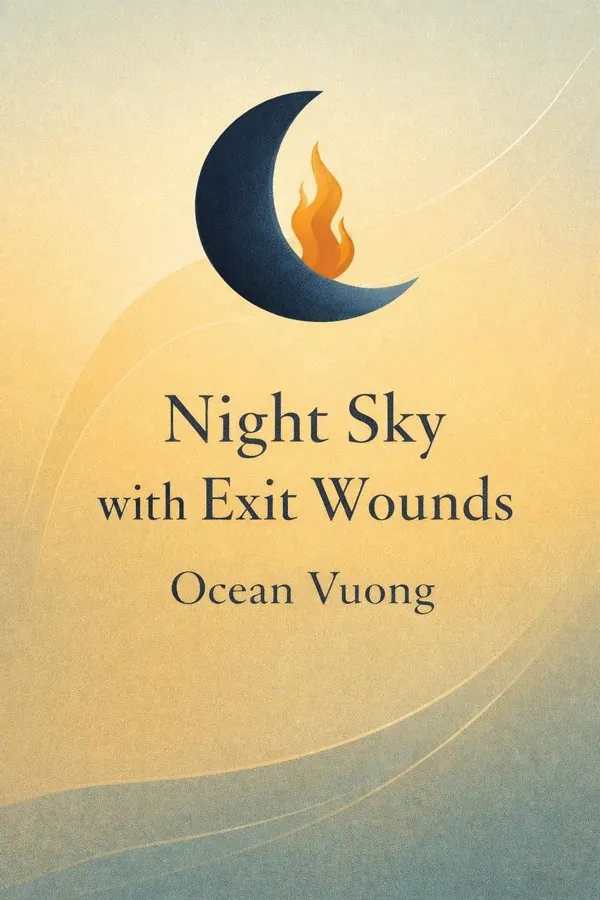
Night Sky with Exit Wounds: Summary & Key Insights
by Ocean Vuong
 10 min9 chaptersAudio available
Key Takeaways from Night Sky with Exit Wounds
We do not begin life as blank pages; we begin as echoes.
You do not need to see a war directly to live inside its consequences.
Love is not always gentle; sometimes it arrives bruised by survival.
Words can connect us, but they can also reveal how far apart we are.
To be seen in love can feel as dangerous as it is necessary.
What Is Night Sky with Exit Wounds About?
Night Sky with Exit Wounds by Ocean Vuong is a poetry book spanning 7 pages. Ocean Vuong’s Night Sky with Exit Wounds is a debut poetry collection that turns private memory into a language for history, grief, desire, and survival. Across its poems, Vuong explores what it means to live in the aftermath of war while trying to build a self out of fractured inheritance: a Vietnamese family marked by violence, migration, silence, and enduring tenderness. The collection moves between intimate scenes and larger historical forces, linking the body to empire, the family to displacement, and love to the difficult work of being seen. What makes this book matter is not only its subject matter, but its method. Vuong writes with startling lyrical precision, allowing brokenness, beauty, and vulnerability to exist in the same breath. He shows how trauma is carried through generations, how language can both wound and rescue, and how queer love becomes a site of discovery as well as risk. As a Vietnamese American poet whose work has been widely celebrated for its craft and emotional intensity, Vuong brings lived authority and artistic mastery to these themes. This collection is essential reading for anyone interested in poetry that is intimate, politically alert, and unforgettable.
This FizzRead summary covers all 9 key chapters of Night Sky with Exit Wounds in approximately 10 minutes, distilling the most important ideas, arguments, and takeaways from Ocean Vuong's work. Also available as an audio summary and Key Quotes Podcast.
Night Sky with Exit Wounds
Ocean Vuong’s Night Sky with Exit Wounds is a debut poetry collection that turns private memory into a language for history, grief, desire, and survival. Across its poems, Vuong explores what it means to live in the aftermath of war while trying to build a self out of fractured inheritance: a Vietnamese family marked by violence, migration, silence, and enduring tenderness. The collection moves between intimate scenes and larger historical forces, linking the body to empire, the family to displacement, and love to the difficult work of being seen.
What makes this book matter is not only its subject matter, but its method. Vuong writes with startling lyrical precision, allowing brokenness, beauty, and vulnerability to exist in the same breath. He shows how trauma is carried through generations, how language can both wound and rescue, and how queer love becomes a site of discovery as well as risk. As a Vietnamese American poet whose work has been widely celebrated for its craft and emotional intensity, Vuong brings lived authority and artistic mastery to these themes. This collection is essential reading for anyone interested in poetry that is intimate, politically alert, and unforgettable.
Who Should Read Night Sky with Exit Wounds?
This book is perfect for anyone interested in poetry and looking to gain actionable insights in a short read. Whether you're a student, professional, or lifelong learner, the key ideas from Night Sky with Exit Wounds by Ocean Vuong will help you think differently.
- ✓Readers who enjoy poetry and want practical takeaways
- ✓Professionals looking to apply new ideas to their work and life
- ✓Anyone who wants the core insights of Night Sky with Exit Wounds in just 10 minutes
Want the full summary?
Get instant access to this book summary and 100K+ more with Fizz Moment.
Get Free SummaryAvailable on App Store • Free to download
Key Chapters
We do not begin life as blank pages; we begin as echoes. One of the most powerful ideas in Night Sky with Exit Wounds is that identity is shaped long before conscious memory begins. Vuong returns repeatedly to origin stories, but not in a simple autobiographical sense. Birth in this collection is historical, linguistic, and familial. To be born is also to enter wounds one did not create: war, migration, poverty, racism, and silence. The speaker inherits not only a family line, but also a set of ruptures that continue to structure how he sees himself and the world.
Vuong’s poems show migration as more than movement from one country to another. Migration is a condition of living between places, between names, between languages, and between versions of the self. Home becomes unstable. The family carries one geography in memory while inhabiting another in daily life. This creates a strange doubleness: one must survive the present while also tending to histories that remain unresolved.
What makes this idea so compelling is that inherited trauma is never portrayed as abstract theory. It appears in the body, in domestic routines, in the way stories are told or avoided, and in the emotional weather of a household. A family dinner, a remembered photograph, or a mother’s gesture can reveal an entire history of displacement.
For readers, this idea offers a practical way to think about identity with more depth and compassion. Instead of asking only, “Who am I?” Vuong invites us to ask, “What histories am I carrying, knowingly or not?” This applies to anyone shaped by migration, family conflict, or unspoken grief. Actionable takeaway: reflect on one inherited story from your family and consider how it still influences your language, fears, or sense of belonging.
You do not need to see a war directly to live inside its consequences. In this collection, the Vietnam War is often approached not as battlefield spectacle, but as residue: a force that lingers in family memory, in immigrant life, and in the emotional life of the next generation. Vuong writes from the position of someone born after the conflict, yet deeply marked by it. This distance is crucial. It allows him to explore how violence survives in stories, habits, absences, and bodies.
Rather than presenting war as a closed historical event, the poems show it as a continuing structure. A mother’s labor, a grandmother’s memories, and the son’s struggle to make meaning in America all belong to the same aftermath. The war reaches into language itself; even naming, remembering, and speaking become difficult. This is one reason the poems often feel fragmented. Their form mirrors the incomplete, interrupted way traumatic history is passed on.
Vuong also complicates the way war is commonly remembered in American culture. He shifts attention away from military narratives and toward civilians, refugees, and families whose lives remain shaped by decisions made far above them. The effect is deeply humanizing. History is not reduced to dates or ideology; it is felt as hunger, fear, migration, and the longing to remain alive.
In practical terms, this idea teaches readers to think of history as personal, not distant. The aftermath of public violence often enters private life for decades. This insight can change how we read news, understand communities, or listen to older relatives. It asks us to look for the hidden continuities between large events and ordinary suffering. Actionable takeaway: when learning about a historical conflict, seek one family or individual story connected to it so history becomes lived reality rather than abstraction.
Love is not always gentle; sometimes it arrives bruised by survival. One of the emotional centers of Night Sky with Exit Wounds is the relationship between mother and son. Vuong presents this bond as intimate, difficult, and shaped by displacement. The mother is not idealized into a simple symbol of comfort. She is burdened by labor, trauma, cultural dislocation, and the demand to endure. Yet through her, the speaker encounters both the ache of inheritance and the possibility of care.
What makes these poems especially moving is their refusal to divide tenderness from damage. The mother may be loving and harsh, protective and wounded, intimate and unreachable. This complexity reflects how migration and poverty strain family bonds. Love becomes entangled with fear, discipline, silence, and sacrifice. The son tries to understand a parent whose suffering often exceeds language, especially across generational and linguistic gaps.
Displacement intensifies this dynamic. The mother’s life in America is shaped by work, instability, and the pressure of adaptation. The son, meanwhile, moves through English, education, and self-discovery in ways that may distance him from her even as he remains emotionally bound to her. The collection captures that painful paradox: the people who give us life may also be those we struggle hardest to fully know.
This idea resonates beyond the book because many readers know what it means to love someone whose history they cannot fully access. Families often communicate through gesture, duty, and repetition rather than direct explanation. Vuong teaches us to read those forms of care with greater sensitivity. Actionable takeaway: consider one difficult family relationship and ask what hidden forms of love or survival may exist beneath conflict, silence, or misunderstanding.
Words can connect us, but they can also reveal how far apart we are. In Night Sky with Exit Wounds, language is never neutral. It is both a tool of survival and a site of fracture. Vuong writes from the tension between Vietnamese inheritance and English expression, showing how language can create access, distance, power, and loss all at once. To speak in English is to enter a world of possibility in America, but it may also mean speaking at a remove from one’s elders, memories, and native rhythms.
This dual role of language matters because the collection itself is built from that tension. Vuong’s style is lush, inventive, and precise, yet it often circles the unsayable. The poems suggest that some experiences, especially trauma and migration, resist direct articulation. As a result, metaphor, image, and silence become essential. Poetry is not used to solve the problem of language, but to inhabit it honestly.
At the same time, language can be an act of reclamation. By writing in English about Vietnamese history, queer desire, and family memory, Vuong reshapes a language that has often excluded or simplified such experiences. He makes English carry what it might otherwise ignore. This is one reason the collection feels radical: it demonstrates that marginalized lives do not merely enter literary language; they transform it.
For readers, this idea has practical relevance in any context where communication crosses cultures, generations, or emotional thresholds. Misunderstanding is not always a failure of intention; it may be built into the words available to us. Better listening requires humility about the limits of expression. Actionable takeaway: in an important conversation, pay attention not only to what is said, but also to pauses, metaphors, and what seems difficult for the other person to name.
To be seen in love can feel as dangerous as it is necessary. Vuong’s collection treats queer desire not as a side theme, but as one of its most vital emotional and artistic energies. These poems explore intimacy between men with extraordinary tenderness, physical specificity, and vulnerability. Yet love is never isolated from the forces surrounding it. Desire unfolds within histories of masculinity, violence, race, shame, and impermanence. As a result, queer love becomes both refuge and risk.
Vuong is especially skilled at showing how intimacy can be fleeting without becoming trivial. A touch, a glance, a shared moment in the body can carry immense emotional weight. The poems reject the idea that brief love is lesser love. Instead, they suggest that ephemerality can sharpen feeling, making connection more luminous precisely because it may not last. This gives the collection much of its ache.
There is also a political dimension here. By rendering queer desire with lyric seriousness and sensual beauty, Vuong refuses erasure. He places queer experience within the same frame as war, family, and migration, insisting that it belongs to the core of human life rather than the margins. This matters particularly because the speaker’s queerness is shaped by cultural inheritance and social vulnerability, not abstract identity categories.
Readers can apply this insight by rethinking intimacy itself. Real closeness is rarely tidy or guaranteed. It often requires courage, attention, and acceptance of uncertainty. The poems remind us that vulnerability is not weakness; it is the condition for genuine contact. Actionable takeaway: think of one relationship where fear of exposure limits honesty, and identify one small way to speak or act more truthfully.
History is not only recorded in books; it is carried in flesh. A striking feature of Night Sky with Exit Wounds is the way Vuong links the body to myth, memory, and political history. Bodies in these poems are vulnerable, erotic, racialized, wounded, desired, and mortal. They are where large historical forces become intimate. War enters through scar, hunger, migration, and touch. Love is not abstract emotion, but something felt in skin, breath, and gesture.
Vuong often places personal experience alongside mythic or symbolic language, creating a layered effect. Myth does not distance the poems from reality; instead, it deepens reality by showing that suffering and desire have archetypal dimensions. A family member can appear both as a particular person and as part of a larger human drama involving exile, sacrifice, transformation, and survival. This allows the poems to move fluidly between the everyday and the elemental.
The body is also where identity becomes complicated. Race, gender, and sexuality are not detached concepts; they shape how one moves through danger, pleasure, and visibility. A body can be cherished by a lover while threatened by the state. It can carry ancestral memory while trying to invent a future. Vuong captures these contradictions with extraordinary compression.
This idea helps readers understand that our bodies are not separate from history. Social structures leave marks in posture, labor, illness, desire, and fear. Paying attention to embodiment can make discussions of politics or identity more humane and concrete. Actionable takeaway: notice one way your body responds to memory, stress, or belonging, and ask what personal or social history might be speaking through that response.
Some landscapes do more than frame experience; they become emotional maps. In Night Sky with Exit Wounds, recurring images of sea, sky, light, and horizon create a language for grief, distance, longing, and release. These elements are not merely decorative. They offer scale. Against the vastness of sky or the movement of water, private pain is neither erased nor diminished, but placed within a larger field of being. The collection repeatedly reaches outward toward such images as if searching for room to breathe.
The sea carries particular resonance in a book shaped by migration and diaspora. It can suggest passage, loss, danger, memory, and transformation all at once. Water separates homelands but also connects them. Sky, meanwhile, often holds contradiction: beauty and wound, openness and exposure, transcendence and violence. The title itself captures this paradox. Even the heavens can be marked by injury.
What emerges from these images is not simple healing, but a tentative movement toward peace. Vuong does not promise closure. The poems remain aware of death, fracture, and historical pain. Yet they also keep turning toward moments of stillness, attention, and wonder. Peace here is not the absence of damage; it is the ability to continue perceiving beauty without denying what has been suffered.
For readers, this idea suggests the value of external images in processing internal life. Nature can become a vocabulary for emotions that feel too complex to state directly. Looking outward can help us make sense of what we carry inwardly. Actionable takeaway: when facing an emotion you cannot easily name, describe it through a natural image such as weather, water, light, or landscape to uncover what it is asking of you.
Sometimes broken form tells the truth more fully than smooth narration. One reason Night Sky with Exit Wounds is so powerful is that its style mirrors its subject matter. Vuong often writes in fragments, leaps, compressed images, and abrupt transitions. This is not obscurity for its own sake. The fractured form reflects fractured inheritance: interrupted histories, disrupted migration, unspeakable pain, and identities assembled from scattered parts.
Silence plays an equally important role. What is omitted, paused over, or left unresolved can carry as much emotional force as what is directly stated. In a book concerned with trauma and displacement, this makes perfect sense. Not everything can be narrated cleanly. Some experiences survive as flashes, distortions, or recurring images rather than complete stories. Vuong trusts readers to feel meaning in these spaces.
This approach also broadens what poetry can do. Instead of offering argument in a linear way, the collection builds understanding through association. A reader may not grasp every reference on first encounter, but the emotional architecture remains clear. The poems teach us to read with patience, allowing resonance to accumulate rather than demanding instant certainty.
Practically, this has value beyond literature. Many important human experiences are nonlinear. Grief, memory, identity formation, and recovery often unfold in fragments. Expecting neat coherence can make us misread ourselves and others. Vuong’s formal choices remind us that broken expression can still be deeply meaningful. Actionable takeaway: when journaling or reflecting on a difficult experience, allow yourself to write in fragments or images rather than forcing a polished story too soon.
Beauty is often mistaken for decoration, but in Vuong’s poetry it is a means of endurance. Night Sky with Exit Wounds is filled with lush imagery, sonic elegance, and moments of startling visual clarity. Yet this beauty does not function as denial. It exists beside brutality, grief, and historical violence. The poems suggest that beauty matters most when it is created within damaged conditions, not outside them.
This is a crucial distinction. In many contexts, aesthetic language is criticized for softening reality. Vuong does something more demanding. He uses beauty to increase our capacity to remain present with pain. A precise image can hold what ordinary description cannot. Musical language can make difficult truths bearable enough to approach. In this sense, lyricism becomes ethical: it does not hide suffering, but keeps us from turning away.
The collection also shows beauty in ordinary, transient things: a body in motion, light on a surface, the shape of a sentence, a remembered voice. Such moments matter because they interrupt despair without erasing it. They remind the speaker, and the reader, that perception itself can be a form of survival. To notice beauty under pressure is to resist numbness.
This idea has everyday application. In times of stress, uncertainty, or grief, small acts of attention can help preserve dignity and aliveness. Beauty need not solve a problem to matter. It can steady the mind, open feeling, and create room for meaning. Actionable takeaway: during a difficult week, deliberately note one beautiful detail each day and consider how that act of noticing changes your emotional posture.
All Chapters in Night Sky with Exit Wounds
About the Author
Ocean Vuong is a Vietnamese American poet, essayist, and novelist whose work is celebrated for its lyrical intensity and emotional precision. Born in Saigon, Vietnam, he immigrated to the United States as a child and was raised in a working-class family in Connecticut. His writing often examines war, migration, family inheritance, queerness, masculinity, and the ways language can both wound and heal. Vuong first gained major recognition with his debut poetry collection, Night Sky with Exit Wounds, which won wide critical acclaim and several prestigious honors. He later expanded his literary reputation through acclaimed prose as well. Across genres, Vuong is known for transforming personal and historical pain into art that is intimate, formally inventive, and deeply humane.
Get This Summary in Your Preferred Format
Read or listen to the Night Sky with Exit Wounds summary by Ocean Vuong anytime, anywhere. FizzRead offers multiple formats so you can learn on your terms — all free.
Available formats: App · Audio · PDF · EPUB — All included free with FizzRead
Download Night Sky with Exit Wounds PDF and EPUB Summary
Key Quotes from Night Sky with Exit Wounds
“We do not begin life as blank pages; we begin as echoes.”
“You do not need to see a war directly to live inside its consequences.”
“Love is not always gentle; sometimes it arrives bruised by survival.”
“Words can connect us, but they can also reveal how far apart we are.”
“To be seen in love can feel as dangerous as it is necessary.”
Frequently Asked Questions about Night Sky with Exit Wounds
Night Sky with Exit Wounds by Ocean Vuong is a poetry book that explores key ideas across 9 chapters. Ocean Vuong’s Night Sky with Exit Wounds is a debut poetry collection that turns private memory into a language for history, grief, desire, and survival. Across its poems, Vuong explores what it means to live in the aftermath of war while trying to build a self out of fractured inheritance: a Vietnamese family marked by violence, migration, silence, and enduring tenderness. The collection moves between intimate scenes and larger historical forces, linking the body to empire, the family to displacement, and love to the difficult work of being seen. What makes this book matter is not only its subject matter, but its method. Vuong writes with startling lyrical precision, allowing brokenness, beauty, and vulnerability to exist in the same breath. He shows how trauma is carried through generations, how language can both wound and rescue, and how queer love becomes a site of discovery as well as risk. As a Vietnamese American poet whose work has been widely celebrated for its craft and emotional intensity, Vuong brings lived authority and artistic mastery to these themes. This collection is essential reading for anyone interested in poetry that is intimate, politically alert, and unforgettable.
More by Ocean Vuong
You Might Also Like
Browse by Category
Ready to read Night Sky with Exit Wounds?
Get the full summary and 100K+ more books with Fizz Moment.