
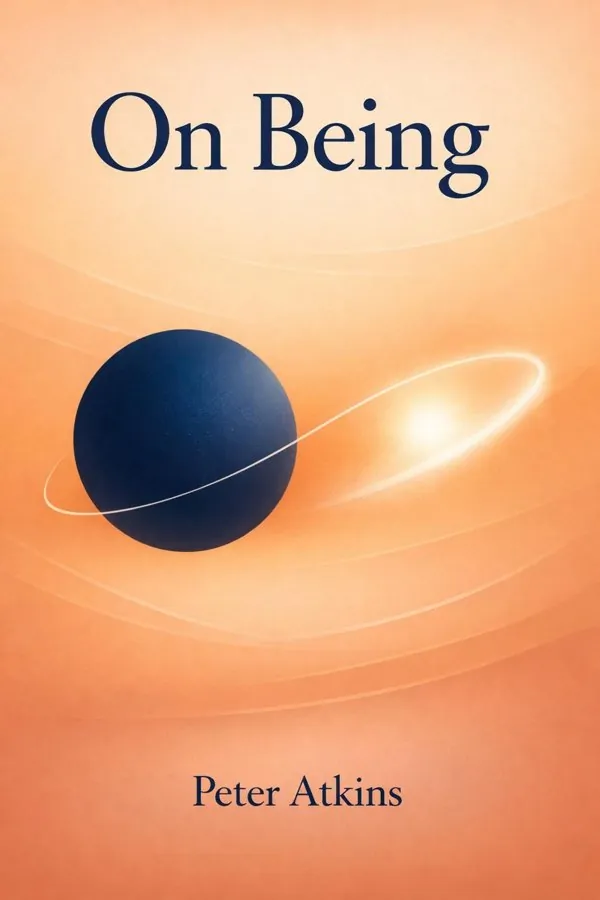
On Being: Summary & Key Insights
by Peter Atkins
 10 min9 chaptersAudio available
Key Takeaways from On Being
One of the book’s most provocative starting points is this: the universe does not need a designer in order to exist.
A difficult truth runs through On Being: reality is not obligated to comfort us.
It is tempting to believe that life is too intricate, too adaptive, and too beautiful to arise from unguided matter.
Few questions feel more intimate than consciousness.
A universe without built-in purpose can sound bleak, but Atkins turns that absence into a challenge.
What Is On Being About?
On Being by Peter Atkins is a popular_sci book. What does it mean to exist in a universe that offers no comforting script, no hidden purpose, and no supernatural guarantee? In On Being, renowned chemist and science writer Peter Atkins confronts that question with unusual boldness. This short but intellectually charged book is a philosophical defense of a scientific worldview, arguing that reality, consciousness, meaning, and morality can all be understood without appealing to divine design or mystical forces. Atkins invites readers to examine existence through the lens of physics, chemistry, and evolutionary thought, and to see how the natural world, however indifferent, is still rich enough to account for life and human experience. The book matters because it addresses one of the oldest human concerns: why we are here, and how we should think about ourselves in a vast, impersonal cosmos. Atkins writes not as a theologian or speculative philosopher, but as a distinguished scientist with decades of experience explaining complex ideas to general audiences. His authority comes from both scientific expertise and intellectual clarity. On Being is not merely a rejection of comforting illusions; it is a challenge to build a mature, honest understanding of existence from the evidence reality provides.
This FizzRead summary covers all 9 key chapters of On Being in approximately 10 minutes, distilling the most important ideas, arguments, and takeaways from Peter Atkins's work. Also available as an audio summary and Key Quotes Podcast.
On Being
What does it mean to exist in a universe that offers no comforting script, no hidden purpose, and no supernatural guarantee? In On Being, renowned chemist and science writer Peter Atkins confronts that question with unusual boldness. This short but intellectually charged book is a philosophical defense of a scientific worldview, arguing that reality, consciousness, meaning, and morality can all be understood without appealing to divine design or mystical forces. Atkins invites readers to examine existence through the lens of physics, chemistry, and evolutionary thought, and to see how the natural world, however indifferent, is still rich enough to account for life and human experience.
The book matters because it addresses one of the oldest human concerns: why we are here, and how we should think about ourselves in a vast, impersonal cosmos. Atkins writes not as a theologian or speculative philosopher, but as a distinguished scientist with decades of experience explaining complex ideas to general audiences. His authority comes from both scientific expertise and intellectual clarity. On Being is not merely a rejection of comforting illusions; it is a challenge to build a mature, honest understanding of existence from the evidence reality provides.
Who Should Read On Being?
This book is perfect for anyone interested in popular_sci and looking to gain actionable insights in a short read. Whether you're a student, professional, or lifelong learner, the key ideas from On Being by Peter Atkins will help you think differently.
- ✓Readers who enjoy popular_sci and want practical takeaways
- ✓Professionals looking to apply new ideas to their work and life
- ✓Anyone who wants the core insights of On Being in just 10 minutes
Want the full summary?
Get instant access to this book summary and 100K+ more with Fizz Moment.
Get Free SummaryAvailable on App Store • Free to download
Key Chapters
One of the book’s most provocative starting points is this: the universe does not need a designer in order to exist. Peter Atkins argues that many people instinctively assume that complexity, order, or life itself must point beyond nature to a supernatural cause. He challenges that instinct by showing how science explains increasingly large parts of reality through natural processes alone. For Atkins, invoking a creator does not solve the mystery of existence; it only postpones it by raising a bigger question about the origin of the creator.
At the center of this idea is intellectual economy. Good explanations should not multiply entities unnecessarily. If matter, energy, physical law, and time are sufficient to account for what we observe, then adding a divine agent is not an explanation but an extra assumption. Atkins does not claim science has answered every ultimate question in final form. Instead, he argues that naturalistic explanations have earned our confidence because they consistently deepen understanding without requiring invisible intervention.
A practical implication of this view is that it encourages disciplined thinking. In everyday life, people often explain uncertainty with vague claims about fate, destiny, or cosmic intent. Atkins would urge us to resist that temptation. When facing illness, social conflict, or personal hardship, it is more useful to ask what causes are actually operating and what evidence supports them. That habit leads to better medicine, better policy, and more responsible personal choices.
The takeaway is simple but demanding: when confronted by mystery, start with the natural world and follow the evidence as far as it goes before reaching for supernatural answers.
A difficult truth runs through On Being: reality is not obligated to comfort us. Atkins insists that one of science’s greatest strengths is its refusal to tailor explanations to human emotional needs. Many belief systems survive because they soothe anxiety about death, suffering, and insignificance. Science, by contrast, asks a harder question: what is true, regardless of whether it feels reassuring?
This does not make science cold in a trivial sense. Rather, it makes science morally serious. A worldview that values truth over consolation respects human maturity. Atkins suggests that adulthood, both intellectual and cultural, requires letting go of stories that exist mainly to make us feel central. The universe is vast, ancient, and fundamentally indifferent to individual hopes. Yet this indifference is not a flaw in science; it is a fact we must learn to live with honestly.
In practical terms, this perspective changes how we approach difficult experiences. Consider grief. A consoling worldview may promise cosmic reunion or divine purpose in suffering. A scientific worldview may offer no such guarantee. But it can still provide meaning through memory, human connection, and the recognition that our lives matter deeply to one another even if they do not command cosmic attention. Likewise, in education, teaching students how to tolerate uncertainty may be more valuable than giving them neat but false certainties.
Atkins’s broader point is that truth-seeking is itself a form of dignity. Human beings are capable of confronting reality without sentimental distortion. We can build meaning not from fantasy, but from courage, curiosity, and shared life.
Actionable takeaway: practice separating what is comforting from what is supported, and make important decisions based on evidence rather than emotional convenience.
It is tempting to believe that life is too intricate, too adaptive, and too beautiful to arise from unguided matter. Atkins directly confronts that intuition by arguing that life is a natural outgrowth of physical and chemical processes operating over immense spans of time. The remarkable complexity of organisms does not require intention at the beginning; it can emerge through lawful interactions, selection, and accumulation.
This idea depends on seeing nature as creative without being conscious. Atoms combine according to physical laws. Molecules form structures with different stabilities and behaviors. Under suitable conditions, increasingly complex systems can develop. Evolution by natural selection then explains how organisms become exquisitely fitted to their environments without foresight or design. The appearance of purpose in biology is produced by selection, not by a prior purpose-giver.
Atkins’s argument has practical consequences beyond abstract metaphysics. When people think life is specially inserted into nature, they may underestimate how much biology can be studied, manipulated, and understood. A naturalistic view supports advances in medicine, genetics, biochemistry, and ecology. For example, understanding disease as a biochemical and evolutionary process leads to better treatments than treating it as moral punishment or spiritual imbalance. Understanding antibiotic resistance as evolution in action helps doctors and patients use medication more responsibly.
This idea also affects personal perspective. If human beings emerged from the same physical reality as stars, oceans, and cells, then we are not visitors to nature but expressions of it. That recognition can deepen humility and environmental awareness.
Actionable takeaway: whenever something in nature appears designed, ask what cumulative physical or evolutionary process might account for it before assuming intentional creation.
Few questions feel more intimate than consciousness. Our thoughts, emotions, and sense of self seem so immediate that many people regard them as evidence of a soul or nonmaterial essence. Atkins takes the opposite position: mind is what highly organized matter does. Consciousness is extraordinary, but it does not require a supernatural ingredient.
His view follows the broader scientific pattern of explanation. As biology has illuminated digestion, immunity, and reproduction, neuroscience increasingly illuminates perception, memory, emotion, and decision-making. The fact that subjective experience feels mysterious does not justify placing it outside nature. Rather, it signals that the brain is a deeply complex organ whose processes are only partially understood. For Atkins, appealing to a soul explains nothing; it merely labels our ignorance.
This perspective has important practical applications. In mental health, seeing the mind as embodied supports compassionate, evidence-based treatment. Depression, anxiety, addiction, and trauma are not signs of spiritual failure; they involve neural patterns, lived experience, and social conditions. Likewise, education benefits from understanding attention and memory scientifically rather than morally. Even everyday habits, from sleep routines to digital distraction, make more sense when we treat cognition as biological rather than mystical.
Atkins’s materialism does not reduce human life to something trivial. It highlights how astonishing matter can be when organized by evolution and development into a reflective organism. A brain capable of poetry, mathematics, grief, and wonder is not less impressive because it is physical. If anything, it is more impressive, because it shows what nature can produce.
Actionable takeaway: treat your mind as part of your body by supporting it with sleep, movement, learning, and evidence-based care instead of relying on mystical explanations.
A universe without built-in purpose can sound bleak, but Atkins turns that absence into a challenge. If existence comes with no cosmic instruction manual, then meaning is not something waiting to be discovered in the stars. It is something human beings create through relationships, projects, values, and understanding. This is one of the book’s most demanding and liberating ideas.
Many traditions promise externally supplied purpose: serve God, fulfill destiny, occupy a preassigned place in a grand design. Atkins argues that such promises may feel satisfying precisely because they relieve us of responsibility. But in a naturalistic universe, responsibility shifts back to us. Meaning becomes local, human, and enacted. It grows out of what we love, what we build, whom we help, and how honestly we live.
This outlook is highly practical. A teacher may find meaning in shaping curious minds. A parent may find it in care and continuity. A researcher may find it in contributing a small piece of truth. An artist may find it in creating forms that intensify experience. None of these meanings require cosmic endorsement to be real. They are validated through lived significance, not metaphysical guarantees.
The same principle helps in times of drift or disappointment. When people ask, “What is my purpose?” they may be assuming purpose is hidden somewhere, waiting to be uncovered. Atkins’s worldview suggests a better question: “What commitments will I choose that make life worthwhile?” That shift transforms passive searching into active construction.
Actionable takeaway: write down three sources of meaning you can actively cultivate this month, and treat purpose as a practice of commitment rather than a mystery to be revealed.
A common fear about secular thinking is that without God, morality collapses into selfishness or chaos. Atkins rejects that fear. He argues that ethical life does not require supernatural command. Human beings can develop moral systems through reason, empathy, social cooperation, and an understanding of consequences. In other words, morality can be grounded in human flourishing rather than divine decree.
This argument matters because it distinguishes obedience from ethics. If something is good only because an authority commands it, morality becomes submission. But if moral reflection involves evaluating harm, fairness, compassion, and long-term well-being, then ethics becomes an active human enterprise. Atkins does not pretend morality is easy or mathematically certain. Scientific naturalism does not hand us a complete moral code. What it does offer is a framework for asking better questions: What promotes flourishing? What reduces suffering? What rules help communities endure and individuals thrive?
Practical examples make the point clearer. Public health policy, criminal justice reform, environmental stewardship, and medical ethics all benefit from evidence-based moral reasoning. A society deciding how to treat addiction, for instance, can ask whether punishment or treatment better reduces harm. Parents teaching children honesty can frame it not as fear of supernatural surveillance but as the basis of trust and cooperation.
Atkins’s position encourages moral maturity. We do not act well because the universe is watching; we act well because other conscious beings are vulnerable, and our choices shape the kind of world we inhabit together.
Actionable takeaway: when making an ethical decision, ask how each option affects real people’s well-being, trust, and freedom instead of relying solely on inherited authority.
Atkins repeatedly emphasizes that human beings are not the center of the universe. To many readers, that claim sounds diminishing. Yet one of the deeper insights of On Being is that insignificance in cosmic scale need not produce despair. It can produce humility, perspective, and even awe. We are tiny in the universe, but we are also the part of it able to reflect on itself.
The historical importance of this idea is immense. Science has repeatedly displaced human centrality: Earth is not the center of the cosmos, humanity is one branch of life, and the mind is rooted in biology. Each displacement can wound pride. But each also enlarges understanding. Atkins treats anthropocentrism as a comforting illusion that limits maturity. Once we stop assuming reality was built around us, we become freer to appreciate it on its own terms.
In practical life, this humility can be healthy. Personal setbacks often feel absolute because we judge them from a narrow scale. Remembering the vastness of time and space can soften ego and restore balance. In environmental thinking, human noncentrality can support stewardship: nature is not merely raw material for our desires. In intellectual life, humility makes inquiry possible because it replaces certainty with openness.
This idea also offers a paradoxical kind of dignity. Our importance is not guaranteed by cosmic privilege, but by what we do with our brief existence. Kindness, curiosity, and integrity matter more, not less, when no universal script ensures them.
Actionable takeaway: use cosmic perspective deliberately when ego, panic, or self-importance swells, and let that perspective guide you toward humility and proportion.
A recurring force in the book is Atkins’s suspicion of wishful thinking. Human beings are skilled at believing what flatters, reassures, or excuses them. We prefer narratives that make death less final, suffering more purposeful, and our role more central. Atkins argues that intellectual clarity requires courage because it often means resisting precisely those attractive distortions.
Wishful thinking does not operate only in religion or metaphysics. It appears in politics, health, relationships, and self-image. We ignore data that challenge our preferences, cling to identities built on weak evidence, and mistake repetition for truth. Atkins’s scientific attitude is therefore broader than laboratory method. It is a discipline of self-correction: a willingness to let reality overrule desire.
This discipline is highly applicable. In personal finance, it means facing spending habits honestly rather than assuming things will work out. In health, it means seeking diagnoses and proven treatment instead of miracle cures. In relationships, it means recognizing incompatibility or harmful patterns instead of preserving a fantasy. In public life, it means valuing evidence even when it disrupts ideological comfort.
Atkins is not recommending emotional harshness for its own sake. He is defending a form of intellectual integrity that allows genuine progress. False hope may briefly soothe, but accurate understanding is what enables wiser action. A worldview built on illusion cannot remain stable when reality presses back.
Actionable takeaway: identify one belief you hold mainly because it is comforting, then actively test it against evidence, criticism, and alternative explanations.
A persistent myth about science is that explanation destroys enchantment. Atkins pushes back strongly against that idea. For him, understanding the mechanisms of reality does not flatten the world; it enriches it. Knowing how stars form, how molecules bond, or how evolution shapes life does not make these things mundane. It reveals their depth, coherence, and grandeur.
This is a crucial emotional counterpoint in On Being. Although Atkins rejects supernatural mystery as an explanation, he does not reject wonder. He relocates wonder within nature itself. A rainbow is not less beautiful because optics explains it. Consciousness is not less astonishing because it depends on neurons. In fact, the more we understand, the more intricate and improbable the natural world appears.
The practical importance of this idea is educational and cultural. Many people feel forced to choose between meaning and science, or between wonder and rationality. Atkins shows that this is a false choice. A scientifically literate person can experience awe in a laboratory, under a night sky, or while reading about the origin of life. Parents and teachers can use this insight to present science not as a list of dry facts but as an invitation into reality’s deepest patterns.
This idea also changes how we respond to mystery. Instead of treating unanswered questions as proof of the supernatural, we can treat them as opportunities for exploration. Curiosity becomes a mode of reverence.
Actionable takeaway: replace one passive mystery with active investigation this week by reading, observing, or learning the science behind something that already fills you with awe.
All Chapters in On Being
About the Author
Peter Atkins is a British chemist, academic, and celebrated science writer known for explaining difficult scientific ideas with precision and confidence. He taught chemistry at the University of Oxford and became especially influential through his widely used textbooks on physical chemistry. Beyond the classroom, Atkins built a large readership through books on science, rationality, and the philosophical implications of a naturalistic worldview. His writing often explores how physics and chemistry shape our understanding of life, consciousness, and existence itself. He is also well known for his outspoken secularism and his defense of science as the most reliable path to truth. In On Being, Atkins brings together his scientific expertise and philosophical clarity to examine what it means to exist in a universe without supernatural design.
Get This Summary in Your Preferred Format
Read or listen to the On Being summary by Peter Atkins anytime, anywhere. FizzRead offers multiple formats so you can learn on your terms — all free.
Available formats: App · Audio · PDF · EPUB — All included free with FizzRead
Download On Being PDF and EPUB Summary
Key Quotes from On Being
“One of the book’s most provocative starting points is this: the universe does not need a designer in order to exist.”
“A difficult truth runs through On Being: reality is not obligated to comfort us.”
“It is tempting to believe that life is too intricate, too adaptive, and too beautiful to arise from unguided matter.”
“Few questions feel more intimate than consciousness.”
“A universe without built-in purpose can sound bleak, but Atkins turns that absence into a challenge.”
Frequently Asked Questions about On Being
On Being by Peter Atkins is a popular_sci book that explores key ideas across 9 chapters. What does it mean to exist in a universe that offers no comforting script, no hidden purpose, and no supernatural guarantee? In On Being, renowned chemist and science writer Peter Atkins confronts that question with unusual boldness. This short but intellectually charged book is a philosophical defense of a scientific worldview, arguing that reality, consciousness, meaning, and morality can all be understood without appealing to divine design or mystical forces. Atkins invites readers to examine existence through the lens of physics, chemistry, and evolutionary thought, and to see how the natural world, however indifferent, is still rich enough to account for life and human experience. The book matters because it addresses one of the oldest human concerns: why we are here, and how we should think about ourselves in a vast, impersonal cosmos. Atkins writes not as a theologian or speculative philosopher, but as a distinguished scientist with decades of experience explaining complex ideas to general audiences. His authority comes from both scientific expertise and intellectual clarity. On Being is not merely a rejection of comforting illusions; it is a challenge to build a mature, honest understanding of existence from the evidence reality provides.
More by Peter Atkins
You Might Also Like

Structures: Or Why Things Don"t Fall Down
J.E. Gordon
10 min
The Road to Wigan Pier
George Orwell
10 min
Bonk: The Curious Coupling of Science and Sex
Mary Roach
10 min
First Bite: How We Learn to Eat
Bee Wilson
10 min
In Pursuit Of The Unknown: 17 Equations That Changed The World
Ian Stewart
10 min
Napoleon's Buttons: 17 Molecules That Changed History
Penny Le Couteur and Jay Burreson
10 minBrowse by Category
Ready to read On Being?
Get the full summary and 100K+ more books with Fizz Moment.