
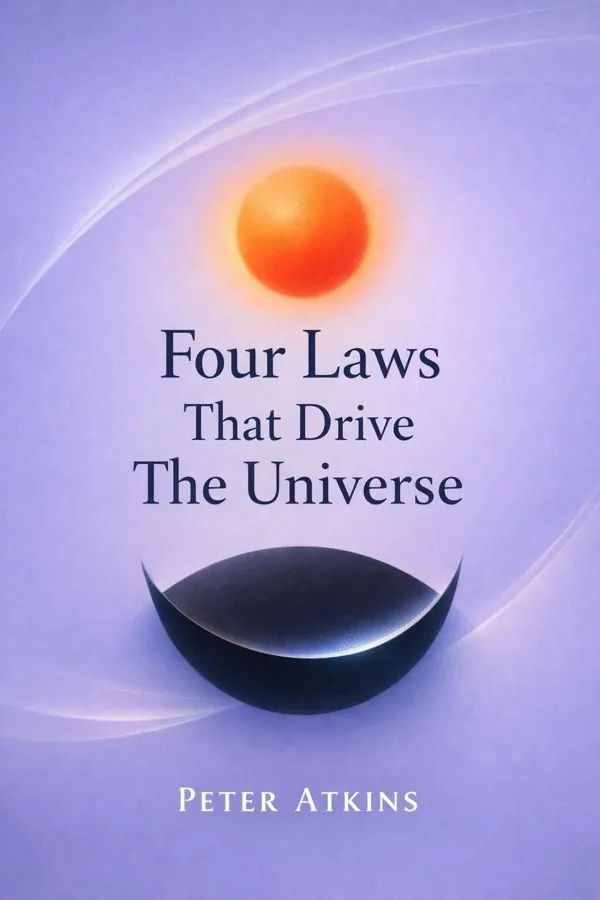
Four Laws That Drive The Universe: Summary & Key Insights
by Peter Atkins
 10 min10 chaptersAudio available
What Is Four Laws That Drive The Universe About?
Four Laws That Drive The Universe by Peter Atkins is a popular_sci book spanning 10 pages. Written by Peter Atkins, one of the world's leading authorities on thermodynamics, this compact and accessible introduction explains the four laws that govern energy and matter in the universe. Using minimal mathematics, Atkins explores how these laws drive everything from the expansion of gases to the cooling of metals, offering readers a clear understanding of the fundamental principles that underpin physical reality.
This FizzRead summary covers all 10 key chapters of Four Laws That Drive The Universe in approximately 10 minutes, distilling the most important ideas, arguments, and takeaways from Peter Atkins's work. Also available as an audio summary and Key Quotes Podcast.
Four Laws That Drive The Universe
Written by Peter Atkins, one of the world's leading authorities on thermodynamics, this compact and accessible introduction explains the four laws that govern energy and matter in the universe. Using minimal mathematics, Atkins explores how these laws drive everything from the expansion of gases to the cooling of metals, offering readers a clear understanding of the fundamental principles that underpin physical reality.
Who Should Read Four Laws That Drive The Universe?
This book is perfect for anyone interested in popular_sci and looking to gain actionable insights in a short read. Whether you're a student, professional, or lifelong learner, the key ideas from Four Laws That Drive The Universe by Peter Atkins will help you think differently.
- ✓Readers who enjoy popular_sci and want practical takeaways
- ✓Professionals looking to apply new ideas to their work and life
- ✓Anyone who wants the core insights of Four Laws That Drive The Universe in just 10 minutes
Want the full summary?
Get instant access to this book summary and 100K+ more with Fizz Moment.
Get Free SummaryAvailable on App Store • Free to download
Key Chapters
The story begins with the notion of equilibrium, an unassuming yet foundational concept. The Zeroth Law declares that if system A is in thermal equilibrium with system B, and system B with system C, then A and C are in equilibrium with each other. At first glance, this seems trivial—a statement almost not worth dignifying as a 'law.' But embedded in it is the profound realization that temperature is a measurable, comparable, and transitive property.
Temperature is not just a feeling; it is the coordinate by which systems find balance in energy exchange. Without this law, we could not define temperature rigorously, nor make sense of thermometers or thermal scales. The Zeroth Law lays the bedrock on which all subsequent laws are built, because it introduces the concept of a system that can achieve and maintain thermal balance.
When I think of this law, I imagine a conversation between systems—each exchanging energy until their dialogue ceases, signaling quiet harmony. This balance is the foundation of predictability in thermodynamics. Whether we study gases, metals, stars, or biological cells, every process strives toward equilibrium. The Zeroth Law reminds us that temperature is the universal language that allows systems to communicate their energetic states.
Once we can measure energy through temperature, the next question is how energy behaves when it moves. The First Law of Thermodynamics gives the answer: energy can be transformed, but it can neither be created nor destroyed. Energy merely changes its form—into heat, into work, into potential, into motion—but the total sum remains constant.
This principle of conservation defines all physical processes. When a flame burns, or when a planet orbits its star, or when we metabolize food, energy shifts form but never vanishes. It is a profoundly democratic rule: every joule that exists now existed from the earliest moments of the universe. The cornucopia of processes we observe are simply permutations in disguise.
In the book, I explore how this law governs chemical reactions and physical transformations alike. When heat is absorbed by a system, it may manifest as work done or as internal agitation of particles. I use the imagery of energy as a currency—exchanged, invested, and conserved. Just as in economics, there is no creation of wealth without an equivalent depletion elsewhere.
This conservation underwrites the stability of the cosmos. The First Law reassures us that while change is constant, nothing is lost. In every transformation, the universe writes no debts; it merely rearranges its accounts.
+ 8 more chapters — available in the FizzRead app
All Chapters in Four Laws That Drive The Universe
About the Author
Peter Atkins is a British chemist and professor known for his contributions to physical chemistry and science education. He has authored numerous textbooks and popular science works, including 'Physical Chemistry' and 'Four Laws That Drive the Universe', which are widely used in academic and general science contexts.
Get This Summary in Your Preferred Format
Read or listen to the Four Laws That Drive The Universe summary by Peter Atkins anytime, anywhere. FizzRead offers multiple formats so you can learn on your terms — all free.
Available formats: App · Audio · PDF · EPUB — All included free with FizzRead
Download Four Laws That Drive The Universe PDF and EPUB Summary
Key Quotes from Four Laws That Drive The Universe
“The story begins with the notion of equilibrium, an unassuming yet foundational concept.”
“Once we can measure energy through temperature, the next question is how energy behaves when it moves.”
Frequently Asked Questions about Four Laws That Drive The Universe
Four Laws That Drive The Universe by Peter Atkins is a popular_sci book that explores key ideas across 10 chapters. Written by Peter Atkins, one of the world's leading authorities on thermodynamics, this compact and accessible introduction explains the four laws that govern energy and matter in the universe. Using minimal mathematics, Atkins explores how these laws drive everything from the expansion of gases to the cooling of metals, offering readers a clear understanding of the fundamental principles that underpin physical reality.
More by Peter Atkins
You Might Also Like

Structures: Or Why Things Don"t Fall Down
J.E. Gordon
10 min
The Road to Wigan Pier
George Orwell
10 min
Bonk: The Curious Coupling of Science and Sex
Mary Roach
10 min
First Bite: How We Learn to Eat
Bee Wilson
10 min
In Pursuit Of The Unknown: 17 Equations That Changed The World
Ian Stewart
10 min
Napoleon's Buttons: 17 Molecules That Changed History
Penny Le Couteur and Jay Burreson
10 minBrowse by Category
Ready to read Four Laws That Drive The Universe?
Get the full summary and 100K+ more books with Fizz Moment.