
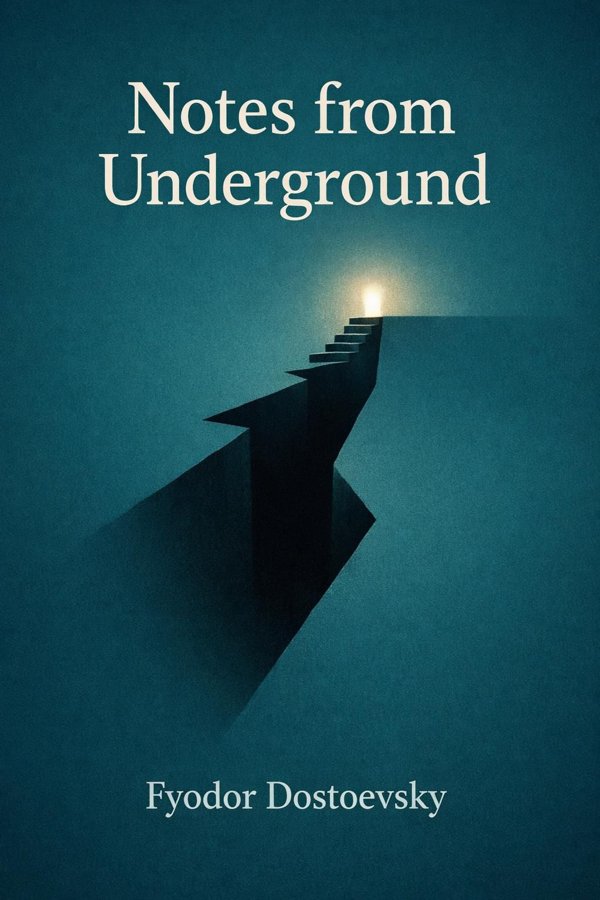
Notes from Underground: Summary & Key Insights
 10 min9 chaptersAudio available
Key Takeaways from Notes from Underground
The most disturbing confessions often begin with radical honesty.
Human beings do not always want what is best for them, and Dostoevsky insists that any philosophy ignoring this fact will eventually fail.
Too much self-consciousness can be as disabling as ignorance.
There is a deep tension in the book between the person who acts and the person who endlessly reflects.
Some of the deepest wounds in life are not physical injuries but moments of perceived insignificance.
What Is Notes from Underground About?
Notes from Underground by Fyodor Dostoevsky is a classics book spanning 7 pages. Notes from Underground is Fyodor Dostoevsky’s dark, brilliant exploration of a mind at war with itself. First published in 1864, this short but unsettling novella takes the form of a confession by an unnamed former civil servant who has withdrawn from society and now speaks from his self-made “underground” of resentment, shame, pride, and painful self-awareness. What begins as a bitter monologue turns into a devastating study of freedom, humiliation, spite, and the human tendency to act against our own best interests simply because we can. The book matters because it challenges comforting ideas about rationality and progress. Dostoevsky attacks the belief that people can be reduced to logic, utility, or social engineering. Instead, he reveals how often we choose contradiction, self-sabotage, and suffering in order to preserve our sense of individuality. In doing so, he anticipates existentialism, psychoanalysis, and many modern debates about identity and alienation. Dostoevsky writes with unusual authority because he understood extremes of thought and feeling from the inside. Across his work, he probed guilt, freedom, moral struggle, and spiritual crisis with unmatched psychological depth. Notes from Underground remains one of literature’s sharpest portraits of the divided self.
This FizzRead summary covers all 9 key chapters of Notes from Underground in approximately 10 minutes, distilling the most important ideas, arguments, and takeaways from Fyodor Dostoevsky's work. Also available as an audio summary and Key Quotes Podcast.
Notes from Underground
Notes from Underground is Fyodor Dostoevsky’s dark, brilliant exploration of a mind at war with itself. First published in 1864, this short but unsettling novella takes the form of a confession by an unnamed former civil servant who has withdrawn from society and now speaks from his self-made “underground” of resentment, shame, pride, and painful self-awareness. What begins as a bitter monologue turns into a devastating study of freedom, humiliation, spite, and the human tendency to act against our own best interests simply because we can.
The book matters because it challenges comforting ideas about rationality and progress. Dostoevsky attacks the belief that people can be reduced to logic, utility, or social engineering. Instead, he reveals how often we choose contradiction, self-sabotage, and suffering in order to preserve our sense of individuality. In doing so, he anticipates existentialism, psychoanalysis, and many modern debates about identity and alienation.
Dostoevsky writes with unusual authority because he understood extremes of thought and feeling from the inside. Across his work, he probed guilt, freedom, moral struggle, and spiritual crisis with unmatched psychological depth. Notes from Underground remains one of literature’s sharpest portraits of the divided self.
Who Should Read Notes from Underground?
This book is perfect for anyone interested in classics and looking to gain actionable insights in a short read. Whether you're a student, professional, or lifelong learner, the key ideas from Notes from Underground by Fyodor Dostoevsky will help you think differently.
- ✓Readers who enjoy classics and want practical takeaways
- ✓Professionals looking to apply new ideas to their work and life
- ✓Anyone who wants the core insights of Notes from Underground in just 10 minutes
Want the full summary?
Get instant access to this book summary and 100K+ more with Fizz Moment.
Get Free SummaryAvailable on App Store • Free to download
Key Chapters
The most disturbing confessions often begin with radical honesty. The narrator of Notes from Underground introduces himself as a “sick” and “spiteful” man, but his illness is not simply physical. It is moral, psychological, and existential. He is deeply alienated from others, yet he clings to that alienation as proof of his superiority. He despises social conventions, mocks himself relentlessly, and seems unable to move toward genuine connection. His self-description is both confession and performance: he exposes his ugliness while also using that ugliness to control the conversation.
This matters because Dostoevsky is showing what happens when self-awareness becomes detached from growth. The Underground Man sees his flaws with painful clarity, but insight alone does not redeem him. Instead, he circles endlessly around his grievances, turning reflection into paralysis and humiliation into identity. He would rather remain wounded than risk becoming ordinary, vulnerable, or changed.
In modern life, this pattern is recognizable. Someone may define themselves by cynicism, believing that because they see hypocrisy clearly, they are somehow freer than everyone else. Another person may use sarcasm or self-deprecation to avoid real intimacy. A third may constantly narrate their own flaws without ever taking responsibility for changing them. The result is a private prison built from intelligence, pride, and fear.
Dostoevsky does not ask us simply to condemn the narrator. He asks us to recognize how easily bitterness can masquerade as depth. When pain becomes part of one’s identity, healing can feel like betrayal.
Actionable takeaway: Notice where honest self-knowledge has turned into self-protective stagnation. Choose one flaw you often explain but rarely address, and take one concrete step to change it.
Human beings do not always want what is best for them, and Dostoevsky insists that any philosophy ignoring this fact will eventually fail. In the first part of the novella, the Underground Man attacks the optimistic thinkers of his age who believed reason, science, and enlightened self-interest could organize society into harmony. According to such views, if people properly understood their interests, they would choose what is useful, efficient, and beneficial. Life could become a kind of solvable equation.
The narrator rejects this with ferocity. He argues that people often desire what is irrational, self-destructive, or absurd precisely because they do not want to be reduced to predictable machines. Even if a flawless social system could guarantee comfort and prosperity, human beings might revolt against it simply to prove they are free. For Dostoevsky, the human person is not only rational but also willful, contradictory, and capable of choosing pain over order.
This argument still feels fresh. Modern institutions often assume that better information, incentives, and systems will produce better behavior. Yet people still sabotage healthy habits, damage stable relationships, and vote or act against their own interests. Why? Because desire is not identical with logic. Pride, boredom, resentment, and the need for autonomy matter as much as reason.
The insight is not that reason is useless. Rather, reason alone cannot explain the whole person. Any view of human nature that ignores emotion, ego, rebellion, and imagination will remain incomplete. Dostoevsky warns us that a society built only on calculation may produce comfort but not dignity.
Actionable takeaway: When trying to change behavior—your own or someone else’s—do not rely on logic alone. Ask what hidden need for control, identity, or resistance may be shaping the decision.
Too much self-consciousness can be as disabling as ignorance. One of the Underground Man’s most famous ideas is that excessive awareness leads not to wisdom but to inertia. He thinks too much, imagines too many possible motives and outcomes, and therefore becomes incapable of direct action. Every impulse is examined, mocked, doubted, and reversed. As a result, he does almost nothing—except brood.
Dostoevsky draws a contrast between clear-eyed reflection and corrosive overthinking. The narrator prides himself on being more intelligent and more conscious than “men of action,” yet that superiority is hollow. People who act may be simplistic, but they at least move through the world. The Underground Man remains trapped inside layers of interpretation. He analyzes insults until they grow larger than life. He imagines conversations that never happen. He rehearses revenge instead of living.
This dynamic is strikingly modern. Many people today become immobilized by endless inner commentary: Should I say this? What will they think? What if I fail? What if I appear foolish? Perfectionism, rumination, and social anxiety often work this way. The mind mistakes constant processing for meaningful control, but in reality it postpones life.
Dostoevsky’s insight is not anti-intellectual. He is not praising thoughtlessness. He is exposing a form of intelligence that has turned against itself. When every choice must survive total internal scrutiny, no choice feels possible. Reflection becomes a defense against risk.
Healthy action requires accepting incompleteness. You cannot think your way into total certainty before acting, apologizing, creating, or loving. At some point, motion must interrupt analysis.
Actionable takeaway: The next time you find yourself stuck in repetitive thought, set a small deadline for action. Send the email, make the call, or begin the task before your mind can convert uncertainty into paralysis.
There is a deep tension in the book between the person who acts and the person who endlessly reflects. The Underground Man envies and despises “men of action”—those straightforward individuals who commit themselves to goals, respond to insult directly, and live without dismantling every motive. To him, they seem crude, limited, almost mechanical. Yet he also senses that their simplicity gives them a strength he lacks.
Dostoevsky uses this contrast to explore two different distortions of human life. The man of action may be naïve, driven by narrow certainties and unexamined assumptions. But the man of excessive thought can become detached from reality, incapable of commitment, and addicted to irony. The Underground Man cannot join ordinary life because he sees too much ambiguity. But because he cannot live within ambiguity, he collapses into resentment.
This tension remains relevant in work, relationships, and ethics. Some people make decisions quickly, trusting instinct and responsibility. Others continually reevaluate, second-guess, and hesitate. Both styles have dangers. Action without reflection can become cruelty or recklessness. Reflection without action can become evasion. Dostoevsky is not simply endorsing one side. He is showing how difficult it is to unite intelligence with courage.
A practical example appears in conflict. One person addresses an issue directly, perhaps imperfectly, but moves toward resolution. Another analyzes the conflict for weeks, constructing motives and alternate scenarios, until the relationship grows colder. The second person may feel more sophisticated, but sophistication has not produced truth or healing.
The book suggests that dignity lies not in never doubting, but in acting despite doubt. Mature action does not require total certainty; it requires accepting responsibility in an unclear world.
Actionable takeaway: When facing a difficult decision, ask not only “What do I think?” but also “What does responsible action look like now?” Then take the smallest concrete step toward it.
Some of the deepest wounds in life are not physical injuries but moments of perceived insignificance. In the second part of the novella, “Apropos of the Wet Snow,” Dostoevsky dramatizes how humiliation can colonize memory. The Underground Man recalls social slights, awkward encounters, and imagined offenses with obsessive intensity. A minor insult becomes an epic moral event inside his mind. He does not merely remember humiliation; he relives and reshapes it until it defines him.
This is crucial to understanding the narrator. He is not detached from society because he has transcended it. He is profoundly dependent on it, especially on how others rank and perceive him. He longs to be recognized, fears being dismissed, and turns every social interaction into a struggle for dignity. His attempt to confront an officer who once moved him aside without noticing him becomes absurdly important because it symbolizes his need to assert that he exists.
Many readers recognize this emotional logic. A dismissive comment from a colleague, being excluded from a group, an embarrassing moment at school, or a social slight online can remain vivid for years. The mind revisits the scene, invents better responses, and nourishes secret grievances. Left unchecked, humiliation can become identity: “I am the one overlooked, the one diminished.”
Dostoevsky reveals the cost of living this way. When self-worth depends on defeating humiliation, one becomes hypersensitive, defensive, and unable to meet others openly. The past gains too much power over the present.
The antidote is not pretending insults do not matter. They do. But not every wound deserves permanent residence in the self. Some memories must be reinterpreted, released, or placed in proportion.
Actionable takeaway: Identify one old humiliation you revisit mentally. Write down the event, what it made you believe about yourself, and one more truthful interpretation that weakens its hold.
People often hurt others not from strength, but from wounded pride. This becomes painfully clear in the Underground Man’s interactions with former schoolmates and later with Liza. In both cases, he feels small, exposed, and powerless. Rather than admit vulnerability, he seeks situations where he can reverse the humiliation and regain control. His cruelty is not random. It is compensation.
Dostoevsky is remarkably precise here. The narrator longs for human closeness, but when closeness becomes possible, he sabotages it. Why? Because authentic relationship would require equality and openness. He prefers domination, theatrical confession, or emotional manipulation—forms of contact that preserve his superiority. He would rather wound than be seen needing anyone.
This pattern appears far beyond literature. Someone feels ignored at work and responds with passive-aggressive behavior. A partner feels insecure and becomes controlling. A friend fears rejection and preemptively insults others. In each case, the real issue is not malice for its own sake, but the inability to bear dependence, uncertainty, or shame. The ego converts pain into aggression.
The Underground Man shows how seductive this can be. A cutting remark, a moral lecture, or a moment of dominance can feel like self-restoration. But it is counterfeit restoration. It does not heal wounded dignity; it deepens isolation. The person wins the moment and loses the relationship.
Dostoevsky’s psychological lesson is severe but useful: cruelty often signals hidden fragility. This does not excuse harm, but it helps explain why self-loathing and pride so often coexist. Unless vulnerability is acknowledged honestly, it returns as manipulation.
Actionable takeaway: The next time you feel the urge to assert power through sarcasm, withdrawal, or superiority, pause and ask: “What hurt or fear am I trying not to feel?” Name that feeling before you act.
The encounter with Liza is the emotional center of Notes from Underground because it reveals the difference between understanding suffering and responding to it with love. Liza is a young sex worker whom the narrator meets in a brothel. In a moment of intense moral speech, he describes the degradation and loneliness of her future, moving her deeply. For a brief moment, he seems capable of genuine compassion. He sees her humanity, and she sees in him the possibility of rescue, tenderness, or at least truth.
Yet when Liza later comes to his apartment, the possibility of connection collapses. Faced with real intimacy rather than imagined moral authority, the Underground Man panics. He feels exposed in his poverty, vanity, and emotional neediness. Instead of receiving her with kindness, he humiliates her and then tries to force money on her, turning a potentially human encounter into another scene of domination and shame.
This episode is devastating because it shows how easily compassion can be corrupted by ego. The narrator can speak beautifully about suffering when he remains in control. He cannot sustain compassion when another person comes close enough to reveal his own need. He prefers the role of savior to the reality of mutual vulnerability.
The lesson extends beyond the novel. It is possible to care about people in theory while failing them in practice. We may offer advice, sympathy, or moral language, but withdraw when real patience, humility, or reciprocity is required. Public compassion is easier than private tenderness.
Liza’s quiet dignity exposes the narrator’s spiritual poverty. She does not save him, but she reveals the person he could have been.
Actionable takeaway: Measure compassion not by what you say when moved, but by how you act when another person’s need interrupts your pride, comfort, or self-image.
One of Dostoevsky’s most provocative claims is that people sometimes choose what harms them simply to preserve their sense of freedom. The Underground Man resists systems, advice, and moral expectations not only because he disagrees with them, but because obedience itself feels intolerable. To choose pain over imposed happiness can seem, in his distorted logic, like a final assertion of personhood.
This is a central philosophical contribution of the book. Modern thought often links freedom with better choices: if we are informed and rational, we will choose health, stability, and mutual benefit. Dostoevsky complicates this picture. For him, freedom also includes the terrifying ability to reject what is good, useful, or redemptive. Human dignity is bound up not only with reason but with will, and the will can turn destructively inward.
We see this constantly in ordinary life. Someone resists help because accepting it feels like dependence. Another ruins a promising opportunity because success would require trust or discipline. A third stays attached to a damaging identity because change feels like surrender. In each case, self-sabotage is not accidental; it contains a hidden declaration: “No one gets to determine me.”
The danger, of course, is that such rebellion can become empty. Freedom severed from truth or responsibility ceases to liberate. It becomes compulsion wearing the costume of independence. The Underground Man insists on his freedom, but what he actually achieves is repetition, bitterness, and loneliness.
Dostoevsky’s challenge is not to abandon freedom, but to mature it. Real freedom is not merely the power to refuse. It is the capacity to choose what leads to fuller life.
Actionable takeaway: When resisting advice, structure, or help, ask yourself whether you are protecting genuine values or simply defending your ego through refusal.
The most chilling aspect of Notes from Underground is that there is no neat redemption. The narrator remains unfinished, unresolved, and trapped inside his own contradictions. He admits much, understands much, and yet does not fundamentally change. This is Dostoevsky’s final warning: insight is not transformation, and confession is not cure.
The “underground” is more than a physical retreat or a social condition. It is a mode of being in which resentment, self-consciousness, wounded pride, and estrangement become habitual. One withdraws from the world while continuing to obsess over it. One rejects others while craving their recognition. One despises one’s own condition while making it the basis of identity. Left untreated, this interior underground becomes self-sustaining.
This has practical importance because many destructive patterns persist not from lack of awareness but from lack of surrender, discipline, and action. People may understand their anxieties, traumas, or defensive habits in great detail and still remain governed by them. Self-knowledge is necessary, but by itself it can become another refined form of avoidance.
Dostoevsky does not provide a simple program for escape. But he does imply what the narrator lacks: humility, genuine relationship, moral courage, and a willingness to step out of self-enclosure. The novella remains powerful because it refuses the comforting illusion that seeing the truth automatically sets us free. Often, the first clear sight of the truth only reveals how much inner work remains.
Actionable takeaway: If you recognize an “underground” pattern in your own life, pair insight with a practice—conversation, therapy, apology, routine, or service—that moves you outward instead of deeper into yourself.
All Chapters in Notes from Underground
About the Author
Fyodor Dostoevsky (1821–1881) was a Russian novelist, journalist, and thinker whose work transformed world literature. Born in Moscow, he first gained recognition with Poor Folk, but his life soon took a dramatic turn: he was arrested for involvement in a political discussion group, sentenced to death, and reprieved at the last moment before being sent to Siberian imprisonment and military service. Those experiences shaped his lifelong concern with suffering, freedom, guilt, and spiritual renewal. Dostoevsky later wrote some of the most influential novels ever published, including Crime and Punishment, The Idiot, Demons, and The Brothers Karamazov. Renowned for his psychological depth and philosophical intensity, he remains one of the essential writers for understanding the complexities of modern consciousness and the moral struggles of the human soul.
Get This Summary in Your Preferred Format
Read or listen to the Notes from Underground summary by Fyodor Dostoevsky anytime, anywhere. FizzRead offers multiple formats so you can learn on your terms — all free.
Available formats: App · Audio · PDF · EPUB — All included free with FizzRead
Download Notes from Underground PDF and EPUB Summary
Key Quotes from Notes from Underground
“The most disturbing confessions often begin with radical honesty.”
“Human beings do not always want what is best for them, and Dostoevsky insists that any philosophy ignoring this fact will eventually fail.”
“Too much self-consciousness can be as disabling as ignorance.”
“There is a deep tension in the book between the person who acts and the person who endlessly reflects.”
“Some of the deepest wounds in life are not physical injuries but moments of perceived insignificance.”
Frequently Asked Questions about Notes from Underground
Notes from Underground by Fyodor Dostoevsky is a classics book that explores key ideas across 9 chapters. Notes from Underground is Fyodor Dostoevsky’s dark, brilliant exploration of a mind at war with itself. First published in 1864, this short but unsettling novella takes the form of a confession by an unnamed former civil servant who has withdrawn from society and now speaks from his self-made “underground” of resentment, shame, pride, and painful self-awareness. What begins as a bitter monologue turns into a devastating study of freedom, humiliation, spite, and the human tendency to act against our own best interests simply because we can. The book matters because it challenges comforting ideas about rationality and progress. Dostoevsky attacks the belief that people can be reduced to logic, utility, or social engineering. Instead, he reveals how often we choose contradiction, self-sabotage, and suffering in order to preserve our sense of individuality. In doing so, he anticipates existentialism, psychoanalysis, and many modern debates about identity and alienation. Dostoevsky writes with unusual authority because he understood extremes of thought and feeling from the inside. Across his work, he probed guilt, freedom, moral struggle, and spiritual crisis with unmatched psychological depth. Notes from Underground remains one of literature’s sharpest portraits of the divided self.
More by Fyodor Dostoevsky



You Might Also Like






Browse by Category
Ready to read Notes from Underground?
Get the full summary and 100K+ more books with Fizz Moment.