
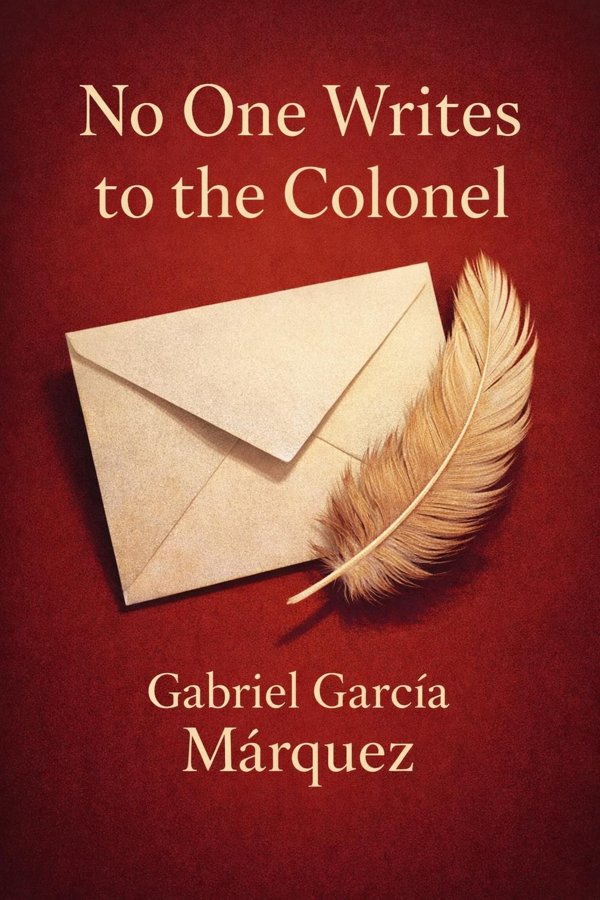
No One Writes to the Colonel: Summary & Key Insights
 10 min9 chaptersAudio available
Key Takeaways from No One Writes to the Colonel
Waiting can become a way of life long before it becomes a tragedy.
Poverty in this novel is not only material deprivation; it is a daily pressure that enters every conversation, every meal, and every decision.
Hope often survives by attaching itself to something concrete.
Oppression is most effective when it does not need to shout.
One of the novel’s deepest achievements is its insistence that dignity is not the same as success.
What Is No One Writes to the Colonel About?
No One Writes to the Colonel by Gabriel García Márquez is a classics book spanning 4 pages. No One Writes to the Colonel is a short novel with the emotional force of a much larger work. Set in a poor Colombian town under repression, it follows an aging colonel who has spent fifteen years waiting for the pension promised for his military service. Each week he goes to the dock to ask whether a letter has arrived. Each week, nothing comes. Around this deceptively simple routine, Gabriel García Márquez builds a powerful meditation on poverty, dignity, marriage, political silence, and the strange endurance of hope. The colonel and his asthmatic wife live in near starvation, yet they cling to one precious possession: a fighting rooster inherited from their dead son. In that bird, they invest memory, pride, and the possibility of a future. García Márquez, the Nobel Prize-winning Colombian master of narrative compression and moral clarity, turns ordinary hardship into something unforgettable. This novel matters because it asks a timeless question: when the world gives you no reason to believe, what keeps you going? Its answer is tender, severe, and deeply human.
This FizzRead summary covers all 9 key chapters of No One Writes to the Colonel in approximately 10 minutes, distilling the most important ideas, arguments, and takeaways from Gabriel García Márquez's work. Also available as an audio summary and Key Quotes Podcast.
No One Writes to the Colonel
No One Writes to the Colonel is a short novel with the emotional force of a much larger work. Set in a poor Colombian town under repression, it follows an aging colonel who has spent fifteen years waiting for the pension promised for his military service. Each week he goes to the dock to ask whether a letter has arrived. Each week, nothing comes. Around this deceptively simple routine, Gabriel García Márquez builds a powerful meditation on poverty, dignity, marriage, political silence, and the strange endurance of hope. The colonel and his asthmatic wife live in near starvation, yet they cling to one precious possession: a fighting rooster inherited from their dead son. In that bird, they invest memory, pride, and the possibility of a future. García Márquez, the Nobel Prize-winning Colombian master of narrative compression and moral clarity, turns ordinary hardship into something unforgettable. This novel matters because it asks a timeless question: when the world gives you no reason to believe, what keeps you going? Its answer is tender, severe, and deeply human.
Who Should Read No One Writes to the Colonel?
This book is perfect for anyone interested in classics and looking to gain actionable insights in a short read. Whether you're a student, professional, or lifelong learner, the key ideas from No One Writes to the Colonel by Gabriel García Márquez will help you think differently.
- ✓Readers who enjoy classics and want practical takeaways
- ✓Professionals looking to apply new ideas to their work and life
- ✓Anyone who wants the core insights of No One Writes to the Colonel in just 10 minutes
Want the full summary?
Get instant access to this book summary and 100K+ more with Fizz Moment.
Get Free SummaryAvailable on App Store • Free to download
Key Chapters
Waiting can become a way of life long before it becomes a tragedy. At the center of No One Writes to the Colonel is a retired officer who has spent years expecting the government pension legally owed to him. Every Friday, he repeats the same ritual: he dresses carefully, maintains his appearance, and goes to the dock in the hope that the mail will finally contain his letter. The routine is heartbreaking precisely because it is so orderly. He has almost nothing, yet he preserves the structure of expectation.
This endless wait is not only about bureaucracy. It represents the painful distance between justice promised and justice delivered. The colonel is not asking for charity; he is asking for what is his by right. That distinction matters. His persistence shows how institutions can exhaust people not simply by denying them, but by forcing them to hope indefinitely. García Márquez captures the emotional cruelty of delay: the colonel is neither fully rejected nor helped, only suspended.
The idea has broad application beyond the novel. People wait for job offers, legal decisions, medical results, overdue payments, or recognition they have earned. In many cases, the uncertainty is harder than a clear no. The colonel teaches us that routines can preserve self-respect, but also that systems often rely on the powerless remaining patient forever.
His Friday ritual is therefore both noble and devastating. It reveals the human need to believe that order, paperwork, and law still mean something. Actionable takeaway: identify one area in your life where you are passively waiting for fairness, and decide whether to keep hoping, escalate your efforts, or redirect your energy toward what you can control.
Poverty in this novel is not only material deprivation; it is a daily pressure that enters every conversation, every meal, and every decision. The colonel and his wife live with almost nothing. They count coins, pawn possessions, stretch food, and argue over practical survival. Their house contains the residue of former respectability, but little remains that can be sold without sacrificing memory or identity. García Márquez shows how scarcity shrinks the horizon of life until even tiny expenses acquire moral weight.
What makes this portrayal so powerful is that poverty does not reduce the characters to symbols. The colonel’s wife is not merely pessimistic, nor is the colonel merely noble. Hunger sharpens disagreement between them. She worries about medicine, food, and immediate necessity. He clings to honor and possibility. Both positions are valid. The novel understands that love under hardship is rarely serene; it is tense, repetitive, and often expressed through complaint rather than tenderness.
This dynamic appears in real life whenever financial stress affects relationships. Couples under strain may argue about bills, possessions, debt, or priorities, but beneath those disputes lie deeper fears about security, self-worth, and the future. The novel reminds us that poverty is exhausting partly because it forces constant trade-offs between dignity and need.
Yet the colonel and his wife endure together. Their quarrels reveal attachment as much as frustration. They continue negotiating life side by side, even when both are nearly defeated. Actionable takeaway: when scarcity creates conflict, look beneath the immediate argument and ask what fear or value each person is trying to protect.
One of the novel’s deepest achievements is its insistence that dignity is not the same as success. The colonel fails, in practical terms, to secure his pension. He cannot provide adequately for his household. He has no power to change the state that neglects him. Yet he refuses humiliation. He continues to dress carefully, to maintain manners, and to treat his claim as legitimate. His dignity is not theatrical pride; it is a disciplined refusal to let misery define the whole of his identity.
This matters because modern life often ties worth to visible outcomes. People are encouraged to judge themselves by income, efficiency, status, or measurable achievement. García Márquez offers a harsher and more compassionate standard. A person can be economically ruined, politically ignored, and socially marginal, yet still preserve an inner code. The colonel’s self-respect becomes a form of resistance.
At the same time, the novel does not romanticize suffering. Dignity does not feed the hungry or cure illness. It has limits. But where material victory is unavailable, dignity protects moral coherence. The colonel remains someone to himself. That interior continuity is what poverty and oppression often try to destroy.
In practical terms, many people face situations in which outcomes lie beyond their control: layoffs, chronic illness, delayed recognition, aging, or institutional neglect. The novel suggests that while we may not command results, we can still choose bearing, language, and principle. Actionable takeaway: in one area where you feel powerless, define the standard of conduct you want to keep regardless of the outcome.
Long relationships are often held together less by romance than by endurance, memory, and repeated acts of negotiation. The colonel and his wife offer one of literature’s sharpest portraits of marriage under pressure. They are grieving the loss of their son, struggling with illness, and facing relentless scarcity. Their conversations are often edged with irritation. She accuses him of impracticality; he resists her demand for immediate compromises. Yet beneath these conflicts lies a history of shared suffering that neither can escape nor easily articulate.
The brilliance of the novel is that it presents disagreement not as failure but as a realistic form of intimacy. The wife sees what hunger costs in concrete terms. The colonel sees what surrender would cost in moral terms. They are not enemies; they are two responses to the same pain. Their marriage becomes a small arena in which the novel stages a universal question: should people protect survival first, or preserve hope even when it seems irrational?
This tension is familiar in many partnerships. One person prioritizes caution, medicine, savings, and present stability. The other protects ambition, identity, or long-term possibility. Neither side is simply right. Healthy relationships depend on recognizing that practical arguments often conceal emotional wounds.
The couple’s bond survives because, despite resentment, they remain engaged in the same struggle. They still argue because they still care what happens. In that sense, conflict itself becomes evidence of attachment. Actionable takeaway: in an important relationship, ask whether your recurring argument is really about logistics, or about grief, fear, pride, and competing ways of loving.
Some novels move through dramatic events; this one moves through duration. No One Writes to the Colonel is built from delay, repetition, and postponed resolution. Time does not heal the colonel’s situation. Instead, it accumulates weight. Fifteen years of waiting have transformed a legal claim into a whole existence shaped by anticipation. The novel’s pacing mirrors that burden, making readers feel how slowness itself can become oppressive.
This treatment of time reveals an important truth: institutions often exercise power through delay rather than direct violence. To postpone is to weaken. To defer is to wear people down. The colonel lives within this logic, but he also counters it with his own rituals. By continuing to go to the dock, by feeding the rooster, by preparing for the future, he creates a counter-time based on persistence rather than surrender.
The idea resonates in everyday life. Long periods of uncertainty can distort judgment and drain energy. Waiting for a response, recovery, payment, or opportunity can make people feel suspended between past and future, unable to act fully in the present. One response is despair. Another is structure: routines that preserve agency while larger outcomes remain unresolved.
García Márquez suggests that repetition can either imprison or sustain us, depending on whether it is imposed or chosen. The colonel suffers under state delay, but he also survives through habitual acts of care and expectation. Actionable takeaway: when facing prolonged uncertainty, create a personal rhythm of meaningful actions so that waiting does not become the only story you are living.
Although the novel focuses closely on one couple, it never loses sight of the surrounding town. The colonel’s suffering is personal, but it is also social. Neighbors, officials, the doctor, and the young people connected to the rooster all form a community that reflects different responses to hardship. Some are resigned, some cynical, some quietly generous. The town itself seems suspended between decay and expectation, making the colonel’s story feel less like an isolated case than a shared condition.
The rooster is especially important here because it turns private struggle into communal investment. The townspeople see the bird as a chance for collective excitement and perhaps symbolic victory. In a repressed environment, even a cockfight becomes a site where energy, pride, and imagination gather. This reminds us that people rarely survive despair alone. They rely on small networks of recognition, however fragile.
At the same time, community is not portrayed sentimentally. It does not solve the couple’s hunger. Gossip, pressure, and conflicting interests remain. Yet the novel shows that even minimal solidarity matters. A doctor’s tact, a group’s enthusiasm, a shared silence, or a mutual understanding can help sustain human beings when official systems fail them.
In modern life, people often underestimate the value of weak ties: neighbors, colleagues, local groups, and informal circles. These connections may not transform structural injustice, but they can preserve morale and dignity. Actionable takeaway: invest in one small community around you, because collective meaning often begins where formal support ends.
The novel’s most unforgettable lesson is that hope is not the same thing as optimism. Optimism expects things to improve because evidence suggests they might. Hope, as García Márquez presents it, persists even when evidence is scarce or absent. The colonel has almost no rational reason to believe his pension will arrive soon or that the rooster will rescue him. Yet he continues. This is not naïveté. It is a deliberate refusal to let reality have the final word over meaning.
The distinction matters. Optimism is often comfortable and mood-based. Hope, in this book, is costly. It demands sacrifice, invites ridicule, and strains relationships. The colonel’s wife sees this clearly. Hope does not erase hunger. Still, without it, the couple would surrender not only expectations but identity. Their dead son’s memory, their sense of justice, and their claim on the future would all collapse.
This form of hope has strong relevance today. In periods of personal loss, social breakdown, or political disappointment, people may find optimism impossible. The novel offers another path: one can act meaningfully without guarantees. One can feed the rooster, go to the dock, hold one’s posture, and continue preparing for a future that has not yet justified itself.
The famous ending crystallizes this ethic with unforgettable bluntness, showing hope stripped of comfort and reduced to raw endurance. It is one of literature’s starkest affirmations of human will. Actionable takeaway: when optimism fails, choose one disciplined act of hope that expresses who you are, not what outcomes you can guarantee.
All Chapters in No One Writes to the Colonel
About the Author
Gabriel García Márquez (1927–2014) was a Colombian novelist, journalist, screenwriter, and Nobel Prize winner whose work reshaped modern literature. Born in Aracataca, Colombia, he drew deeply on the politics, oral storytelling, and social tensions of Latin America. He became internationally famous for One Hundred Years of Solitude, a landmark novel often associated with magical realism, though his range extended far beyond that style. His fiction combines vivid atmosphere, emotional precision, and sharp attention to power, memory, love, and injustice. In 1982, he received the Nobel Prize in Literature for works in which “the fabulous and the realistic are combined in a richly composed world of imagination.” No One Writes to the Colonel remains one of his most admired shorter works, showcasing his ability to give immense moral and political weight to ordinary lives.
Get This Summary in Your Preferred Format
Read or listen to the No One Writes to the Colonel summary by Gabriel García Márquez anytime, anywhere. FizzRead offers multiple formats so you can learn on your terms — all free.
Available formats: App · Audio · PDF · EPUB — All included free with FizzRead
Download No One Writes to the Colonel PDF and EPUB Summary
Key Quotes from No One Writes to the Colonel
“Waiting can become a way of life long before it becomes a tragedy.”
“Poverty in this novel is not only material deprivation; it is a daily pressure that enters every conversation, every meal, and every decision.”
“Hope often survives by attaching itself to something concrete.”
“Oppression is most effective when it does not need to shout.”
“One of the novel’s deepest achievements is its insistence that dignity is not the same as success.”
Frequently Asked Questions about No One Writes to the Colonel
No One Writes to the Colonel by Gabriel García Márquez is a classics book that explores key ideas across 9 chapters. No One Writes to the Colonel is a short novel with the emotional force of a much larger work. Set in a poor Colombian town under repression, it follows an aging colonel who has spent fifteen years waiting for the pension promised for his military service. Each week he goes to the dock to ask whether a letter has arrived. Each week, nothing comes. Around this deceptively simple routine, Gabriel García Márquez builds a powerful meditation on poverty, dignity, marriage, political silence, and the strange endurance of hope. The colonel and his asthmatic wife live in near starvation, yet they cling to one precious possession: a fighting rooster inherited from their dead son. In that bird, they invest memory, pride, and the possibility of a future. García Márquez, the Nobel Prize-winning Colombian master of narrative compression and moral clarity, turns ordinary hardship into something unforgettable. This novel matters because it asks a timeless question: when the world gives you no reason to believe, what keeps you going? Its answer is tender, severe, and deeply human.
More by Gabriel García Márquez



You Might Also Like






Browse by Category
Ready to read No One Writes to the Colonel?
Get the full summary and 100K+ more books with Fizz Moment.