
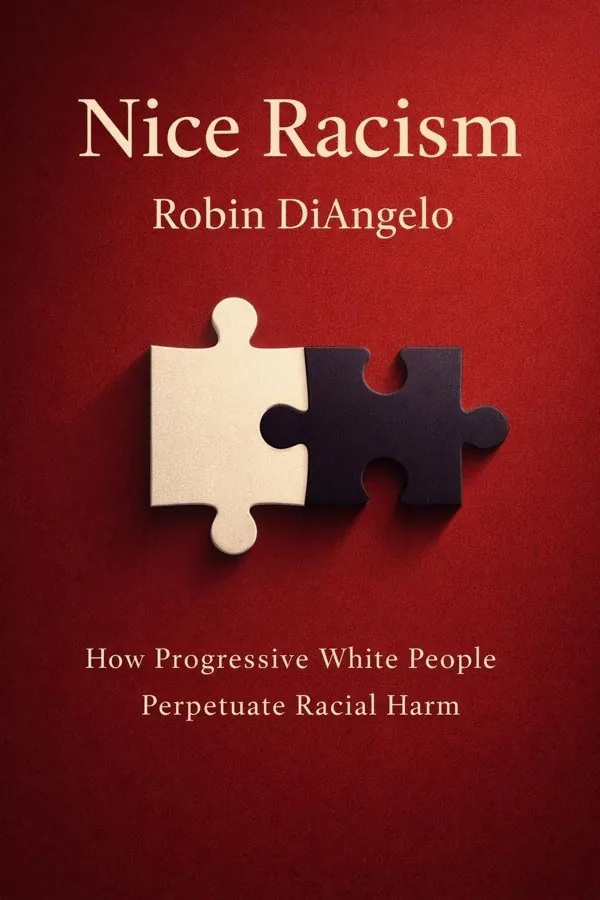
Nice Racism: How Progressive White People Perpetuate Racial Harm: Summary & Key Insights
 10 min9 chaptersAudio available
What Is Nice Racism: How Progressive White People Perpetuate Racial Harm About?
Nice Racism: How Progressive White People Perpetuate Racial Harm by Robin DiAngelo is a sociology book spanning 9 pages. Nice Racism es un análisis profundo de cómo las personas blancas progresistas, a pesar de sus buenas intenciones, pueden perpetuar el daño racial y mantener estructuras de supremacía blanca. Robin DiAngelo examina las dinámicas de poder, la fragilidad blanca y los comportamientos cotidianos que contribuyen al racismo sistémico, ofreciendo una reflexión crítica sobre la necesidad de una autoconciencia racial más profunda.
This FizzRead summary covers all 9 key chapters of Nice Racism: How Progressive White People Perpetuate Racial Harm in approximately 10 minutes, distilling the most important ideas, arguments, and takeaways from Robin DiAngelo's work. Also available as an audio summary and Key Quotes Podcast.
Nice Racism: How Progressive White People Perpetuate Racial Harm
Nice Racism es un análisis profundo de cómo las personas blancas progresistas, a pesar de sus buenas intenciones, pueden perpetuar el daño racial y mantener estructuras de supremacía blanca. Robin DiAngelo examina las dinámicas de poder, la fragilidad blanca y los comportamientos cotidianos que contribuyen al racismo sistémico, ofreciendo una reflexión crítica sobre la necesidad de una autoconciencia racial más profunda.
Who Should Read Nice Racism: How Progressive White People Perpetuate Racial Harm?
This book is perfect for anyone interested in sociology and looking to gain actionable insights in a short read. Whether you're a student, professional, or lifelong learner, the key ideas from Nice Racism: How Progressive White People Perpetuate Racial Harm by Robin DiAngelo will help you think differently.
- ✓Readers who enjoy sociology and want practical takeaways
- ✓Professionals looking to apply new ideas to their work and life
- ✓Anyone who wants the core insights of Nice Racism: How Progressive White People Perpetuate Racial Harm in just 10 minutes
Want the full summary?
Get instant access to this book summary and 100K+ more with Fizz Moment.
Get Free SummaryAvailable on App Store • Free to download
Key Chapters
White progressivism did not emerge in a vacuum; it developed through a long history of racial inequity intersecting with liberal ideals. From the abolitionist movements of the nineteenth century to the civil rights solidarity of the mid-twentieth, white Americans have often framed their engagement with race as benevolence. Yet embedded in these narratives of help and sympathy is a deep paternalism—a tendency to assume leadership, define the terms of justice, and remain centered even when the cause is liberation for others.
When I analyze history through the lens of whiteness, I see a consistent pattern: good intentions coexist with structural harm. The social programs, education systems, and policy reforms championed by progressives have often failed to disrupt the racial hierarchy at their core. Instead, they reproduce it, cloaked in moral virtue. Even the most egalitarian rhetoric—calling for colorblindness or meritocracy—often masks an unwillingness to confront how whiteness continues to define who belongs and who succeeds.
The problem, therefore, is not just the past but how the past lives within us. White progressives inherit institutional benefits without interrogating their origins. Many of us are proud of voting for the right candidates or supporting diversity initiatives, yet remain oblivious to how these actions reinforce a sense of superiority—an assumption that we know what is best for those who experience racism. The question I urge my readers to ask is not 'Am I a good white person?' but 'What does my goodness cost others?' That question opens a doorway to deeper accountability.
White identity is often invisible to those who inhabit it. We define ourselves as individuals, as simply human, while expecting others—particularly people of color—to carry racial identity on their shoulders. This invisibility is one of whiteness’s greatest shields. It allows white people to claim objectivity, purity, and innocence. Yet when our racial position is named or challenged, the emotional response can be swift and explosive. Guilt, denial, anger, tears—all of these are symptoms of what I call white fragility.
In *White Fragility*, I examined the defensive reactions that arise when white people’s racial worldview is interrupted. In *Nice Racism*, I extend that analysis to the progressive sphere, where fragility often wears a sophisticated disguise. Instead of overt defensiveness, we see moral outrage at being misunderstood, an insistence that one’s intention should absolve the impact of harm, or an emotional withdrawal that recenters white feelings. Fragility, in this context, is not an anomaly; it is a structure of protection, deeply embedded in our socialization.
To confront this pattern, we must cultivate what I call racial stamina—the capacity to engage with racial discomfort without fleeing or collapsing into guilt. Discomfort is not a signal that something is wrong; it is the price of unlearning dominance. Fragility preserves white comfort; stamina expands our ability to listen, learn, and be held accountable. For progressive white people, this means practicing humility in moments of challenge rather than striving to appear enlightened.
+ 7 more chapters — available in the FizzRead app
All Chapters in Nice Racism: How Progressive White People Perpetuate Racial Harm
About the Author
Robin DiAngelo es una académica y escritora estadounidense especializada en estudios sobre raza y justicia social. Es conocida por su trabajo sobre la fragilidad blanca y la educación antirracista, y ha impartido conferencias y talleres en todo Estados Unidos sobre cómo abordar el racismo estructural.
Get This Summary in Your Preferred Format
Read or listen to the Nice Racism: How Progressive White People Perpetuate Racial Harm summary by Robin DiAngelo anytime, anywhere. FizzRead offers multiple formats so you can learn on your terms — all free.
Available formats: App · Audio · PDF · EPUB — All included free with FizzRead
Download Nice Racism: How Progressive White People Perpetuate Racial Harm PDF and EPUB Summary
Key Quotes from Nice Racism: How Progressive White People Perpetuate Racial Harm
“White progressivism did not emerge in a vacuum; it developed through a long history of racial inequity intersecting with liberal ideals.”
“White identity is often invisible to those who inhabit it.”
Frequently Asked Questions about Nice Racism: How Progressive White People Perpetuate Racial Harm
Nice Racism: How Progressive White People Perpetuate Racial Harm by Robin DiAngelo is a sociology book that explores key ideas across 9 chapters. Nice Racism es un análisis profundo de cómo las personas blancas progresistas, a pesar de sus buenas intenciones, pueden perpetuar el daño racial y mantener estructuras de supremacía blanca. Robin DiAngelo examina las dinámicas de poder, la fragilidad blanca y los comportamientos cotidianos que contribuyen al racismo sistémico, ofreciendo una reflexión crítica sobre la necesidad de una autoconciencia racial más profunda.
More by Robin DiAngelo
You Might Also Like

Between the World and Me
Ta-Nehisi Coates
10 min
Half the Sky
Nicholas D. Kristof, Sheryl WuDunn
10 min
Men Explain Things To Me
Rebecca Solnit
10 min
Rational Ritual
Michael Suk-Young Chwe
10 min
The New Jim Crow
Michelle Alexander
10 min
Beyond Culture
Edward T. Hall
10 minBrowse by Category
Ready to read Nice Racism: How Progressive White People Perpetuate Racial Harm?
Get the full summary and 100K+ more books with Fizz Moment.